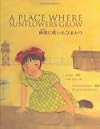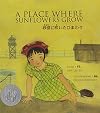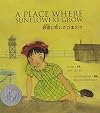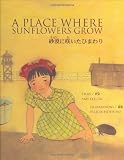
A Place Where Sunflowers Grow (English and Japanese Edition)
by Amy Lee-Tai
On This Page
Description
While she and her family are interned at Topaz Relocation Center during World War II, Mari gradually adjusts as she enrolls in an art class, makes a friend, plants sunflowers and waits for them to grow.Tags
Recommendations

Member Reviews
A Place Where Sunflowers Grow (English and Japanese Edition) by Amy Lee-Tai (Author), Felicia Hoshino (Illustrator)
Children's Book Press (2012), 32 pages
A Place Where Sunflowers Grow is a picture book written by Amy Lee-Tai and illustrated by Felicia Hoshino based off the experiences of her mother's time in the Japanese-American internment camps in Utah during WWII. Because of the setting and time period, and the fact that it's not explicitly biographical, it fits really well in the historical fiction genre.
This story is told from the perspective of Mari, a young girl who is living with her family during WWII in an internment camp who is despairing over their captivity and feeling homestick. Mari is struggling to find a reason to stay show more hopeful. She eventually finds hope and joy through a new friend, her art, and through her garden that her mother helps her with.
I think this is an incredibly important book, especially for children. As a culture, Americans like to forget that our government rounded up American citizens of Japanese descent and imprisoned them for four years simply on racist suspicion that they would be willing to betray the USA to the Emperor. It's barely covered in American history classes and if we can bring this to light early on, I feel like that we can make sure this stays in our nations consciousness. The book also provides information about that period of time to provide more background for the reader. Especailly helpful is the fact that this book is bilingual, so that the grandchildren and great-grandchildren of these people can remember this horrible thing that happened. Ultimately, this book is a story about hope in difficult times and the different places hope can come from. show less
Children's Book Press (2012), 32 pages
A Place Where Sunflowers Grow is a picture book written by Amy Lee-Tai and illustrated by Felicia Hoshino based off the experiences of her mother's time in the Japanese-American internment camps in Utah during WWII. Because of the setting and time period, and the fact that it's not explicitly biographical, it fits really well in the historical fiction genre.
This story is told from the perspective of Mari, a young girl who is living with her family during WWII in an internment camp who is despairing over their captivity and feeling homestick. Mari is struggling to find a reason to stay show more hopeful. She eventually finds hope and joy through a new friend, her art, and through her garden that her mother helps her with.
I think this is an incredibly important book, especially for children. As a culture, Americans like to forget that our government rounded up American citizens of Japanese descent and imprisoned them for four years simply on racist suspicion that they would be willing to betray the USA to the Emperor. It's barely covered in American history classes and if we can bring this to light early on, I feel like that we can make sure this stays in our nations consciousness. The book also provides information about that period of time to provide more background for the reader. Especailly helpful is the fact that this book is bilingual, so that the grandchildren and great-grandchildren of these people can remember this horrible thing that happened. Ultimately, this book is a story about hope in difficult times and the different places hope can come from. show less
I really enjoyed this book for many reasons. I thought that it was unique that this book included the story both in English and Japanese. Additionally, I enjoyed how the book includes and introduction from the author explaining what internment camps are and why the U.S. government was forcing Japanese-Americans to go to these camps during World War II. I thought this introduction was informative and helpful for the reader to gain knowledge and context on the story. The author also explained that this story is fictional, but she used her mother's experiences as a reference while writing this book. This made the book feel more realistic which also made me enjoy it even more. I also liked how the purpose of this book was to show readers a show more glimpse into the lives of Japanese-Americans during the time of these internment camps. I think this book did a good job of this while also keeping it in terms that younger readers can grasp. show less
I enjoyed Amy Lee-Tai's "A Place Where Sunflowers Grow" and I would give it 5 stars. I think that the book did a good job of illustrating the sense of hopelessness and despair that Japanese-Americans felt when forced into internment camps during WWII. The dusty yellows and browns used in the illustrations helped to create a bland, dull feeling, much like the feeling that Mari expresses when she is uninspired to create anything in her art class in Topaz. Mari cannot think of anything happy to draw and feels disheartened by the terrible conditions in Topaz, like the communal bathrooms without doors and the shack where she lives with her family. Finally, Mari finds inspiration when her teacher asks her to draw something she loved back home show more in California before being forced to move to Topaz. Mari realizes that she can find happiness in her memories of her life before Topaz to get her through difficult times, and that even in times of sadness there can still be things that brighten the mood. Mari becomes excited when her sunflower seeds sprout from the dirt outside of her shack in Topaz and is inspired enough by this image to create a work of art to share with the rest of her class. The sunflowers serve as a metaphor for Mari's situation. While they are not in a nice garden where they would be more suited to grow, they nevertheless grow tall and blossom in their new setting. Mari is forced to live in Topaz, a miserable internment camp that makes her feel depressed, but she learns that even she can grow and flourish there if she holds a more optimistic outlook and holds on to the happy memories of the past. I would say that the "big idea" of the book is to remain strong in the face of adversity and to be optimistic and hopeful, because optimism and hope can help people to endure even the most terrible of conditions. show less
Goodreads Review:
Under the harsh summer sun, Mari's art class has begun. But it's hard to think of anything to draw in a place where nothing beautiful grows—especially a place like Topaz, the internment camp where Mari's family and thousands of other Japanese Americans have been sent to live during World War II. Somehow, glimmers of hope begin to surface—in the eyes of a kindly art teacher, in the tender words of Mari's parents, and in the smile of a new friend. Amy Lee-Tai's sensitive prose and Felicia Hoshino's stunning mixed-media images show that hope can survive even the harshest injustice.
Under the harsh summer sun, Mari's art class has begun. But it's hard to think of anything to draw in a place where nothing beautiful grows—especially a place like Topaz, the internment camp where Mari's family and thousands of other Japanese Americans have been sent to live during World War II. Somehow, glimmers of hope begin to surface—in the eyes of a kindly art teacher, in the tender words of Mari's parents, and in the smile of a new friend. Amy Lee-Tai's sensitive prose and Felicia Hoshino's stunning mixed-media images show that hope can survive even the harshest injustice.
I really enjoyed this book for a couple reasons. The topic of Japanese American families in internment camps during World War II was interesting because as Americans, we rarely read about the perspectives of Japanese Americans at this time period. It saddened me to read about how the family lost their home and were forced to live in the camps, surrounded by guardsmen armed with guns watching their every move. I also liked that the book emphasized art as a medium of expression. The main character begins to feel more adjusted to her new life in the camp as her art teacher encourages her to draw whatever she wants to, and she expresses her sadness of leaving her home in California through drawing a picture of her old backyard. I rarely show more read books centered around art so I thought this book was unique. I think the big idea of this book is to communicate the difficulties adjusting to a loss of freedom and life in the internment camps. show less
When the Japanese bombed Pearl Harbor on December 7, 1941, fear and prejudice towards the Japanese reached a fever pitch. These attitudes extended to both citizens and non-citizens of Japanese descent living in the United States.
In 1942 Roosevelt signed Executive Order 9066. Under the terms of the Order, approximately 110,000 people of Japanese descent living in the US were removed from their homes and placed in internment camps. The US justified its' action by claiming that there was a danger of those of Japanese descent spying for the Japanese. However more than two thirds of those interned were American citizens and half of them were children. None had ever shown evidence of disloyalty.
The internees were transported to one of ten show more relocation centers in California, Utah, Arkansas, Arizona, Idaho, Colorado, and Wyoming for up to 4 years, without due process of law or any factual basis, in bleak, remote camps surrounded by barbed wire and armed guards. Families were crammed into 20- by 25-foot rooms and forced to use communal bathrooms. No razors, scissors, or radios were allowed. Children attended War Relocation Authority schools.
The story in this book takes place in one of these camps, Topaz, which was located in central Utah, where the weather ranged from over 100 degrees in the summer to below zero in the winter. There were many hardships, but in Topaz, there was also something special.
Chiura Obata was an art instructor at the University of California at Berkeley when WWII broke out. He started an art school for internees, and the school, with over 600 students, thrived. Obata left Topaz in 1943 and George Hibi [the author’s grandfather] took over, explaining how essential the school was thought to be:
"Training in art maintains high ideals among our people, for its object is to prevent their minds from remaining on the plains, to encourage human spirits to dwell high above the mountains.”
In the book, Mari is a little girl who is scared and lonely when her family is abruptly relocated to the camp. She starts art class, and her teacher encourages her to express her feelings. She makes pictures of sunflowers, and simultaneously the desert sunflowers in her mother’s small garden start to grow in spite of the harsh sun and heat. She also makes a new friend. Mari feels new hope and learns one can survive even in the worst of circumstances.
The author based this story on the experiences of her mother and grandparents. Her mother really did plant sunflower seeds, and the flowers grew to the top of the barrack wall. Other internees were cheered by them, and art students used arrangements of them as models.
The lovely illustrations by Felicia Hoshino were created with watercolor, ink, tissue paper, and acrylics, and are based in part on the artwork of the grandmother of the author, Hisako Hibi, who was a prominent Japanese American painter, and wife of George Hibi (quoted above).
Reading level: Ages 6 and up
Hardcover: 32 pages
Language: English and Japanese (bilingual) show less
In 1942 Roosevelt signed Executive Order 9066. Under the terms of the Order, approximately 110,000 people of Japanese descent living in the US were removed from their homes and placed in internment camps. The US justified its' action by claiming that there was a danger of those of Japanese descent spying for the Japanese. However more than two thirds of those interned were American citizens and half of them were children. None had ever shown evidence of disloyalty.
The internees were transported to one of ten show more relocation centers in California, Utah, Arkansas, Arizona, Idaho, Colorado, and Wyoming for up to 4 years, without due process of law or any factual basis, in bleak, remote camps surrounded by barbed wire and armed guards. Families were crammed into 20- by 25-foot rooms and forced to use communal bathrooms. No razors, scissors, or radios were allowed. Children attended War Relocation Authority schools.
The story in this book takes place in one of these camps, Topaz, which was located in central Utah, where the weather ranged from over 100 degrees in the summer to below zero in the winter. There were many hardships, but in Topaz, there was also something special.
Chiura Obata was an art instructor at the University of California at Berkeley when WWII broke out. He started an art school for internees, and the school, with over 600 students, thrived. Obata left Topaz in 1943 and George Hibi [the author’s grandfather] took over, explaining how essential the school was thought to be:
"Training in art maintains high ideals among our people, for its object is to prevent their minds from remaining on the plains, to encourage human spirits to dwell high above the mountains.”
In the book, Mari is a little girl who is scared and lonely when her family is abruptly relocated to the camp. She starts art class, and her teacher encourages her to express her feelings. She makes pictures of sunflowers, and simultaneously the desert sunflowers in her mother’s small garden start to grow in spite of the harsh sun and heat. She also makes a new friend. Mari feels new hope and learns one can survive even in the worst of circumstances.
The author based this story on the experiences of her mother and grandparents. Her mother really did plant sunflower seeds, and the flowers grew to the top of the barrack wall. Other internees were cheered by them, and art students used arrangements of them as models.
The lovely illustrations by Felicia Hoshino were created with watercolor, ink, tissue paper, and acrylics, and are based in part on the artwork of the grandmother of the author, Hisako Hibi, who was a prominent Japanese American painter, and wife of George Hibi (quoted above).
Reading level: Ages 6 and up
Hardcover: 32 pages
Language: English and Japanese (bilingual) show less
I like that this story shows both how emotionally hard it was to have your life taken from you, and how powerful creative outlets and friendship can be in moving forward.
Members
- Recently Added By
Author Information
1 Work 205 Members
Awards and Honors
Common Knowledge
- Important events
- World War II
Classifications
Statistics
- Members
- 204
- Popularity
- 158,871
- Reviews
- 26
- Rating
- (4.43)
- Languages
- English
- Media
- Paper, Ebook
- ISBNs
- 5
- ASINs
- 5