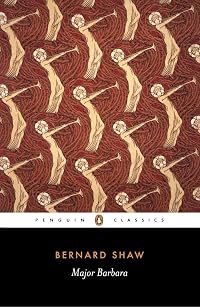
Major Barbara
by George Bernard Shaw
On This Page
Description
Major Barbara is a 1905 play by George Bernard Shaw. Andrew Undershaft, a wealthy weapons trader, despises poverty believing "The greatest of our evils and the worst of our crimes is poverty ... our first duty, to which every other consideration should be sacrificed, is not to be poor". His daughter, Barbara, devotes herself to charity. When a shelter for the poor is at risk of closure due to lack of funds, the idealistic Barbara, a Major in the Salvation Army must reassess her beliefs and show more opinions about wealth, poverty and philanthropy.. show less
Tags
Recommendations

























Member Recommendations

SnootyBaronet Religious belief vs pressing worldly needs
Member Reviews
Wow is Shaw a master of putting a lot of provocative ideas in a short play. A young lady rejects society to try to save the bellies, livers, and souls of the poor - is she truly a good person? An arms manufacturer claims power over government to get them to make war so he can sell weapons to all who can pay - is he truly a bad person? Is the pragmatic matron or the idealistic professor more likely to hold sway over their own destinies? Or over the destinies of the others in the family?
A line from the beginning that made me realize this polemic was going to be funny is spoken by the society matron, Barbara's mother, a strong & opinionated woman, Let snobbish people say what they please: Barbara shall marry, not the man they like, but show more the man *I* like."
And an exchange from the end that reminds me of Oscar Wilde, first Lady B. again, "[You] ought to know better than to go about saying that wrong things are true. What does it matter whether they are true if they are wrong?" The arms merchant retorts, "What does it matter whether they are wrong if they are true?"
What indeed? What is right? What is true? What is valuable? What do people need in this life, or in the hereafter? What is our duty to ourselves, to truth, to God, to our family, to our fellow man? Don't expect Shaw to tell you - he wants you to do the work to figure it out for yourself." show less
A line from the beginning that made me realize this polemic was going to be funny is spoken by the society matron, Barbara's mother, a strong & opinionated woman, Let snobbish people say what they please: Barbara shall marry, not the man they like, but show more the man *I* like."
And an exchange from the end that reminds me of Oscar Wilde, first Lady B. again, "[You] ought to know better than to go about saying that wrong things are true. What does it matter whether they are true if they are wrong?" The arms merchant retorts, "What does it matter whether they are wrong if they are true?"
What indeed? What is right? What is true? What is valuable? What do people need in this life, or in the hereafter? What is our duty to ourselves, to truth, to God, to our family, to our fellow man? Don't expect Shaw to tell you - he wants you to do the work to figure it out for yourself." show less
Ah, George Bernard Shaw, master dramatist, winner of the Nobel, a playwright of endless wit and wisdom -- who is rarely staged these days, and who is probably known best as the guy who wrote the play from which came My Fair Lady. Why, in fifteen years covering theater around here, have I only seen one Shavian production? Probably because 1) Shaw's works are full of the play of ideas, 2) they tend to question the values of the middle class -- that is, the audience, and 3) his plays require many actors, expensive actors. So I must settle for reading the blasted things.
Major Barbara centers around a millionaire named Undershaft, a man who made his money through the sale of munitions. Who will inherit his business? Does anyone in his show more family want it? No, but everyone in the family wants his money. Too bad he is determined to hand the foundry over to a foundling.
The title character is Undershaft's daughter, who holds a rank in the Salvation Army. She struggles to raise up the poor by saving their souls. Undershaft argues that a job at the bomb factory would elevate a poor man much more efficiently. Blood money! shrieks the family. But there is no other kind, Undershaft replies.
The whole play was/is part of Shaw's campaign to prove that by far the most pernicious social evil is poverty, and that there's no point trying to eradicate the others without ending poverty first. Undershaft frankly says that he'd rather be a murderer than a beggar; that the world never changes until men are willing to kill for a cause; that the Salvation Army is a humbug, useful mainly as a way to keep the poor from killing the bosses; and many other shocking, hard-to-refute things.
Do yourself a favor, skip a sitcom and read Shaw instead. He's smarter and funnier, for he knew (though he did not like it) that his ideas would fall on deaf ears if he failed to amuse. show less
Major Barbara centers around a millionaire named Undershaft, a man who made his money through the sale of munitions. Who will inherit his business? Does anyone in his show more family want it? No, but everyone in the family wants his money. Too bad he is determined to hand the foundry over to a foundling.
The title character is Undershaft's daughter, who holds a rank in the Salvation Army. She struggles to raise up the poor by saving their souls. Undershaft argues that a job at the bomb factory would elevate a poor man much more efficiently. Blood money! shrieks the family. But there is no other kind, Undershaft replies.
The whole play was/is part of Shaw's campaign to prove that by far the most pernicious social evil is poverty, and that there's no point trying to eradicate the others without ending poverty first. Undershaft frankly says that he'd rather be a murderer than a beggar; that the world never changes until men are willing to kill for a cause; that the Salvation Army is a humbug, useful mainly as a way to keep the poor from killing the bosses; and many other shocking, hard-to-refute things.
Do yourself a favor, skip a sitcom and read Shaw instead. He's smarter and funnier, for he knew (though he did not like it) that his ideas would fall on deaf ears if he failed to amuse. show less
I feel like the genius of the play's ideas merits more than 2 stars; HOWEVER, this wasn't an enjoyable read. Far from it. From hopelessly trying to decipher the writing style Shaw uses to portray the dialect of the poor to struggling to determine what exactly Shaw was recommending, I found it difficult to appreciate Major Barbara.
What I think Shaw is trying to say is that only through wealth can we eradicate poverty. Which, in the case of Undershaft using his munitions factory to outfit potentially oppressed peoples with weapons, is valid. It's also valid since Undershaft's factory complex is a mini-socialist utopia where all the needs of the workers are met. But in reality, I don't agree with this "solution" to poverty. Unfortunately, show more most wealthy people aren't intelligent and kindly Undershafts. Most rich business owners work selfishly for themselves and fail to protect the needs of the poor.
But then again, I may have completely missed the point of the play; I truly have no idea. Perhaps I would better appreciate this if I saw it staged. Then some of my problems--namely the unreadable dialect--would disappear. It's also rather funny in spots, and again, humor always translates better on stage. show less
What I think Shaw is trying to say is that only through wealth can we eradicate poverty. Which, in the case of Undershaft using his munitions factory to outfit potentially oppressed peoples with weapons, is valid. It's also valid since Undershaft's factory complex is a mini-socialist utopia where all the needs of the workers are met. But in reality, I don't agree with this "solution" to poverty. Unfortunately, show more most wealthy people aren't intelligent and kindly Undershafts. Most rich business owners work selfishly for themselves and fail to protect the needs of the poor.
But then again, I may have completely missed the point of the play; I truly have no idea. Perhaps I would better appreciate this if I saw it staged. Then some of my problems--namely the unreadable dialect--would disappear. It's also rather funny in spots, and again, humor always translates better on stage. show less
This is one weird play. None of the characters seem like real people and they are all obnoxious. The main theme is an interesting one: an argument betwixt right and wrong. Shaw points out that all money for organizations like the Salvation Army comes from the war-makers and booze-makers. What meaning does salvation have in this context? Also, how much does a salvation borne of starvation fed mean? It actually occurs to me that the dynamic between charity/morality and between industry/immorality is somewhat reminiscent of The Fountainhead.
George Bernard Shaw has a fairly recognizable style. The most noticeable aspect is his scene setup. He describes the scene down to every last detail. Where Shakespeare plays have exceedingly brief show more notes, Shaw goes on for a page or two any time there is a location change. I really have trouble imagining how the scene change in the middle of the third act would be accomplished, since two very precise sets would need to be made.
The other thing about Shaw that I noticed is that he is much like Wilde, only perhaps not so funny. Both Wilde and Shaw were born Irishman. Shaw moved to England as a young boy. Still, you can see his judgment of the English in his writing, which is why the characters are so irritating. Like Wilde, the humor in the story comes from the mocking of the English, particularly the upper crust.
Best line, which comes after Undershaft tells Barbara that he saved her from the seven deadly sins:
"Yes, the deadly seven. [Counting on his fingers.] Food, clothing, firing, rent, taxes, respectability and children."
And yes, I do love this largely because children are listed as a deadly sin. How hilarious is that? show less
George Bernard Shaw has a fairly recognizable style. The most noticeable aspect is his scene setup. He describes the scene down to every last detail. Where Shakespeare plays have exceedingly brief show more notes, Shaw goes on for a page or two any time there is a location change. I really have trouble imagining how the scene change in the middle of the third act would be accomplished, since two very precise sets would need to be made.
The other thing about Shaw that I noticed is that he is much like Wilde, only perhaps not so funny. Both Wilde and Shaw were born Irishman. Shaw moved to England as a young boy. Still, you can see his judgment of the English in his writing, which is why the characters are so irritating. Like Wilde, the humor in the story comes from the mocking of the English, particularly the upper crust.
Best line, which comes after Undershaft tells Barbara that he saved her from the seven deadly sins:
"Yes, the deadly seven. [Counting on his fingers.] Food, clothing, firing, rent, taxes, respectability and children."
And yes, I do love this largely because children are listed as a deadly sin. How hilarious is that? show less
Read as part of my Kindle omnibus "The Plays of Shaw". Also listened to the Librivox full cast recording as I read this: https://librivox.org/major-barbara-by-george-bernard-shaw/
Very witty satire about Barbara Undershaft, a major in the Salvation Army, and her family, most notably her father who owns & operates a munitions factory. The debate about physical versus moral power is a bit wordy in places otherwise I might have given this a 5 star rating. Now I am off to watch the film version with Rex Harrison and Wendy Hiller...
Very witty satire about Barbara Undershaft, a major in the Salvation Army, and her family, most notably her father who owns & operates a munitions factory. The debate about physical versus moral power is a bit wordy in places otherwise I might have given this a 5 star rating. Now I am off to watch the film version with Rex Harrison and Wendy Hiller...
Shaw tries to deal with the problem of non-establishment religion in this 1905 play. An arms manufacturer has a daughter who wishes to marry a student of Greek. The couple will need money to live on, and she has a post in the Salvation Army, partly taken to make up for her father's poor reputation. Her suitor, is at first appalled but finally reconcilled to the family business, and comes to terms with it as a relatively honest trade in a world that does rely on force and capital to run.
This little known play is one of my favorite plays, and the best libertarian play I have ever seen or read. The play concerns the family wealthy Andrew Undershaft. Because he is an amoral weapons manufacturer, he is a social pariah. His high-born wife has separated herself from him to raise their children. The play opens when Mrs. Undershaft realizes her daughters are soon to be engaged, and that the men they will probably choose will not be able to support their new wives. She therefore invites her husband to her home to discuss an increase in the allowance of her girls.
The eldest daughter, Barbara, has rejected the life-style of her wealthy parents, and joined the Salvation Army where, as a major, she runs a soup-kitchen in a London show more slum. She is in love with a young Greek scholar with no means of support. He volunteers at the soup-kitchen to be close to Barbara.
Undershaft arrives at the home of his wife and can not recognize his children. The comedy of the play occurs because Undershaft is an unrepentant Capitalist to the embarrassment of his family. There is much philosophical discussion as to the efficacy of weapons manufacturing.
Mrs. Undershaft loses control of the evening when Barbara and her father challenge each other as to the righteousness of their chosen paths. Barbara invites her father to come to the rescue mission and see the good work that is done there with the downtrodden. Undershaft agrees to visit the mission if Barbara will visit the arms factory.
Thus the two life styles are laid out and contrasted for us. Undershaft notes that the people who use the mission are made sober but they continue to return to the mission; nothing changes in their lives. Then Barbara becomes disillusioned when the Salvation Army accepts money from Undershaft and a wealthy liquor producer.
In the third act, Undershaft escorts his family through the arms factory. Undershaft points out how he has taken the unemployed downtrodden off the streets, and given them meaningful employment. He has taken the unwashed off the streets and made them sober middle class employees.
In the end, Barbara sees the error of her ways. Arrangements are made for her Greek scholar boyfriend to run the factory when he marries Barbara. He and Barbara will continue to run the arms factory with her father’s philosophy. show less
The eldest daughter, Barbara, has rejected the life-style of her wealthy parents, and joined the Salvation Army where, as a major, she runs a soup-kitchen in a London show more slum. She is in love with a young Greek scholar with no means of support. He volunteers at the soup-kitchen to be close to Barbara.
Undershaft arrives at the home of his wife and can not recognize his children. The comedy of the play occurs because Undershaft is an unrepentant Capitalist to the embarrassment of his family. There is much philosophical discussion as to the efficacy of weapons manufacturing.
Mrs. Undershaft loses control of the evening when Barbara and her father challenge each other as to the righteousness of their chosen paths. Barbara invites her father to come to the rescue mission and see the good work that is done there with the downtrodden. Undershaft agrees to visit the mission if Barbara will visit the arms factory.
Thus the two life styles are laid out and contrasted for us. Undershaft notes that the people who use the mission are made sober but they continue to return to the mission; nothing changes in their lives. Then Barbara becomes disillusioned when the Salvation Army accepts money from Undershaft and a wealthy liquor producer.
In the third act, Undershaft escorts his family through the arms factory. Undershaft points out how he has taken the unemployed downtrodden off the streets, and given them meaningful employment. He has taken the unwashed off the streets and made them sober middle class employees.
In the end, Barbara sees the error of her ways. Arrangements are made for her Greek scholar boyfriend to run the factory when he marries Barbara. He and Barbara will continue to run the arms factory with her father’s philosophy. show less
Members
- Recently Added By
Lists

Plays I Like
230 works; 31 members

New Lifetime Reading Plan by Fadiman and Major
225 works; 5 members

School Made Us Read It
380 works; 196 members

Next Plays to Watch
50 works; 1 member

Next Plays / 2025
352 works; 1 member

Books That Changed Our Perspective
423 works; 168 members
My Play Collection
769 works; 3 members

Recommended Reading : 600 Classics Reviewed, Editors of Salem Press, 2015
634 works; 6 members

Books You Read For University
184 works; 3 members
Essential/Recognized Stage Plays
115 works; 4 members

Literary Works Read in College
316 works; 15 members

AP Lit
363 works; 6 members
1:28 p.m.'s 350 Stage Plays Challenge
94 works; 3 members
How to Read a Book's Recommended Reading List
309 works; 10 members
Stage Plays/Screenplays/Dialogues/Anything Dialogue-Storytelling Related
81 works; 2 members

Read the book and saw the movie
1,170 works; 195 members

Fiction with Women's Names in the Title
378 works; 15 members

Harold Bloom - The Western Canon: D. The Chaotic Age
833 works; 24 members

Western World's Greatest Books - Project Gutenberg
295 works; 15 members

Books Read in 2025
4,128 works; 98 members
Author Information

764+ Works 32,310 Members
Renowned literary genius George Bernard Shaw was born on July 26, 1856 in Dublin, Ireland. He later moved to London and educated himself at the British Museum while several of his novels were published in small socialist magazines. Shaw later became a music critic for the Star and for the World. He was a drama critic for the Saturday Review and show more later began to have some of his early plays produced. Shaw wrote the plays Man and Superman, Major Barbara, and Pygmalion, which was later adapted as My Fair Lady in both the musical and film form. He also transformed his works into screenplays for Saint Joan, How He Lied to Her Husband, Arms and the Man, Pygmalion, and Major Barbara. Shaw won the Nobel Prize for Literature in 1925. George Bernard Shaw died on November 2, 1950 at Ayot St. Lawrence, Hertfordshire, England. (Bowker Author Biography) show less
Some Editions
Awards and Honors
Series
Belongs to Publisher Series
Work Relationships
Is contained in
Inspired
Has as a commentary on the text
Common Knowledge
- Canonical title
- Major Barbara
- Original publication date
- 1905 (performed) (performed); 1907 (printed) (printed)
- People/Characters
- Andrew Undershaft; Barbara Undershaft; Lady Britomart Undershaft; Stephen Undershaft; Adolphus Cusins; Bill Walker
- Important places
- London, England, UK
- Related movies
- Major Barbara (1941 | IMDb)
- First words
- Stephen: What's the matter?
- Quotations
- Alcohol is a very necessary article... It makes life bearable to millions of people who could not endure their existence if they were quite sober. It enables Parliament to do things at eleven at night that no sane person woul... (show all)d do at eleven in the morning.
I am a Millionaire. That is my religion.
He knows nothing; and he thinks he knows everything. That points clearly to a political career. - Last words
- (Click to show. Warning: May contain spoilers.)Undershaft [to Cusins]: Six o'clock tomorrow morning, my young friend.
- Disambiguation notice
- Per Bernard Shaw's N.B. to his 1940-41 work, Major Barbara: A Screen Version, please distinguish between that later Screen Version and this LT work (Shaw's original 1905 stage treatment of the same material), s... (show all)imilarly titled Major Barbara. Thank you.
Classifications
Statistics
- Members
- 1,296
- Popularity
- 18,841
- Reviews
- 13
- Rating
- (3.53)
- Languages
- 5 — Dutch, English, French, German, Italian
- Media
- Paper, Audiobook, Ebook
- ISBNs
- 84
- UPCs
- 1
- ASINs
- 37