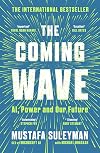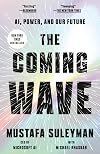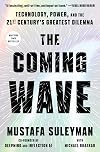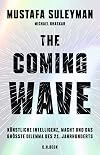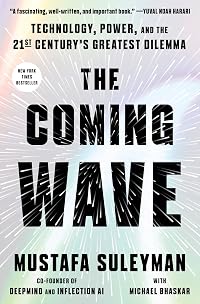
The Coming Wave: Technology, Power, and the Twenty-first Century's Greatest Dilemma
by Mustafa Suleyman
On This Page
Description
NEW YORK TIMES BESTSELLER * An urgent warning of the unprecedented risks that AI and other fast-developing technologies pose to global order, and how we might contain them while we have the chance--from a co-founder of the pioneering artificial intelligence company DeepMind "A fascinating, well-written, and important book."--Yuval Noah Harari "Essential reading."--Daniel Kahneman "An excellent guide for navigating unprecedented times."--Bill Gates Longlisted for the Financial Times and show more Schroders Business Book of the Year Award * One of Kirkus Reviews' Most Anticipated Books of the Fall We are approaching a critical threshold in the history of our species. Everything is about to change. Soon you will live surrounded by AIs. They will organise your life, operate your business, and run core government services. You will live in a world of DNA printers and quantum computers, engineered pathogens and autonomous weapons, robot assistants and abundant energy. None of us are prepared. As co-founder of the pioneering AI company DeepMind, part of Google, Mustafa Suleyman has been at the centre of this revolution. The coming decade, he argues, will be defined by this wave of powerful, fast-proliferating new technologies. In The Coming Wave, Suleyman shows how these forces will create immense prosperity but also threaten the nation-state, the foundation of global order. As our fragile governments sleepwalk into disaster, we face an existential dilemma: unprecedented harms on one side, the threat of overbearing surveillance on the other. Can we forge a narrow path between catastrophe and dystopia? This groundbreaking book from the ultimate AI insider establishes "the containment problem"--the task of maintaining control over powerful technologies--as the essential challenge of our age. show lessTags
Recommendations














Member Reviews
When talking about something that’s evolving as quickly AI, publication date and subject expertise matter. This was copywritten in 2023 with an afterward added in 2024, and the author is one of the founders of DeepMind (now Google DeepMind), one of firms that pioneered AI. Timely, informed analysis was what I wanted, and what the book delivers ... with one important caveat, which I'm saving for the end.
The book is divided into four sections. The purpose of the first is to reflect on the fact that, so far, we humans have been 99% unsuccessful in containing new technologies. (The arguable exception is nuclear weapons, but that’s been less a matter of prescience or willpower than the unavailability of the ingredients.)
The purpose of show more the second is to talk about how the AI “wave” is going to be exponential, asymmetric, multifaceted, and – at some point – autonomous, as AI systems continue the work of improving themselves. (Suleyman defines this as the ability of AI to autonomously act on ambiguous, open-ended, complex goals - like "make me $1M in the stock market.") This growth will be fueled by humanity’s most potent incentives - profit, power, and ego - facilitated by the open nature of global scientific endeavor. While Suleyman chooses to downplay the threat of a Terminator-like “Singularity” outcome (not so much "it won't happen" as "let's worry about that when we get closer"), he does convincingly argue that AI is like rocket fuel, an amplifier that will launch us on trajectories we have neither the time nor, possibly, the imagination to anticipate.
The third section delves into potential consequences, exploring AI’s potential to solve genetic puzzles, identify new medicines, facilitate new materials and forms of energy, and accelerate the deployment of robotics capable of performing amazing feats. AI might even hold the key to figuring out how we survive climate change. But even our techno-optimist author acknowledges the potential of AI to amplify the threat posed by bad actors like corrupt political parties, extremist organizations, megalomaniacal multinational companies, and mad scientists. And also the potential of AI to create systems so automated and interrelated, even small crashes/accidents/hacks trigger catastrophic, unintended consequences.
Section four: how do we contain the threats? Suleyman offers ten recommendations, all of which would work in a perfect world … but there’s a problem.
Remember that this book was written in 2023 and updated in 2024? That means both Suleyman’s list of threats (section 3) and containment options (section 4) are uninformed by the events of the Trump administration, an administration that is inadvertently modelling the ease with which bad actors willingly corrupt tools to facilitate their own agendas, while simultaneously pointing out flaws in almost all of Suleyman’s recommendations. Place regulatory constraints on AI? The Big Beautiful Bill contained a provision that would have forbidden states from placing ANY regulations on AI for 10 years. Create an IPCC-like international body to oversee compliance? The US just withdrew from IPCC – as any self-serving nation-state can do at any time. I can only wonder what Suleyman’s 2025 update is going to look like, in which he’ll have to acknowledge that all to many of his recommended containment options have just in the past year been shown to be paper tigers, as weak and as easily controverted as the paper they’re printed on.
The one thing the book does accomplish: making the case that the biggest threat to humanity may not be AI, but the average citizen's ignorance of AI. Right now the only people thinking about these things are tech bros and capitalists, both operating with questionable perspective and an intense pro-tech bias. If we have any hope of leveraging the promise of IA while simultaneously containing its most terrifying potentiality, we humans are going to need to be informed, disciplined, principled, and proactive. Intelligence is what has allowed humans to claw their way to the top of the food chain; it’s darkly appropriate that our own ignorance may be the thing that topples us. Books like these are where we all need to start. show less
The book is divided into four sections. The purpose of the first is to reflect on the fact that, so far, we humans have been 99% unsuccessful in containing new technologies. (The arguable exception is nuclear weapons, but that’s been less a matter of prescience or willpower than the unavailability of the ingredients.)
The purpose of show more the second is to talk about how the AI “wave” is going to be exponential, asymmetric, multifaceted, and – at some point – autonomous, as AI systems continue the work of improving themselves. (Suleyman defines this as the ability of AI to autonomously act on ambiguous, open-ended, complex goals - like "make me $1M in the stock market.") This growth will be fueled by humanity’s most potent incentives - profit, power, and ego - facilitated by the open nature of global scientific endeavor. While Suleyman chooses to downplay the threat of a Terminator-like “Singularity” outcome (not so much "it won't happen" as "let's worry about that when we get closer"), he does convincingly argue that AI is like rocket fuel, an amplifier that will launch us on trajectories we have neither the time nor, possibly, the imagination to anticipate.
The third section delves into potential consequences, exploring AI’s potential to solve genetic puzzles, identify new medicines, facilitate new materials and forms of energy, and accelerate the deployment of robotics capable of performing amazing feats. AI might even hold the key to figuring out how we survive climate change. But even our techno-optimist author acknowledges the potential of AI to amplify the threat posed by bad actors like corrupt political parties, extremist organizations, megalomaniacal multinational companies, and mad scientists. And also the potential of AI to create systems so automated and interrelated, even small crashes/accidents/hacks trigger catastrophic, unintended consequences.
Section four: how do we contain the threats? Suleyman offers ten recommendations, all of which would work in a perfect world … but there’s a problem.
Remember that this book was written in 2023 and updated in 2024? That means both Suleyman’s list of threats (section 3) and containment options (section 4) are uninformed by the events of the Trump administration, an administration that is inadvertently modelling the ease with which bad actors willingly corrupt tools to facilitate their own agendas, while simultaneously pointing out flaws in almost all of Suleyman’s recommendations. Place regulatory constraints on AI? The Big Beautiful Bill contained a provision that would have forbidden states from placing ANY regulations on AI for 10 years. Create an IPCC-like international body to oversee compliance? The US just withdrew from IPCC – as any self-serving nation-state can do at any time. I can only wonder what Suleyman’s 2025 update is going to look like, in which he’ll have to acknowledge that all to many of his recommended containment options have just in the past year been shown to be paper tigers, as weak and as easily controverted as the paper they’re printed on.
The one thing the book does accomplish: making the case that the biggest threat to humanity may not be AI, but the average citizen's ignorance of AI. Right now the only people thinking about these things are tech bros and capitalists, both operating with questionable perspective and an intense pro-tech bias. If we have any hope of leveraging the promise of IA while simultaneously containing its most terrifying potentiality, we humans are going to need to be informed, disciplined, principled, and proactive. Intelligence is what has allowed humans to claw their way to the top of the food chain; it’s darkly appropriate that our own ignorance may be the thing that topples us. Books like these are where we all need to start. show less
The Coming Wave is a book that corners you.
Written by Mustafa Suleyman, this isn’t some wide-eyed techno-utopian sermon or doomsday rant. It’s something colder. More precise. Like a man standing in front of a rising tide, not panicking, not preaching—just telling you, plainly, that it’s already too late to stop it.
Suleyman lays it out: artificial intelligence, synthetic biology, autonomous systems—these aren’t trends. They’re inevitabilities. Not tools we’ll master, but forces we’ll negotiate with. The “wave” isn’t coming. It’s here. Quietly reshaping power, labour, warfare, and identity. Everything you thought was fixed starts to feel… provisional.
And that’s what stayed with me.
Not fear. Not show more hype.
Recognition.
Because beneath the policy frameworks and geopolitical warnings, there’s a deeper current running through this book: control is slipping. Not all at once. Not dramatically. But steadily, like sand giving way under your feet while you’re still convincing yourself the ground is solid.
Suleyman talks about containment—how governments and institutions might hold the line. But you can feel the tension in it. The same tension you feel when someone insists they’ve got things under control a little too many times.
What makes this book work isn’t just the information—it’s the restraint. No theatrics. No screaming headlines. Just a clear-eyed look at what happens when creation outpaces comprehension.
And if you’re paying attention, you start to see it everywhere.
This isn’t a book you read and move on from. It lingers. It reframes things. Makes your phone feel heavier in your hand. Makes the future feel closer than it should.
If you’re interested in artificial intelligence, the future of technology, or the quiet ways power shifts without asking permission—read this.
Just don’t expect to feel comfortable afterward.
#TheComingWave #MustafaSuleyman #AI #ArtificialIntelligence #FutureOfTechnology #TechBooks #BookReview #DigitalAge #AIRevolution #MustRead show less
Written by Mustafa Suleyman, this isn’t some wide-eyed techno-utopian sermon or doomsday rant. It’s something colder. More precise. Like a man standing in front of a rising tide, not panicking, not preaching—just telling you, plainly, that it’s already too late to stop it.
Suleyman lays it out: artificial intelligence, synthetic biology, autonomous systems—these aren’t trends. They’re inevitabilities. Not tools we’ll master, but forces we’ll negotiate with. The “wave” isn’t coming. It’s here. Quietly reshaping power, labour, warfare, and identity. Everything you thought was fixed starts to feel… provisional.
And that’s what stayed with me.
Not fear. Not show more hype.
Recognition.
Because beneath the policy frameworks and geopolitical warnings, there’s a deeper current running through this book: control is slipping. Not all at once. Not dramatically. But steadily, like sand giving way under your feet while you’re still convincing yourself the ground is solid.
Suleyman talks about containment—how governments and institutions might hold the line. But you can feel the tension in it. The same tension you feel when someone insists they’ve got things under control a little too many times.
What makes this book work isn’t just the information—it’s the restraint. No theatrics. No screaming headlines. Just a clear-eyed look at what happens when creation outpaces comprehension.
And if you’re paying attention, you start to see it everywhere.
This isn’t a book you read and move on from. It lingers. It reframes things. Makes your phone feel heavier in your hand. Makes the future feel closer than it should.
If you’re interested in artificial intelligence, the future of technology, or the quiet ways power shifts without asking permission—read this.
Just don’t expect to feel comfortable afterward.
#TheComingWave #MustafaSuleyman #AI #ArtificialIntelligence #FutureOfTechnology #TechBooks #BookReview #DigitalAge #AIRevolution #MustRead show less
The Coming Wave is a smart and urgent look at how artificial intelligence and synthetic biology are changing the world faster than we can keep up. Suleyman, one of the founders of DeepMind, writes from firsthand experience and explains both the promise and the danger of these new forces.
He warns that our biggest challenge now is not building new technology but learning how to control it. The book is clear, grounded, and thought provoking.
Verdict: A must read for anyone who wants to understand where the future is heading and what we can still do about it.
He warns that our biggest challenge now is not building new technology but learning how to control it. The book is clear, grounded, and thought provoking.
Verdict: A must read for anyone who wants to understand where the future is heading and what we can still do about it.
I've been a bit wary of spending time reading books on AI because they are almost by default, out of date by the time they reach the bookshops.
However, this is relatively recent and I'm glad I've invested the time in reading it. Suleyman an Bhaskar make a powerful car that a tsunami of change is inevitable in the near future with AI and a biotech revolution and it brings with it both incredible possibilities but also massive dangers. And we are not equipping ourselves to handle it. As insiders in the AI revolution they are well placed to make these observations and the world really needs to sit up and take notice.
They have raised the issues and they have made a valiant attempt to suggest some solutions for containment. However, to my show more mind, they have somewhat missed the obvious. That is, human psychology. There is always going to be one (or more); people, institutions, governments, criminal gangs, apocalyptic cults, nut cases, etc., who are going to do "the wrong thing". How do we (humanity) manage this....apart from Draconian surveillance? I've tried to capture the essence of their arguments and observations in the following extracts. But it's certainly worth reading the full text and digesting the arguments:
"The coming wave is defined by two core technologies: artificial intelligence (AI) and synthetic biology.
I believe this coming wave of technology is bringing human history to a turning point. If containing it is impossible, the consequences for our species are dramatic, potentially dire.
What if we could distill the essence of what makes us humans so productive and capable into software, into an algorithm
As I write this and think back over the last decade, progress in AI has been nothing short of staggering....It’s clear this wave is accelerating.....In more challenging domains, ones long thought to be uniquely suited to human capabilities like long-term planning, imagination, and simulation of complex ideas, progress leaps forward......I have long worried about not just the consequences of advancing AI but where the entire technological ecosystem was heading. Beyond AI, a wider revolution was underway, with AI feeding a powerful, emerging generation of genetic technologies and robotics.
What if the wave is actually a tsunami?.....in 2010 almost no one was talking seriously about AI.......But, once matured, these emerging technologies will spread rapidly, becoming cheaper, more accessible, and widely diffused throughout society.
And yet alongside these benefits, AI, synthetic biology, and other advanced forms of technology produce tail risks on a deeply concerning scale....They open pathways to immense AI-empowered cyberattacks, automated wars that could devastate countries, engineered pandemics, and a world subject to unexplainable and yet seemingly omnipotent forces......Some countries will react to the possibility of such catastrophic risks with a form of technologically charged authoritarianism to slow the spread of these new powers.
Equally plausible is a Luddite reaction.....Moreover, attempting to ban development of new technologies is itself a risk: technologically stagnant societies are historically unstable......And yet stepping away is no option either. Even as we worry about their risks, we need the incredible benefits of the technologies.......This is the core dilemma: that, sooner or later, a powerful generation of technology leads humanity toward either catastrophic or dystopian outcomes. I believe this is the great meta-problem of the twenty-first century......Somehow we need to get the best out of technology, something essential to facing a daunting set of global challenges, and also get out of the dilemma.
You rarely hear anything about containing........Even technology’s harshest critics tend to dodge this language of hard containment. [It’s been argued that AI introduced a host of threats requiring proactive responses. It might lead to massive invasions of privacy or ignite a misinformation apocalypse. It might be weaponized, creating a lethal suite of new cyberweapons, introducing new vulnerabilities into our networked world.
Someone could supplement homemade experiments with DNA ordered online and reassembled at home.....[This] was a live risk, now.....A single person today likely “has the capacity to kill a billion people.” All it takes is motivation.
Why weren’t we all, taking it more seriously?.....[I] have come to call the pessimism-aversion trap: the misguided analysis that arises when you are overwhelmed by a fear of confronting potentially dark realities, and the resulting tendency to look the other way......We must begin to suggest what to do if it looks like there is a real risk that technology fails us. What’s required is a societal and political response,....As a builder of these technologies, I believe they can deliver an extraordinary amount of good,.....But without containment, every other aspect of technology, every discussion of its ethical shortcomings, or the benefits it could bring, is inconsequential.
Since the early 1970s the number of transistors per chip has increased ten-million-fold. Their power has increased by ten orders of magnitude—a seventeen-billion-fold improvement.....This is what pure, uncontained technological proliferation looks like. It created a yet more mind-boggling proliferation: data, up twenty times in the decade 2010–2020 alone
It’s easy to get lost in the details, but step back and you can see waves gathering speed, scope, accessibility, and consequence.....Decades after their invention, the architects of the atomic bomb could no more stop a nuclear war than Henry Ford could stop a car accident. Technology’s unavoidable challenge is that its makers quickly lose control over the path their inventions take once introduced to the world. Understanding technology is, in part, about trying to understand its unintended consequences,....In most cases, containment is about meaningful control, the capability to stop a use case, change a research direction, or deny access to harmful actors. It means preserving the ability to steer waves to ensure their impact reflects our values, helps us flourish as a species,....Technology is not an adversary; it’s a basic property of human society....It’s a necessary prerequisite for the survival of our species
Technical containment refers to what happens in a lab or an R& D facility. In AI, for example, it means air gaps, sandboxes, simulations, off switches, hard built-in safety and security measures—protocols for verifying the safety or integrity or uncompromised nature of a system and taking it offline if needed.....Then come the values and cultures around creation and dissemination that support boundaries, layers of governance,...acceptance of limits.....Have we ever really attempted this, tried to contain a wave?
Glimmers of containment are rare and often flawed. They include moratoriums on biological and chemical weapons; the Montreal Protocol of 1987, which phased out substances damaging the atmosphere’s ozone layer, particularly CFCs; the EU’s ban on genetically modified organisms in foodstuffs; and a self-organized moratorium on human gene editing.....In general these containment efforts are limited to highly specific technologies, some in narrow jurisdictions, all with only a shaky purchase.
Technology causes problems, and always has......And yet none of that seems to matter. It might take time, but the pattern is unmistakable: proliferating, cheaper, and more efficient technologies......The challenge of technology today is about containing its unleashed power, ensuring it continues to serve us and our planet.
The coming wave will be more difficult to contain than any in history, more fundamental, more far-reaching......“the overall collection of technologies bootstraps itself upward from the few to the many and from the simple to the complex. Another trait of the new wave is speed......Ray Kurzweil5 talks about the “law of accelerating returns,” feedback loops where advances in technology further increase the pace of development, with AI helping design better chips....Progress is visible and accelerating. It’s happening month by month.
Thanks to deep learning, computer vision is now everywhere, working so well it can classify dynamic real-world street scenes with visual input equivalent to twenty-one full-HD screens, or about 2.5 billion pixels per second, accurately enough to weave an SUV through busy city streets.
Mass-scale AI rollout is already well underway...AI has reached a point where it could convince otherwise intelligent people—indeed, someone with a real understanding of how it actually worked—that it was conscious.....What seems like near-magic engineering one day is just another part of the furniture the next......In the words of John McCarthy, who coined the term “artificial intelligence”: “As soon as it works, no one calls it AI anymore.”
Debating timelines to AGI is an exercise in reading crystal balls...For the time being, it doesn’t matter whether the system is self-aware, or has understanding, or has humanlike intelligence....All that matters is what the system can do.
For a vast range of tasks in the world economy today all you need is access to a computer; most of global GDP is mediated in some way through screen-based interfaces amenable to an AI. The challenge is in advancing what AI developers call hierarchical planning, stitching multiple goals and subgoals and capabilities into a seamless process toward a singularity ......We should refocus the entire debate around near-term capabilities and....while they are already having an enormous impact, they will be dwarfed by what happens as we progress through the next few doublings.......think of this as “artificial capable intelligence” (ACI), the point at which AI can achieve complex goals and tasks with minimal oversight......It will take us to a point where anyone can have an ACI in their pocket.....It’s hard to say for certain what happens when everyone is empowered like this....AI is far deeper and more powerful than just another technology. The risk isn’t in overhyping it; it’s rather in missing the magnitude of the coming wave.....It’s not just a tool or platform but a transformative meta-technology,
While Moore’s law justifiably attracts considerable attention, less well known is what The Economist calls the Carlson curve: the epic collapse in costs for sequencing DNA. Thanks to ever-improving techniques, the cost of human genome sequencing fell from $ 1 billion in 2003 to well under $ 1,000 by 2022. That is, the price dropped a millionfold in under twenty years........CRISPR gene editing (the acronym stands for clustered regularly interspaced short palindromic repeats) is perhaps the best-known example of how we can directly intervene in genetics.....Today technologies like CRISPR are simple and cheap to use; they have, in the words of the biologist Nessa Carey, “democratized biological science.”...You can now buy a benchtop DNA synthesizer for as little as $ 25,000 and use it as you wish, without restriction or oversight, at home in your bio-garage....McKinsey estimates that up to 60 percent of physical inputs into the economy could ultimately be subject to “bio-innovation
The bio-revolution is coevolving with advances in AI, and indeed many of the phenomena discussed in this chapter will rely on AI for their realization
The coming wave is, however, characterized by a set of four intrinsic features compounding the problem of containment.
• First among them is......hugely asymmetric impact.
• Second, they are developing fast, a kind of hyper-evolution,
• Third, they are often omni-use;
• And fourth, they increasingly have a degree of autonomy beyond any previous technology.
Interlinked global systems are containment nightmares. And we already live in an age of interlinked global systems.....Scientists have used neural networks to produce new configurations of lithium, with big implications for battery technology......Now simulations speed up the process of vaccine discovery......One of the most promising areas of AI, and a way out of this grim picture, is automated drug discovery
Today, China has an explicit national strategy to be the world leader in AI by 2030
China is already ahead of the United States in green energy, 5G, and AI and is on a trajectory to overtake it in quantum and biotech in the next few years......The arms race is usually presented as a Sino-American duopoly. This is myopic, many others are significant participants..India’s government is working to ensure the world’s most populous country achieves ownership of core technology systems competitive with the United States and China.
The idea that CRISPR or AI can be put back in the box is not credible.
The grand bargain of the nation-state, therefore, is that not only can centralized power enable peace and prosperity, but this power can be contained using a series of checks, balances, redistributions, and institutional forms....One of the core propositions of the state is undermined: the semblance of a security umbrella for citizens is deeply damaged.....If the state can’t protect you and your family, what’s the point of compliance and belonging?
Now powerful, asymmetric, omni-use technologies are certain to reach the hands of those who want to damage the state. ...More than seventy countries have been found running disinformation campaigns....SARS is supposed to be kept in BSL-3 conditions, but it has escaped from virology labs in Singapore, Taiwan, and China. Quite incredibly, it escaped four times from the same laboratory in Beijing.....What gets lost in the analysis is that all these new pressures on our institutions stem from the same underlying general-purpose revolution. How they will arrive together, simultaneous stressors intersecting, buttressing, and boosting one another. The full amplification of fragility is missed
The pessimism-averse complacency greeting the prospect of disaster is itself a recipe for disaster.....Those who dismiss catastrophe are, I believe, discounting the objective facts before us......Even if it was fully aligned with human interests, a sufficiently powerful AI could potentially overwrite its programming, discarding safety and alignment features apparently built in
Trading off liberty and security is an ancient dilemma. It was there in the foundational account of the Leviathan state from Thomas Hobbes.....If the answer to catastrophe is dystopia like this, then that is no kind of answer at all.
Exponential change is coming. It is inevitable. That fact needs to be addressed....What might containment, even in theory, look like?....Saying “Regulation!” in the face of awesome technological change is the easy part. It’s also the classic pessimism-averse answer.....
The computer scientist Stuart Russells proposes using the kind of built-in systematic doubt....How can you build secure values into a powerful Al system potentially capable of overriding its own instructions? How might Als infer these values from humans?
The highest-level challenge, whether in synthetic biology, robotics, or Al, is building a bulletproof off switch, a means of closing down any technology threatening to run out of control.....Safety features should not be afterthoughts but inherent design properties of all these new technologies.....It's high time that all big tech companies proactively collaborate here, quickly sharing insights about novel risks, just like the cybersecurity industry has long shared knowledge of new zero-day attacks......It's also time to create government-funded red teams that would rigorously attack and stress test every system,
That's what's needed for the coming wave: real, gut-level buy-in from everyone involved in frontier technologies.......While the tech industry talks a big game when it comes to
"embracing failure," it rarely does so when it comes to privacy or safety or technical breaches..........as soon as a new technology or product goes awry, a culture of secrecy takes over....In Al, capabilities like recursive self-improvement and autonomy are, I think, boundaries we should not cross. This will have technical and legal components, but also needs moral, emotional, cultural buy-in from the people and organizations closest to it....Actions like this can't just operate as laws or corporate mantras....They must instead operate at a deeper level whereby the culture of technology is not that just-go-for-it "engineering mindset" but something more wary, more curious about what might happen......Fundamentally, neither technologists nor governments will solve this problem alone. But together "we" all might.
Few people have considered biosecurity threats in more detail than from the MIT biotechnologist Kevin Esvelt.....His program is one of the most holistic containment strategies around. It's built around three pillars: delay, detect, and defend.....It would amp up the costs of responsibility in an immediately tangible way by literally factoring low-probability but catastrophic consequences-currently negative externalities borne by everyone else-into the price of the research.......Institutions conducting potentially dangerous research would have to take out additional insurance, but a trigger law would mean anyone shown to be responsible for a major biohazard or catastrophic event would become liable......Then, if the worst happens, defend. Resilient and prepared countries are vital:.....Open-source has been a boon to technological development and a major spur to progress more widely. But it's not an appropriate philosophy for powerful Al models or synthetic organisms; here it should be banned.....Safety relies on things not failing, not getting into the wrong hands, forever. Technologists and the general public alike will have to accept greater levels of oversight and regulation than have ever been the case before.....The blunt challenge of containment is not a reason to turn away; it is a call to action....Technologists should focus not just on the engineering minutiae but on helping to imagine and realize a richer, social, human future in the broadest sense, a complex tapestry of which technology is just one strand....Technology should amplify the best of us, It should make us happier and healthier."
My overall take on the book? Profound, important, persuasive, should be necessary reading for politicians, students of AI, etc. etc. I certainly learned a lot from it. Yet I come away, profoundly worried. Despite regulation, embedding caution into our gut-level buy in...etc. There seems to be no sensible method of controlling rogue actors such as apocalyptic cults who don't "buy-in". An easy five stars from me. show less
However, this is relatively recent and I'm glad I've invested the time in reading it. Suleyman an Bhaskar make a powerful car that a tsunami of change is inevitable in the near future with AI and a biotech revolution and it brings with it both incredible possibilities but also massive dangers. And we are not equipping ourselves to handle it. As insiders in the AI revolution they are well placed to make these observations and the world really needs to sit up and take notice.
They have raised the issues and they have made a valiant attempt to suggest some solutions for containment. However, to my show more mind, they have somewhat missed the obvious. That is, human psychology. There is always going to be one (or more); people, institutions, governments, criminal gangs, apocalyptic cults, nut cases, etc., who are going to do "the wrong thing". How do we (humanity) manage this....apart from Draconian surveillance? I've tried to capture the essence of their arguments and observations in the following extracts. But it's certainly worth reading the full text and digesting the arguments:
"The coming wave is defined by two core technologies: artificial intelligence (AI) and synthetic biology.
I believe this coming wave of technology is bringing human history to a turning point. If containing it is impossible, the consequences for our species are dramatic, potentially dire.
What if we could distill the essence of what makes us humans so productive and capable into software, into an algorithm
As I write this and think back over the last decade, progress in AI has been nothing short of staggering....It’s clear this wave is accelerating.....In more challenging domains, ones long thought to be uniquely suited to human capabilities like long-term planning, imagination, and simulation of complex ideas, progress leaps forward......I have long worried about not just the consequences of advancing AI but where the entire technological ecosystem was heading. Beyond AI, a wider revolution was underway, with AI feeding a powerful, emerging generation of genetic technologies and robotics.
What if the wave is actually a tsunami?.....in 2010 almost no one was talking seriously about AI.......But, once matured, these emerging technologies will spread rapidly, becoming cheaper, more accessible, and widely diffused throughout society.
And yet alongside these benefits, AI, synthetic biology, and other advanced forms of technology produce tail risks on a deeply concerning scale....They open pathways to immense AI-empowered cyberattacks, automated wars that could devastate countries, engineered pandemics, and a world subject to unexplainable and yet seemingly omnipotent forces......Some countries will react to the possibility of such catastrophic risks with a form of technologically charged authoritarianism to slow the spread of these new powers.
Equally plausible is a Luddite reaction.....Moreover, attempting to ban development of new technologies is itself a risk: technologically stagnant societies are historically unstable......And yet stepping away is no option either. Even as we worry about their risks, we need the incredible benefits of the technologies.......This is the core dilemma: that, sooner or later, a powerful generation of technology leads humanity toward either catastrophic or dystopian outcomes. I believe this is the great meta-problem of the twenty-first century......Somehow we need to get the best out of technology, something essential to facing a daunting set of global challenges, and also get out of the dilemma.
You rarely hear anything about containing........Even technology’s harshest critics tend to dodge this language of hard containment. [It’s been argued that AI introduced a host of threats requiring proactive responses. It might lead to massive invasions of privacy or ignite a misinformation apocalypse. It might be weaponized, creating a lethal suite of new cyberweapons, introducing new vulnerabilities into our networked world.
Someone could supplement homemade experiments with DNA ordered online and reassembled at home.....[This] was a live risk, now.....A single person today likely “has the capacity to kill a billion people.” All it takes is motivation.
Why weren’t we all, taking it more seriously?.....[I] have come to call the pessimism-aversion trap: the misguided analysis that arises when you are overwhelmed by a fear of confronting potentially dark realities, and the resulting tendency to look the other way......We must begin to suggest what to do if it looks like there is a real risk that technology fails us. What’s required is a societal and political response,....As a builder of these technologies, I believe they can deliver an extraordinary amount of good,.....But without containment, every other aspect of technology, every discussion of its ethical shortcomings, or the benefits it could bring, is inconsequential.
Since the early 1970s the number of transistors per chip has increased ten-million-fold. Their power has increased by ten orders of magnitude—a seventeen-billion-fold improvement.....This is what pure, uncontained technological proliferation looks like. It created a yet more mind-boggling proliferation: data, up twenty times in the decade 2010–2020 alone
It’s easy to get lost in the details, but step back and you can see waves gathering speed, scope, accessibility, and consequence.....Decades after their invention, the architects of the atomic bomb could no more stop a nuclear war than Henry Ford could stop a car accident. Technology’s unavoidable challenge is that its makers quickly lose control over the path their inventions take once introduced to the world. Understanding technology is, in part, about trying to understand its unintended consequences,....In most cases, containment is about meaningful control, the capability to stop a use case, change a research direction, or deny access to harmful actors. It means preserving the ability to steer waves to ensure their impact reflects our values, helps us flourish as a species,....Technology is not an adversary; it’s a basic property of human society....It’s a necessary prerequisite for the survival of our species
Technical containment refers to what happens in a lab or an R& D facility. In AI, for example, it means air gaps, sandboxes, simulations, off switches, hard built-in safety and security measures—protocols for verifying the safety or integrity or uncompromised nature of a system and taking it offline if needed.....Then come the values and cultures around creation and dissemination that support boundaries, layers of governance,...acceptance of limits.....Have we ever really attempted this, tried to contain a wave?
Glimmers of containment are rare and often flawed. They include moratoriums on biological and chemical weapons; the Montreal Protocol of 1987, which phased out substances damaging the atmosphere’s ozone layer, particularly CFCs; the EU’s ban on genetically modified organisms in foodstuffs; and a self-organized moratorium on human gene editing.....In general these containment efforts are limited to highly specific technologies, some in narrow jurisdictions, all with only a shaky purchase.
Technology causes problems, and always has......And yet none of that seems to matter. It might take time, but the pattern is unmistakable: proliferating, cheaper, and more efficient technologies......The challenge of technology today is about containing its unleashed power, ensuring it continues to serve us and our planet.
The coming wave will be more difficult to contain than any in history, more fundamental, more far-reaching......“the overall collection of technologies bootstraps itself upward from the few to the many and from the simple to the complex. Another trait of the new wave is speed......Ray Kurzweil5 talks about the “law of accelerating returns,” feedback loops where advances in technology further increase the pace of development, with AI helping design better chips....Progress is visible and accelerating. It’s happening month by month.
Thanks to deep learning, computer vision is now everywhere, working so well it can classify dynamic real-world street scenes with visual input equivalent to twenty-one full-HD screens, or about 2.5 billion pixels per second, accurately enough to weave an SUV through busy city streets.
Mass-scale AI rollout is already well underway...AI has reached a point where it could convince otherwise intelligent people—indeed, someone with a real understanding of how it actually worked—that it was conscious.....What seems like near-magic engineering one day is just another part of the furniture the next......In the words of John McCarthy, who coined the term “artificial intelligence”: “As soon as it works, no one calls it AI anymore.”
Debating timelines to AGI is an exercise in reading crystal balls...For the time being, it doesn’t matter whether the system is self-aware, or has understanding, or has humanlike intelligence....All that matters is what the system can do.
For a vast range of tasks in the world economy today all you need is access to a computer; most of global GDP is mediated in some way through screen-based interfaces amenable to an AI. The challenge is in advancing what AI developers call hierarchical planning, stitching multiple goals and subgoals and capabilities into a seamless process toward a singularity ......We should refocus the entire debate around near-term capabilities and....while they are already having an enormous impact, they will be dwarfed by what happens as we progress through the next few doublings.......think of this as “artificial capable intelligence” (ACI), the point at which AI can achieve complex goals and tasks with minimal oversight......It will take us to a point where anyone can have an ACI in their pocket.....It’s hard to say for certain what happens when everyone is empowered like this....AI is far deeper and more powerful than just another technology. The risk isn’t in overhyping it; it’s rather in missing the magnitude of the coming wave.....It’s not just a tool or platform but a transformative meta-technology,
While Moore’s law justifiably attracts considerable attention, less well known is what The Economist calls the Carlson curve: the epic collapse in costs for sequencing DNA. Thanks to ever-improving techniques, the cost of human genome sequencing fell from $ 1 billion in 2003 to well under $ 1,000 by 2022. That is, the price dropped a millionfold in under twenty years........CRISPR gene editing (the acronym stands for clustered regularly interspaced short palindromic repeats) is perhaps the best-known example of how we can directly intervene in genetics.....Today technologies like CRISPR are simple and cheap to use; they have, in the words of the biologist Nessa Carey, “democratized biological science.”...You can now buy a benchtop DNA synthesizer for as little as $ 25,000 and use it as you wish, without restriction or oversight, at home in your bio-garage....McKinsey estimates that up to 60 percent of physical inputs into the economy could ultimately be subject to “bio-innovation
The bio-revolution is coevolving with advances in AI, and indeed many of the phenomena discussed in this chapter will rely on AI for their realization
The coming wave is, however, characterized by a set of four intrinsic features compounding the problem of containment.
• First among them is......hugely asymmetric impact.
• Second, they are developing fast, a kind of hyper-evolution,
• Third, they are often omni-use;
• And fourth, they increasingly have a degree of autonomy beyond any previous technology.
Interlinked global systems are containment nightmares. And we already live in an age of interlinked global systems.....Scientists have used neural networks to produce new configurations of lithium, with big implications for battery technology......Now simulations speed up the process of vaccine discovery......One of the most promising areas of AI, and a way out of this grim picture, is automated drug discovery
Today, China has an explicit national strategy to be the world leader in AI by 2030
China is already ahead of the United States in green energy, 5G, and AI and is on a trajectory to overtake it in quantum and biotech in the next few years......The arms race is usually presented as a Sino-American duopoly. This is myopic, many others are significant participants..India’s government is working to ensure the world’s most populous country achieves ownership of core technology systems competitive with the United States and China.
The idea that CRISPR or AI can be put back in the box is not credible.
The grand bargain of the nation-state, therefore, is that not only can centralized power enable peace and prosperity, but this power can be contained using a series of checks, balances, redistributions, and institutional forms....One of the core propositions of the state is undermined: the semblance of a security umbrella for citizens is deeply damaged.....If the state can’t protect you and your family, what’s the point of compliance and belonging?
Now powerful, asymmetric, omni-use technologies are certain to reach the hands of those who want to damage the state. ...More than seventy countries have been found running disinformation campaigns....SARS is supposed to be kept in BSL-3 conditions, but it has escaped from virology labs in Singapore, Taiwan, and China. Quite incredibly, it escaped four times from the same laboratory in Beijing.....What gets lost in the analysis is that all these new pressures on our institutions stem from the same underlying general-purpose revolution. How they will arrive together, simultaneous stressors intersecting, buttressing, and boosting one another. The full amplification of fragility is missed
The pessimism-averse complacency greeting the prospect of disaster is itself a recipe for disaster.....Those who dismiss catastrophe are, I believe, discounting the objective facts before us......Even if it was fully aligned with human interests, a sufficiently powerful AI could potentially overwrite its programming, discarding safety and alignment features apparently built in
Trading off liberty and security is an ancient dilemma. It was there in the foundational account of the Leviathan state from Thomas Hobbes.....If the answer to catastrophe is dystopia like this, then that is no kind of answer at all.
Exponential change is coming. It is inevitable. That fact needs to be addressed....What might containment, even in theory, look like?....Saying “Regulation!” in the face of awesome technological change is the easy part. It’s also the classic pessimism-averse answer.....
The computer scientist Stuart Russells proposes using the kind of built-in systematic doubt....How can you build secure values into a powerful Al system potentially capable of overriding its own instructions? How might Als infer these values from humans?
The highest-level challenge, whether in synthetic biology, robotics, or Al, is building a bulletproof off switch, a means of closing down any technology threatening to run out of control.....Safety features should not be afterthoughts but inherent design properties of all these new technologies.....It's high time that all big tech companies proactively collaborate here, quickly sharing insights about novel risks, just like the cybersecurity industry has long shared knowledge of new zero-day attacks......It's also time to create government-funded red teams that would rigorously attack and stress test every system,
That's what's needed for the coming wave: real, gut-level buy-in from everyone involved in frontier technologies.......While the tech industry talks a big game when it comes to
"embracing failure," it rarely does so when it comes to privacy or safety or technical breaches..........as soon as a new technology or product goes awry, a culture of secrecy takes over....In Al, capabilities like recursive self-improvement and autonomy are, I think, boundaries we should not cross. This will have technical and legal components, but also needs moral, emotional, cultural buy-in from the people and organizations closest to it....Actions like this can't just operate as laws or corporate mantras....They must instead operate at a deeper level whereby the culture of technology is not that just-go-for-it "engineering mindset" but something more wary, more curious about what might happen......Fundamentally, neither technologists nor governments will solve this problem alone. But together "we" all might.
Few people have considered biosecurity threats in more detail than from the MIT biotechnologist Kevin Esvelt.....His program is one of the most holistic containment strategies around. It's built around three pillars: delay, detect, and defend.....It would amp up the costs of responsibility in an immediately tangible way by literally factoring low-probability but catastrophic consequences-currently negative externalities borne by everyone else-into the price of the research.......Institutions conducting potentially dangerous research would have to take out additional insurance, but a trigger law would mean anyone shown to be responsible for a major biohazard or catastrophic event would become liable......Then, if the worst happens, defend. Resilient and prepared countries are vital:.....Open-source has been a boon to technological development and a major spur to progress more widely. But it's not an appropriate philosophy for powerful Al models or synthetic organisms; here it should be banned.....Safety relies on things not failing, not getting into the wrong hands, forever. Technologists and the general public alike will have to accept greater levels of oversight and regulation than have ever been the case before.....The blunt challenge of containment is not a reason to turn away; it is a call to action....Technologists should focus not just on the engineering minutiae but on helping to imagine and realize a richer, social, human future in the broadest sense, a complex tapestry of which technology is just one strand....Technology should amplify the best of us, It should make us happier and healthier."
My overall take on the book? Profound, important, persuasive, should be necessary reading for politicians, students of AI, etc. etc. I certainly learned a lot from it. Yet I come away, profoundly worried. Despite regulation, embedding caution into our gut-level buy in...etc. There seems to be no sensible method of controlling rogue actors such as apocalyptic cults who don't "buy-in". An easy five stars from me. show less
I do not read non-fiction a lot but I saw an interview with the author and decided to get the book. Given all the hype over AI it was good to get insight from a leader in the development of AI technologies. Suleyman does a great job of putting the current "wave" in a historical context. He cites inventions from the past and how they did not. always end up as their creators thought they would(Alfred Nobel-dynamite). Given the power of AI, Suleyman says that we need to move cautiously as this technology enters all aspects of our lives. He got my attention when he said that AI, unlike other technologies, can act on its own without human control and continues to learn more as it consumes more information. It is possible for it to deliver show more services that its creators can't figure out how it works. It could lead to humans losing control. He mentions. that. it is possible for AGI to exceed human capabilities. The machines can control us. Of course you may consider that he is an alarmist but he cites the importance of controls and moving slowly. I strongly recommend this book and hope that we don't the same mistakes with AI that we have made with social. media and other negative aspects of the internet. show less
Mustafa Suleyman and Michael Bhaskar have written an excellent book, "The Coming Wave." Unlike many authors who project unbridled optimism, the authors strike two notes simultaneously: one of inevitability and the other of caution and concern.
They divided the book into four sections, which they call 'Homo Technoligicus,' 'The Next Wave,' 'States of Failure,' and 'Through the Wave.'
They devote the first section to explaining how waves of technological innovation have transformed humanity for thousands of years. Even the slightest pause will convince anyone of this truism. Since we fashioned stone tools centuries ago, humans have innovated, changing the world and society.
The next wave will create changes at an exponential rate, a topic show more they discuss. When I was a child, we did not possess direct dialing telephones, and now the mobile phone often appears to extend our brains. They discuss artificial intelligence and its impact–now and in the future. A person growing up now will live a different life than we do today. When will machine intelligence overtake human intelligence? Most people cannot perform the most straightforward calculations and resort to a calculator. No one knows of Trachtenberg's system of speed mathematics anymore!
The book's third section focuses on the dangers of this advancing wave of technology: misinformation, disinformation, cyberwar, and the changing nature of war, amongst others. Yet, as the authors emphasize, technological advances are improving our lives–at least, the lives of those with access to the benefits. Technology does not benefit a starving person.
Unlike most authors who present us with an overtly sunny view of these advancements, Mustafa Suleyman and Michael Bhaskar acknowledge that the sunlight warms us but can also burn us. The book's fourth section focuses on the necessity for responsible containment. It proposes ten steps (or means) by which governments, society, and corporations can work together to contain the dangers this new 'machine technology' poses to society while retaining the benefits.
They end with a provocative question: how will the nature and meaning of humanity change in the coming decades?
The book is excellent, well-written, and accessible to everyone, including the lay reader. It is a book that many people must read to educate themselves on current and future developments in AI and synthetic biology. People must read the book now. In five years, it will be outdated. show less
They divided the book into four sections, which they call 'Homo Technoligicus,' 'The Next Wave,' 'States of Failure,' and 'Through the Wave.'
They devote the first section to explaining how waves of technological innovation have transformed humanity for thousands of years. Even the slightest pause will convince anyone of this truism. Since we fashioned stone tools centuries ago, humans have innovated, changing the world and society.
The next wave will create changes at an exponential rate, a topic show more they discuss. When I was a child, we did not possess direct dialing telephones, and now the mobile phone often appears to extend our brains. They discuss artificial intelligence and its impact–now and in the future. A person growing up now will live a different life than we do today. When will machine intelligence overtake human intelligence? Most people cannot perform the most straightforward calculations and resort to a calculator. No one knows of Trachtenberg's system of speed mathematics anymore!
The book's third section focuses on the dangers of this advancing wave of technology: misinformation, disinformation, cyberwar, and the changing nature of war, amongst others. Yet, as the authors emphasize, technological advances are improving our lives–at least, the lives of those with access to the benefits. Technology does not benefit a starving person.
Unlike most authors who present us with an overtly sunny view of these advancements, Mustafa Suleyman and Michael Bhaskar acknowledge that the sunlight warms us but can also burn us. The book's fourth section focuses on the necessity for responsible containment. It proposes ten steps (or means) by which governments, society, and corporations can work together to contain the dangers this new 'machine technology' poses to society while retaining the benefits.
They end with a provocative question: how will the nature and meaning of humanity change in the coming decades?
The book is excellent, well-written, and accessible to everyone, including the lay reader. It is a book that many people must read to educate themselves on current and future developments in AI and synthetic biology. People must read the book now. In five years, it will be outdated. show less
This is a very interesting book about coming technological advances and effect it will have on our lives. Book is written from the perspective of the person who pioneered the AI reasearch by starting up companies that worked on the bleeding edge of this technological advancement. As such, for me book echoes the despair of business man trying to calm everybody down that AI and other emerging technologies are not so dangerous but they need to be controlled and contained [because they are dangerous] - but please do not take it as if they are inhererently bad. And I have to admit I was turned off by a parlor trick used in the book opening (more on this below).
I have to admit that book is organized in a very lecture-like way. As discussion show more unfolds, all the questions that I was coming up were answered in detail in follow up chapters (for example - how to verify the data provided to the AIs (more on the terminology below) and how data is used for decision making and by whom).
View given by the author is, in the end, rather grim and, as it seems to be the case with almost every science-subject book these days, full of contradictions. To name the few - AIs are powerful tools, they are already here, no they are coming in few decades, no they will be with us very soon (etc); population growth is big problem followed by Chinese scientists predicting they will have bare 600 million people by 2050 due to the age alone (I mean what? Do you guys talk between yourself at all?); Gain of function is benign (what? then why do we look at people bashing people on the head with rocks as murderers - they are actually proving that adding speed and force to heavy objects can cause death, right? I mean why is this different from combining deadly pathogen with high level of reproduction?); various details on previous epidemics that show last one was not any different in any way but that society's capabilities have completely diminished in the meantime; and so on.
While author does note that true AI is long way coming, what is treated as AI in the book (with use of all of the buzzwords as LLMs etc) is something that is with us for at least last 60 years - expert systems. Only difference being high power modern hardware used - this, coupled with sensationalism that became dominant in our news and media and natural approach to antropomorphize tools and environment, causes us to think something is "alive".
I think that author has covered the ground pretty well. I guess to be "modern" book, Ukraine war stories (will try to be polite here because i just dont have strength .... to discuss this) had to be mentioned (this is third book I have read that wont age well in regard to this). There are some other elements that show rather naive approach to life and the way technology propagates (I guess when one runs tech company everybody else is looked at through the same lense), but in general I agree that nation-state is the only mechanism capable of absorbing incoming changes.
Problems I see are more related to the society, and current state of affairs does not make me an optimist.
First thing is globalism - this proved to be a very dangerous concept that started as economic booster but ended as political vice (micro edition is EU that suffers from the same symptoms). This is major danger for nation states because unfortunately it has infiltrated the same and works against it. If you look at the current political situation, we are encountering very strong anti-human wave where some weird moves are made that will have great affect on the population everywhere (take food production and severe limitations imposed on it at the moment). Why? I dont think anybody has idea. Problem is that it seems that goal is to reverse technology for the common people (no or highly restricted travel, limited general mobility, limited access to goods and services) while elites are of course not affected.
Second thing is high level of polarization and echo chamber creation. In time when people are not interested to invest time to actually learn about anything (imagine history!) and are only concentrated on the 2 minute articles and "experts" do we truly need artificial generators for literature and informations? Do we need cliche texts based on thousands of existing works and regurgitated over and over again? And this is just without taking into account what texts are these copies based off? Am I to believe that activists in these companies will not filter the data based on the current trends and what they see as "the right information"? This is very, very scary and will bring back the days of closed groups going through "forbidden" literature to (re)learn various subjects. Not to mention shutting down everyone thinking differently and destroying careers of people for having views of their own (and all of this is highly automated and uses AI driven systems).
Third thing is concept of trusting AI. With the above how can it be trusted?
Fourth is context - are AI systems aware of the context of data they are loaded with? How can system used by government understand what is meant by global domination as a goal? If goal is marked as global domination is it so inconceivable to imagine that use of very drastic measures - from aggressive economic to outright war actions - will be orchestrated in a very fast sequence of steps that will not give party using the AI suggestions time to think and change direction.
Fifth are governments - they are not governments (maybe they are on the local level but not on national level). They are managers, riding on the indisposition of people who decide not to vote because they are disappointed (stupid), get appointed to offices where they are just pulling off term after term without doing anything for their own nation (for all means and purposes these governments are just part of huge international corporation). Due to their complete lack of skills imagine when they start believing various nebulous (order came from afar) data models and predictions and start to base their responses on them? Wait, this already happened couple of years back - right? Horror!
In my opinion humanity has become solely consumer society. Removing the actual fruits of labor from the people and just plugging them into weird day loops where they can see they actually do not account for anything wont make people strive for greatness or accomplishments. If government is not prepared to handle more and more people with nothing to do (and no, I do not think that universal income is a solution, rising generations on welfare will only create disastreous problems - people need meaning, need to be active, not to devolve) I am afraid we are looking at very long period of wars because this will be seen as a safety valve to direct all of the people that government sees as a burden. And this has potential to collapse everything.
We live in interesting times (yes, you can look at it also from the perspective of ancient proverbs that are not talking about the good things), lots of things are happening simultaneously, and I have a bad feeling that governments are already using these imperfect AI systems to plan their actions. As a result this just speeds up the process because escalations are the only way forward it seems - nobody is doing any alternative checking.
Emerging technologies are tools, and they are as good as people wielding them. This is where I have little faith - if somebody compared humanity from only 60 years ago versus today I guarantee they would think these are two different species. People need to be "reawakened" and set to learn and tought to take time to learn, not just consume and forever run in the neverending loop under the light of monitor. It takes 9 months to physically develop, go through all physical changes of our species and come to world and then it takes 18 years to mentally develop - go through all mental stages of our species - before one is considered fully grown. Learning about the world around us is not single person purpose, it is generational task - learning from the past is what matters. AI can help to speed up things but only if working on objective set of data and to a degree, people need to be in charge and solving tasks one at the time when consequences are understood. AI's purpose is to bring us quicker to respective generation's start point. All the development does not need to take place in a decade or less time no matter how sexy that might sound - shortcuts are roads to destruction.
Interesting book, highly recommended. show less
I have to admit that book is organized in a very lecture-like way. As discussion show more unfolds, all the questions that I was coming up were answered in detail in follow up chapters (for example - how to verify the data provided to the AIs (more on the terminology below) and how data is used for decision making and by whom).
View given by the author is, in the end, rather grim and, as it seems to be the case with almost every science-subject book these days, full of contradictions. To name the few - AIs are powerful tools, they are already here, no they are coming in few decades, no they will be with us very soon (etc); population growth is big problem followed by Chinese scientists predicting they will have bare 600 million people by 2050 due to the age alone (I mean what? Do you guys talk between yourself at all?); Gain of function is benign (what? then why do we look at people bashing people on the head with rocks as murderers - they are actually proving that adding speed and force to heavy objects can cause death, right? I mean why is this different from combining deadly pathogen with high level of reproduction?); various details on previous epidemics that show last one was not any different in any way but that society's capabilities have completely diminished in the meantime; and so on.
While author does note that true AI is long way coming, what is treated as AI in the book (with use of all of the buzzwords as LLMs etc) is something that is with us for at least last 60 years - expert systems. Only difference being high power modern hardware used - this, coupled with sensationalism that became dominant in our news and media and natural approach to antropomorphize tools and environment, causes us to think something is "alive".
I think that author has covered the ground pretty well. I guess to be "modern" book, Ukraine war stories (will try to be polite here because i just dont have strength .... to discuss this) had to be mentioned (this is third book I have read that wont age well in regard to this). There are some other elements that show rather naive approach to life and the way technology propagates (I guess when one runs tech company everybody else is looked at through the same lense), but in general I agree that nation-state is the only mechanism capable of absorbing incoming changes.
Problems I see are more related to the society, and current state of affairs does not make me an optimist.
First thing is globalism - this proved to be a very dangerous concept that started as economic booster but ended as political vice (micro edition is EU that suffers from the same symptoms). This is major danger for nation states because unfortunately it has infiltrated the same and works against it. If you look at the current political situation, we are encountering very strong anti-human wave where some weird moves are made that will have great affect on the population everywhere (take food production and severe limitations imposed on it at the moment). Why? I dont think anybody has idea. Problem is that it seems that goal is to reverse technology for the common people (no or highly restricted travel, limited general mobility, limited access to goods and services) while elites are of course not affected.
Second thing is high level of polarization and echo chamber creation. In time when people are not interested to invest time to actually learn about anything (imagine history!) and are only concentrated on the 2 minute articles and "experts" do we truly need artificial generators for literature and informations? Do we need cliche texts based on thousands of existing works and regurgitated over and over again? And this is just without taking into account what texts are these copies based off? Am I to believe that activists in these companies will not filter the data based on the current trends and what they see as "the right information"? This is very, very scary and will bring back the days of closed groups going through "forbidden" literature to (re)learn various subjects. Not to mention shutting down everyone thinking differently and destroying careers of people for having views of their own (and all of this is highly automated and uses AI driven systems).
Third thing is concept of trusting AI. With the above how can it be trusted?
Fourth is context - are AI systems aware of the context of data they are loaded with? How can system used by government understand what is meant by global domination as a goal? If goal is marked as global domination is it so inconceivable to imagine that use of very drastic measures - from aggressive economic to outright war actions - will be orchestrated in a very fast sequence of steps that will not give party using the AI suggestions time to think and change direction.
Fifth are governments - they are not governments (maybe they are on the local level but not on national level). They are managers, riding on the indisposition of people who decide not to vote because they are disappointed (stupid), get appointed to offices where they are just pulling off term after term without doing anything for their own nation (for all means and purposes these governments are just part of huge international corporation). Due to their complete lack of skills imagine when they start believing various nebulous (order came from afar) data models and predictions and start to base their responses on them? Wait, this already happened couple of years back - right? Horror!
In my opinion humanity has become solely consumer society. Removing the actual fruits of labor from the people and just plugging them into weird day loops where they can see they actually do not account for anything wont make people strive for greatness or accomplishments. If government is not prepared to handle more and more people with nothing to do (and no, I do not think that universal income is a solution, rising generations on welfare will only create disastreous problems - people need meaning, need to be active, not to devolve) I am afraid we are looking at very long period of wars because this will be seen as a safety valve to direct all of the people that government sees as a burden. And this has potential to collapse everything.
We live in interesting times (yes, you can look at it also from the perspective of ancient proverbs that are not talking about the good things), lots of things are happening simultaneously, and I have a bad feeling that governments are already using these imperfect AI systems to plan their actions. As a result this just speeds up the process because escalations are the only way forward it seems - nobody is doing any alternative checking.
Emerging technologies are tools, and they are as good as people wielding them. This is where I have little faith - if somebody compared humanity from only 60 years ago versus today I guarantee they would think these are two different species. People need to be "reawakened" and set to learn and tought to take time to learn, not just consume and forever run in the neverending loop under the light of monitor. It takes 9 months to physically develop, go through all physical changes of our species and come to world and then it takes 18 years to mentally develop - go through all mental stages of our species - before one is considered fully grown. Learning about the world around us is not single person purpose, it is generational task - learning from the past is what matters. AI can help to speed up things but only if working on objective set of data and to a degree, people need to be in charge and solving tasks one at the time when consequences are understood. AI's purpose is to bring us quicker to respective generation's start point. All the development does not need to take place in a decade or less time no matter how sexy that might sound - shortcuts are roads to destruction.
Interesting book, highly recommended. show less
Members
- Recently Added By
Lists

Books Read in 2024
4,727 works; 128 members
Author Information

7 Works 611 Members
All Editions
Awards and Honors
Classifications
Statistics
- Members
- 601
- Popularity
- 49,073
- Reviews
- 20
- Rating
- (3.81)
- Languages
- 6 — English, German, Hungarian, Japanese, Portuguese, Spanish
- Media
- Paper, Audiobook, Ebook
- ISBNs
- 25
- ASINs
- 10