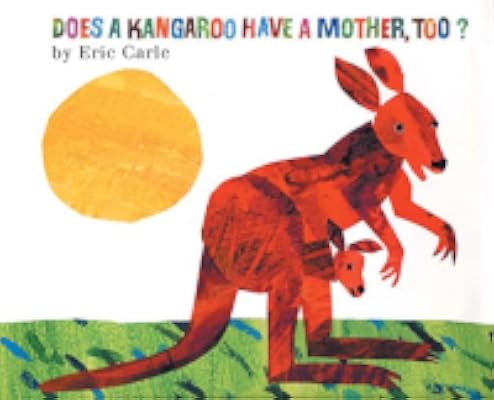
Does a Kangaroo Have a Mother, Too?
by Eric Carle
On This Page
Description
Presents the names of animal babies, parents, and groups, for example, a baby kangaroo is a joey, its mother is a flyer, its father is a boomer, and a group of kangaroos is a troop, mob, or herd.Tags
Recommendations









Member Reviews
I found this book on an old dusty bookshelf in my living room and knew I wanted to talk about it. This book talks about having a mom, which seems simple - but for some students can be a very difficult topic. The wording of this book is incredibly repetitive, but it is supposed to be. This book has absolute beautiful illustrations of different animals with their mothers on each page. The illustrations are unique in creative art style, colorful, as well as engaging. There is not really a point of view in this story, I think it would be a third person outsider telling the story.The plot is very organized and repetitive. I was slightly disappointed in this book. The book goes on listing things about how mothers love their children, but what show more if the child doesn't have a mother. This book is great for a specific time and place, but this place is not in the classroom. If students do not have a mother figure this book would definitely be very upsetting. The main message of this story is that mothers love their children. show less
This picture book is illustrated in classic Eric Carle style using cut and paste shapes from finger painted paper. The textures draw the eye and the colors are vivid and bold.
At first I thought, how is this text going to hold my grandchild’s interest? Every page asked “Does a (insert animal name here) have a mother, too? The next page reads, “Yes! A (insert animal name here) has a mother. Just like me and you. I needn’t have worried. Carle tapped into the universal interest of toddlers mothers, animals, repetition, and participation. After the first reading, my granddaughter answered, “Yes!” To every page. She loved the pictures of the animal mother and child. She loved the reassuring tone. And she loved the show more predictability.
The book ends with a page explaining the correct terms for the animal babies, parents, and groups featured in the book. These are lovely tidbits of information to share periodically, in small bites, with toddlers and small children. Adults may be intrigued as well to learn that the father kangaroo is a Boomer, which explains that odd Australian Christmas Carol “Six White Boomers.” I did not know that penguin parents are a dam and a sire or that a swan father is called a cob. I love when the simplest book still has something to teach me. show less
At first I thought, how is this text going to hold my grandchild’s interest? Every page asked “Does a (insert animal name here) have a mother, too? The next page reads, “Yes! A (insert animal name here) has a mother. Just like me and you. I needn’t have worried. Carle tapped into the universal interest of toddlers mothers, animals, repetition, and participation. After the first reading, my granddaughter answered, “Yes!” To every page. She loved the pictures of the animal mother and child. She loved the reassuring tone. And she loved the show more predictability.
The book ends with a page explaining the correct terms for the animal babies, parents, and groups featured in the book. These are lovely tidbits of information to share periodically, in small bites, with toddlers and small children. Adults may be intrigued as well to learn that the father kangaroo is a Boomer, which explains that odd Australian Christmas Carol “Six White Boomers.” I did not know that penguin parents are a dam and a sire or that a swan father is called a cob. I love when the simplest book still has something to teach me. show less
This book goes through a list of popular animals asking is they too have mothers. Each illustration uses very colorful and intricate textures in order to visually represent each animal. With each animal their seems to also be a color scheme the we most commonly associate with the presented animal. Some of the animals are seen being rather silly and affectionate to one another. This imagery might spark the loving image a child's own mother while reading this story. By the end of the book it exclaims that all “animal mothers love their babies just as yours loves you”. This ending could be an important reminder for some students with difficult family situations or even separation anxiety. This would be a fun book to read with a show more classroom full of young children. show less
This book uses repetitive language and beautiful illustrations to inform its readers that every animal has a mother, as well as the language we use to describe both animal babies and mothers.
Once again, I really like the illustrations that help entice students to learn about nature and fact. I think this was a really great venue to teach young children about animals. I also liked the additional page at the end that gave a list of all the names we use to describe the featured animals. I could see some really cute art project ideas stemming from this!
Once again, I really like the illustrations that help entice students to learn about nature and fact. I think this was a really great venue to teach young children about animals. I also liked the additional page at the end that gave a list of all the names we use to describe the featured animals. I could see some really cute art project ideas stemming from this!
Very cute book about mothers loving their babies which uses an amazing techniques of illustration. A variety of animals are used in this book with the ending referring to the readers own motherly love. All the animals are introduced with the theme of loving families being expressed. Amazing art in this book! Great for preschoolers early readers.
¿El Canguro Tiene Mama? by Eric Carle Is a great book for English Language Learners or those who speak predominantly Spanish. Throughout the story, it asks readers’ questions about different animals wanting their moms and answers them on the next page. Although I cannot understand it in entirety, the pictures illustrated in the story help to provide context clues on what the author is trying to tell his audience. This book made me smile because despite it being in a different language, it shows the relationship between mom and child. I also really enjoy this book because it is important for children to be able to open a sliding glass door and step into the story. This is made possible in this book for a student whose native language show more is Spanish. The artistic style of positive space and colored pencil shading allows you to feel as if a student wrote this as well and made me feel an even deeper connection to the text. show less
This is a very sweet book that teaches children that all babies have mothers and that all mothers love their babies. I would read this to a kindergarten class probably because it is short and easy and they could choral read along with me since it is such a repetitive book.
Members
- Recently Added By
Lists

Brightly Beaming Curriculum Books
281 works; 8 members

Written and Illustrated By
805 works; 1 member
Author Information

585+ Works 194,872 Members
Eric Carle is an award-winning, children's picture book author and illustrator whose most recognized work is The Very Hungry Caterpillar Board Book. Carle was born to German parents in 1929 in Syracuse, New York. The family returned to Germany in 1935, moving to a suburb of Stuttgart. Carle disliked high school, quitting at the age of 16 before show more graduation. He was admitted as the youngest student to the Akademie der bildenden Kunste, an art school. After finishing at the Akademie, he worked as a poster designer for the U.S. Information Center in Germany until 1952, when he moved back to New York City. He was a graphic designer at the New York Times and later worked as an art director at L.W. Frohlich & Co. In 1963, Bill Martin, Jr. saw a poster of a red lobster that Carle had designed and asked him to illustrate Brown Bear, Brown Bear, What Do You See?, thus launching his freelance career. Among his many children's books are Dream Snow, Hello, Red Fox, The Very Clumsy Click Beetle, and Pancakes, Pancakes! His title The Artist Who Painted a Blue Horse made Publisher's Weekly Best Seller List for 2011. His title Brown Bear Brown Bear What to You See? made The New York Times Best Seller List for 2012. In 2015 he made The New Zealand Best Seller List with Love from the Very Hungry Caterpillar. Eric Carle, beloved children's book author and illustrator, died on May 23, 2021. He was 91. (Bowker Author Biography) show less
Common Knowledge
- Canonical title*
- Heeft een kangoeroe een mama?
- Original title
- Does a kangaroo have a mother, too?
- Original publication date
- 2000
- Dedication
- For Fred Rogers
- First words
- Does a kangaroo have a mother, too?
Yes! A kangaroo has a mother. Just like me and you. - Quotations
- Yes! A kangaroo has a mother. Just like me and you.
- Last words
- (Click to show. Warning: May contain spoilers.)And do animal mothers love their babies? Yes! Yes! Of course they do. Animal mothers love their babies, just as yours loves you.
(Click to show. Warning: May contain spoilers.)Animal mothers love their babies, just as yours loves you.
*Some information comes from Common Knowledge in other languages. Click "Edit" for more information.
Classifications
Statistics
- Members
- 4,892
- Popularity
- 2,879
- Reviews
- 144
- Rating
- (3.87)
- Languages
- 9 — Arabic, Chinese, Dutch, English, Finnish, French, German, Japanese, Spanish
- Media
- Paper, Audiobook
- ISBNs
- 45
- UPCs
- 1
- ASINs
- 7