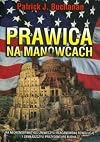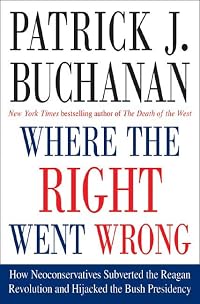
Where the Right Went Wrong: How Neoconservatives Subverted the Reagan Revolution and Hijacked the Bush Presidency
by Patrick J. Buchanan
On This Page
Description
A searing exposé of the saboteurs of Reaganism and sappers of the Bush administration by three-time presidential candidate and bestselling author Pat Buchanan. American Empire is at its apex. We are the sole superpower, with no potential challenger for a generation. We can reach any point on the globe with our cruise missiles and smart bombs, and our culture penetrates every nook and cranny of the global village. Yet our beloved America is now reviled abroad, dictated to by arrogant judges show more at home, overrun by special interests, and buried beneath a mountain of debt. Where the Right Went Wrong chronicles how the Bush administration and Beltway conservatives have abandoned their principles, and how a tiny cabal hijacked U.S. foreign policy and may have ignited a "war of civilizations" with the Islamic world that will leave America mired down in Middle East wars for years to come. At the same time, these Republicans have sacrificed the American worker on the altar of free trade and discarded the beliefs of Taft, Goldwater, and Reagan to become a party of big government that sells its soul to the highest bidder. show lessTags
Recommendations






Member Reviews
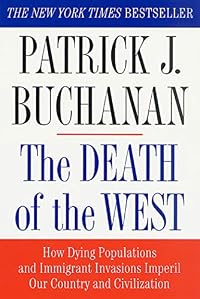
Rather amusing how LibraryThing is truncating the title. Beyond that, I was candidly rather disappointed with Buchanan here. No real ground was broken, this work seemed in large part a rehash of The Death of the West (especially the sections on China, and immigration into Europe). He didn't seem to be even all that interested in explaining in the detail he should have how Neoconservatism arose, and I'm not sure he even did enough work to back up his claims of Israel controlling US foreign policy in the Middle East. On a slightly different line: Would it be that much more work to add some footnotes? So much of what is in this work is a direct quotation of others that in my view Buchanan is opening himself up to charges of misquotation. show more
Having said that, the section on how Congress has largely abandoned their traditional role was very well done. But I came away with the feeling that Buchanan wants to crank out a book every two years or so nowadays, even if he doesn't have much new to say. show less
Having said that, the section on how Congress has largely abandoned their traditional role was very well done. But I came away with the feeling that Buchanan wants to crank out a book every two years or so nowadays, even if he doesn't have much new to say. show less
Patrick Buchanan got it right in this book. He writes that Bush's posture after 9/11 is unconstitutional and harmful to the U.S. Nowhere in the Constitution is the president afforded the power of making preemptive war, yet his approach was to declare a virtual battle against evil, rather than going after the perpetrator of the act itself. Ignoring precedent and reality (numerous countries have developed chemical and nuclear capacities in the twentieth century despite U.S. policy to prevent such a spread even among our friends with no retribution,) Bush put several countries on notice they would be liable for regime change if they tried to enter that circle of countries.
"To attain Churchillian heights, Bush's speechwriters had taken him show more over the top." They defined four elements in his speech:
1. The war on terror is a war between good and evil and will not end until all elements of evil are eradicated;
2. Every nation must decide if it is with us or against us, if not with us they are with the terrorists;
3. Any nation that funds or assists any group we decide is a terrorist will be considered a terrorist state subject to attack;
4. Iran, Iraq, and Korea will not be permitted weapons of mass destruction and we would engage in preemptive strikes and wars to prevent their acquisition by those countries.
These elements caused the coalitions that had been created after 9/11 to "crumble." He went further in a speech to West Point graduates in 2002. The thrust of the speech was that the United States would never permit any country in the world to threaten its hegemony and would use its military to prevent any country from becoming greater than we are.
"Containment is not possible when unbalanced dictators can deliver those weapons on missiles.... If we wait for threats to fully materialize, we will have waited too long." Ignoring history (containment worked with such lunatics as Mao and Stalin) Bush is making a case for perpetual war.
How did this happen? Buchanan argues that Bush's inexperience and ignorance of foreign policy permitted the neoconservatives to hijack his foreign policy Buchanan goes on with a more traditional (for him) jeremiad against free trade that he (and Ralph Nader - now there's a ticket) will lead to a us become a non-industrial low-paying service center economy unable to compete.
While I have rarely been in agreement with Buchanan, this time he got it right. show less
"To attain Churchillian heights, Bush's speechwriters had taken him show more over the top." They defined four elements in his speech:
1. The war on terror is a war between good and evil and will not end until all elements of evil are eradicated;
2. Every nation must decide if it is with us or against us, if not with us they are with the terrorists;
3. Any nation that funds or assists any group we decide is a terrorist will be considered a terrorist state subject to attack;
4. Iran, Iraq, and Korea will not be permitted weapons of mass destruction and we would engage in preemptive strikes and wars to prevent their acquisition by those countries.
These elements caused the coalitions that had been created after 9/11 to "crumble." He went further in a speech to West Point graduates in 2002. The thrust of the speech was that the United States would never permit any country in the world to threaten its hegemony and would use its military to prevent any country from becoming greater than we are.
"Containment is not possible when unbalanced dictators can deliver those weapons on missiles.... If we wait for threats to fully materialize, we will have waited too long." Ignoring history (containment worked with such lunatics as Mao and Stalin) Bush is making a case for perpetual war.
How did this happen? Buchanan argues that Bush's inexperience and ignorance of foreign policy permitted the neoconservatives to hijack his foreign policy Buchanan goes on with a more traditional (for him) jeremiad against free trade that he (and Ralph Nader - now there's a ticket) will lead to a us become a non-industrial low-paying service center economy unable to compete.
While I have rarely been in agreement with Buchanan, this time he got it right. show less
Despite a few minor disagreements and Mr. Buchanan's tendency to wander far afield from his main subject matter, I found this book to be a very helpful explanation of the current state of affairs within the Republican party and of the country as a whole. Even though written in 2004, the issues are still current and Buchanan gives much valuable historical insight to help understand the present. Even Buchanan's main weakness of over-explaining the history of Islam and terrorism, as well as the rise of Chinese power, were interesting, just not completely relevant to his subject. I learned much and enjoyed reading wise words from a man who should have been in the White House.
Political agendas aside, Buchanan presents some thought-provoking ideas that he aims to bolster with snapshots from other eras spanning many centuries. That's where this book tends to get bogged down. In too many spots, the author begins sounding like a rambling history professor who has lost track of time in a class that should have ended 10 minutes earlier. Also, some of the tenets in this book have been explored many times before. Still, "Where the Right Went Wrong" provides an interesting glimpse of what Buchanan labels "neoconservatism," thrusting a revealing spotlight on the factionalism that often overshadows Washington.
Ratings
Members
- Recently Added By
Lists

Shaykh Hamza's Book Recommendations
439 works; 3 members
Author Information

18+ Works 2,559 Members
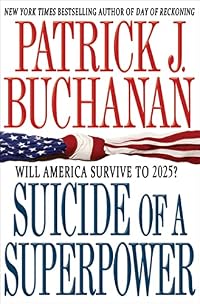
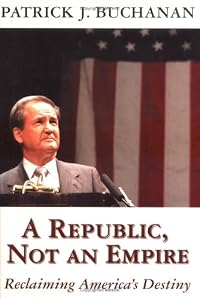
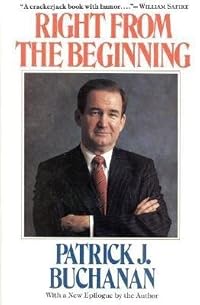
Patrick J. Buchanan, 1938 - Pat Buchanan was born November 2, 1938 in Washington, DC. He attended Georgetown University and received his Bachelor's of Arts degree in English and Philosophy in 1961, and his Master's in 1962 from the Columbia School of Journalism. After graduation, Buchanan got a job as an Editorial Writer for the St. Louis show more Globe-Dispatch, from 1962 till 1966. He was a syndicated news columnist from 1975 to 1985, and from 1987 to 1999, as well as co-host of CNN's Crossfire talk show from 1987 to 1991, 1992 to 1995 and 1996 to 1999. In 1966, Buchanan began his political career, becoming Executive Assistant to former Vice President Richard Nixon, a position he held until 1969. He then became President Nixon's speechwriter until 1974, when he was nominated by President Ford to be US Ambassador to South Africa, which was later withdrawn. He was the White House Director of Communications from 1985 to 1987, Founder and Chair of The American Cause from 1993 to 1999, and an unsuccessful candidate for the Republican nomination for President in 1992 and 1996. In October of 1999, he quit the Republican Party and joined the Reform Party. Buchanan is also a renowned author. His books include The New Majority: President Nixon at Mid-Passage (1973); Right from the Beginning (1988); A Republic, Not an Empire: Reclaiming America's Destiny (1999); Where the Right Went Wrong: How Neoconservatives Subverted the Reagan Revolution and Hijacked the Bush Presidency (2004); Day of Reckoning: How Hubris, Ideology, and Greed Are Tearing America Apart (2007); Churchill, Hitler, and The Unnecessary War: How Britain Lost Its Empire and the West Lost the World (2008); and Suicide of a Superpower: Will America Survive to 2025? (2011). (Bowker Author Biography) show less
Awards and Honors
Distinctions
Common Knowledge
Classifications
- Genres
- Politics and Government, Nonfiction, General Nonfiction, History
- DDC/MDS
- 320.52 — Society, Government, and Culture Political science Types of Government Political ideologies Conservatism
- LCC
- JK275 — Political Science Political institutions and public administration (United States) Political institutions and public administration United States
- BISAC
Statistics
- Members
- 307
- Popularity
- 103,813
- Reviews
- 5
- Rating
- (3.84)
- Languages
- English, Polish
- Media
- Paper, Audiobook, Ebook
- ISBNs
- 9
- ASINs
- 3