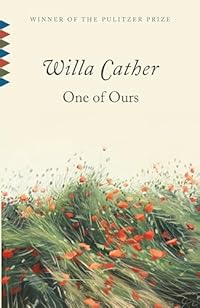
One of Ours
by Willa Cather 
On This Page
Description
This groundbreaking novel from acclaimed American writer Willa Cather was awarded the Pulitzer Prize in 1923. The tale follows the ups and downs of the young protagonist Claude Wheeler through his tumultuous transition to adulthood, as he takes on college life, new experiences, marriage, disillusionment, and finally, the ultimate test of courage on the battlefields of World War I. Cather explores with great precision and acuity the travails of an aimless youth, as well as the relief and show more clarity that discovering one's true purpose in life can bring.. show less
Tags
Recommendations









Member Reviews
Note: Duke Classics edition
I was once asked why I join different reading challenges, and it is to have opportunities like reading this book. Male protagonist. Coming of age story. Wartime (WWI). The combo of all of these put together would normally put me off, but it won the Pulitzer Prize in 1923 (thereby checking off two different challenges I've signed on for), and this was my first Willa Cather (and probably won't be my last). When Cather was writing in 1922, it was a mere four years after World War I ended, so for her time it was contemporary fiction (for mine, historical). Claude Wheeler, a young Nebraskan farmer, searches for his identity as a student, as a farmer's son, as a friend, as a husband, as a soldier, and not least as show more an American. Cather has a gift for making you care about sunsets and wheat fields in the same measure as young men marching off to war because she weaves these things together with intentionality, always teetering on the brink of idealism to remind you it is there, but also with a certain pragmatism to keep us with one foot in reality. The book is harshly beautiful, if I can describe it thus. Cather allegedly ascribed to Claude some aspects of her own personality, along with that of her cousin G.P., who was killed in action during WWI. The result is a protagonist with whom we can sympathize, even when he makes poor decisions (or maybe ESPECIALLY when he does), and for whom we cheer in his idealism and sense of resolve.
The book is not a "war novel" -- the war only makes a real entrance with descriptions of trench warfare and the like toward the end of the book. There are moments where Cather's critique shines through, like when Ernest tells Claude: "You Americans are always looking for something outside yourselves to warm you up, and it is no way to do. In old countries, where not very much can happen to us, we know that, --and we learn to make the most of little things." (88). And other times she zooms out from the story to remind us of the entire Zeitgeist. As news of the war becomes more noted by members of the Wheeler family, Claude's mother goes up to the attic to find a map of Europe -- "a thing for which Nebraska farmers had never had much need."(246). Cather follows this with: "But that night, on many prairie homesteads, the women, American and foreign-born, were hunting for a map." (246). There are so many moments like this.
Cather received criticism (from the likes of Sinclair Lewis and H.L. Mencken) for romanticizing war, and that's perhaps a valid critique. However, with almost a century of hindsight, I read it differently. The romanticization is really about Claude and his idealism (and that of his soldier companions). The emotional distance Cather employs in her descriptions of some of the brutalities of war creates an almost journalistic narrative, and she reserves her emotional energy for moments of human interaction. I don't think Cather is suggesting/advocating war as a solution for youthful searching for purpose, but I think she is suggesting that World War I offered something particular for certain young American men who became disillusioned with what was available on their home turf. show less
I was once asked why I join different reading challenges, and it is to have opportunities like reading this book. Male protagonist. Coming of age story. Wartime (WWI). The combo of all of these put together would normally put me off, but it won the Pulitzer Prize in 1923 (thereby checking off two different challenges I've signed on for), and this was my first Willa Cather (and probably won't be my last). When Cather was writing in 1922, it was a mere four years after World War I ended, so for her time it was contemporary fiction (for mine, historical). Claude Wheeler, a young Nebraskan farmer, searches for his identity as a student, as a farmer's son, as a friend, as a husband, as a soldier, and not least as show more an American. Cather has a gift for making you care about sunsets and wheat fields in the same measure as young men marching off to war because she weaves these things together with intentionality, always teetering on the brink of idealism to remind you it is there, but also with a certain pragmatism to keep us with one foot in reality. The book is harshly beautiful, if I can describe it thus. Cather allegedly ascribed to Claude some aspects of her own personality, along with that of her cousin G.P., who was killed in action during WWI. The result is a protagonist with whom we can sympathize, even when he makes poor decisions (or maybe ESPECIALLY when he does), and for whom we cheer in his idealism and sense of resolve.
The book is not a "war novel" -- the war only makes a real entrance with descriptions of trench warfare and the like toward the end of the book. There are moments where Cather's critique shines through, like when Ernest tells Claude: "You Americans are always looking for something outside yourselves to warm you up, and it is no way to do. In old countries, where not very much can happen to us, we know that, --and we learn to make the most of little things." (88). And other times she zooms out from the story to remind us of the entire Zeitgeist. As news of the war becomes more noted by members of the Wheeler family, Claude's mother goes up to the attic to find a map of Europe -- "a thing for which Nebraska farmers had never had much need."(246). Cather follows this with: "But that night, on many prairie homesteads, the women, American and foreign-born, were hunting for a map." (246). There are so many moments like this.
Cather received criticism (from the likes of Sinclair Lewis and H.L. Mencken) for romanticizing war, and that's perhaps a valid critique. However, with almost a century of hindsight, I read it differently. The romanticization is really about Claude and his idealism (and that of his soldier companions). The emotional distance Cather employs in her descriptions of some of the brutalities of war creates an almost journalistic narrative, and she reserves her emotional energy for moments of human interaction. I don't think Cather is suggesting/advocating war as a solution for youthful searching for purpose, but I think she is suggesting that World War I offered something particular for certain young American men who became disillusioned with what was available on their home turf. show less
One of Ours, winner of the 1923 Pulitzer Prize, is my third Willa Cather read, the first two being her more well-known stories Death Comes for the Archbishop and My Antonia. Cather’s prose is fabulous, as is her ability to bring to life her portrayal of Midwest Plains life. Her character development is exceptional, as is her vivid descriptions. Reading this one, it was like being exposed to a series of Impressionist agrarian paintings, where time (and technological advancements) move (are accepted) at a slower pace. I feel as though I intimately know both the land and the characters. The story focus is on Claude, an intelligent young man from a Nebraska farming family, who finds that his life does not have any purpose until he decides show more to enlist in the army to go and fight in the Great War. For Claude, this decision provides him with a way to fight for a higher purpose and contribute to the common good. Cather approach to war fiction (the second half of the story) is the same contemplative, introspective approach she takes when writing about hardscrabble Plains living. She does not sugar coat or exclude anything but she also does not dwell on graphic war details or focus on military strategy. Cather’s writing takes on a more holistic approach to the war, although the parts of the story set in France do not come across with the same graceful flow of the earlier sections of the story. Cather captures all of this through a slightly dreamy lens that may frustrate fans of war fiction like Ernest Hemingway’s A Farewell to Arms (apparently, Hemingway was a vocal critic of One of Ours when it was published).
Overall, another wonderful story communicated through Cather’s simple, straightforward, descriptive prose. show less
Overall, another wonderful story communicated through Cather’s simple, straightforward, descriptive prose. show less
This is a splendid novel, well deserving of the Pulitzer Prize it received in 1923.
Claude Wheeler is a, idealistic, restless young farmer, pulled from a small religious college to be put in charge of his father's Nebraska farmlands. He feels he has no purpose in life, hemmed in by a narrow education and an American materialism that he finds meaningless.
It is only when he enlists in the Army as the US is pulled into WWI that he feels he find a purpose and sense of the wider world. He is sent to France and as a lieutenant leads his men into the horrors of trench warfare.
The novel has been criticized, most notably by Hemingway, as idealizing war, but I didn't see it that way at all. Certainly Cather is sympathetic to a young man's show more idealism that leads him to enlist to fight such a war, but her descriptions of the trenches and war-ravaged France leave no such impression.
The prose is gorgeous, and her characterizations are subtle and multi-faceted, even of minor characters. At times I was reminded of DH Lawrence's layers in a novel such as [Women in Love].
One of Ours, The Song of the Lark, and My Antonia are certainly Cather's best novels.
When Ernest left, Claude walked as far as the Yoeder's place with him, and came back across the snow-drifted field, under the frosty brilliance of the winter stars. As he looked up at them, he felt more than ever that they must have something to do with the fate of nations, and with the incomprehensible things that were happening in the world. In the ordered universe there must be some mind that read the riddle of this one unhappy planet, that knew what was forming in the dark eclipse of this hour. A question hung in the air; over all this quiet land about him, over him, over his mother, even. He was afraid for his country, as he had been that night on the State House steps in Denver, when this war was undreamed of, hidden in the womb of time. show less
Claude Wheeler is a, idealistic, restless young farmer, pulled from a small religious college to be put in charge of his father's Nebraska farmlands. He feels he has no purpose in life, hemmed in by a narrow education and an American materialism that he finds meaningless.
It is only when he enlists in the Army as the US is pulled into WWI that he feels he find a purpose and sense of the wider world. He is sent to France and as a lieutenant leads his men into the horrors of trench warfare.
The novel has been criticized, most notably by Hemingway, as idealizing war, but I didn't see it that way at all. Certainly Cather is sympathetic to a young man's show more idealism that leads him to enlist to fight such a war, but her descriptions of the trenches and war-ravaged France leave no such impression.
The prose is gorgeous, and her characterizations are subtle and multi-faceted, even of minor characters. At times I was reminded of DH Lawrence's layers in a novel such as [Women in Love].
One of Ours, The Song of the Lark, and My Antonia are certainly Cather's best novels.
When Ernest left, Claude walked as far as the Yoeder's place with him, and came back across the snow-drifted field, under the frosty brilliance of the winter stars. As he looked up at them, he felt more than ever that they must have something to do with the fate of nations, and with the incomprehensible things that were happening in the world. In the ordered universe there must be some mind that read the riddle of this one unhappy planet, that knew what was forming in the dark eclipse of this hour. A question hung in the air; over all this quiet land about him, over him, over his mother, even. He was afraid for his country, as he had been that night on the State House steps in Denver, when this war was undreamed of, hidden in the womb of time. show less
this read much faster than i expected for its length and topic, and the writing is often really nice. not my antoniabeautiful, in my recollection anyway, but still. i felt easily taken with the story and found that far more pages would go by before i realized it. but at the same time, i'm not really sure i like that she's given such a view of war - one that seems to really solidify many men's purpose - and how she depicts being over in france - almost as a series of small trips or vacations punctuated with spots of battle. i know that war can actually be a highlight for people, but showing it this way didn't feel right to me. she also didn't tie up the loose ends between claude and enid, or with any of the rest of his family. i don't show more know, i think i liked this well enough when reading it because her language and descriptions carried me along, but the more i think about it, the less i think i did actually like it.
"'You Americans are always looking for something outside yourselves to warm you up, and it is no way to do. In old countries, where not very much can happen to us, we know that,--and we learn to make the most of little things.'" show less
"'You Americans are always looking for something outside yourselves to warm you up, and it is no way to do. In old countries, where not very much can happen to us, we know that,--and we learn to make the most of little things.'" show less
1923 winner of the Pulitzer Prize for fiction.
I’ve lived in Nebraska and know well the rolling landscape, the hard-working but easy-going people who farm and ranch the land there. Willa Cather’s prose, as far as I’m concerned, reflects perfectly their characters. That is the first impression that a reader takes away from One of Ours. And its protagonist, Claude Wheeler, reminds me of young people I’ve met there, who love their state and their families, but somehow don’t quite fit in. While Cather was writing about the turn of the 20th century, the story could indeed have taken place over 50 years later.
Claude’s pragmatic father doesn’t see the necessity, for a farmer, of too much education. Thus, Claude has to forego show more completing his college degree, and forsaking he friends, much different from those at home, he’s made in Lincoln. His mother, a more or less fundamentalist Christian (although the movement itself within Christianity hadn’t yet begun), is quite sensitive to Claude’s moods and aspirations; her emotional pain on behalf of her son is almost physical. Claude, as would be expected of a young man his age, marries—only to have his wife go to China to help her sister. His emotional desolation is nearly complete; he wonders if that’s all there is to life—getting up in the morning, working, going to bed at night. It may satisfy friends his age who ask nothing better than to farm their own land, but Claude longs for something more—what, he’s not sure but something.
Then World War I erupts in Europe. Claude and his mother follow the war through the newspapers and maps they pore over together. When the United States enters the war, Claude enlists—and finds his place in the world.
Cather describes the effect of the war on France and its people. She also writes about little-known facts, such as the toll sickness took of the soldiers on the way over, many dying from pneumonia. She has interesting details about what it was like for the soldiers to live under wartime conditions—bathing in polluted water in shell holes was a nice touch. There is some description—not much—of the fighting but it fits in with her story. Clearly she was more interested in what happened to the people, both French and the Allied soldiers, than she was in the details of the fighting itself.
The last pages are heart-rendering; the impact is enormous. I think you have to be a stone to be unmoved.
For a relatively short book—371 pages in my edition, One of Ours is beautifully evocative of a time, a place, and a young man’s successful search for himself. One of the best of the early Pulitzer winners. show less
I’ve lived in Nebraska and know well the rolling landscape, the hard-working but easy-going people who farm and ranch the land there. Willa Cather’s prose, as far as I’m concerned, reflects perfectly their characters. That is the first impression that a reader takes away from One of Ours. And its protagonist, Claude Wheeler, reminds me of young people I’ve met there, who love their state and their families, but somehow don’t quite fit in. While Cather was writing about the turn of the 20th century, the story could indeed have taken place over 50 years later.
Claude’s pragmatic father doesn’t see the necessity, for a farmer, of too much education. Thus, Claude has to forego show more completing his college degree, and forsaking he friends, much different from those at home, he’s made in Lincoln. His mother, a more or less fundamentalist Christian (although the movement itself within Christianity hadn’t yet begun), is quite sensitive to Claude’s moods and aspirations; her emotional pain on behalf of her son is almost physical. Claude, as would be expected of a young man his age, marries—only to have his wife go to China to help her sister. His emotional desolation is nearly complete; he wonders if that’s all there is to life—getting up in the morning, working, going to bed at night. It may satisfy friends his age who ask nothing better than to farm their own land, but Claude longs for something more—what, he’s not sure but something.
Then World War I erupts in Europe. Claude and his mother follow the war through the newspapers and maps they pore over together. When the United States enters the war, Claude enlists—and finds his place in the world.
Cather describes the effect of the war on France and its people. She also writes about little-known facts, such as the toll sickness took of the soldiers on the way over, many dying from pneumonia. She has interesting details about what it was like for the soldiers to live under wartime conditions—bathing in polluted water in shell holes was a nice touch. There is some description—not much—of the fighting but it fits in with her story. Clearly she was more interested in what happened to the people, both French and the Allied soldiers, than she was in the details of the fighting itself.
The last pages are heart-rendering; the impact is enormous. I think you have to be a stone to be unmoved.
For a relatively short book—371 pages in my edition, One of Ours is beautifully evocative of a time, a place, and a young man’s successful search for himself. One of the best of the early Pulitzer winners. show less
Lots that I liked about this book. The first half would have rated 4 stars. Interestingly, I felt like it lost some narrative tension when the main character begins serving in WWI. That said, there were briliant moments throughout. I've heard it received a lot of criticism (from Mencken, Hemingway, etc.) for being naively pro-war. I didn't feel that. Certainly, the main character romanticized war, but I didn't feel like that was Cather. Some of her feelings about it may be displayed through the mother's thoughts near the end of the book. And, yes, this was on my pandemic reading list, as it does touch on the 1918 flu pandemic...
A surprise-- really liked this justly deserved Pulitzer winner. I thought it was a fascinating look at war that is far away, and how it affects individuals and families.
Members
- Recently Added By
Lists

The Guardian's 1000 Novels Everyone Must Read
1,005 works; 549 members

Pulitzer Prize Winners for Fiction
102 works; 54 members

Women in War
148 works; 29 members

Novels from The Guardian's Great American Novelist Tournament
148 works; 24 members

Favourite Virago Modern Classics
183 works; 38 members

Best 20th Century Books as of 1924
100 works; 6 members

World War I Fiction
94 works; 15 members

Top Five books of 2014
9 works; 2 members
1920s
141 works; 6 members
World War I - fiction & non-fiction
19 works; 4 members

Books Read in 2022
5,164 works; 113 members

CCE 1000 Good Books List
1,033 works; 12 members

Books about World War I
80 works; 14 members
THE WAR ROOM
813 works; 24 members

Library List - Pulitzer
18 works; 1 member
Author Information

150+ Works 45,793 Members
Willa Siebert Cather was born in 1873 in the home of her maternal grandmother in western Virginia. Although she had been named Willela, her family always called her "Willa." Upon graduating from the University of Nebraska in 1895, Cather moved to Pittsburgh where she worked as a journalist and teacher while beginning her writing career. In 1906, show more Cather moved to New York to become a leading magazine editor at McClure's Magazine before turning to writing full-time. She continued her education, receiving her doctorate of letters from the University of Nebraska in 1917, and honorary degrees from the University of Michigan, the University of California, Columbia, Yale, and Princeton. Cather wrote poetry, short stories, essays, and novels, winning awards including the Pulitzer Prize for her novel, One of Ours, about a Nebraska farm boy during World War I. She also wrote The Professor's House, My Antonia, Death Comes for the Archbishop, and Lucy Gayheart. Some of Cather's novels were made into movies, the most well-known being A Lost Lady, starring Barbara Stanwyck. In 1961, Willa Cather was the first woman ever voted into the Nebraska Hall of Fame. She was also inducted into the Hall of Great Westerners in Oklahoma in 1974, and the National Women's Hall of Fame in Seneca, New York in 1988. Cather died on April 24, 1947, of a cerebral hemorrhage, in her Madison Avenue, New York home, where she had lived for many years. (Bowker Author Biography) show less
Willa Cather has a Legacy Library. Legacy libraries are the personal libraries of famous readers, entered by LibraryThing members from the Legacy Libraries group.
Some Editions
Awards and Honors
Series
Belongs to Publisher Series
Work Relationships
Is contained in
Early Novels and Stories: The Troll Garden / O Pioneers! / The Song of the Lark / My Antonia / One of Ours by Willa Cather
Willa Cather - The Library of America Set Complete in 3 Volumes (1. Early Novels & Stories; 2. Stories, Poems and Other Writings; and 3. Later Novels) by Willa Cather (indirect)
Willa Cather Collection (My Ántonia, The Song of the Lark, O Pioneers!, and One of Ours) by Willa Cather
Pulitzer Prize Winning Works Collection: One of Ours, His Family, Miss Lulu Bett, Cornhuskers, Anna Christie, Alice Adams, and More! (11 Works) by Various
Common Knowledge
- Canonical title
- One of Ours
- Alternate titles
- On Lovely Creek.; Enid.; Sunrise on the prairie.; The voyage of the Anchises.; Bidding the eagles of the west fly on.
- Original publication date
- 1922-09 (first printing, 35 copies) (first printing, 35 copies)
- People/Characters
- Enid Royce; Claude Wheeler; Wilhelmina Schroeder-Schatz; Augusta Erlich; Ralph Wheeler; Mahailey (show all 16); Nat Wheeler; Bayliss Wheeler; Ernest Havel; Leonard Dawson; Evangeline Wheeler; David Gerhardt; Victor Morse; Sergeant Hicks; Captain Maxie; Dell Able
- Important places
- Temple College; Nebraska, USA; France; USA
- Important events
- World War I
- Epigraph
- Bidding the eagles of the West fly on . . .
Vachel Lindsay - Dedication
- For my mother
VIRGINIA CATHER - First words
- Claude Wheeler opened his eyes before the sun was up and vigorously shook his younger brother, who lay in the other half of the same bed.
- Last words
- (Click to show. Warning: May contain spoilers.)Mrs. Wheeler always feels that God is near, but Mahailey is not troubled by any knowledge of interstellar spaces, and for her He is nearer still, directly overhead, not so very far above the kitchen stove.
Classifications
Statistics
- Members
- 1,397
- Popularity
- 16,826
- Reviews
- 43
- Rating
- (3.84)
- Languages
- 7 — English, French, German, Italian, Portuguese, Russian, Spanish
- Media
- Paper, Audiobook, Ebook
- ISBNs
- 138
- ASINs
- 45