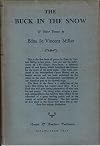
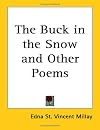
The Buck in the Snow and Other Poems
by Edna St. Vincent Millay 
On This Page
Description
1928. An early collection of verse by the first woman to win the Pulitzer prize for poetry. The volume contains 43 poems including: Justice Denied in Massachusetts, Hangman's Oak, Evening on Lesbos, Moriturus, and others. See other titles by this author available from Kessinger Publishing.Tags
Recommendations






















Member Reviews
By halfway though this book, it was plain to me that Millay wrote it in the midst of a struggle with despair, most likely over the infamous execution of the anarchists Sacco & Vanzetti. This execution occurred in 1927 (one year prior to The Buck in the Snow and Other Poems) depite recanted witness testimonies and conflicting ballistics evidence. Millay had campaigned in the extensive movement to prove their innocence, and the loss must have affected her deeply. Although only a couple poems in this book deal with the execution directly, these two were particularly powerful and heartfelt, and the same disillusion in them can be felt in most of the other poems too.
Her struggle lends the book a bleakness (particularly in the first quarter show more of the book) in a "I heard a Fly buzz - when I died" kind of way, but it also speaks to me strongly. The sonnet "To Jesus on His Birthday" for instance is almost devastatingly powerful!
For this you bled upon the bitter tree:
A yard of tinsel ribbon bought and sold;
A paper wreath; a day at home for me.
...
The stone the angel rolled away with tears
Is back upon your mouth these thousand years.
I feel deeply for this ardent, intelligent woman as she looks out upon a difficult, broken world. In the portion of the public that supported the executions, she clearly saw a general lack of compassion and even integrity of thought that disillusioned her. And given some callous rhetoric of her day, I can certainly understand her disappointment, especially in the un-Christian mindset of the religious people who were supposed to be motivated by the Sermon on the Mount. Particularly now, her disappointment in their lack of compassion speaks to me.
And yet despite this, the second half of the book is intermittently shot through with hope. For instance, I love the exhorting end to her sonnet "The Pioneer," responding to a statue dedicated to Mott, Anthony, and Stanton:
Even now the silk is tugging at the staff:
Take up the song; forget the epitaph.
In terms of craft, this book (along with Fatal Interview: Sonnets) is one of two strongest of her books that I've read so far, and I've read several. The language is sparer, more modern, and the word choice has more resonance.
The title poem is pleasing in its directness:
White sky, over the hemlocks bowed with snow,
Saw you not at the beginning of evening the antlered
buck and his doe
Standing in the apple orchard? I saw them. I saw
them suddenly go,
Tails up, with leaps lovely and slow,
Over the stone-wall into the wood of hemlocks
bowed with snow
There were one or two excellent poems in Renascence & Other Poems, but here to my ear, there are a great many. Quite a few of the lyrics and sonnets alike strike me as very fine. Also, this book for the most part abandons the histrionic posing of Romanticism with a capital R that's very strong in some of the lyrics in earlier books, particularly Second April.
Overall, this is an excellent book that doesn't require a great deal of head scratching to understand. A closer reading can yield more, of course, but the entire book can be comfortably read over a handful of hours. show less
Her struggle lends the book a bleakness (particularly in the first quarter show more of the book) in a "I heard a Fly buzz - when I died" kind of way, but it also speaks to me strongly. The sonnet "To Jesus on His Birthday" for instance is almost devastatingly powerful!
For this you bled upon the bitter tree:
A yard of tinsel ribbon bought and sold;
A paper wreath; a day at home for me.
...
The stone the angel rolled away with tears
Is back upon your mouth these thousand years.
I feel deeply for this ardent, intelligent woman as she looks out upon a difficult, broken world. In the portion of the public that supported the executions, she clearly saw a general lack of compassion and even integrity of thought that disillusioned her. And given some callous rhetoric of her day, I can certainly understand her disappointment, especially in the un-Christian mindset of the religious people who were supposed to be motivated by the Sermon on the Mount. Particularly now, her disappointment in their lack of compassion speaks to me.
And yet despite this, the second half of the book is intermittently shot through with hope. For instance, I love the exhorting end to her sonnet "The Pioneer," responding to a statue dedicated to Mott, Anthony, and Stanton:
Even now the silk is tugging at the staff:
Take up the song; forget the epitaph.
In terms of craft, this book (along with Fatal Interview: Sonnets) is one of two strongest of her books that I've read so far, and I've read several. The language is sparer, more modern, and the word choice has more resonance.
The title poem is pleasing in its directness:
White sky, over the hemlocks bowed with snow,
Saw you not at the beginning of evening the antlered
buck and his doe
Standing in the apple orchard? I saw them. I saw
them suddenly go,
Tails up, with leaps lovely and slow,
Over the stone-wall into the wood of hemlocks
bowed with snow
There were one or two excellent poems in Renascence & Other Poems, but here to my ear, there are a great many. Quite a few of the lyrics and sonnets alike strike me as very fine. Also, this book for the most part abandons the histrionic posing of Romanticism with a capital R that's very strong in some of the lyrics in earlier books, particularly Second April.
Overall, this is an excellent book that doesn't require a great deal of head scratching to understand. A closer reading can yield more, of course, but the entire book can be comfortably read over a handful of hours. show less
Ratings
Members
- Recently Added By
Lists

Best Books of 1926-1935
403 works; 10 members
Author Information

129+ Works 6,708 Members
Edna St. Vincent Millay 1892-1950 Edna St. Vincent Millay, American poet, dramatist, lyricist, lecturer, and playwright, was born on February 22, 1892 in Rockland, Maine, and educated at Barnard College and at Vassar College, where she earned her B. A. (Her poem "Renascence" won fourth place in a contest and was published in The Lyric Year in show more 1912; this resulted in a scholarship to Vassar.) Millay's first volume of poetry, "Renascence and Other Poems," was published in 1917. In 1923, "The Ballad of the Harp-Weaver" won her a Pulitzer Prize in Poetry. Other works include: "A Few Figs from Thistles;" "Sonnets in American Poetry," "A Miscellany," "The Lamp and the Bell" and "There Are No Islands Any More." Millay also wrote the libretto for "The King's Henchman," one of the few American grand operas. Edna St. Vincent Millay married Eugen Jan Boissevain in 1923. Shortly after, they purchased a farm in upstate New York, which they called Steepletop. Millay lived here for the rest of her life, composing some of her finest work in a little shack separate from the main house. Boissevain died in 1949. Millay died of a heart attack in her home on October 19, 1950. (Bowker Author Biography) show less
Edna St. Vincent Millay has a Legacy Library. Legacy libraries are the personal libraries of famous readers, entered by LibraryThing members from the Legacy Libraries group.
Common Knowledge
- Canonical title
- The Buck in the Snow and Other Poems
- Original publication date
- 1928
Classifications
Statistics
- Members
- 85
- Popularity
- 377,010
- Reviews
- 1
- Rating
- (4.15)
- Languages
- English
- Media
- Paper, Ebook
- ISBNs
- 1
- ASINs
- 11