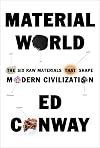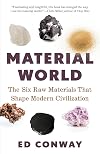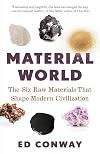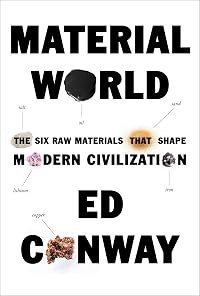
Material World: The Six Raw Materials That Shape Modern Civilization
by Ed Conway
On This Page
Description
"The story of civilization from an entirely new vantage point--the six raw materials that have shaped and will continue to shape humanity's destiny. Sand, iron, salt, oil, copper and lithium: The struggle for these fundamental materials has created empires, razed civilizations, and fed our ingenuity and our greed for thousands of years. It is a story that is far from finished. Though we are told we now live in a weightless world of information, we dug more stuff out of the earth in 2017 than show more in all of human history before 1950. And it's getting exponentially worse. To make one bar of gold, we now have to dig 5,000 tons of earth. For every ton of fossil fuels, we extract six tons of other materials--from sand to stone to wood to metal. Even as we pare back our consumption of fossil fuels we continue to redouble our consumption of everything else. Why? Because these ingredients are the basis for everything. They power our phones and electric cars, build our homes and offices, enable the printing of our books, and supply our packaging. Our modern world would not exist without them, and the hidden battle to control them will shape our future. This is an epic journey across continents, cultures and epochs that captures the astonishing extent to which humanity's prosperity is intertwined with what we extract from the earth and adapt to our needs and desires. It is a story of our past and future, from the ground up"-- show lessTags
Recommendations



Member Reviews
I learned of this book many months ago from the Financial Times and have been anticipating the US release.
This is a book about the fundamental feedstocks of modern (and often ancient) civilization. You might be wondering—what are the six most important materials? Sand, salt, iron, copper, oil, and lithium.
Some might consider this book long, but I wish it was ten times longer! Conway could have written a book-length treatment on each of these materials and I would still have read every page. As it is, the book feels rather scattershot, as there isn't possible enough space to give even a basic overview of the history and import of each of these materials. That said, Conway does a decent job given the limited word count he has to work show more with.
Although Conway doesn't explicitly speak about animism, his enchantment with and treatment of the six materials he covers shows the supreme regard in which he holds these substances. And you can't dig into the properties, histories, and attributes of these materials without beginning to hold them in a certain esteem and develop a certain rapport. I wish this book did get more deeply into an animist treatment of these materials, but there is still plenty of magic to go around regardless.
There are so many fascinating tidbits in the book:
- Germany and Great Britain did a rubber-for-glass swap at the height of World War I
- There is a single mine in North Carolina that is the only supply of the quartz crucibles required to make the silicon wafers required for computer chips. If it was disrupted, global production of chips would halt within six months.
- Rio Tinto mined out (and destroyed) the caves which have housed the Puutu Kunti Kurrama and Pinikura (Aboriginal nations) for the past 46,000 years ("human rights violation" doesn't begin to relate the magnitude of the violation)
- If you want steel that isn't radioactive, you need to source it from metal produced before the advent of the atomic bomb.
- Salt was the first regionally traded good, and is the reason for the creation of the earliest of roads.
"Planet of the Humans," the documentary produced by Michael Moore in 2020, received a lot of flack for being too pessimistic about the outlook for the green transition. Even if the emphasis and some of the citations in that documentary are off, the general thesis was that—the only realistic green transition would require roughly a 100x reduction in our resource and energy use. This is the subtext of Conway's book as well. Conway points out that lithium recovery rates when recycled are only 50%, which, once you start drawing up the numbers across a few dozen cycles, is not much better than zero. He also points out that the creation of a wind farm producing a comparable amount of energy to a natural gas plant requires many more times materials (and currently, we can't recycle the materials in a wind turbine, even though they wear out). We're mined one third of theoretical terrestrial copper reserves (although there is more in the deep sea), and we're already down to about 0.5% yield—those other 2/3rds will only get worse. And the story is the same for so many other resources. Conway talks about how we've been through four energy revolutions—each time moving to a source with higher energy density. If the green revolution comes about, it will be the first time of decreasing energy density.
To come back to animism—maybe this is the only method which enables humans to have the proper reverence for the materials upon which we rely. Want a green revolution? Get animist.
If you're looking to learn more about the building blocks of our world, this is your book. show less
This is a book about the fundamental feedstocks of modern (and often ancient) civilization. You might be wondering—what are the six most important materials? Sand, salt, iron, copper, oil, and lithium.
Some might consider this book long, but I wish it was ten times longer! Conway could have written a book-length treatment on each of these materials and I would still have read every page. As it is, the book feels rather scattershot, as there isn't possible enough space to give even a basic overview of the history and import of each of these materials. That said, Conway does a decent job given the limited word count he has to work show more with.
Although Conway doesn't explicitly speak about animism, his enchantment with and treatment of the six materials he covers shows the supreme regard in which he holds these substances. And you can't dig into the properties, histories, and attributes of these materials without beginning to hold them in a certain esteem and develop a certain rapport. I wish this book did get more deeply into an animist treatment of these materials, but there is still plenty of magic to go around regardless.
There are so many fascinating tidbits in the book:
- Germany and Great Britain did a rubber-for-glass swap at the height of World War I
- There is a single mine in North Carolina that is the only supply of the quartz crucibles required to make the silicon wafers required for computer chips. If it was disrupted, global production of chips would halt within six months.
- Rio Tinto mined out (and destroyed) the caves which have housed the Puutu Kunti Kurrama and Pinikura (Aboriginal nations) for the past 46,000 years ("human rights violation" doesn't begin to relate the magnitude of the violation)
- If you want steel that isn't radioactive, you need to source it from metal produced before the advent of the atomic bomb.
- Salt was the first regionally traded good, and is the reason for the creation of the earliest of roads.
"Planet of the Humans," the documentary produced by Michael Moore in 2020, received a lot of flack for being too pessimistic about the outlook for the green transition. Even if the emphasis and some of the citations in that documentary are off, the general thesis was that—the only realistic green transition would require roughly a 100x reduction in our resource and energy use. This is the subtext of Conway's book as well. Conway points out that lithium recovery rates when recycled are only 50%, which, once you start drawing up the numbers across a few dozen cycles, is not much better than zero. He also points out that the creation of a wind farm producing a comparable amount of energy to a natural gas plant requires many more times materials (and currently, we can't recycle the materials in a wind turbine, even though they wear out). We're mined one third of theoretical terrestrial copper reserves (although there is more in the deep sea), and we're already down to about 0.5% yield—those other 2/3rds will only get worse. And the story is the same for so many other resources. Conway talks about how we've been through four energy revolutions—each time moving to a source with higher energy density. If the green revolution comes about, it will be the first time of decreasing energy density.
To come back to animism—maybe this is the only method which enables humans to have the proper reverence for the materials upon which we rely. Want a green revolution? Get animist.
If you're looking to learn more about the building blocks of our world, this is your book. show less
What was ambiguously recommended to me as a book about some (to me, at least) boring raw materials, turned out to be a goosebump-inducing reflection on the past, present, and some future outlook of humanity as a whole. Filled with amazing facts and details I would otherwise never have dreamed of, this book has flung open wholly new perspectives to my mind. It has provided me with a shipload of general knowledge across a vast variety of topics and entertained me in ways I could never have imagined when I first set off on this journey.
It is a snapshot of the moment, however, for the author has incorporated the most current geopolitical events and placed them into their respective context of history and meaning to our world, so do not show more slack off reading it for too long, if you will. Lastly, I wish especially the political and scientific skeptics that currently manifest in vast numbers across the western world would read this book, but I'm afraid turning it into more than an audiobook (which is also excellently performed!) is just not feasible. A shame, really, just as much that it's over, but I have high hopes the author will continue this successful series. show less
It is a snapshot of the moment, however, for the author has incorporated the most current geopolitical events and placed them into their respective context of history and meaning to our world, so do not show more slack off reading it for too long, if you will. Lastly, I wish especially the political and scientific skeptics that currently manifest in vast numbers across the western world would read this book, but I'm afraid turning it into more than an audiobook (which is also excellently performed!) is just not feasible. A shame, really, just as much that it's over, but I have high hopes the author will continue this successful series. show less
A finely written and meticulously researched look at six substances — sand, salt, copper, iron, oil, and lithium — Ed Conway’s The Material World explores the history and science behind these elements that shape basically everything. At times a little long, but mostly Conway keeps things moving with a sharp mix of personal narrative that helps the reader stay connected. I listened to the audio that Conway reads himself, and I was continuously reminded of Ed Yong’s An Immense World with splashes of humor, wit, and the easy way of describing very scientific things without too much science.
Material World takes us through history and across the world, tracing the journey of raw resources through intricate processes to create the products that make up our world. It is an entertaining journey, enlightening, surprising, and too often distressing. You may think that reading about sand or iron would be dull, but you would be wrong. Conway visits the sources of the materials, incorporates annedocts from human history, explains their social, industrial, and environmental impact, and projects what the future will look as we struggle to keep up with demand.
Sand gives us glass, cement, and silicon.
Salt is necessary to human health but also is essential to the fertilizer, chemical, and pharmaceutical industry.
Iron is needed for steel show more used in our machines and buildings.
Copper gave us the circuitry to light and power our world.
Oil and gas fuels our vehicles and heats our homes, is the source of plastics, and powers hydroponic agriculture.
And lithium, “white gold,” goes into the batteries that store energy.
The modern world requires all of these materials. And nothing is made without oil. Conway doubts that we can arrive at net zero without a new energy source and he considers the emerging technologies.
These materials are sourced in one country, processed in another, an manufactured into goods in another. It is a fragile web, and a breakdown in geopolitics would threaten the supply chain.
As civilization requires batteries to store power, demand will outpace the ability to mine lithium; recycling to reclaim raw materials will become all important.
Conway believes we need to understand the chain that brings us the wonders of modern technology and life. He leaves us with hope that technology will evolve to a more efficient and sustainable energy source. “These six substances helped us survive and thrive. They helped us make magic. They can do it again,” he ends.
Thanks to the publisher for a free book. show less
Sand gives us glass, cement, and silicon.
Salt is necessary to human health but also is essential to the fertilizer, chemical, and pharmaceutical industry.
Iron is needed for steel show more used in our machines and buildings.
Copper gave us the circuitry to light and power our world.
Oil and gas fuels our vehicles and heats our homes, is the source of plastics, and powers hydroponic agriculture.
And lithium, “white gold,” goes into the batteries that store energy.
The modern world requires all of these materials. And nothing is made without oil. Conway doubts that we can arrive at net zero without a new energy source and he considers the emerging technologies.
These materials are sourced in one country, processed in another, an manufactured into goods in another. It is a fragile web, and a breakdown in geopolitics would threaten the supply chain.
As civilization requires batteries to store power, demand will outpace the ability to mine lithium; recycling to reclaim raw materials will become all important.
Conway believes we need to understand the chain that brings us the wonders of modern technology and life. He leaves us with hope that technology will evolve to a more efficient and sustainable energy source. “These six substances helped us survive and thrive. They helped us make magic. They can do it again,” he ends.
Thanks to the publisher for a free book. show less
I’ve actually only read this book in the Blinikist summary version and I’m wondering if I have missed a great deal. It seems to me that to concentrate on just three metals: Silicon, copper and iron plus potassium nitrate and oil is rather limiting. On the one hand it allows the author to go into some detail about the materials chosen but what about all the other materials out there that are of great significance....lead, tin and zinc carbon, oxygen etc., etc. I’ve recently purchased a text book on materials science and engineering and I’ve been struck by the approach; from crystalline structures to mechanical properties of metals,, phase diagrams, ceramics, semiconductors, polymers, and properties such as electrical, thermal, show more optical. All rather different from the approach in this book which is quasi historical.
Recently, I came across a nugget of information about sand. Around the time when Rome was being transformed into a “marble” city huge quantities of “sharp” sand were being imported for use as a cutting agent for the stone. Apparently it took about a cubic meter of sharp sand to cut a marble block of about the same dimensions into usable sizes. And, apparently, this is how the Egyptians cut holes and complex shapes in their stone....including granite.
Did I learn anything new? Hmm....I don’t think so. It’s all fairly well trodden ground. So I did a bit of research on the author. No he is not a geologist or a minerals expert. He is an economist/journalist working for Sky News in the UK. I find that slightly unsettling and it’s not the sort of qualification that I would look for in a book about materials. And, I guess that kind of explains the text. Rather banal really. The kind of writing I expect from a journalist and non-expert in a subject. I checked against some of the full book and he writes well enough but I was looking for something a little more in depth and revealing. Here are a few extracts from the Summary that I found useful:
“The origins of sand are, of course, rooted in natural processes far older than human history.
Its most remarkable transformation is in the form of silicon, derived from quartz sands.
sand is a critical component in construction, glassmaking, and even in the production of certain cosmetics..........But we’re beginning to come to terms with the fact that sand is not an infinite resource......The story of sand is thus also a story of sustainability challenges.
Saltpeter, or potassium nitrate, has been a cornerstone in both agriculture and warfare.
The origins of saltpeter trace back to ancient times, where it was discovered in the soils of East Asia......This simple compound, derived from the Earth, came to dictate the outcomes of wars and the fates of empires.....Its role as a fertilizer was equally transformative, by replenishing depleted soils and boosting crop yields,....The quest for this resource was a key driver in colonial expansions and the shaping of the modern world map....The tale of saltpeter is a reflection of human aspiration, our relationship with the natural world, and the unanticipated consequences of our endeavors.
Iron was first discovered as a tool-making material that surpassed its predecessors in both strength and durability.....Iron tools and weapons gave rise to new possibilities, reshaping agriculture, warfare, and societal structures.....The art of ironworking evolved from a mystical craft into a cornerstone of industrial revolution. The same metal that ploughed fields and constructed marvels of architecture was also forged into weapons....The environmental impact of iron and steel production is a pressing concern, posing challenges that demand innovative solutions.
Copper's significance is rooted in its unique properties: excellent conductivity, ductility (meaning it is able to be pulled into wires or threads), and durability....From manual mining to massive industrial operations, copper extraction reflects our ability to overcome natural limitations. The transition to greener technologies hinges on copper's availability. It's a paradox of needing more copper to reduce our carbon footprint while grappling with the environmental consequences of its extraction.
The narrative of oil begins with its discovery and extraction.....As we tapped into these vast reserves of energy, we set in motion a series of ecological consequences. The burning of fossil fuels, primarily oil and gas, has been a major contributor to greenhouse gas emissions, accelerating the pace of climate change. Moreover, crude oil's role extends beyond energy production. It is a key ingredient in the manufacturing of countless products, from plastics to pharmaceuticals, improving living standards worldwide.....The transition from fossil fuels to renewable energy is not just an environmental imperative but a geopolitical and economic one as well.
Lithium, the lightest metal, and one of the oldest elements tracing back from the big bang, holds unique properties that make it irreplaceable in our technology-driven age. The Salar de Atacama, the largest source of lithium, is a pivotal player in this transition.....Yet, the extraction of lithium from this pristine land is not without consequences.....Concerns that cannot be overlooked are the challenges of water usage in such a dry region, the potential impacts on local ecosystems, and the sustainability of these operations.
Summary: Common materials like sand, saltpeter, iron, copper, crude oil, and lithium are fundamental parts of the earth's crust. They are also pivotal components of human history, our present, and our future. From cosmic origins to ancient discoveries and modern uses, these materials have had a profound impact on civilization, technology, and the environment around us. Through the telling of their stories, we can begin to see how they impact and interconnect with our daily lives.
Critically, we must take to heart the balance we need to strike between utilizing these fascinating resources for good and protecting our planet.”
What’s my overall take on the book? I think I summed it up above: Rather banal. Mildly interesting but I didn’t learn much, if anything, new. I was hoping for more. The usual comments about pollution and global warming as we extract these minerals and transform them. But I didn’t see any great solutions being offered. Three stars from me. show less
Recently, I came across a nugget of information about sand. Around the time when Rome was being transformed into a “marble” city huge quantities of “sharp” sand were being imported for use as a cutting agent for the stone. Apparently it took about a cubic meter of sharp sand to cut a marble block of about the same dimensions into usable sizes. And, apparently, this is how the Egyptians cut holes and complex shapes in their stone....including granite.
Did I learn anything new? Hmm....I don’t think so. It’s all fairly well trodden ground. So I did a bit of research on the author. No he is not a geologist or a minerals expert. He is an economist/journalist working for Sky News in the UK. I find that slightly unsettling and it’s not the sort of qualification that I would look for in a book about materials. And, I guess that kind of explains the text. Rather banal really. The kind of writing I expect from a journalist and non-expert in a subject. I checked against some of the full book and he writes well enough but I was looking for something a little more in depth and revealing. Here are a few extracts from the Summary that I found useful:
“The origins of sand are, of course, rooted in natural processes far older than human history.
Its most remarkable transformation is in the form of silicon, derived from quartz sands.
sand is a critical component in construction, glassmaking, and even in the production of certain cosmetics..........But we’re beginning to come to terms with the fact that sand is not an infinite resource......The story of sand is thus also a story of sustainability challenges.
Saltpeter, or potassium nitrate, has been a cornerstone in both agriculture and warfare.
The origins of saltpeter trace back to ancient times, where it was discovered in the soils of East Asia......This simple compound, derived from the Earth, came to dictate the outcomes of wars and the fates of empires.....Its role as a fertilizer was equally transformative, by replenishing depleted soils and boosting crop yields,....The quest for this resource was a key driver in colonial expansions and the shaping of the modern world map....The tale of saltpeter is a reflection of human aspiration, our relationship with the natural world, and the unanticipated consequences of our endeavors.
Iron was first discovered as a tool-making material that surpassed its predecessors in both strength and durability.....Iron tools and weapons gave rise to new possibilities, reshaping agriculture, warfare, and societal structures.....The art of ironworking evolved from a mystical craft into a cornerstone of industrial revolution. The same metal that ploughed fields and constructed marvels of architecture was also forged into weapons....The environmental impact of iron and steel production is a pressing concern, posing challenges that demand innovative solutions.
Copper's significance is rooted in its unique properties: excellent conductivity, ductility (meaning it is able to be pulled into wires or threads), and durability....From manual mining to massive industrial operations, copper extraction reflects our ability to overcome natural limitations. The transition to greener technologies hinges on copper's availability. It's a paradox of needing more copper to reduce our carbon footprint while grappling with the environmental consequences of its extraction.
The narrative of oil begins with its discovery and extraction.....As we tapped into these vast reserves of energy, we set in motion a series of ecological consequences. The burning of fossil fuels, primarily oil and gas, has been a major contributor to greenhouse gas emissions, accelerating the pace of climate change. Moreover, crude oil's role extends beyond energy production. It is a key ingredient in the manufacturing of countless products, from plastics to pharmaceuticals, improving living standards worldwide.....The transition from fossil fuels to renewable energy is not just an environmental imperative but a geopolitical and economic one as well.
Lithium, the lightest metal, and one of the oldest elements tracing back from the big bang, holds unique properties that make it irreplaceable in our technology-driven age. The Salar de Atacama, the largest source of lithium, is a pivotal player in this transition.....Yet, the extraction of lithium from this pristine land is not without consequences.....Concerns that cannot be overlooked are the challenges of water usage in such a dry region, the potential impacts on local ecosystems, and the sustainability of these operations.
Summary: Common materials like sand, saltpeter, iron, copper, crude oil, and lithium are fundamental parts of the earth's crust. They are also pivotal components of human history, our present, and our future. From cosmic origins to ancient discoveries and modern uses, these materials have had a profound impact on civilization, technology, and the environment around us. Through the telling of their stories, we can begin to see how they impact and interconnect with our daily lives.
Critically, we must take to heart the balance we need to strike between utilizing these fascinating resources for good and protecting our planet.”
What’s my overall take on the book? I think I summed it up above: Rather banal. Mildly interesting but I didn’t learn much, if anything, new. I was hoping for more. The usual comments about pollution and global warming as we extract these minerals and transform them. But I didn’t see any great solutions being offered. Three stars from me. show less
Such an absorbing and engrossing book. With six such boring abundant so familiar materials you are gently led from their earliest economic importance through a succession of twist and turns until their such importance to current life is revealed. With amazing insights, explanations of why they have become so special with first-hand investigations by the author into the complex processes they undergo. What becomes so crystal clear is that we depend on a global interconnected world, from extraction, to purification, to processing along with other materials until incorporated into an end product that is offered to the market. All these individual actions might take place at specific locations around the world and dependant n each other of show more being shipped to the next stage. Staggering. Some of the special source materials are scarce or even worse dependant on vast quantities of waste material being extracted. We are pushing at the limits of what our planet can offer in our pursuit of ever more gadgets. show less
Spend some time with this book and have your eyes opened to some of the miraculous substances that undergird modern civilization as it is enjoyed in the West. To give just one example, I will never look at sand in the same way again now knowing that it makes the glass for our digital devices and optic fibres. Conway is right to step back and take a clear and awestruck look at the materials that make up our world.
Members
- Recently Added By
Author Information

4 Works 822 Members
Ed Conway is the economics editor of Sky News. Previously he was the economics editor of the Daily Telegraph and the Sunday Telegraph. His appointment to this role, when only twenty-five, made him the youngest-ever economics editor of a British national newspaper. He lives in London.
Awards and Honors
Awards
Distinctions
Notable Lists
Common Knowledge
- Canonical title*
- 供應鏈戰爭︰砂、鹽、鐵、銅、鋰、石油的戰略價值
- Original title
- Material World: A Substantial Story of Our Past and Future (UK) (UK)
- Alternate titles
- Material World: The Six Raw Materials That Shape Modern Civilization (US) (US)
*Some information comes from Common Knowledge in other languages. Click "Edit" for more information.
Classifications
Statistics
- Members
- 451
- Popularity
- 67,751
- Reviews
- 13
- Rating
- (4.31)
- Languages
- 6 — Chinese, traditional, English, German, Italian, Polish, Spanish
- Media
- Paper, Audiobook, Ebook
- ISBNs
- 17
- ASINs
- 7