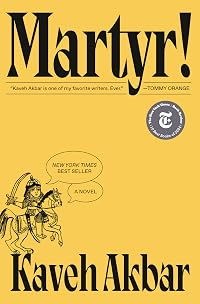
Martyr!
by Kaveh Akbar
On This Page
Description
Cyrus Shams is a young man grappling with an inheritance of violence and loss - his mother's plane was shot down over the skies of the Persian Gulf in a senseless accident; and his father's life in America was circumscribed by his work killing chickens at a factory farm in the Midwest. Cyrus is a drunk, an addict and a poet, whose obsession with martyrs leads him to examine the mysteries of his past - toward an uncle who rode through Iranian battlefields dressed as the angel of death to show more inspire and comfort the dying, and toward his mother, through a painting discovered in a Brooklyn art gallery that suggests she may not have been who or what she seemed. Kaveh Akbar's Martyr! is a paean to how we spend our lives seeking meaning - in faith, art, ourselves, others. show lessTags
Recommendations





Member Recommendations

aprille Addiction, grace, and the redemption of love
Member Reviews
This remarkable debut novel lives up to the hype. Fans of Akbar's poetry won't be disappointed, as he weaves in poems into the manuscript authored by the protagonist, Cyrus, an Iranian-American poet, writer, and recovering alcoholic. I did not know what to expect, having read little about the book as I'm simply trying to read all the 2025 Tournament of Books selections, and I think I'm better for not knowing what I was getting into. It is hard to describe the ride that is this book -- it is beautiful, tragic, funny, historical fiction, and one of those books where you feel you can connect with almost every character. There's even a plot twist -- handled deftly by Akbar, without resorting to clichéd sentimentality. Akbar lays bare show more themes of addiction, abandonment, artistic impulse, religiosity, media filters, racism, sexuality, and yes-- martyrdom--all in a way that seems like one of those rare honest conversations one might have with a close friend (often while inebriated, for some). The only drawback (if I can call it that) for me was the final scene between Cyrus and Zee. While I understand the reason for the lack of earthiness, it jolted me out of what I loved so much about the book -- the "here-and-nowness" of it--the starkness and the reality. I would have enjoyed a more subtle experience. But that doesn't keep me from saying that Martyr! is definitely in my top five books that I've read this year. show less
Cyrus is an Iranian American whose mother was killed shortly after he was born, shot down in the infamous Iran Air Flight 655 by an American Navy warship during the Iran-Iraq war. He and his father eventually move to the American Midwest, where Cyrus spends a gloomy childhood. He eventually goes to college, becomes an addict and an alcoholic, gets sober, and becomes obsessed with the idea of martyrs. In addition to his dead mother, his uncle served in the war doing “the strangest job in the Persian army”: He masqueraded as an angel in the battlefields of dying men at night, “to inspire the dying men to die with dignity, conviction. To keep them from suicide.” So that they could die as martyrs. Chronically depressed Cyrus wants show more his own death to be meaningful. So it’s not surprising that he is interested in visiting the performance art “Death-Speak” of Orkideh, who is dying of cancer and spending her remaining days sitting in the Brooklyn Museum just speaking with visitors.
I didn’t expect to love this as much as I did. Kaveh Akbar is a poet, and it shows in the lovely prose (as well as bits of poems from Cyrus’s book-in-progress). The plot summary sounded grim and unappealing, but this turned out to be a warm, engaging, and sometimes even funny tale about human connection. The ending is somewhat open to interpretation, but however you read it, it’s about what gives death, or life, its meaning. show less
I didn’t expect to love this as much as I did. Kaveh Akbar is a poet, and it shows in the lovely prose (as well as bits of poems from Cyrus’s book-in-progress). The plot summary sounded grim and unappealing, but this turned out to be a warm, engaging, and sometimes even funny tale about human connection. The ending is somewhat open to interpretation, but however you read it, it’s about what gives death, or life, its meaning. show less
Living happened until it didn't. There was no choice in it. To say no to a new day would be unthinkable. So each morning you said yes, then stepped into the consequence.
Cyrus immigrated to the US with his father when he was a baby. He was raised by a depressed single father who worked at a chicken farm and died soon after Cyrus graduated high school. Cyrus stayed in the Midwest for college and stayed in the same town after graduation, doing the same low-paying jobs he'd done in college and mainly drinking and taking drugs and not writing. After he gets sober, he's still not writing but he's not writing about the lives of famous martyrs, fascinated by their meaningful deaths.
I do like a sad sack doomed poet type, so I was predisposed to show more like this book, but it's also beautifully written. Akbar is a poet, and it shows in the word choices and how he can do so much in very few words. The novel centers Cyrus, but it's also about his absent family, with chapters told from the point of view of his mother, father and uncle, all of whom have fascinating stories to recount. And Cyrus also has a good friend, Zee, and a sponsor at AA who cares for him and sticks with him despite their differences. This is a novel that plays with language, moves around with some chapters leaning towards humor, and builds into a novel with a great deal of heart. I really loved this book and I'm looking forward to Akbar's next novel. show less
Cyrus immigrated to the US with his father when he was a baby. He was raised by a depressed single father who worked at a chicken farm and died soon after Cyrus graduated high school. Cyrus stayed in the Midwest for college and stayed in the same town after graduation, doing the same low-paying jobs he'd done in college and mainly drinking and taking drugs and not writing. After he gets sober, he's still not writing but he's not writing about the lives of famous martyrs, fascinated by their meaningful deaths.
I do like a sad sack doomed poet type, so I was predisposed to show more like this book, but it's also beautifully written. Akbar is a poet, and it shows in the word choices and how he can do so much in very few words. The novel centers Cyrus, but it's also about his absent family, with chapters told from the point of view of his mother, father and uncle, all of whom have fascinating stories to recount. And Cyrus also has a good friend, Zee, and a sponsor at AA who cares for him and sticks with him despite their differences. This is a novel that plays with language, moves around with some chapters leaning towards humor, and builds into a novel with a great deal of heart. I really loved this book and I'm looking forward to Akbar's next novel. show less
Summary: A young immigrant poet in recovery struggles to find meaning in a life after his mother’s plane was shot down and his father died.
When Cyrus was an infant in Iran, his mother’s plane was shot down by mistake by a U.S. ship. His father moved to Indiana, seeing a job recruitment notice. He spent the rest of his life cleaning up after chickens and collecting their eggs. And died when Cyrus was in college. Meanwhile his uncle Arash stayed back in Iran, suffering PTSD from the war. He had a gruesome assignment, to ride a black horse through battlefields at night after battle, robed as the Angel of Death. The idea was to comfort the dying. But he would live ever after with what he saw and did.
Cyrus was basically a good boy until show more his father died. In college, he experimented with all the things many students did, becoming addicted to drugs and alcohol. One day, he awoke and considered suicide, praying for a sign that he should go on living. A “sort of” sign was good enough to get him into recovery.
Cyrus was a poet and writer–or at least aspired to be. Talking with friends, he shared his idea to write a book about martyrs–people who died for something greater than themselves. And in this, we come to a central idea of the book–can one’s life–and death–mean something? He learns from a friend that an Iranian artist in New York named Orkideh is holding a unique exhibition. The exhibit is called Death-Speak. She is the exhibit, a woman dying of metastatic breast cancer willing to talk with any who come about death or whatever they want to talk about.
Cyrus and his lover, Zee, decide to make the trip. And for three consecutive days, he has conversations with Orkideh. At the beginning, she mocks his aspiration to write a book on martyrdom –“another death-obsessed Iranian man?” But by the end, there is a bond as he shares he wants to write about her. By the third conversation, they have become close. Orkideh seems gladdened to see Cyrus. He trusts her with his struggle and comes to his central question, “the trick to being at peace at the end.” They talk a bit further and embrace. He will never see her again. But those conversations and what he learns after them will change him forever…
While the book centers around Cyrus, each of the significant characters narrates at different points, sometimes filling in backstory. The narrative moves from the present back as far as Cyrus’ childhood. We hear from Cyrus father Ali, mother Roya, uncle Arash, Orkideh, and even Orkideh’s gallerist and former lover. There is even a strange, dreamlike segment with Orkideh and “President Invective.” There are also short segments with quote’s from Cyrus’ book on martyrs.
These shifts allow the reader to catch one’s breath, or redirect one’s eye in the story Akbar is painting. The story is one of discovery, one in which Cyrus gains knowledge of himself and the meaning of creating and loving. Akbar offers us an exploration of the human condition in all of its heartbreaks, ambiguities, and noble aspirations. Life can be both messy and glorious and our task is learning to live with both. show less
When Cyrus was an infant in Iran, his mother’s plane was shot down by mistake by a U.S. ship. His father moved to Indiana, seeing a job recruitment notice. He spent the rest of his life cleaning up after chickens and collecting their eggs. And died when Cyrus was in college. Meanwhile his uncle Arash stayed back in Iran, suffering PTSD from the war. He had a gruesome assignment, to ride a black horse through battlefields at night after battle, robed as the Angel of Death. The idea was to comfort the dying. But he would live ever after with what he saw and did.
Cyrus was basically a good boy until show more his father died. In college, he experimented with all the things many students did, becoming addicted to drugs and alcohol. One day, he awoke and considered suicide, praying for a sign that he should go on living. A “sort of” sign was good enough to get him into recovery.
Cyrus was a poet and writer–or at least aspired to be. Talking with friends, he shared his idea to write a book about martyrs–people who died for something greater than themselves. And in this, we come to a central idea of the book–can one’s life–and death–mean something? He learns from a friend that an Iranian artist in New York named Orkideh is holding a unique exhibition. The exhibit is called Death-Speak. She is the exhibit, a woman dying of metastatic breast cancer willing to talk with any who come about death or whatever they want to talk about.
Cyrus and his lover, Zee, decide to make the trip. And for three consecutive days, he has conversations with Orkideh. At the beginning, she mocks his aspiration to write a book on martyrdom –“another death-obsessed Iranian man?” But by the end, there is a bond as he shares he wants to write about her. By the third conversation, they have become close. Orkideh seems gladdened to see Cyrus. He trusts her with his struggle and comes to his central question, “the trick to being at peace at the end.” They talk a bit further and embrace. He will never see her again. But those conversations and what he learns after them will change him forever…
While the book centers around Cyrus, each of the significant characters narrates at different points, sometimes filling in backstory. The narrative moves from the present back as far as Cyrus’ childhood. We hear from Cyrus father Ali, mother Roya, uncle Arash, Orkideh, and even Orkideh’s gallerist and former lover. There is even a strange, dreamlike segment with Orkideh and “President Invective.” There are also short segments with quote’s from Cyrus’ book on martyrs.
These shifts allow the reader to catch one’s breath, or redirect one’s eye in the story Akbar is painting. The story is one of discovery, one in which Cyrus gains knowledge of himself and the meaning of creating and loving. Akbar offers us an exploration of the human condition in all of its heartbreaks, ambiguities, and noble aspirations. Life can be both messy and glorious and our task is learning to live with both. show less
There are lines in this book that will take the breath from your chest. I couldn't put it down, knew I was devouring it too quickly, and finished it almost sick to my stomach from the devastating tenderness of Akbar's writing.
This book grabbed me by the heartstrings and took me on a trip. I was drawn into the story by its sheer originality and the pacing kept me on my toes. Just when I thought I had a handle on things, starting to feel comfortable, it slapped me in the face. I was NOT hooked from the start, I was upset. I hated how vividly the bedwetting descriptions were described and I wasn't immediately drawn to the main character, Cyrus. His flaws and shortcomings made him difficult to like, but as the story unfolded and I learned more about his family and background, I found myself rooting for him. From laughter to tears, despair to hope, I felt it all as I followed Cyrus and his family. The book is equal parts poetry and satire, offering a show more thought-provoking commentary on imperialism and capitalism while also serving as a love letter to humanity. It deserves to be read and reread, and I think it will stay with me. Read it! show less
When your main character is a poet who doesn't write poetry named Cyrus Shams, you're probably writing a satire.
But Akbar's Martyr! hits too hard, too earnestly to be satire. It is a comic novel about death, suicide and substance abuse in the way that Slaughterhouse Five is a war novel. There are funny stretches and laugh out loud moments. But what sticks is the revelations, the lies that Cyrus cannot see through. Like so many lonely men, he drifts through life until he is exactly where he needs to be.
But Akbar's Martyr! hits too hard, too earnestly to be satire. It is a comic novel about death, suicide and substance abuse in the way that Slaughterhouse Five is a war novel. There are funny stretches and laugh out loud moments. But what sticks is the revelations, the lies that Cyrus cannot see through. Like so many lonely men, he drifts through life until he is exactly where he needs to be.
Members
- Recently Added By
Published Reviews
In Cyrus, Akbar has created an indelible protagonist, haunted, searching, utterly magnetic. But it speaks to Akbar’s storytelling gifts that “Martyr!” is both a riveting character study and piercing family saga.
There is a life force coursing through the work, implacably curious, devoted to the small human things, and a recognition that even if we shattered ones don’t always put show more ourselves back together, there is dignity in our brokenness show less
There is a life force coursing through the work, implacably curious, devoted to the small human things, and a recognition that even if we shattered ones don’t always put show more ourselves back together, there is dignity in our brokenness show less
added by lilithcat
Lists

Books recommended by Barack Obama
295 works; 28 members

National Book Award Finalists - Fiction
377 works; 12 members

Five star books
1,767 works; 110 members

Books Read in 2024
4,623 works; 126 members

Barack Obama's Summer Reading List 2024
14 works; 2 members

Borrowed Books 2024 (Books We Have Read BUT do NOT Own)
20 works; 1 member

Top Five Books of 2024
795 works; 264 members
2025 Tournament of Books
18 works; 8 members
2025 Notable Books for Adults
26 works; 1 member

Yet another list
67 works; 1 member

2025
42 works; 1 member

Books Read in 2025
4,091 works; 97 members
Top Five Books of 2025
954 works; 303 members

el
1,139 works; 1 member
Author Information

9+ Works 2,866 Members
Kaveh Akbar is the author of a previous poetry collection, Calling a Wolf a Wolf, and the editor of The Penguin Book of Spiritual Verse: 100 Poets on the Divine. He serves as the poetry editor of the Nation and teaches at Purdue University and in the low-residency MFA programs at Randolph College and Warren Wilson.
Some Editions
Awards and Honors
Awards
Distinctions
Notable Lists
Common Knowledge
- Canonical title
- Martyr!
- Original title
- Martyr!
- Original publication date
- 2024
- People/Characters
- Cyrus Shams; Ali Shams; Roya Shams; Arash Shirazi; Zee; Orkideh
- Important places
- Indiana, USA; Brooklyn, New York, New York, USA; Tehran, Iran
- Epigraph
- My God, I just remembered that we die.
—Clarice Lispector - Dedication
- for the martyrs, who live
- First words
- Maybe it was that Cyrus had done the wrong drugs in the right order, or the right drugs in the wrong order, but when God finally spoke back to him after twenty-seven years of silence, what Cyrus wanted more than anything else... (show all) was a do-over.
- Quotations
- The whiskey did, for him, what a bedside table did for normal people—it was always at the head of his mattress, holding what was essential to him in place.
Kathleen was oil-rich, charm-school-and-family-stables rich, a new kind of rich that made Cyrus's moral compass spin all the way through contempt and back around to curiosity.
Love was a room that appeared when you stepped into it.
“You can put a saddle on anger, Cyrus.”
Cyrus had come to expect certain constitutional surprises from his sponsor, sizing him up to be one kind of man--starchy, conservative--only for him to illuminate again and again the wide gulf between the image on his dust ja... (show all)cket and the story inside.
When Leila's fingers first crept down and met an unconscious stiffening of my stomach, she read as robust an autobiography as I'll ever write. And then she added her own movement, her own chapters to it. She changed the text ... (show all)of my living.
Art was a way of storing our brains in each other's...This idea that beauty is the horizon towards which all great art must march. I've never been interested in that. - Last words
- (Click to show. Warning: May contain spoilers.)The three of us stayed there all night in my gallery working, singing along to radio songs we knew, dancing to the ones we didn't, laughing at everything, all of it, the whole absurd production suddenly blossoming straight into our faces, on purpose.
- Original language
- English
Classifications
Statistics
- Members
- 2,214
- Popularity
- 9,138
- Reviews
- 58
- Rating
- (4.05)
- Languages
- 8 — Dutch, English, French, German, Italian, Portuguese, Romanian, Spanish
- Media
- Paper, Audiobook, Ebook
- ISBNs
- 27
- ASINs
- 7