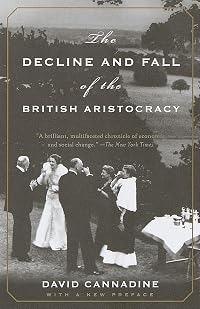
The Decline and Fall of the British Aristocracy
by David Cannadine
On This Page
Description
At the outset of the 1870s, the British aristocracy could rightly consider themselves the most fortunate people on earth: they held the lion's share of land, wealth and power in the world's greatest empire. By the end of the 1930s they had lost not only a generation of sons in the First World War, but also much of their prosperity, prestige and political significance. David Cannadine shows how this shift came about and how it was reinforced in the aftermath of the Second World War. Lucidly show more written and sparkling with wit, The Decline and Fall of the British Aristocracy is a landmark study that dramatically changes our understanding of British social history. show lessTags
Recommendations

















Member Reviews
There was a Punch cartoon during WW II depicting a curate being asked by the vicar as to the state of his breakfast boiled egg (which both knew to have been off). The curate's politically expedient answer was, "Good in parts."
This seems to serve as an admirable description of this book. It does serve up some fascinating facts and figures but, my biggest argument is with the concept that the aristocracy has been beaten, rather than going underground. To read these seven hundred odd pages, one would presume that, since the early twentieth century, we have lived in some psephological heaven: all decisions are made for the people and by the people: yes, right!
It would be interesting to hear the thoughts of Mr Cannadine as we trudge through show more the second decade of the twenty-first century and a ruling elite is clearly being re-established. Ah, but I hear you cry, the old aristocracy of landed gentry has passed away and maybe, just maybe, something else is taking its place.
No. The true power brokers are still the same. Mr Cannadine has been fooled by a re-arrangement in their ranks into believing in the destruction of the ruling class. I cannot think of another country so ruled by class: it still counts if your great, great, great grand-daddie fought with Wellington - and don't think that becoming part of the nouveau riche will put you on a par - it won't. show less
This seems to serve as an admirable description of this book. It does serve up some fascinating facts and figures but, my biggest argument is with the concept that the aristocracy has been beaten, rather than going underground. To read these seven hundred odd pages, one would presume that, since the early twentieth century, we have lived in some psephological heaven: all decisions are made for the people and by the people: yes, right!
It would be interesting to hear the thoughts of Mr Cannadine as we trudge through show more the second decade of the twenty-first century and a ruling elite is clearly being re-established. Ah, but I hear you cry, the old aristocracy of landed gentry has passed away and maybe, just maybe, something else is taking its place.
No. The true power brokers are still the same. Mr Cannadine has been fooled by a re-arrangement in their ranks into believing in the destruction of the ruling class. I cannot think of another country so ruled by class: it still counts if your great, great, great grand-daddie fought with Wellington - and don't think that becoming part of the nouveau riche will put you on a par - it won't. show less
Rather brilliantly researched, with some wittily astringent passages about the foibles and follies of the British and Anglo-Irish aristocracies of the late 19th and 20th centuries. Somewhat over-long and repetitive, however.
Ratings
Members
- Recently Added By
Lists

Best non-science books for scientists
11 works; 7 members

Best Downton Abbey-esqe books to read
17 works; 7 members

r/AskHistorians' Recommended Books
1,068 works; 19 members

In Our Time books
4,934 works; 2 members
Author Information

45+ Works 2,909 Members
David Cannadine is Professor of History and Director of the Institute of Historical Research at London University.
Awards and Honors
Awards
Common Knowledge
- Canonical title
- The Decline and Fall of the British Aristocracy
- Original publication date
- 1990
- People/Characters
- David Lloyd George; Winston Churchill; George Nathaniel Curzon; Grace Curzon, Marchioness Curzon of Kedleston; Anthony Eden; William Ewart Gladstone (show all 21); Nancy Mitford; Archibald Primrose, 5th Earl of Rosebery; Spencer Cavendish, 8th Duke of Devonshire; Victor Cavendish, 9th Duke of Devonshire; Edward Cavendish, 10th Duke of Devonshire; Arthur Ponsonby, 1st Baron Ponsonby of Shulbrede; H. H. Asquith; Margot Asquith; Robert Gascoyne-Cecil, 3rd Marquess of Salisbury; Arthur Balfour; F. E. Smith, 1st Earl of Birkenhead; Lord Robert Cecil; Lord Hugh Cecil; Oswald Mosley; Edward Frederick Lindley Wood, 1st Earl and 3rd Viscount of Halifax
- Important places
- Houses of Parliament, London, England, UK; Hatfield House, Hatfield, Hertfordshire, England, UK; Chatsworth, Derbyshire, England, UK
Classifications
- Genres
- History, Nonfiction, General Nonfiction
- DDC/MDS
- 305.520941 — Society, government, & culture Social sciences, sociology & anthropology Social group - Age, Gender, Ethnicity People by social and economic levels Upper Class British Isles
- LCC
- HT653 .G7 .C358 — Social sciences Communities. Classes. Races Communities. Classes. Races Classes Classes arising from birth
- BISAC
Statistics
- Members
- 512
- Popularity
- 58,879
- Reviews
- 2
- Rating
- (4.02)
- Languages
- English, Italian
- Media
- Paper, Ebook
- ISBNs
- 9
- ASINs
- 1