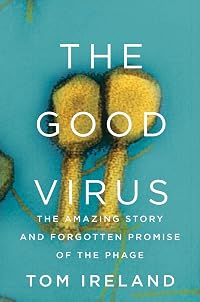
The Good Virus: The Amazing Story and Forgotten Promise of the Phage
by Tom Ireland
On This Page
Description
How a mysterious, super-powerful--yet long-neglected--microbe rules our world and can rescue our health in the age of antibiotic resistance. "How a mysterious, super-powerful--yet long-neglected--microbe rules our world and can rescue our health in the age of antibiotic resistance. At every moment, within our bodies and all around us, trillions of microscopic combatants are waging a war that shapes our health and life on Earth. Countless times per second, viruses known as phages attack and show more destroy bacteria while leaving all other life forms, including us, unscathed. Vastly outnumbering the viruses that do us harm, phages power ecosystems, drive evolutionary innovation, and harbor a remarkable capacity to heal life-threatening infections when conventional antibiotics fail. Yet most of us have never heard of them, thinking of viruses only as enemies to be feared. The Good Virus prompts us to reconsider, and to discover, how these viruses could save countless lives if we can learn to harness their extraordinary abilities. Taking us inside the ongoing quest to use phages' powers for good, Tom Ireland introduces us to the brilliant, often eccentric, scientists who have fought to realize phages' potential in the face of doubt and political intrigue. We meet the renegade French-Canadian scientist who discovered phages and pioneered their use as medicine over a century ago, leading them to be hailed as the world's first genuine antibiotic years before penicillin. We learn why, in some pockets of the former Soviet Union, drinking a vial of phages remains as common as taking an over-the-counter drug. We follow the intrepid scientists and doctors now racing to make "phage therapy" work worldwide as the threat of antibiotic-resistant bacteria grows ever more urgent--even as other researchers uncover how phages bolster our everyday immunity, help generate the oxygen we breathe, and furnish the origins for breakthrough technologies like CRISPR. Unveiling the hidden rulers of the microbial world and celebrating the surprising power of viruses to heal, not harm, The Good Virus forever changes how we see nature's most maligned life forms"--provided by publisher. show lessTags
Recommendations
















Member Reviews
The story is rich but poorly told, spattered with weak jokes. And he has a tin ear for language, mixing bacterium and bacteria, sometimes talking of viruses when he means phages and vice versa. Reveals his ignorance with a footnote on the word "peregrination", which he considers "exotic" It's in a French title for goodness' sake. Has he never heard of a peregrine falcon? It brought my reading to a halt. If you're looking for humour in science writing try Robert Sapolsky and many more.
This was a pretty good book.
I knew nothing about bacteriophages, a class of viruses that specifically targets bacteria. Ireland did a great job of educating me about the biochemistry of these virions (a word he also taught me). He's caused me to think differently about the web of life on Earth. I had no idea that 10^31 different viruses exist (!!!). I knew about horizontal gene transfer among bacteria, but not how virions drive and mediate it.
I'd have given the book a fifth star had it been a little more tightly edited on the personalities of early workers in the field. The history is interesting, but the science is much more so, to me. The internecine scientific squabbles mattered, but could have been covered in fewer pages, I think.
If show more you're curious about science in general, worried about antibacterial resistance in medicine, and just like to learn new stuff, you'll enjoy this book. show less
I knew nothing about bacteriophages, a class of viruses that specifically targets bacteria. Ireland did a great job of educating me about the biochemistry of these virions (a word he also taught me). He's caused me to think differently about the web of life on Earth. I had no idea that 10^31 different viruses exist (!!!). I knew about horizontal gene transfer among bacteria, but not how virions drive and mediate it.
I'd have given the book a fifth star had it been a little more tightly edited on the personalities of early workers in the field. The history is interesting, but the science is much more so, to me. The internecine scientific squabbles mattered, but could have been covered in fewer pages, I think.
If show more you're curious about science in general, worried about antibacterial resistance in medicine, and just like to learn new stuff, you'll enjoy this book. show less
Ratings
Members
- Recently Added By
Author Information
8+ Works 107 Members
Awards and Honors
Classifications
Statistics
- Members
- 83
- Popularity
- 387,800
- Reviews
- 2
- Rating
- (3.70)
- Languages
- English
- Media
- Paper, Audiobook, Ebook
- ISBNs
- 7
- ASINs
- 2