On This Page
Description
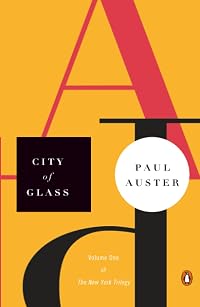
A late-night phone call from a stranger involves Quinn, a mystery writer, in a baffling murder case stranger than his novels.Tags
Recommendations




























Member Reviews
Because City of Glass is the first book in a trilogy, I'm going to write my review in sections, each an impression after completing one book of the three. I'm also going to delay rating the book, since the conclusion of each book is (hopefully) clarified by the contents of the successive books.
Part I
City of Glass is an odd book. A quirky book. If you like Stranger Than Fiction and/or The Eyre Affair, you should enjoy this book.
There is one main character in the book, Daniel Quinn. Or four, because Quinn, the protagonist, is an author using the nom de plume William Wilson to write detective fiction about his private eye Max Work. Quinn receives several late night phone calls for Paul Auster (in true Shoeless Joe and The Razor's Edge show more fashion, the real author interjects his name into the story), who is some sort of detective. Quinn decides to masquerade as Auster and tail Peter Stillman père to prevent him from killing Peter Stillman fils.
Peter Stillman père is a lunatic. So is fils, although only as a result of père's religiously-influenced actions rather than a defect of his own biology. Fils' wife, Virginia, is a lunatic. Quinn becomes a lunatic. In fact, you will probably feel like a lunatic at the conclusion of the novel, after you have successfully weaved your way through multiple intellectually interesting discussions of religion and literature. You have to sift carefully through these digressions to separate fact from fiction and keep track of the plethora of characters who share names and/or initials.
You are not prepared for City of Glass to end, except through your tactile awareness as you read that you are physically nearing the last page, and through the clever usage of Quinn's red notebook in the storyline. When you finish reading, you want to immediately begin Ghosts, because you are simply left hanging as far as what happened to Quinn, and to Peter Stillman and his wife. You also find yourself wondering who the hell told this story, because after 128 pages of third-person narrative, a first-person narrator suddenly interjects himself into the final few pages to explain the novel's events.
Actually, the first-person narrator doesn't explain the events. He doesn't know what became of anyone, and he imparts his lack of knowledge to us in an intriguing, enticing way that makes you want to find out.
Part II
What? The? Hell?
Studs Lonigan managed to show up in all three books of his trilogy. Granted, he is the namesake of the series, so we should expect him. Dunstan Ramsay is present in all three books of the Deptford Trilogy. Nick Jenkins, et al are present for all TWEVLE books in A Dance to the Music of Time.
Disconcertingly, only New York makes a repeat appearance in the second book of this trilogy. Neither Quinn, nor Wilson, nor Work - not even Auster - make even the barest of cameos in Ghosts. So this review will be short, and I fear that my uneasiness with the ending of City of Glass will only increase, that the mystery of what happened to Quinn and the Stillmans will not be answered, and I will have to downgrade this novel, failing as it does to conclude in a satisfying manner.
Part III
Well.
Peter Stillman finally reappears in The Locked Room. The mysterious "I" at the end of the first two novels finds Stillman in Paris, chases him down on foot, and gets beat up by him for his trouble. Quinn also reappears - actually, only makes a non-appearance, in that he can't be located. Neither of these events seems critical to the trilogy's denouement.
"I", it turns out, is the author of all three books (although we are never provided his name). He claims, near the end of The Locked Room, that the stories told in all three novels "are finally the same story". Which feels true in a sense. All three are shrouded in mystery about one or more of the main characters, mysteries that will remain cryptic.
I read an interview with Paul Auster, in which he's questioned on the links between the trilogy and the post-modern movement that was coming to the front at the time the novels were written. Auster downplays the influence of that movement on his work, but you can see the reason for the question if you're familiar with post-modernism or have read Calvino or similar novelists.
City of Glass is a well-written, somewhat entertaining book. I wouldn't include it in my list of must-read books, regardless of whether it's judged on its own merits or as part of the trilogy, because its unresolved plot leaves me unsure of what the book is supposed to be about. show less
Part I
City of Glass is an odd book. A quirky book. If you like Stranger Than Fiction and/or The Eyre Affair, you should enjoy this book.
There is one main character in the book, Daniel Quinn. Or four, because Quinn, the protagonist, is an author using the nom de plume William Wilson to write detective fiction about his private eye Max Work. Quinn receives several late night phone calls for Paul Auster (in true Shoeless Joe and The Razor's Edge show more fashion, the real author interjects his name into the story), who is some sort of detective. Quinn decides to masquerade as Auster and tail Peter Stillman père to prevent him from killing Peter Stillman fils.
Peter Stillman père is a lunatic. So is fils, although only as a result of père's religiously-influenced actions rather than a defect of his own biology. Fils' wife, Virginia, is a lunatic. Quinn becomes a lunatic. In fact, you will probably feel like a lunatic at the conclusion of the novel, after you have successfully weaved your way through multiple intellectually interesting discussions of religion and literature. You have to sift carefully through these digressions to separate fact from fiction and keep track of the plethora of characters who share names and/or initials.
You are not prepared for City of Glass to end, except through your tactile awareness as you read that you are physically nearing the last page, and through the clever usage of Quinn's red notebook in the storyline. When you finish reading, you want to immediately begin Ghosts, because you are simply left hanging as far as what happened to Quinn, and to Peter Stillman and his wife. You also find yourself wondering who the hell told this story, because after 128 pages of third-person narrative, a first-person narrator suddenly interjects himself into the final few pages to explain the novel's events.
Actually, the first-person narrator doesn't explain the events. He doesn't know what became of anyone, and he imparts his lack of knowledge to us in an intriguing, enticing way that makes you want to find out.
Part II
What? The? Hell?
Studs Lonigan managed to show up in all three books of his trilogy. Granted, he is the namesake of the series, so we should expect him. Dunstan Ramsay is present in all three books of the Deptford Trilogy. Nick Jenkins, et al are present for all TWEVLE books in A Dance to the Music of Time.
Disconcertingly, only New York makes a repeat appearance in the second book of this trilogy. Neither Quinn, nor Wilson, nor Work - not even Auster - make even the barest of cameos in Ghosts. So this review will be short, and I fear that my uneasiness with the ending of City of Glass will only increase, that the mystery of what happened to Quinn and the Stillmans will not be answered, and I will have to downgrade this novel, failing as it does to conclude in a satisfying manner.
Part III
Well.
Peter Stillman finally reappears in The Locked Room. The mysterious "I" at the end of the first two novels finds Stillman in Paris, chases him down on foot, and gets beat up by him for his trouble. Quinn also reappears - actually, only makes a non-appearance, in that he can't be located. Neither of these events seems critical to the trilogy's denouement.
"I", it turns out, is the author of all three books (although we are never provided his name). He claims, near the end of The Locked Room, that the stories told in all three novels "are finally the same story". Which feels true in a sense. All three are shrouded in mystery about one or more of the main characters, mysteries that will remain cryptic.
I read an interview with Paul Auster, in which he's questioned on the links between the trilogy and the post-modern movement that was coming to the front at the time the novels were written. Auster downplays the influence of that movement on his work, but you can see the reason for the question if you're familiar with post-modernism or have read Calvino or similar novelists.
City of Glass is a well-written, somewhat entertaining book. I wouldn't include it in my list of must-read books, regardless of whether it's judged on its own merits or as part of the trilogy, because its unresolved plot leaves me unsure of what the book is supposed to be about. show less
Paul Auster's City of Glass (1987) reads like Raymond Chandler on Derrida, that is, a hard-boiled detective novel seasoned with a healthy dose of postmodernist themes, a novel about main character Daniel Quinn as he walks the streets of uptown New York City. I found the story and writing as compelling as Chandler's The Big Sleep or Hammett's The Maltese Falcon and as thought-provoking as reading an essay by Foucault or Barthes. By way of example, here are three quotes from the novel coupled with key concepts from the postmodern tradition along with my brief commentary.
On the first pages of the novel, the narrator conveys mystery writer Quinn's reflections on William Wilson, his literary pseudonym and Max Work, the detective in his show more novels. We read, "Over the years, Work had become very close to Quinn. Whereas William Wilson remained an abstract figure for him Work had increasingly come to life. In the triad of selves that Quinn had become, Wilson served as a kind of ventriloquist, Quinn himself was the dummy, and Work was the animated voice that gave purpose to the enterprise." ---------- Michel Foucault completely rejected the idea that a person has one fixed inner self or essence serving them as their individual personal identity. Rather, he saw personal identity as defined by a process of on-going, ever changing dialogue with oneself and others. ---------- And Quinn's interior dialogue with Work and Wilson is just the beginning. As the novels progresses, Quinn takes on a number of other identities.
In his role as hired detective (quite an ironic role since Quinn is a fiction writer and has zero experience as a detective), he goes to Grand Central Station to locate a man by the name of Peter Stillman, the man he will have to tail. This is what we read after Quinn spots his man, "At that moment Quinn allowed himself a glance to Stillman's right, surveying the rest of the crowd to make doubly sure he made no mistakes. What happened then defined explanation. Directly behind Stillman, heaving into view just inches behind his right shoulder, another man stopped . . . His face was the exact twin of Stillman's." ---------- The double, the original and the copy, occupies the postmodernists on a number of levels, including a double reading of any work of literature. Much technical language is employed, but the general idea is we should read a work of fiction the first time through in the conventional, traditional way, enjoying the characters and the story. Our second reading should be more critical than the first reading we constructed; to be good postmodernists, we should `deconstruct' the text to observe and critically evaluate such things as cultural and social biases and underlying philosophic assumptions. And such a second reading should not only be applied to works of literature but to all our encounters with facets of contemporary mass-duplicated society.
"As for Quinn, it is impossible for me to say where he is now. I have followed the red notebook as closely as I could, and any inaccuracies in the story should be blamed on me." ---------- One key postmodern idea is that a book isn't so much about the world as it is about joining the conversation with other books. ---------- Turns out, the entire story here is a construction/deconstruction/reconstruction of a book: Quinn's red notebook. Life and literature living at the intersection of an ongoing conversation - Quinn's red notebook contains references to many, many other books, including the Diary of Marco Polo, Robinson Caruso, the Bible, Don Quixote and Baudelaire. And the story the narrator relates from Quinn's red notebook is City of Glass by Paul Auster.
One final observation. Although no details are given, Quinn tells us right at the outset he has lost his wife and son. Quinn's tragedy coats every page like a kind of film. No matter what form a story takes, modern or postmodern or anything else, tragedy is tragedy and if we empathize with Quinn at all, we feel his pain. Some things never change. show less
Post-modern, metafictional identity crisis. Who is this protagonist? Is he Daniel Quinn (who shares initials with Don Quixote), bereaved father and widower, or is he William Wilson, and which Wilson - Mets ballplayer or mystery writer? Does he channel the fictional detective, Max Work, or the real author, Paul Auster, who is mistaken for a detective in his own book? And all those father-son duos with mix-and-match names - the two Peter Stillmans, Sr and Jr, Daniel and Peter Quinn, Paul and Daniel Auster. Don't forget the 17th century pamphlet writer, Henry Dark (who shares initials with Humpty Dumpty.)
"In the good mystery there is nothing wasted, no sentence, no word that is not significant. And even if it is not significant, it has show more the potential to be so - which amounts to the same thing. The world of the book comes to life, seething with possibilities, with secrets and contradictions. Since everything seen or said, even the slightest, most trivial thing, can bear a connection to the outcome of the story, nothing must be overlooked. Everything becomes essence; the center of the book shifts with each event that propels it forward. The center, then, is everywhere, and no circumference can be drawn until the book has come to its end." (15)
"Quinn was deeply disillusioned. He had always imagined that the key to good detective work was a close observation of details. The more accurate the scrutiny, the more successful the results. The implication was that human behavior could be understood, that beneath the infinite facade of gestures, tics, and silences, there was finally a coherence, an order, a source of motivation. But after struggling to take in all these surface effects, Quinn felt no closer to Stillman than when he first started following him." (105) show less
"In the good mystery there is nothing wasted, no sentence, no word that is not significant. And even if it is not significant, it has show more the potential to be so - which amounts to the same thing. The world of the book comes to life, seething with possibilities, with secrets and contradictions. Since everything seen or said, even the slightest, most trivial thing, can bear a connection to the outcome of the story, nothing must be overlooked. Everything becomes essence; the center of the book shifts with each event that propels it forward. The center, then, is everywhere, and no circumference can be drawn until the book has come to its end." (15)
"Quinn was deeply disillusioned. He had always imagined that the key to good detective work was a close observation of details. The more accurate the scrutiny, the more successful the results. The implication was that human behavior could be understood, that beneath the infinite facade of gestures, tics, and silences, there was finally a coherence, an order, a source of motivation. But after struggling to take in all these surface effects, Quinn felt no closer to Stillman than when he first started following him." (105) show less
Paul Auster's City of Glass reads like Raymond Chandler on Derrida, that is, a hard-boiled detective novel seasoned with a healthy dose of postmodernist themes, a novel about main character Daniel Quinn as he walks the streets of uptown New York City.
I found the story and writing as compelling as Chandler's The Big Sleep or Hammett's The Maltese Falcon and as thought-provoking as reading an essay by Foucault or Barthes. By way of example, here are three quotes from the novel coupled with key concepts from the postmodern tradition along with my brief commentary.
On the first pages of the novel, the narrator conveys mystery writer Quinn's reflections on William Wilson, his literary pseudonym and Max Work, the detective in his novels. We show more read, "Over the years, Work had become very close to Quinn. Whereas William Wilson remained an abstract figure for him Work had increasingly come to life. In the triad of selves that Quinn had become, Wilson served as a kind of ventriloquist, Quinn himself was the dummy, and Work was the animated voice that gave purpose to the enterprise." ---------- Michel Foucault completely rejected the idea that a person has one fixed inner self or essence serving them as their individual personal identity. Rather, he saw personal identity as defined by a process of on-going, ever changing dialogue with oneself and others. ---------- And Quinn's interior dialogue with Work and Wilson is just the beginning. As the novels progresses, Quinn takes on a number of other identities.
In his role as hired detective (quite an ironic role since Quinn is a fiction writer and has zero experience as a detective), he goes to Grand Central Station to locate a man by the name of Peter Stillman, the man he will have to tail. This is what we read after Quinn spots his man, "At that moment Quinn allowed himself a glance to Stillman's right, surveying the rest of the crowd to make doubly sure he made no mistakes. What happened then defined explanation. Directly behind Stillman, heaving into view just inches behind his right shoulder, another man stopped . . . His face was the exact twin of Stillman's." ---------- The double, the original and the copy, occupies the postmodernists on a number of levels, including a double reading of any work of literature. Much technical language is employed, but the general idea is we should read a work of fiction the first time through in the conventional, traditional way, enjoying the characters and the story.
Our second reading should be more critical than the first reading we constructed; to be good postmodernists, we should `deconstruct' the text to observe and critically evaluate such things as cultural and social biases and underlying philosophic assumptions. And such a second reading should not only be applied to works of literature but to all our encounters with facets of contemporary mass-duplicated society.
"As for Quinn, it is impossible for me to say where he is now. I have followed the red notebook as closely as I could, and any inaccuracies in the story should be blamed on me." ---------- One key postmodern idea is that a book isn't so much about the world as it is about joining the conversation with other books. ---------- Turns out, the entire story here is a construction/deconstruction/reconstruction of a book: Quinn's red notebook. Life and literature living at the intersection of an ongoing conversation - Quinn's red notebook contains references to many, many other books, including the Diary of Marco Polo, Robinson Caruso, the Bible, Don Quixote and Baudelaire. And the story the narrator relates from Quinn's red notebook is City of Glass by Paul Auster. Again, Raymond Chandler on Derrida.
One final observation. Although no details are given, Quinn tells us right at the outset he has lost his wife and son. Quinn's tragedy coats every page like a kind of film. No matter what form a story takes, modern or postmodern or anything else, tragedy is tragedy and if we empathize with Quinn at all, we feel his pain. Some things never change.
New York City author Paul Auster, Born 1947
“Would it be possible, he wondered, to stand up before the world and with the utmost conviction spew out lies and nonsense? To say that windmills were knights, that a barber’s basin was a helmet, that puppets were real people? Would it be possible to persuade others to agree with what he said, even though they did not believe him? In other words, to what extent would people tolerate blasphemies if they gave them amusement? The answer is obvious, isn’t it? To any extent. For the proof is that we still read the book. It remains highly amusing to us. And that’s finally all anyone wants out of a book—to be amused.”
― Paul Auster, City of Glass show less
Astounding. Read it in one sitting (or rather standing. I found it's easier to concentrate reading when I'm leaning on the door frame and occasionally gazing outside to look at the plants and the sky.) It's exhilarating to finally finish reading something after being in a reading slump these past few months.
The theme that is immediately apparent is that of the double. Doppelgangers, aliases, that whole thing. The discussions about the words are interesting. The Paul Stillman character was interesting. One of the main character's discussions with Peter Stillman reminded me of that episode in Garcia Marquez's 'Cien Anos ...' (R.I.P.) where the people were stricken by the sickness of forgetting. The episode about the child suffering for show more the greater good reminds me of the story 'Those Who Walk Away from Omelas' by Le Guin. The episode where the character tried to minimize his eating to focus more on the job, reminded me of Kafka's 'A Hunger Artist.' Keeping up with the theme of the double is the structure of the book itself. Paul Auster writes a book about an author (Daniel Quinn) who writes detective stories under an alias, who somehow gets hired by a woman, who assumed he was a detective named Paul Auster (again the whole double thing). And it gets crazier from there.
Overall the story very much lived up to the hype I've been reading about. This is the second story of his I've read after Moon Palace. show less
The theme that is immediately apparent is that of the double. Doppelgangers, aliases, that whole thing. The discussions about the words are interesting. The Paul Stillman character was interesting. One of the main character's discussions with Peter Stillman reminded me of that episode in Garcia Marquez's 'Cien Anos ...' (R.I.P.) where the people were stricken by the sickness of forgetting. The episode about the child suffering for show more the greater good reminds me of the story 'Those Who Walk Away from Omelas' by Le Guin. The episode where the character tried to minimize his eating to focus more on the job, reminded me of Kafka's 'A Hunger Artist.' Keeping up with the theme of the double is the structure of the book itself. Paul Auster writes a book about an author (Daniel Quinn) who writes detective stories under an alias, who somehow gets hired by a woman, who assumed he was a detective named Paul Auster (again the whole double thing). And it gets crazier from there.
Overall the story very much lived up to the hype I've been reading about. This is the second story of his I've read after Moon Palace. show less
This is one of my favorite books of Auster's, and one of my favorites in general. Billed as an "anti-detective story," it uses many of the trappings of the classic detective formula, but rather than unraveling a whodunnit, it retains an aura of mystery throughout. Auster explores many of his favorite topics in this short book: loss, the nature of language, identity, obsession with intellectual concepts. While these might seem like heady or perhaps tedious subjects to some, the form he uses keeps up a narrative pace that makes it all flow naturally.
I can't even...
In the form of a mystery, this is a book about authorship and the possibility of a true language. I can't tell if it's actually great or merely aping greatness, but its definitely a bizarre and entertaining read.
In the form of a mystery, this is a book about authorship and the possibility of a true language. I can't tell if it's actually great or merely aping greatness, but its definitely a bizarre and entertaining read.
Members
- Recently Added By
Lists

Slipstream or Interstitial Fiction
160 works; 19 members

1,001 BYMRBYD Concensus
723 works; 27 members

Best First Lines
133 works; 8 members

Daria Morgendorffer's Bookshelf
70 works; 5 members

Blue Pyramid 1,276 Best Books of All Time
1,248 works; 32 members

To Read - Literature / Fiction
26 works; 1 member

Books Read in 2015
3,299 works; 129 members

Best Horror Mega-List
342 works; 6 members

Reedsydiscovery 100 Best Horror Books of All Time
100 works; 5 members

First Novels
373 works; 16 members

Reddit Recommendations
3 works; 1 member

My TBR
371 works; 3 members

Books Read in 2025
4,091 works; 97 members
Author Information

101+ Works 64,808 Members
Paul Auster was born on February 3, 1947, in Newark, New Jersey. He received a B.A. and a M.A. in English and Comparative Literature from Columbia University. In addition to his career as a writer, Auster has been a census taker, tutor, merchant seaman, little-league baseball coach, and a telephone operator. He started his writing career as a show more translator. He soon gained popularity for the detective novels that make up his New York Trilogy. His other works include The Invention of Solitude; Leviathan; Moon Palace; Facing the Music; In the Country of Last Things; The Music of Chance; Mr. Vertigo; and The Brooklyn Follies. His latest novels are entitled, Invisible and Sunset Park. In addition to his novels, Auster has written screenplays and directed several films. He is the recipient of a fellowship from the National Endowment for the Arts and a French Prix Medicis for Foreign Literature. (Bowker Author Biography) show less
Some Editions
Awards and Honors
Awards
Series

Belongs to Publisher Series
Work Relationships
Is contained in
Has the adaptation
Has as a student's study guide
Common Knowledge
- Canonical title
- City of Glass
- Original title
- City of Glass
- Original publication date
- 1985-10-14
- People/Characters
- Daniel Quinn; Virginia Stillman; Peter Stillman Jr.; Peter Stillman Sr.; Paul Auster; Siri Hustvedt (show all 7); Daniel Auster
- Important places
- New York, New York, USA
- First words
- It was a wrong number that started it, the telephone ringing three times in the dead of night, and the voice on the other end asking for someone he was not.
- Quotations
- "For our words no longer correspond to the world. When things were whole, we felt confident that our words could express them. But little by little these things have broken apart, shattered, collapsed into chaos. And yet our... (show all) words have remained the same. They have not adapted themselves to the new reality. Hence, every time we try to speak of what we see, we speak falsely, distorting the very thing we are trying to represent."
- Last words*
- (Click to show. Warning: May contain spoilers.)Ja katosipa hän minne tahansa, niin toivon hänelle onnea.
- Original language*
- englanti
- Disambiguation notice
- This work is the original prose novel City of Glass by Paul Auster. Please do not combine it with the comic adaptation.
*Some information comes from Common Knowledge in other languages. Click "Edit" for more information.
Classifications
- Genres
- Fiction and Literature, General Fiction, Graphic Novels & Comics
- DDC/MDS
- 813.54 — Literature & rhetoric American literature in English American fiction in English 1900-1999 1945-1999
- LCC
- PS3551 .U77 .C5 — Language and Literature American literature American literature Individual authors 1961-
- BISAC
Statistics
- Members
- 1,625
- Popularity
- 13,834
- Reviews
- 36
- Rating
- (3.76)
- Languages
- 16 — Danish, Dutch, English, Finnish, French, German, Galician, Greek, Italian, Japanese, Croatian, Spanish, Swedish, Turkish, Portuguese (Portugal), Portuguese (Brazil)
- Media
- Paper, Audiobook, Ebook
- ISBNs
- 45
- ASINs
- 12