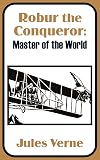
Robur the Conqueror / Master of the World
by Jules Verne
Robur the Conqueror (Collections and Selections — omnibus)
On This Page
Description
Jules Verne was a French writer; born in Nantes, February 8, 1828. He was educated in his native town; studied law in Paris, where he devoted much attention to dramatic literature. His comedy, Les Pailles Rompues, was performed at the Gymnase in 1850, and Onze Tours de Liege followed. His fame rests upon his scientific romances, which have a touch of extravagance in their treatment. His works, which are widely read, have been translated into English. Among his works are: Five Weeks in a show more Balloon (1870); A Journey to the Center of the Earth (1872); Twenty Thousand Leagues Under the Sea (1873); Meridiana, the Adventures of Three Englishmen and Three Russians in South Africa (1873); From the Earth to the Moon Direct in Ninety-seven Hours, Twenty Minutes, and a Trip Round It (1873); The Fur Country, or Seventy Degrees North Latitude (1874); Around the World in Eighty Days (1874); A Floating City and The Blockade Runners (1874); The English at the North Pole (1874); Dr. Ox's Experiment (1874); A Winter Amid the Ice (1875); The Mysterious Island (1875); The Survivors of the "Chancellor" (1875); Michael Strogoff, the Courier of the Czar (1876); The Child of the Cavern (1877); Hector Servadac, or the Career of a Comet (1877); Dick Sands, the Boy Captain (1878); Le Rayon Vert (1882); Kera-ban-le-teta (1883); L?Etoile du Sud (1884) ; Le Plays de Diamants (1884); Le Chemin de France (1887); Deux Ans de Vaccances (1888); Famille Sans Nom (1889); Caesar Cascabel (1890); Mathias Sautlorf (1890); Nord Contre Sud (1890); The Purchase of the North Pole (1890); Claudius Bombamac (1892); A Castle in the Carpathians (1892). show lessTags
Recommendations



























Member Reviews
This book reads like it was written by someone who really liked Twenty Thousand Leagues under the Sea and wanted to imitate it, but didn't understand what actually made that book work. It collects two novels by Verne; the first, Robur the Conqueror, opens very similarly to Twenty Thousand Leagues, with scenes from all over the world of a mysterious machine making appearances-- only it's a flying machine not a submarine. And unlike Twenty Thousand, where our protagonists seek out the mysterious machine to discover its provenance, these ones just happen to be selected by the strange Robur.
Why does Robur bring them aboard? I think because he's kind of a jerk. Robur is basically Nemo without a motivation: whereas Nemo wants the world to show more leave him alone because it's hurt him so much, yet his morals still require him to save those in distress, meaning he'll rescue people but leave them trapped, Robur just picks up some guys to show off... but won't let them leave. So how exactly is he planning on showing off? And unlike how Nemo's prisoners in Twenty Thousand Leagues are fascinated by what he has to show them, Robur's prisoners in Robur the Conqueror just complain a lot, yet don't really do much to escape. A novel about people seeing wondrous sights that they don't think are wondrous... well, it's not going to be very interesting is it? And once they do get away, they haven't learned a thing.
As for the sequel, Master of the World... well, the entire game is given away by knowing it's the sequel, since the mystery of the book is "Who owns the strange flying-machine-combination-car-combination-submarine-combination-boat?" But you the reader know it's Robur because otherwise the two books wouldn't be packaged together. Again, Robur seems to be flying around for no apparent reason, and eventually some guy catches him. And then Robur reenacts Nemo's fantastic end from Twenty Thousand Leagues, just in the air... only no one cares.
Read these books if you've ever imagined what Twenty Thousand Leagues under the Sea would be like if it was set in the air and everyone was dumb. show less
Why does Robur bring them aboard? I think because he's kind of a jerk. Robur is basically Nemo without a motivation: whereas Nemo wants the world to show more leave him alone because it's hurt him so much, yet his morals still require him to save those in distress, meaning he'll rescue people but leave them trapped, Robur just picks up some guys to show off... but won't let them leave. So how exactly is he planning on showing off? And unlike how Nemo's prisoners in Twenty Thousand Leagues are fascinated by what he has to show them, Robur's prisoners in Robur the Conqueror just complain a lot, yet don't really do much to escape. A novel about people seeing wondrous sights that they don't think are wondrous... well, it's not going to be very interesting is it? And once they do get away, they haven't learned a thing.
As for the sequel, Master of the World... well, the entire game is given away by knowing it's the sequel, since the mystery of the book is "Who owns the strange flying-machine-combination-car-combination-submarine-combination-boat?" But you the reader know it's Robur because otherwise the two books wouldn't be packaged together. Again, Robur seems to be flying around for no apparent reason, and eventually some guy catches him. And then Robur reenacts Nemo's fantastic end from Twenty Thousand Leagues, just in the air... only no one cares.
Read these books if you've ever imagined what Twenty Thousand Leagues under the Sea would be like if it was set in the air and everyone was dumb. show less
Reprint of edition publ. New York : 1951
Ratings
Members
- Recently Added By
Author Information

Jules Verne was born on February 8, 1828 in Nantes, France. He wrote for the theater and worked briefly as a stockbroker. He is considered by many to be the father of science fiction. His most popular novels included Journey to the Center of the Earth, Twenty Thousand Leagues Under the Sea, and Around the World in Eighty Days. Several of his works show more have been adapted into movies and TV mini-series. In 1892, he was made a Chevalier of the Legion of Honor in France. He died on March 24, 1905 at the age of 77. (Bowker Author Biography) Jules Verne (1828-1905) is the author of numerous adventure stories grounded in popularizations of science. (Publisher Provided) show less
Series

Belongs to Publisher Series
Die grosse Jules Verne Ausgabe (Band 10)
Work Relationships
Contains
Common Knowledge
- Canonical title
- Robur the Conqueror / Master of the World
- Original publication date
- 1886 (Robur the Conqueror) (Robur the Conqueror); 1904 (The Master of the World) (The Master of the World)
- Disambiguation notice
- This is an omnibus version of ROBUR THE CONQUEROR (also known as THE CLIPPER OF THE CLOUDS) and its sequel, THE MASTER OF THE WORLD. It should not be combined with either individual work. Thank you.
Classifications
Statistics
- Members
- 113
- Popularity
- 287,708
- Reviews
- 2
- Rating
- (3.61)
- Languages
- 6 — Czech, English, French, German, Hungarian, Polish
- Media
- Paper
- ISBNs
- 7
- ASINs
- 10