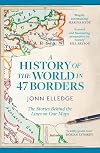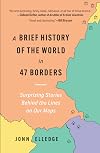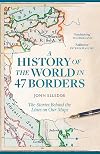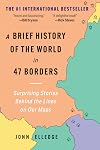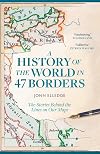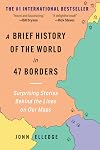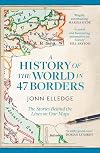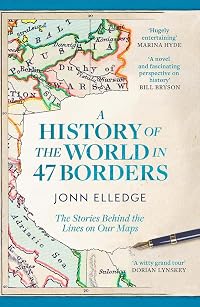
A Brief History of the World in 47 Borders: Surprising Stories Behind the Lines on Our Maps
by Jonn Elledge
On This Page
Description
People have been drawing lines on maps for as long as there have been maps to draw on. Sometimes rooted in physical geography, sometimes entirely arbitrary, these lines might often have looked very different if a war or treaty or the decisions of a handful of tired Europeans had gone a different way. By telling the stories of these borders, we can learn a lot about how political identities are shaped, why the world looks the way it does - and about the scale of human folly. From the Roman show more attempts to define the boundaries of civilisation, to the secret British-French agreement to carve up the Ottoman Empire during the First World War, to the reason why landlocked Bolivia still maintains a navy, this is a fascinating, witty and surprising look at the history of the world told through its borders. show lessTags
Recommendations




Member Reviews
Elledge is astoundingly knowledgeable and has a great sense of what makes a line on a map interesting. That said, this isn't really a "history of the world," brief or not. It blends history, geography, and cartography to tell interesting stories about the often weird ways in which human beings have delineated their territories.
And they really are interesting. The story of how the border between South Sudan and Uganda was decided by a couple of doughty Victorian Englishmen who couldn't stand each other and finally abandoned their surveying project halfway shows how closely comedy and tragedy are bound together; conflict rages over that border 140 years later. And who can resist the story of the eighty-man army of Liechtenstein that show more returned home with eighty-one men? Not the author; he admits it's only true if you stretch the truth, but can't resist telling it anyway.
Which brings me to the only quibble I have with the book. Elledge just can't stop making jokes, ironic comments and non-sequiturs that distract from his points. At first I thought the publisher might have told him to spice it up with humor to keep a general readership interested — after all, this is the same publisher that inserted the word "brief" into the title for the US edition, apparently on the theory that American readers are afraid of anything comprehensive - but the tic is so pervasive, I think it must simply be the author's personality. It's particularly present because the book is written in a deliberately casual, blokes-over-a-pint tone: frequent use of the first person ("I'm getting distracted...you'll notice I said..."), conversational paragraph starters ("Oh, and...,"" "Got that?"), and colloquialisms (a fortification is "a bugger to defend"). This kind of thing isn't a crime, exactly, but it seems like a symptom of something, such as a lack of confidence that the stories one's telling are interesting in themselves.
(At one point a sentence is interrupted by the phrase "— citation needed —"). Was this an author's note to himself that made it past proofing, or was it an ironic comment about an unverifiable assertion? It reflects on the author's style that I can't be sure which.)
Nonetheless, there are too many great stories and factoids here to risk missing. There's a well made index at the end so you can find them again, and a "Further Reading" section that tells you where you can learn more. Recommended. show less
And they really are interesting. The story of how the border between South Sudan and Uganda was decided by a couple of doughty Victorian Englishmen who couldn't stand each other and finally abandoned their surveying project halfway shows how closely comedy and tragedy are bound together; conflict rages over that border 140 years later. And who can resist the story of the eighty-man army of Liechtenstein that show more returned home with eighty-one men? Not the author; he admits it's only true if you stretch the truth, but can't resist telling it anyway.
Which brings me to the only quibble I have with the book. Elledge just can't stop making jokes, ironic comments and non-sequiturs that distract from his points. At first I thought the publisher might have told him to spice it up with humor to keep a general readership interested — after all, this is the same publisher that inserted the word "brief" into the title for the US edition, apparently on the theory that American readers are afraid of anything comprehensive - but the tic is so pervasive, I think it must simply be the author's personality. It's particularly present because the book is written in a deliberately casual, blokes-over-a-pint tone: frequent use of the first person ("I'm getting distracted...you'll notice I said..."), conversational paragraph starters ("Oh, and...,"" "Got that?"), and colloquialisms (a fortification is "a bugger to defend"). This kind of thing isn't a crime, exactly, but it seems like a symptom of something, such as a lack of confidence that the stories one's telling are interesting in themselves.
(At one point a sentence is interrupted by the phrase "— citation needed —"). Was this an author's note to himself that made it past proofing, or was it an ironic comment about an unverifiable assertion? It reflects on the author's style that I can't be sure which.)
Nonetheless, there are too many great stories and factoids here to risk missing. There's a well made index at the end so you can find them again, and a "Further Reading" section that tells you where you can learn more. Recommended. show less
This looked like a very interesting concept and with recommendations from Bill Bryson, Tom Holland (of The Rest is History fame) and Andrew Sweet (of what fame?) who must have a low respect for Douglas Adams as Sweet says of this book "With the wit -and often the tone - of Douglas Adams...", I had elevated expectations.
Alas, they were not met.
This is not a history of the world in any sense. There are 48 chapters/stories (an extra one included in the paperback edition), and whilst organised across three themes: Histories, Legacies, Externalities), there is no 'flow' either within any theme or across them. Rather they come across as discordant stories.
With a focus on borders (most between countries/states etc) one would expect many show more maps...but with only 23 maps in total and with those on pages 166 and 168, both dealing with Russia, Lithuania and (the previously unknown to me) Kaliningrad being virtually identical and which could have easily been combined to give space to one more different map, there is a paucity of them.
And many maps lack names for cities/towns and other features which are mentioned in the accompanying text...
There are some interesting facts and stories along the way, but not enough of themselves to make a book.
Of the more interesting/amusing are:
- (p251) Liechtenstein, being so small, does not currently have a military, though it once had one. It was last deployed in the 1866 Austrian-Prussian War, when it dispatched 80 members of its military, only to have it expanded with 81 returning (alas, it turns out the 81st was apparently an Austrian liaison officer)
- (p 246) Australia's Queensland apparently had 2 starts, the later being in 1859. There was a short-lived 'North Australia' which had letters patent issued in May 1846 in London and which would have seen its southern border pass through Noosa (a little north of current capital, Brisbane) and extend west along the 26th parallel south, which today forms the border between (different parts of) South Australia, the Northern Territory and Queensland. Alas, following a change of government in London, the 1846 letters patent were revoked only a few months later, to be replaced almost a decade later with the current arrangements.
I am glad I borrowed the book from the library and did not buy my own copy, but the book has been very successful, so there is definitely a readership out there somewhere.
Big Ship
27 March 2026 show less
Alas, they were not met.
This is not a history of the world in any sense. There are 48 chapters/stories (an extra one included in the paperback edition), and whilst organised across three themes: Histories, Legacies, Externalities), there is no 'flow' either within any theme or across them. Rather they come across as discordant stories.
With a focus on borders (most between countries/states etc) one would expect many show more maps...but with only 23 maps in total and with those on pages 166 and 168, both dealing with Russia, Lithuania and (the previously unknown to me) Kaliningrad being virtually identical and which could have easily been combined to give space to one more different map, there is a paucity of them.
And many maps lack names for cities/towns and other features which are mentioned in the accompanying text...
There are some interesting facts and stories along the way, but not enough of themselves to make a book.
Of the more interesting/amusing are:
- (p251) Liechtenstein, being so small, does not currently have a military, though it once had one. It was last deployed in the 1866 Austrian-Prussian War, when it dispatched 80 members of its military, only to have it expanded with 81 returning (alas, it turns out the 81st was apparently an Austrian liaison officer)
- (p 246) Australia's Queensland apparently had 2 starts, the later being in 1859. There was a short-lived 'North Australia' which had letters patent issued in May 1846 in London and which would have seen its southern border pass through Noosa (a little north of current capital, Brisbane) and extend west along the 26th parallel south, which today forms the border between (different parts of) South Australia, the Northern Territory and Queensland. Alas, following a change of government in London, the 1846 letters patent were revoked only a few months later, to be replaced almost a decade later with the current arrangements.
I am glad I borrowed the book from the library and did not buy my own copy, but the book has been very successful, so there is definitely a readership out there somewhere.
Big Ship
27 March 2026 show less
If you enjoy geography and history, this is an interesting book. Elledge takes a look at world history through the lens of borders across the ages. He also takes a look at the history of the prime meridian upon which maps are based and upon geography's influence on the international date line. Chapters are relatively short but are packed with interesting tidbits.
Ratings
Members
- Recently Added By
Lists

Non-Fiction Worth Reading
1,015 works; 261 members

Wishlist
99 works; 1 member

Books Read in 2025
4,091 works; 97 members

Kindle Non-Fiction
221 works; 1 member
Author Information

6 Works 379 Members
Awards and Honors
Common Knowledge
- Blurbers
- Lynskey, Dorian; Hyde, Marina; Bryson, Bill; Holland, Tom; Sawyer, Miranda; Bush, Stephen (show all 7); Defoe, Gideon
Classifications
- Genres
- Reference, History, General Nonfiction, Nonfiction, Travel
- DDC/MDS
- 912.09 — History & geography Geography & travel Maps and plans of surface of earth and of extraterrestrial worlds modified standard subdivisions History and biography of maps and map making
- LCC
- JC323 .E45 — Political Science Political theory Political theory. The state. Theories of the state Political geography
- BISAC
Statistics
- Members
- 357
- Popularity
- 88,309
- Reviews
- 3
- Rating
- (4.08)
- Languages
- English, Italian, Spanish
- Media
- Paper, Audiobook, Ebook
- ISBNs
- 8
- ASINs
- 5