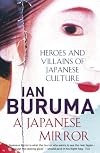
A Japanese Mirror: Heroes and Villains of Japanese Culture
by Ian Buruma
On This Page
Description
The received myth is that the Japanese are a race so different from the rest of us that no outsider can understand them - a myth they seem rather to enjoy. But one that Ian Buruma explodes in this fascinating study of the Japanese character through a studied analysis of the way they perceive and, more importantly, portray, themselves in their popular culture. Anyone who has ever been intrigued by the images of kamikaze pilots, geisha girls or the intricate arts of Japan should find this book show more appealing. show lessTags
Recommendations









































Member Reviews
Ian Buruma’s older but still fascinating look into Japanese popular culture is just the right kind of book for its purpose. At about 225 pages or so, it’s long enough to develop several related themes, e.g. the roles of women in Japanese culture as mothers and whores (and often both), the appeal of androgynous teen ‘stars’, the plight of the pitiable salaryman, and so on.
But although erudite and sophisticated, it’s free from the dreary ‘theorizing’ and ‘problematizing’ and other ‘cultural studies’ cant that bloats and usually makes unreadable most ‘scholarly’ works.
The conclusion Buruma reaches, though, is quite negative: he sees Japanese culture as ultimately torn between a lack of overarching moral standards show more (i.e. it’s historically, deeply relativistic) and a gross surplus of socially-constructed taboos and mores governing individual behavior. It’s not a happy mix, and it goes a long way to explaining much of what is so enigmatic about Japan and the Japanese: they feel compelled to be normal rather than good.
Recommended. show less
But although erudite and sophisticated, it’s free from the dreary ‘theorizing’ and ‘problematizing’ and other ‘cultural studies’ cant that bloats and usually makes unreadable most ‘scholarly’ works.
The conclusion Buruma reaches, though, is quite negative: he sees Japanese culture as ultimately torn between a lack of overarching moral standards show more (i.e. it’s historically, deeply relativistic) and a gross surplus of socially-constructed taboos and mores governing individual behavior. It’s not a happy mix, and it goes a long way to explaining much of what is so enigmatic about Japan and the Japanese: they feel compelled to be normal rather than good.
Recommended. show less
Buruma writes an interesting book about Japanese culture and its heroes. I'm not sure I always accept where he wants to take me, but it is still fascinating.
Ratings
Members
- Recently Added By
Lists

Shaking a Leg
111 works; 3 members
Author Information

Awards and Honors
Notable Lists
Series
Belongs to Publisher Series
Work Relationships
Has as a commentary on the text
Common Knowledge
- Original language*
- Engels
- Disambiguation notice
- Originally published as A Japanese Mirror (Cape, 1983) in the UK.
*Some information comes from Common Knowledge in other languages. Click "Edit" for more information.
Classifications
Statistics
- Members
- 260
- Popularity
- 124,155
- Reviews
- 2
- Rating
- (3.94)
- Languages
- Chinese, Dutch, English, German
- Media
- Paper, Ebook
- ISBNs
- 15
- ASINs
- 2