On This Page
Description
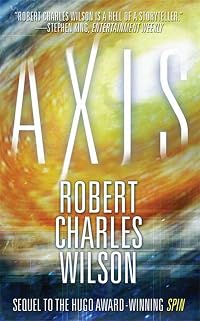
Wildly praised by readers and critics alike, Robert Charles Wilson's Spin won science fiction's highest honor, the Hugo Award for Best Novel.Now, in Axis, Spin's direct sequel, Wilson takes us to the "world next door"—the planet engineered by the mysterious Hypotheticals to support human life, and connected to Earth by way of the Arch that towers hundreds of miles over the Indian Ocean. Humans are colonizing this new world—and, predictably, fiercely exploiting its resources, chiefly show more large deposits of oil in the western deserts of the continent of Equatoria.
Lise Adams is a young woman attempting to uncover the mystery of her father's disappearance ten years earlier. Turk Findley is an ex-sailor and sometimes-drifter. They come together when an infall of cometary dust seeds the planet with tiny remnant Hypothetical machines. Soon, this seemingly hospitable world will become very alien indeed—as the nature of time is once again twisted, by entities unknown.
At the Publisher's request, this title is being sold without Digital Rights Management Software (DRM) applied.
. show less
Tags
Recommendations






Member Reviews
Unfortunately, many of the other reviewers here are on point. In Spin, we followed the lives of a small groups of characters while big ideas happened around them, spanning either decades or billions of years, depending on your perspective. In Axis, the ideas are not nearly as big, the timespan isn't quite so vast, and the cast of characters has changed to ones I don't find myself caring about as much.
There is a bit of an interesting follow up here to the last chapter of Spin: what's on the other side of the arch and just what are the Hypotheticals. I think the first could make an interesting story all of itself, just following a series of explorers further and further through the worlds, but that's not what Axis is. And so far as the show more second--we don't really learn anything new. There are hints of something bigger (which is saying something, given something on a scale with the entire galaxy) and a few smaller neat ideas, but nothing quite comes together.
All together, I think one can either read just Spin or read the entire series (since from what I've read, Vortex is more of a sequel to Axis than either was directly to Spin). Looks like we'll give Vortex a chance. show less
There is a bit of an interesting follow up here to the last chapter of Spin: what's on the other side of the arch and just what are the Hypotheticals. I think the first could make an interesting story all of itself, just following a series of explorers further and further through the worlds, but that's not what Axis is. And so far as the show more second--we don't really learn anything new. There are hints of something bigger (which is saying something, given something on a scale with the entire galaxy) and a few smaller neat ideas, but nothing quite comes together.
All together, I think one can either read just Spin or read the entire series (since from what I've read, Vortex is more of a sequel to Axis than either was directly to Spin). Looks like we'll give Vortex a chance. show less
The sequel to Spin, Axis is yet another tightly-woven, thought-provoking novel from one of my favorites, Robert Charles Wilson. Wilson's earliest novels were very enjoyable but almost too tightly constructed. In his later works, there is some room for the reader to breathe, and thus, I think, to identify more with the protagonists. Spin described the enveloping of Earth by a mysterious barrier, and made some revelations about its origin and purposes. It is not necessary to have read it to understand Axis, though it might be helpful. Axis includes sufficient exposition about previous events to carry the story, but for the full effect of a theme that pervades Wilson's work, the shift from the numinous and inexplicable to the mundane and show more ordinary, read both.
Axis includes other echoes of Wilson's previous work, notably returning to the question of life as a recording or replica after death, and some characters' choices about whether or not to accede to this process. Wilson's Jungian themes are also present, and his aliens are, as always, believably alien. Read Axis in conjunction with Sturgeon's More Than Human: They're not the same, but they belong together and should contribute to an interesting discussion. show less
Axis includes other echoes of Wilson's previous work, notably returning to the question of life as a recording or replica after death, and some characters' choices about whether or not to accede to this process. Wilson's Jungian themes are also present, and his aliens are, as always, believably alien. Read Axis in conjunction with Sturgeon's More Than Human: They're not the same, but they belong together and should contribute to an interesting discussion. show less
Axis is almost a 4 star book but I can't quite give it that, primarily because it never rose to the level that Spin did. Spin was a 4 1/2 star read - not a perfect novel by any means but an excellent, engaging one. This is more like a very good one. The author tries, I'll give him that, but most characters just never got their hooks into me, and the story builds on the first novel but does not have any "WOW" to it for me - there's stuff that might wow some readers, but not me. I've seen a number of comments saying it suffers from middle book syndrome and that the final book "Vortex" is the payoff.
The author throws some big ideas out here (and in Spin), that appeals to the science nerd part of me. He doesn't explain them though, explain show more in the sense of how is that even remotely possible. The big idea in Spin was not explained. We were told about it in various ways, but there is no way it could be explained. What seems to be the start of an explanation here gets a little woo-woo, and I've pretty much given up on seeing an explanation for what happened - but there's always the chance that "Vortex" the third book will deliver something believable.
I am very glad to have read this though. It is a bit better than what I consider an average science fiction read, and there is a lot of stuff in here to think about. I'll be reading the next one before long. show less
The author throws some big ideas out here (and in Spin), that appeals to the science nerd part of me. He doesn't explain them though, explain show more in the sense of how is that even remotely possible. The big idea in Spin was not explained. We were told about it in various ways, but there is no way it could be explained. What seems to be the start of an explanation here gets a little woo-woo, and I've pretty much given up on seeing an explanation for what happened - but there's always the chance that "Vortex" the third book will deliver something believable.
I am very glad to have read this though. It is a bit better than what I consider an average science fiction read, and there is a lot of stuff in here to think about. I'll be reading the next one before long. show less
Wilson, Robert Charles. Axis. Spin No. 2. Tor, 2007.
In the Spin series, Robert Charles Wilson has created a cosmos that just keeps getting creepier and creepier, and I mean that in a good way, I guess. In Spin, aliens have screwed with the solar system in a big way for purposes the novel’s characters can only guess at. In Axis, we begin to find out just a little bit more about what they are up to. Most of the action takes place on the second planet the earth became attached to in Spin. Once again characters struggle to discover who they are and what place they hold in a universe that keeps literally changing under their feet. They are an interesting lot: Martians, daughters looking for their fathers, genetically modified people who show more may be connected to the aliens in a special way, a soldier of fortune, a government agent, and a doctor who calls herself a nurse. And then interstellar ashes begin to fall out of the sky. To say more would lead to spoilers. On to Vortex. show less
In the Spin series, Robert Charles Wilson has created a cosmos that just keeps getting creepier and creepier, and I mean that in a good way, I guess. In Spin, aliens have screwed with the solar system in a big way for purposes the novel’s characters can only guess at. In Axis, we begin to find out just a little bit more about what they are up to. Most of the action takes place on the second planet the earth became attached to in Spin. Once again characters struggle to discover who they are and what place they hold in a universe that keeps literally changing under their feet. They are an interesting lot: Martians, daughters looking for their fathers, genetically modified people who show more may be connected to the aliens in a special way, a soldier of fortune, a government agent, and a doctor who calls herself a nurse. And then interstellar ashes begin to fall out of the sky. To say more would lead to spoilers. On to Vortex. show less
This is book two in Robert Charles Wilson’s Spin Trilogy. He won the Hugo for best novel with book one - ‘Spin.’ I feel a bit guilty judging book two before finishing the trilogy – as I think it’s in large part a set-up for the final book in the trilogy.
The book has some cool concepts, building on the excellent ideas in book one. Earth has been connected to a string of planets via an alien megastructure Arch in the Indian Ocean. The adjacent planet is habitable and is quickly being colonized by humans. We still know very little about the alien entity(s) (the Hypotheticals) that are responsible for the tech in both books. The book only carries forward one character from book one. You’ve probably read a similar plot before in show more sci-fi. A group of characters have come together and are being drawn to a location where something amazing is going to happen.
So, this book was much less of a soap opera than book one. It largely focused on the sci-fi elements, along with a minimal ‘love affair’ story line, and some shadowy quasi-government characters adding to the tension. The best parts are the sci-fi elements carried forward from book one – this is what got me through to the end. I have to say, the book dragged for me. There was opportunity – a new world, a post-human group of people (the Fourths), and the mysterious Hypotheticals. However, the new world is only slightly different than Earth, the Fourths are just crusty, emotionally stunted humans. So, it’s really the mystery of the Hypotheticals that pulled me through. And while there was a climax of action, the answer to the central questions of the series were not answered (of course not, it’s book two!) I’m invested enough to continue with book three (partially because I bought the whole trilogy up front).
A serviceable middle-book that unfortunately fails to stand up to its predecessor. Three stars for this continuation of a fantastic apocalyptic sci-fi saga, established in ‘Spin.’ show less
The book has some cool concepts, building on the excellent ideas in book one. Earth has been connected to a string of planets via an alien megastructure Arch in the Indian Ocean. The adjacent planet is habitable and is quickly being colonized by humans. We still know very little about the alien entity(s) (the Hypotheticals) that are responsible for the tech in both books. The book only carries forward one character from book one. You’ve probably read a similar plot before in show more sci-fi. A group of characters have come together and are being drawn to a location where something amazing is going to happen.
So, this book was much less of a soap opera than book one. It largely focused on the sci-fi elements, along with a minimal ‘love affair’ story line, and some shadowy quasi-government characters adding to the tension. The best parts are the sci-fi elements carried forward from book one – this is what got me through to the end. I have to say, the book dragged for me. There was opportunity – a new world, a post-human group of people (the Fourths), and the mysterious Hypotheticals. However, the new world is only slightly different than Earth, the Fourths are just crusty, emotionally stunted humans. So, it’s really the mystery of the Hypotheticals that pulled me through. And while there was a climax of action, the answer to the central questions of the series were not answered (of course not, it’s book two!) I’m invested enough to continue with book three (partially because I bought the whole trilogy up front).
A serviceable middle-book that unfortunately fails to stand up to its predecessor. Three stars for this continuation of a fantastic apocalyptic sci-fi saga, established in ‘Spin.’ show less
http://nwhyte.livejournal.com/2553844.html
I really loved Spin, to which this is a sequel; in fact, Spin was the first Hugo winner that I actually voted for. Axis is not as good a book, but it's still a good enough read; a complete change of central characters, pursuing a quest up the back country of an unknown parallel world, with a lot more emotional depth than you usually get in a two-fisted adventure tale. Took me ages to get around to reading it, but I am glad I finally did.
I really loved Spin, to which this is a sequel; in fact, Spin was the first Hugo winner that I actually voted for. Axis is not as good a book, but it's still a good enough read; a complete change of central characters, pursuing a quest up the back country of an unknown parallel world, with a lot more emotional depth than you usually get in a two-fisted adventure tale. Took me ages to get around to reading it, but I am glad I finally did.
Axis is the sequel to the excellent novel Spin. Just to give a little background, the premise of Spin is that the world has been mysteriously encased in an opaque membrane by an alien force termed the "Hypotheticals." This membrane allows Earth's time to pass normally, while the rest of the universe ages billions of years. At the end of what is essentially a planet wide time travel, a bridge appears on Earth that leads to another world. There is a lot I'm leaving out, but that's the basic plotline.
Axis is the somewhat less successful sequel, taking place a few decades later, as Earth colonizes the new planet termed Equatoria. Spin focused on three friends who first witness the blotting of Earth's stars as children and grow up during show more this crises., Because one of them, as an adult, comes to play a large part in Earth's reaction to the planet's encasing, the plot is revealed on two levels: The personal and the global. That was its strength. Axis attempts to do the same. But where it worked in Spin, it falls flat in Axis.
The overarching story is supposed to be a revelation on the origin of the Hypotheticals and their exact nature. Not only does the book fail to reveal this in the end, but the build up is slow and agonizing. Similarly, the individual story deals primarily with characters who have no connection to Spin. I tried to care about these characters, but the realization that the characterization was so much superior in Spin left these second raters feeling shallow.
Ultimately, I feel Spin should have been a stand alone novel. Axis, while a decent novel, undoes a lot of best elements of Spin. Because Spin was so great, Axis is so poor. show less
Axis is the somewhat less successful sequel, taking place a few decades later, as Earth colonizes the new planet termed Equatoria. Spin focused on three friends who first witness the blotting of Earth's stars as children and grow up during show more this crises., Because one of them, as an adult, comes to play a large part in Earth's reaction to the planet's encasing, the plot is revealed on two levels: The personal and the global. That was its strength. Axis attempts to do the same. But where it worked in Spin, it falls flat in Axis.
The overarching story is supposed to be a revelation on the origin of the Hypotheticals and their exact nature. Not only does the book fail to reveal this in the end, but the build up is slow and agonizing. Similarly, the individual story deals primarily with characters who have no connection to Spin. I tried to care about these characters, but the realization that the characterization was so much superior in Spin left these second raters feeling shallow.
Ultimately, I feel Spin should have been a stand alone novel. Axis, while a decent novel, undoes a lot of best elements of Spin. Because Spin was so great, Axis is so poor. show less
Members
- Recently Added By
Lists

Books Read in 2018
4,360 works; 110 members
Author Information

47+ Works 14,413 Members
Some Editions
Awards and Honors
Awards
Notable Lists
Series

Belongs to Publisher Series
Work Relationships
Is contained in
Common Knowledge
- Canonical title
- Axis
- Original title
- Axis
- Original publication date
- 2007
- People/Characters
- Diane Lawton (as Diane Dupree); Turk Findley; Isaac; Lise Adams; Sulean Moi; Anna Rebka (show all 8); Dr. Avram Dvali; Brian Gately
- Important places
- Equatoria; Port Magellan
- Epigraph
- It is necessary that things should pass away into that from which they are born. For things must pay one another the penalty and compensation for their injustice according to the ordinance of time. -- Anaximander
- Dedication
- Dedicated to the memory of Dr. Albert Goldhar and Ella Beautone (Bootie) Goldhar, and to the family they created and into which they generously accepted me.
- First words
- In the summer of his twelfth year - the summer the stars began to fall from the sky - the boy Isaac discovered that he could tell East from West with his eyes closed.
- Last words
- (Click to show. Warning: May contain spoilers.)Mahmud smiled. "It's these sunsets. Seems like they go on forever."
- Publisher's editor
- Nielsen Hayden, Teresa
- Blurbers
- King, Stephen
- Original language*
- Anglais canadien
*Some information comes from Common Knowledge in other languages. Click "Edit" for more information.
Classifications
Statistics
- Members
- 1,210
- Popularity
- 20,606
- Reviews
- 46
- Rating
- (3.38)
- Languages
- 6 — English, French, German, Hungarian, Italian, Romanian
- Media
- Paper, Audiobook, Ebook
- ISBNs
- 15
- ASINs
- 8