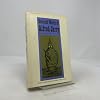
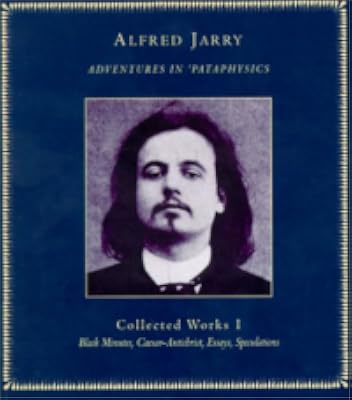
Selected Works of Alfred Jarry
by Alfred Jarry
On This Page
Description
Shelved in drama reserve collection room 239.Tags
Recommendations
















Member Reviews
The absurdist whorl of mock exoticism, fabulist science and playful lyricism buzzing through the plays, poetry, essays, graphics and novels presented here sets up Jarry as an antecedent to the dark, satirical strain of European modernism and the outré experimentation of literary scientist-artists like Alfred Korzybski, Blaise Cendrars, Marcel Duchamp, Flann O’Brien, et.al.—not to mention Jarry’s various pataphysical descendents (Daumal, Parsons, et al.) and a whole raft of Surrealists. I’m pretty sure that the unifying element in all this has something to do with the molecular structure of the bicycle, a machine complex and primitive at the same time.
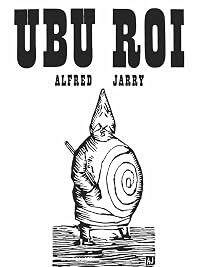
The well-known Ubu series, with its blasphemy and obscenity, presents only a show more partial picture of Jarry’s work (and not the best of it). The best way to take in the Ubu plays is probably as Jarry intended them, performed by marionettes. They grow tiresome on the page, though the depth and meaning of these early works evolved over time, as we see in the excerpts from Ubu’s Almanac, which Jarry published irregularly over the course of his life, and in the “Writings on the Theatre” included here. Jarry considers every element of the presentation, from décor to background colors to the shape of the placards used to give stage directions and the expressions on the masks worn by the cross-gendered actors as crucial, while also insisting that ‘theatricality is futile’ and, besides, the public is incapable of understanding anything profound anyway. Of his generation of artists, Jarry writes
We too shall become solemn, fat, and Ubu-like and shall publish classical books which will probably lead to our becoming mayors of small towns where, when we become academicians, the blockheads constituting the local intelligentsia will present us with Sévres vases, while they present their mustaches on velvet cushions to our children. And another lot of young people will appear, and consider us completely out of date, and they will write ballads to express their loathing of us, and that is just the way things should always be.
The included photographs, paintings, woodcuts and sketches by Jarry reflect the acute visual aspect of his writing, and the section of “Essays and Speculations” contains several excellent pieces, including “The New Rifle” (a decade before WWI), “Visions of Present and Future” (with the Disembraining Machine), “How to Construct a Time Machine” (‘the Explorer in his Machine beholds Time as a curve or better as a closed, curved surface’ even before Einstein), and “The Passion Considered as an Uphill Bicycle Race” (inspiration for J.G. Ballard’s equally brilliant “The Assassination of John Fitzgerald Kennedy Considered as a Downhill Motor Race”).
The second half of the book demonstrates Jarry’s capacity for working at a high pitch in prose form. If you understand where Jarry’s coming from, the absurdist erudition of his fabulous, philosophical Days and Nights will feel like a kind of truth. The last and most valuable selection here is the full text of Jarry’s great befuddling fin-de-siècle masterpiece, Exploits and Opinions of Doctor Faustroll, Pataphysician, with annotations. Anyone who wants to be alive should read it. It’s like a secret weird history of the 20th c. European mind, before it happens. Bravo and all that.
Jarry died in 1907 at the age of 34, from an excess of absinthe and ether—an appropriately alliterative avant-garde end for such an imaginative and influential writer. show less
The well-known Ubu series, with its blasphemy and obscenity, presents only a show more partial picture of Jarry’s work (and not the best of it). The best way to take in the Ubu plays is probably as Jarry intended them, performed by marionettes. They grow tiresome on the page, though the depth and meaning of these early works evolved over time, as we see in the excerpts from Ubu’s Almanac, which Jarry published irregularly over the course of his life, and in the “Writings on the Theatre” included here. Jarry considers every element of the presentation, from décor to background colors to the shape of the placards used to give stage directions and the expressions on the masks worn by the cross-gendered actors as crucial, while also insisting that ‘theatricality is futile’ and, besides, the public is incapable of understanding anything profound anyway. Of his generation of artists, Jarry writes
We too shall become solemn, fat, and Ubu-like and shall publish classical books which will probably lead to our becoming mayors of small towns where, when we become academicians, the blockheads constituting the local intelligentsia will present us with Sévres vases, while they present their mustaches on velvet cushions to our children. And another lot of young people will appear, and consider us completely out of date, and they will write ballads to express their loathing of us, and that is just the way things should always be.
The included photographs, paintings, woodcuts and sketches by Jarry reflect the acute visual aspect of his writing, and the section of “Essays and Speculations” contains several excellent pieces, including “The New Rifle” (a decade before WWI), “Visions of Present and Future” (with the Disembraining Machine), “How to Construct a Time Machine” (‘the Explorer in his Machine beholds Time as a curve or better as a closed, curved surface’ even before Einstein), and “The Passion Considered as an Uphill Bicycle Race” (inspiration for J.G. Ballard’s equally brilliant “The Assassination of John Fitzgerald Kennedy Considered as a Downhill Motor Race”).
The second half of the book demonstrates Jarry’s capacity for working at a high pitch in prose form. If you understand where Jarry’s coming from, the absurdist erudition of his fabulous, philosophical Days and Nights will feel like a kind of truth. The last and most valuable selection here is the full text of Jarry’s great befuddling fin-de-siècle masterpiece, Exploits and Opinions of Doctor Faustroll, Pataphysician, with annotations. Anyone who wants to be alive should read it. It’s like a secret weird history of the 20th c. European mind, before it happens. Bravo and all that.
Jarry died in 1907 at the age of 34, from an excess of absinthe and ether—an appropriately alliterative avant-garde end for such an imaginative and influential writer. show less
Ratings
Members
- Recently Added By
Lists

Harold Bloom - The Western Canon: D. The Chaotic Age
833 works; 24 members
Author Information

153+ Works 3,446 Members
Alfred Jarry, eccentric dramatist, poet, and humorist, was born in Laval, France, in 1873. He was the co-founder, with Remy de Gourmont in 1894, of the magazine L'ymagier, which literally translated is "the maker of prints." This magazine, in existence only two years, presented texts and art images from a number of literary avant-garde artists of show more the late 19th century. Jarry is perhaps best known for the satirical and farcical play Ubu Roi (King Ubu), the first in a series of Ubu plays, published in 1896. Jarry died in 1907 in Paris. (Bowker Author Biography) show less
Classifications
Statistics
- Members
- 117
- Popularity
- 277,665
- Reviews
- 1
- Rating
- (4.06)
- Languages
- English
- Media
- Paper
- ISBNs
- 5
- ASINs
- 2