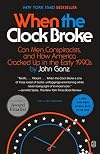
When the Clock Broke: Con Men, Conspiracists, and How America Cracked Up in the Early 1990s
by John Ganz
On This Page
Description
"A history of the right-wing political figures who defined the early 1990s"-- In When the Clock Broke, the acclaimed political writer John Ganz tells the story of America's late-century discontents. Ranging from upheavals in Crown Heights and Los Angeles to the advent of David Duke and the heartland survivalists, the broadcasts of Rush Limbaugh, and the bitter disputes between neoconservatives and the "paleo-con" right, Ganz immerses us in a time when what Philip Roth called the "indigenous show more American berserk" took new and ever-wilder forms. In the 1992 campaign, Pat Buchanan's and Ross Perot's insurgent populist bids upended the political establishment, all while Americans struggled through recession, alarm about racial and social change, the specter of a new power in Asia, and the end of Cold War-era political norms. Conspiracy theories surged, and intellectuals and activists strove to understand the "Middle American Radicals" whose alienation fueled new causes. Meanwhile, Bill Clinton appeared to forge a new, vital center, though it would not hold for long. In a rollicking, eye-opening book, Ganz narrates the fall of the Reagan order and the rise of a new and more turbulent America. show lessTags
Recommendations


































Member Reviews
Ganz's "When the Clock Broke" is a powerful book that will stick with you after you finish it. Each chapter narrates a different event in the early 1990s and uses it to develop the author's thesis of a "politics of despair" as an explanation of the explosion of the far right in the United States over the last thirty years.
Ganz has an amazing knack for connecting personal stories and biography to broader societal trends in a way that is both informative and relatable. A story about the deregulation of radio and television broadcast to explain the rise of a figure like Rush Limbaugh is humanized and made relatable through the idea of an epidemic of loneliness and the creation of large imagined communities with parasocial celebrity show more relationships. Ganz's empathy aids his explanations.
Ganz, despite his obvious misgivings, almost seems to have a certain kind of love for the figures he writes about and through his writing one almost feels empathy for figures like Perot, Limbaugh, and even the Ruby Ridge family. Ganz is a good humanist and has a tremendous ability to understand his subjects nonmoralistically, while also avoiding the trap of romanticization or implicit endorsement. This goes a long way in providing credence for his thesis about the far right. He also knows when to include a revealing (and sometimes hilarious) detail.
Like all good history, the book is not afraid to tackle the fraught topics of intellectual history and political theory, while also avoiding being hamfisted or oversimplifying. Ganz's thesis is about twenty times better thought out than Timothy Snyder's "politics of inevitability and eternity" in his Road to Unfreedom (Although that is not a high bar). Ganz also lets his points develop themselves through his narrative. The book gives a more sophisticated social explanation for the development of the American far right in the late 20th and 21st century than any other book I've read, and he manages to do it through a critical reading of the far right's own writers and the borrowed concept of a "politics of national despair."
Although he only rears his fat orange head in a few places, this is probably the best explanation of the Trump movement that i've personally read. The only criticism that could be leveled is that the book probably would have benefited from a full chapter covering Gingrich. One can't blame him though as it fall beyond the chronology of the book. As far as the "explanation of new authoritarianism" trend in nonfiction in recent years, this is in the upper echelon. It certainly leaves Timothy Snyder in the mud. One also catches a whiff of Marx's 18th Brumaire. Spooky. show less
Ganz has an amazing knack for connecting personal stories and biography to broader societal trends in a way that is both informative and relatable. A story about the deregulation of radio and television broadcast to explain the rise of a figure like Rush Limbaugh is humanized and made relatable through the idea of an epidemic of loneliness and the creation of large imagined communities with parasocial celebrity show more relationships. Ganz's empathy aids his explanations.
Ganz, despite his obvious misgivings, almost seems to have a certain kind of love for the figures he writes about and through his writing one almost feels empathy for figures like Perot, Limbaugh, and even the Ruby Ridge family. Ganz is a good humanist and has a tremendous ability to understand his subjects nonmoralistically, while also avoiding the trap of romanticization or implicit endorsement. This goes a long way in providing credence for his thesis about the far right. He also knows when to include a revealing (and sometimes hilarious) detail.
Like all good history, the book is not afraid to tackle the fraught topics of intellectual history and political theory, while also avoiding being hamfisted or oversimplifying. Ganz's thesis is about twenty times better thought out than Timothy Snyder's "politics of inevitability and eternity" in his Road to Unfreedom (Although that is not a high bar). Ganz also lets his points develop themselves through his narrative. The book gives a more sophisticated social explanation for the development of the American far right in the late 20th and 21st century than any other book I've read, and he manages to do it through a critical reading of the far right's own writers and the borrowed concept of a "politics of national despair."
Although he only rears his fat orange head in a few places, this is probably the best explanation of the Trump movement that i've personally read. The only criticism that could be leveled is that the book probably would have benefited from a full chapter covering Gingrich. One can't blame him though as it fall beyond the chronology of the book. As far as the "explanation of new authoritarianism" trend in nonfiction in recent years, this is in the upper echelon. It certainly leaves Timothy Snyder in the mud. One also catches a whiff of Marx's 18th Brumaire. Spooky. show less
A detailed recap of the 92 campaign for those who missed it. Probably destined to be required reading for poli sci classes on the era, I found it lacked a stance on what could have been different or what that election really cost America.
Did the third party insurgency of Ross Perot really presage the Citizens United fueled MAGA movement? Was the Bush presidency really the pinnacle of the self serving lies of the Southern Strategy era, rather than Iran Contra scandal, or the unamerican backroom diplomacy of candidate Nixon to the VFC or candidate Reagan to the Ayatollah? I'm not convinced that Clinton's New Democrats are really to blame for George W's faked WMDs.
In the end, this is an exhaustive review of an election. All presidential show more elections are consequential, so 92 was a consequential election. But it fails to make the case that 92 was epochal in ways that 68, 80, 2000 or 2016 were not. show less
Did the third party insurgency of Ross Perot really presage the Citizens United fueled MAGA movement? Was the Bush presidency really the pinnacle of the self serving lies of the Southern Strategy era, rather than Iran Contra scandal, or the unamerican backroom diplomacy of candidate Nixon to the VFC or candidate Reagan to the Ayatollah? I'm not convinced that Clinton's New Democrats are really to blame for George W's faked WMDs.
In the end, this is an exhaustive review of an election. All presidential show more elections are consequential, so 92 was a consequential election. But it fails to make the case that 92 was epochal in ways that 68, 80, 2000 or 2016 were not. show less
Detailed, well written, and devastating. Clarified a lot of memories from the 1980's and 1990's, dredged up a few that I could have done without. How we got to where we are. Recommended.
Ratings
Members
- Recently Added By
Lists

Books recommended by Barack Obama
295 works; 28 members

Barack Obama's Summer Reading List 2024
14 works; 2 members

Library Books
70 works; 1 member
Author Information

1 Work 341 Members
Awards and Honors
Awards
Distinctions
Notable Lists
Common Knowledge
- Canonical title
- When the Clock Broke: Con Men, Conspiracists, and How America Cracked Up in the Early 1990s
- Dedication
- FOR GOTTFRIED BALLIN
- First words
- History, as the cliche goes, is written by the winners, but this is a history of the losers: candidates who lost their elections, movements that bubbled up and fizzled out, protests that exploded and dissipate, writers who to... (show all)iled at the margins of American life, figures who became briefly famous or infamous and then were forgotten. Some of the characters are still well remembered, but the substance of what they said, did, and meant is not. Their defeats are as important to the history of this country as the (temporary) victories of their opponents. - Introduction: The End
On January 21, 1989, the day after George H. W. Bush's inauguration, David Duke, the former Grand Wizard of the Ku Klux Klan, a neo-Nazi, and the head of an organization called the National Association for the Advancement of ... (show all)White People, finished first in an open primary for Louisiana's eight-first legislative district. Running as a Republican, he came out ahead of the state party's preferred candidate, John Treen, brother of David Treen, Louisiana's first Republican governor since Reconstruction. While a majority of the District 81 voters were still registered Democrats, they had overwhelmingly voted for Ronald Reagan and then for George H.W. Bush - and were not up for grabs. -Chapter 1, Swamp Creature - Canonical DDC/MDS
- 320.520973
- Canonical LCC
- E839.G308
Classifications
- Genres
- History, Nonfiction, Politics and Government, General Nonfiction
- DDC/MDS
- 320.520973 — Society, Government, and Culture Political science Types of Government Political ideologies Conservatism Standard subdivisions History, geographic treatment, biography North America United States
- LCC
- E839 .G308 — History of the United States United States Later twentieth century, 1961-2000 Political history Un-American activities
- BISAC
Statistics
- Members
- 341
- Popularity
- 92,772
- Reviews
- 3
- Rating
- (4.13)
- Languages
- English
- Media
- Paper, Audiobook, Ebook
- ISBNs
- 5
- ASINs
- 2