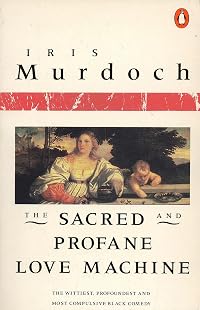
The Sacred and Profane Love Machine
by Iris Murdoch 
On This Page
Description
Swinging between his wife and his mistress in the sacred and profane love machine and between the charms of morality and the excitements of sin, the psychotherapist, Blaise Gavender, sometimes wishes he could divide himself in two. Instead, he lets loose misery and confusion and--for the spectators at any rate--a morality play, rich in reflections upon the paradoxes of human life and the nature of the battle between sacred and profane love.Tags
Recommendations


























Member Recommendations
Member Reviews
A fairly schematic look inside the heads of a set of characters with their own idealized fantasies about themselves. Blaise is married to a paragon, but having a long-term affair with someone else. Monte is mourning his wife and their difficult marriage. There are two lovers, two sons, two advisors, etc. I found the cranial view very interesting. book circle didn't love this one. But you can't rate a book by how much you like the characters, right?
This was my 20th of Murdoch's 26 novels, so it is increasingly difficult to find much to distinguish it from the rest of her ouevre.
This one centres on a married psychotherapist Blaise Gavender and his relationships with his loyal and trusting wife Harriet, and his mistress of nine years Emily, both of which have given him sons. These are the sacred and profane loves of the title. The other main character is their neighbour Monty Small, a recently widowed writer of spy thrillers who helps Blaise concoct alibis for his frequent visits to Emily.
As always Murdoch treats her characters like a capricious and mischievous God, and the writing is very enjoyable and often funny.
This one centres on a married psychotherapist Blaise Gavender and his relationships with his loyal and trusting wife Harriet, and his mistress of nine years Emily, both of which have given him sons. These are the sacred and profane loves of the title. The other main character is their neighbour Monty Small, a recently widowed writer of spy thrillers who helps Blaise concoct alibis for his frequent visits to Emily.
As always Murdoch treats her characters like a capricious and mischievous God, and the writing is very enjoyable and often funny.
I struggled with how to rate this book. I hated the ending -- it made me angry, in fact. However, up to the last 30 pages, I loved reading this -- gave me a lot to think about. I couldn't put it down.
Murdoch is a terrific writer--this was the smoothest, most elegant writing I've encountered in a while now that I'm not in English anymore and I'm slumming in most of my pleasure reading. The first few pages drew me into this tangled mess of a machine right away and I was happy to have this volume in my purse on a cross-country flight. But Harriet's fate and the near-complete disregard of so many people for her nauseated me. I feel like there might be really brilliant connections and hidden meanings here, but by the time I got to the end I was too perturbed to want to dig them out. The "love machine" made several leitmotif appearances, as it maneuvered its victims, but still not any too clear or necessary to the story.
It took a while for me to get interested in this story, but when I did I could appreciate both Harriet's and Emily's perspectives. Blaise was just a loser, all around. I don't understand why so much time was given to Monty and Edgar, since they seem to be peripheral; maybe I missed something. I would rate most of the book higher, but the ending was terrible. I really hated what happened to Harriet. I thought it was unfair and kind of a cheap way to resolve her character.
As usual a cast of dreadful people fall in and out of love with each other and ludicrous situations ensue. Its really enjoyable to read, but has a completely mad ending.
** spoiler alert ** Ultimately, I liked the book. It is very British, and it took my a while to get into, but overall it was a decent book. It had a rather deus ex machina ending, which, for a book with such a title, seems quite appropriate. I don't stand by the comments below 100%, but I still feel that the book was largely concerned with the mechanical way in which people approach their lives and relationships, and their unwillingness/inability to break free of this and change. One character seems to break free from this machine, but the consequences are catastrophic, and we never really see whether the change was true and lasting.
***
2/27/08:
I'm 140 pages in and I can't decide if I like this book. I keep putting it down to do other show more things (check my email, look for replacement camera accessories...), which isn't a good sign.
So far, it appears to be about a man with two kept women (a wife and a mistress, neither of whom seems to have much autonomy) and their relationships. He has a child with each woman, which complicates matters. I'm wondering if it is going to turn out to be a commentary on the way people latch on to certain roles (gender or other), and their reluctance to change. The title and the themes of relationship as machine/human emotions as mechanical (which keep surfacing) seem to support this idea. If it turns out that this is the case, I will be delighted. If it doesn't, I fear I will feel I've wasted my time reading this book.
***
Thoughts at pg. 214 (2/29/08):
Each character in the book does seem to feel bound to what they see as the mechanical (and therefore inflexible) nature of interpersonal relationships and the world. BUT, each characters view of how the machine works is slightly different. So far none have come to the idea that the mechanical rules dominating their existence might not be universal, might actually be imposed by themselves and society, and none of them are really moving in that direction. What makes the book interesting is the way each character's perception of the machine flexes and shifts when it bumps up against someone else's perceptions, until both parties are able to make sense of the friction within the framework of their own sociological rules. They don't really understand each other, but they fit together neatly enough to convince themselves that they do. show less
***
2/27/08:
I'm 140 pages in and I can't decide if I like this book. I keep putting it down to do other show more things (check my email, look for replacement camera accessories...), which isn't a good sign.
So far, it appears to be about a man with two kept women (a wife and a mistress, neither of whom seems to have much autonomy) and their relationships. He has a child with each woman, which complicates matters. I'm wondering if it is going to turn out to be a commentary on the way people latch on to certain roles (gender or other), and their reluctance to change. The title and the themes of relationship as machine/human emotions as mechanical (which keep surfacing) seem to support this idea. If it turns out that this is the case, I will be delighted. If it doesn't, I fear I will feel I've wasted my time reading this book.
***
Thoughts at pg. 214 (2/29/08):
Each character in the book does seem to feel bound to what they see as the mechanical (and therefore inflexible) nature of interpersonal relationships and the world. BUT, each characters view of how the machine works is slightly different. So far none have come to the idea that the mechanical rules dominating their existence might not be universal, might actually be imposed by themselves and society, and none of them are really moving in that direction. What makes the book interesting is the way each character's perception of the machine flexes and shifts when it bumps up against someone else's perceptions, until both parties are able to make sense of the friction within the framework of their own sociological rules. They don't really understand each other, but they fit together neatly enough to convince themselves that they do. show less
Members
- Recently Added By
Lists

Books Read in 2019
4,052 works; 110 members
Author Information

100+ Works 29,322 Members
Iris Murdoch was one of the twentieth century's most prominent novelists, winner of the Booker Prize for The Sea. She died in 1999. (Publisher Provided) Iris Murdoch was born in Dublin, Ireland on July 15, 1919. She was educated at Badminton School in Bristol and Oxford University, where she read classics, ancient history, and philosophy. After show more several government jobs, she returned to academic life, studying philosophy at Newnham College, Cambridge. In 1948, she became a fellow and tutor at St. Anne's College, Oxford. She also taught at the Royal College of Art in London. A professional philosopher, she began writing novels as a hobby, but quickly established herself as a genuine literary talent. She wrote over 25 novels during her lifetime including Under the Net, A Severed Head, The Unicorn, and Of the Nice and the Good. She won several awards including the James Tait Black Memorial Prize for The Black Prince in 1973 and the Booker Prize for The Sea, The Sea in 1978. She died on February 8, 1999 at the age of 79. (Bowker Author Biography) show less
Iris Murdoch has a Legacy Library. Legacy libraries are the personal libraries of famous readers, entered by LibraryThing members from the Legacy Libraries group.
Some Editions
Awards and Honors
Awards
Series
Belongs to Publisher Series
Impedimenta (243)
Common Knowledge
- Canonical title
- The Sacred and Profane Love Machine
- Original title
- The sacred and profane love machine
- Original publication date
- 1974
- First words
- The boy was there again this evening, and the dogs were not barking.
- Last words
- (Click to show. Warning: May contain spoilers.)And he could not help being a little bit cheered up and consoled as he got into the Bentley and set off alone for Oxford.
Classifications
Statistics
- Members
- 631
- Popularity
- 46,080
- Reviews
- 15
- Rating
- (3.62)
- Languages
- 8 — Dutch, English, Estonian, French, German, Portuguese, Russian, Spanish
- Media
- Paper, Ebook
- ISBNs
- 22
- ASINs
- 11