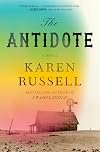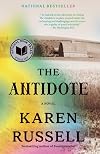
The Antidote
by Karen Russell
On This Page
Description
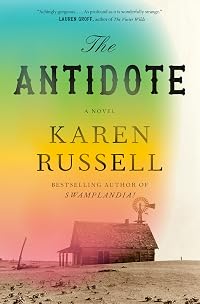
"The Antidote opens on Black Sunday, as a historic dust storm ravages the fictional town of Uz, Nebraska. But Uz is already collapsing--not just under the weight of the Great Depression and the dust bowl drought but beneath its own violent histories. The Antidote follows a "Prairie Witch," whose body serves as a bank vault for peoples' memories and secrets; a Polish wheat farmer who learns how quickly a hoarded blessing can become a curse; his orphan niece, a basketball star and witch's show more apprentice in furious flight from her grief; a voluble scarecrow; and a New Deal photographer whose time-traveling camera threatens to reveal both the town's secrets and its fate. Russell's novel is above all a reckoning with a nation's forgetting--enacting the settler amnesia and willful omissions passed down from generation to generation, and unearthing not only horrors but shimmering possibilities. The Antidote echoes with urgent warnings for our own climate emergency, challenging readers with a vision of what might have been--and what still could be."--. show lessTags
Recommendations







Member Reviews
I checked this book out from my local library multiple times. The gorgeous cover would lure me in but then it would get skipped over for something else -- something easier, something not set during the Dust Bowl. But when I saw a segment on PBS Newshour where both Ann Patchett and Maureen Corrigan highlighted this as a favorite of 2025, I decided I'd read it first in 2026 (I also may or may not have a goal to read Karen Russell's entire bibliography this year, I'm struggling to land on which author but she's at the top of my list).
This book is about the holes in our memory; it's about what we as a society remember (or write in textbooks) and what we choose to forget (or edit out). While prairie witches might not be real, everything else in this book felt VERY real. (Conversely, it's also about what we choose TO remember, those memories we hold on to with our entire beings.)
Memory is wibbly-wobbly and maybe even timey-wimey. Forgetting the painful is far easier than working through it. I was reminded (again) of this quote from Fourth Wing: “One generation to change the text. One generation chooses to teach that text. The next grows, and the lie becomes history.” It is so easy to alter a textbook and it's almost as easy to alter a single person's memory.
This book is filled with grief and sometime those memories aren't enough. The thirst for more time, the gaping holes left behind, the shared memories, all gone.
I was reminded of three nonfiction books about American history that I read last year, almost like I read them to appreciate this book more:
- The Rediscovery of America: Native Peoples and the Unmaking of U.S. History
- Wild Girls: How the Outdoors Shaped the Women Who Challenged a Nation
- Brave Hearted: The Women of the American West
Wild Girls includes a chapter on the 1904 Indigenous women's basketball time from Ft Shaw, while The Rediscovery of America reviews our nation's history through a different lens (one that isn't white-washed), and Brave Hearted shares the stories of Frontier women (Indigenous and not). show less
"Why should money make evil comprehensible to anyone? But it does precisely this. Greed, violence, cruelty —money can explain them. Money can make the most heinous act seem like a sane one. A businessshow more
decision, a necessary calculation. Evil's genius is to costume itself as sense. The "reasonable choice." “
This book is about the holes in our memory; it's about what we as a society remember (or write in textbooks) and what we choose to forget (or edit out). While prairie witches might not be real, everything else in this book felt VERY real. (Conversely, it's also about what we choose TO remember, those memories we hold on to with our entire beings.)
Memory is wibbly-wobbly and maybe even timey-wimey. Forgetting the painful is far easier than working through it. I was reminded (again) of this quote from Fourth Wing: “One generation to change the text. One generation chooses to teach that text. The next grows, and the lie becomes history.” It is so easy to alter a textbook and it's almost as easy to alter a single person's memory.
"I grew up in Omaha, and yet I knew next to nothing about the Omaha people. I did not know about the Pawnee, the Ponca, the Otoe and Missouria, the Lakota, the Dakota, the Iowa, or any of the many people who were living here long before my family became Americans.
I hadn't known—no one had ever told me-that I was a soldier in a war. We newcomers to the Great Plains were invited out here by the U.S. government to hold ground. The Homestead Act, the Dawes Act, all part of a battle plan. Over time, light-skinned children would grow old in this West with no memory of an earlier home, no awareness that they were the daughters and the sons of an invading army-second- and third- and fourth- and fifth-generation Americans. Putting Native lands into White hands. Putting forests and plains into production. Turning soil into cash."
This book is filled with grief and sometime those memories aren't enough. The thirst for more time, the gaping holes left behind, the shared memories, all gone.
"Remembering someone you’ve lost can feel like drinking mist.”
I was reminded of three nonfiction books about American history that I read last year, almost like I read them to appreciate this book more:
- The Rediscovery of America: Native Peoples and the Unmaking of U.S. History
- Wild Girls: How the Outdoors Shaped the Women Who Challenged a Nation
- Brave Hearted: The Women of the American West
Wild Girls includes a chapter on the 1904 Indigenous women's basketball time from Ft Shaw, while The Rediscovery of America reviews our nation's history through a different lens (one that isn't white-washed), and Brave Hearted shares the stories of Frontier women (Indigenous and not). show less
Set during the Dust Bowl, and set in a small farming community in Nebraska, Karen Russell's new book follows several characters, among them a Polish farmer, his orphaned niece, a photographer hired by the federal government, a scarecrow, and a prairie witch; a woman able to take memories from people. As conditions worsen and the farmers who did well through the previous decades are now destitute, people are leaving. After the Black Sunday storm, strange things start happening. The prairie witch has lost the memories she'd been holding and as people stream in to withdraw their memories on their way out of town, she's faced with either fleeing in the night or manufacturing memories. Harp Oletsky's fields are untouched by the giant storm show more and soon after that the wheat starts growing, the only successful crop anywhere. The FSA photographer buys a camera in a pawn shop and the pictures she develops bear little resemblance to the ones she took.
This is a well-researched novel about the Dust Bowl, with Russell's ability to bring a setting to life. At first the magical elements worked well to add a layer of unpredictability to what would otherwise be a straightforward historical novel. Russell writes about the desperation and hope that led people to move across an ocean and work to build a future in a strange place with real empathy, and about the native people displaced, lied to and mistreated to make room for these new settlers. But along with this comes the trap that too many writers of historic fiction fall into, and which ruins a work of historic fiction in my opinion -- that of making the "good" characters modern people with progressive views dressed up in old timey costumes, while the "bad" characters are the ones who hold beliefs and ways of thinking common of their time. The idea that if only these people living in the past held our beliefs and habits, everything would have been better is an easy trap and a perfidious one. And by falling into that trap, this book is far less than it could have been. Russell has let her need to deliver a message turn her fiction into a lecture. show less
This is a well-researched novel about the Dust Bowl, with Russell's ability to bring a setting to life. At first the magical elements worked well to add a layer of unpredictability to what would otherwise be a straightforward historical novel. Russell writes about the desperation and hope that led people to move across an ocean and work to build a future in a strange place with real empathy, and about the native people displaced, lied to and mistreated to make room for these new settlers. But along with this comes the trap that too many writers of historic fiction fall into, and which ruins a work of historic fiction in my opinion -- that of making the "good" characters modern people with progressive views dressed up in old timey costumes, while the "bad" characters are the ones who hold beliefs and ways of thinking common of their time. The idea that if only these people living in the past held our beliefs and habits, everything would have been better is an easy trap and a perfidious one. And by falling into that trap, this book is far less than it could have been. Russell has let her need to deliver a message turn her fiction into a lecture. show less
Beautiful writing! Russell's characters, including the scarecrow and the dust itself, are interwoven so realistically, at odds even as they depend on the ones they love. Creative and destructive actions hand in hand. Russell takes an unflinching look at the devastation suffered by the Pawnee and other Native tribes and the philosophy, the rationalization that the settlers tell themselves ring so familiarly in today's America, in the "For me but not thee" of the right-wing and the lengths to which people go to protect their secrets. A good addition to anti-racist reading lists.
Spanish philosopher George Santayana is credited with saying, "Those who cannot remember the past are condemned to repeat it." This belief may be the central theme of Karen Russell's The Antidote. Another related theme is purposefully forgetting or depositing one's memories in a vault so that life can proceed without dealing with or learning from historical events.
The Antidote is set in a fictional Nebraska town called Uz while FDR was president in 1935. The main story takes place roughly between two disasters that struck the people of this region: Black Sunday, one of the most catastrophic dusters during the Dust Bowl, and the Republican River Flood. Uz is an allusion to Oz, the magical land that does not quite deliver its promises. show more In The Antidote, a group of Polish immigrants received large tracts of land to farm and seek the American dream. Although they had been forced from their homeland because of oppression, few honored the Native Americans they had oppressed to obtain their land.
Karen Russell's novel includes multiple characters' viewpoints, one of which is Antonina Rossi, who, before Black Sunday, had been the vault to the townspeople, allowing them to deposit their memories and withdraw them if they wanted. She was known in Uz as the Prairie Witch and the Antidote. She lost her superpowers on Black Sunday and was soon to be exposed for the fraud she was. The Antidote addresses her narration to her son, who was taken from her at birth at a cruel, abusive home for unwed mothers. She is the quintessential, disparaged outsider "woman" who is a mother. Although the reader knows about her motherhood from the book's early chapters, she does not reveal it to the other storytellers until later in the novel. There are multiple nuanced messages for modern readers in the descriptors and actions of the Antidote.
Another storyteller whose viewpoint is essential to the overall story is Asphodel (Dell) Oletsky, named after a flower, and living with her Uncle Harp Oletsky in Uz after her mother was brutally murdered. Dell is a rising basketball star on a local team that becomes known as The Dangers after Black Sunday. Dell and her uncle, another storyteller, have differences in lifestyle and personality, but both have a love for the murdered mother, Harp's sister. Both also struggle with good and evil. When the Oletsky wheat farm is the only one spared after the infamous Black Sunday dusting, we realize how magical realism and supernatural intervention play a role in the development of the plot.
The government sent New Deal Black photographer Cleo Allfrey to document the Dust Bowl in Nebraska. Cleo's descriptions of the people and land differ from those of the primarily white townspeople, and her narration contributes to the themes of what is real and what is counterfeit. Cleo's Graflex camera has the magical ability to show past and present. With her unusual camera and her outsider status, she is instrumental in exposing the inaccuracies believed and perpetuated by local town leaders since the Polish settlers took the land from the Natives. Of course, her presence in this novel highlights the injustices of the United States government that continue today. Uz is but a microcosm of the country where the people ignore the value of the Natives, persecute non-Europeans, and continually repeat the mistakes of the past.
Other narrators include a scarecrow and a cat. They further the analogy to the fable of the Wizard of Oz and figure prominently as the story progresses. While The Wizard of Oz provided commentary on political, economic, and social events of America in the late 1800s, The Antidote is a modern parable that uses the atrocities of Manifest Destiny and the Dust Bowl as its basis but is clearly speaking about modern times. It is a cautionary tale about how Americans cannot choose to erase the ugly memories. Government officials throughout the history of the United States have used rhetoric and euphemisms to deny and rationalize the treatment of the disenfranchised. In 2025, when this novel is published, our country continues to face far-reaching consequences of questionable actions over the past years. show less
The Antidote is set in a fictional Nebraska town called Uz while FDR was president in 1935. The main story takes place roughly between two disasters that struck the people of this region: Black Sunday, one of the most catastrophic dusters during the Dust Bowl, and the Republican River Flood. Uz is an allusion to Oz, the magical land that does not quite deliver its promises. show more In The Antidote, a group of Polish immigrants received large tracts of land to farm and seek the American dream. Although they had been forced from their homeland because of oppression, few honored the Native Americans they had oppressed to obtain their land.
Karen Russell's novel includes multiple characters' viewpoints, one of which is Antonina Rossi, who, before Black Sunday, had been the vault to the townspeople, allowing them to deposit their memories and withdraw them if they wanted. She was known in Uz as the Prairie Witch and the Antidote. She lost her superpowers on Black Sunday and was soon to be exposed for the fraud she was. The Antidote addresses her narration to her son, who was taken from her at birth at a cruel, abusive home for unwed mothers. She is the quintessential, disparaged outsider "woman" who is a mother. Although the reader knows about her motherhood from the book's early chapters, she does not reveal it to the other storytellers until later in the novel. There are multiple nuanced messages for modern readers in the descriptors and actions of the Antidote.
Another storyteller whose viewpoint is essential to the overall story is Asphodel (Dell) Oletsky, named after a flower, and living with her Uncle Harp Oletsky in Uz after her mother was brutally murdered. Dell is a rising basketball star on a local team that becomes known as The Dangers after Black Sunday. Dell and her uncle, another storyteller, have differences in lifestyle and personality, but both have a love for the murdered mother, Harp's sister. Both also struggle with good and evil. When the Oletsky wheat farm is the only one spared after the infamous Black Sunday dusting, we realize how magical realism and supernatural intervention play a role in the development of the plot.
The government sent New Deal Black photographer Cleo Allfrey to document the Dust Bowl in Nebraska. Cleo's descriptions of the people and land differ from those of the primarily white townspeople, and her narration contributes to the themes of what is real and what is counterfeit. Cleo's Graflex camera has the magical ability to show past and present. With her unusual camera and her outsider status, she is instrumental in exposing the inaccuracies believed and perpetuated by local town leaders since the Polish settlers took the land from the Natives. Of course, her presence in this novel highlights the injustices of the United States government that continue today. Uz is but a microcosm of the country where the people ignore the value of the Natives, persecute non-Europeans, and continually repeat the mistakes of the past.
Other narrators include a scarecrow and a cat. They further the analogy to the fable of the Wizard of Oz and figure prominently as the story progresses. While The Wizard of Oz provided commentary on political, economic, and social events of America in the late 1800s, The Antidote is a modern parable that uses the atrocities of Manifest Destiny and the Dust Bowl as its basis but is clearly speaking about modern times. It is a cautionary tale about how Americans cannot choose to erase the ugly memories. Government officials throughout the history of the United States have used rhetoric and euphemisms to deny and rationalize the treatment of the disenfranchised. In 2025, when this novel is published, our country continues to face far-reaching consequences of questionable actions over the past years. show less
I listened to this in audiobook format.
This complex and richly layered novel is set during the Dust Bowl in Nebraska. Full of magical realism, the cast of narrators include: a “prairie witch” that hears, erases, and stores within herself secrets from townsfolk to help ease their minds of guilt, a 15 year old orphaned basketball star, a sentient scarecrow, an evil sheriff, a vengeful cat, and a photographer with a time traveling camera. Given this, it’s surprising how serious the story is, with themes of societal guilt, the importance of remembering both personal and historical occurrences, and the challenges of capturing truth through any medium. I think this book is meant to be discussed and explored, not just read. I liked it, show more but the ending felt preachy. It is not a subtle book. Good book club selection perhaps. show less
This complex and richly layered novel is set during the Dust Bowl in Nebraska. Full of magical realism, the cast of narrators include: a “prairie witch” that hears, erases, and stores within herself secrets from townsfolk to help ease their minds of guilt, a 15 year old orphaned basketball star, a sentient scarecrow, an evil sheriff, a vengeful cat, and a photographer with a time traveling camera. Given this, it’s surprising how serious the story is, with themes of societal guilt, the importance of remembering both personal and historical occurrences, and the challenges of capturing truth through any medium. I think this book is meant to be discussed and explored, not just read. I liked it, show more but the ending felt preachy. It is not a subtle book. Good book club selection perhaps. show less
Reminiscent of Barbara Kingsolver or Anthony Doerr, Karen Russell has penned a sweeping, historical novel that shines a light on the past and the future. In the deepest depths of Dust Bowl Nebraska, Asphodel “Dell” Oletsky arrives in the town of Uz to live with her bachelor uncle, Harp, after her mother’s violent death. Dell soon crosses paths with the town’s prairie witch, The Antidote, who holds the secrets of Uz — the good and the bad. Other inhabitants of Russell’s strange world are a corrupt sheriff, a sentient scarecrow, an angry cat, and a New Deal photographer with a magical camera who merge to tell their story that reflects the story of the country.
If you like:
Literary fiction, magical realism, unforgettable show more characters, historical fiction
If you don’t mind:
Dense (in a good way!) writing, magical realism, a bit of preaching
Russell’s gorgeous writing weaves an enchanting tale with memorable characters that every reader of literary fiction should get their hands on as soon as possible. show less
If you like:
Literary fiction, magical realism, unforgettable show more characters, historical fiction
If you don’t mind:
Dense (in a good way!) writing, magical realism, a bit of preaching
Russell’s gorgeous writing weaves an enchanting tale with memorable characters that every reader of literary fiction should get their hands on as soon as possible. show less
I believe we have a choice in all this. There should be a word that means both “blessed” and “cursed,” I have often thought. Maybe that word is “freedom.” Maybe that word is “us.” from The Antidote by Karen Russell
In 1930s Dust Bowl Kansas, four people learn dark secrets. With the story shifting between these characters and their past and present, dark secrets unfold.
There is the farmer dwelling on the legacy of his inheritance. his immigrant ancestor settling on Native American land. His orphaned niece, a teenage basketball star whose mother was murdered. The woman called the Prairie Witch who takes men’s deepest secrets into her vault. A photographer with a magical camera that shows what has been or will be.
The show more farmer has been spared by the black cloud of dust that had decimated Uz, his field still green under blue skies. His niece and her team survived the storm en route to the championship game. The Prairie Witch lost her power to retreat into the Vault, and the WPA photographer can’t take a photograph to satisfy her boss.
The town sheriff has provided a suspect for a series of murders, ensuring his reelection. One of the victims was the farmer’s sister and niece’s mother. He fears the Vault for the secrets he has given her to lock away. When the photographer develops photographs of the secrets, the women and the farmer decide to confront the town.
An original blend of historical fiction and magical realism, the novel questions if we can tolerate the truth of our past, accept our contribution to the problems we have created. For these characters it is the degradation of the land, the genocide of Native Americans, murders to cover up a crime. The story is a mirror, making us aware that we have our own legacy for which we must take responsibility.
“Are these photographs of what did happen? What will happen?” “I don’t know myself,” she said. […] But I’ll tell you this much: I suspect we have more choices than we know.” from The Antidote by Karen Russell
Thanks to the publisher for a free book through NetGalley. show less
In 1930s Dust Bowl Kansas, four people learn dark secrets. With the story shifting between these characters and their past and present, dark secrets unfold.
There is the farmer dwelling on the legacy of his inheritance. his immigrant ancestor settling on Native American land. His orphaned niece, a teenage basketball star whose mother was murdered. The woman called the Prairie Witch who takes men’s deepest secrets into her vault. A photographer with a magical camera that shows what has been or will be.
The show more farmer has been spared by the black cloud of dust that had decimated Uz, his field still green under blue skies. His niece and her team survived the storm en route to the championship game. The Prairie Witch lost her power to retreat into the Vault, and the WPA photographer can’t take a photograph to satisfy her boss.
The town sheriff has provided a suspect for a series of murders, ensuring his reelection. One of the victims was the farmer’s sister and niece’s mother. He fears the Vault for the secrets he has given her to lock away. When the photographer develops photographs of the secrets, the women and the farmer decide to confront the town.
An original blend of historical fiction and magical realism, the novel questions if we can tolerate the truth of our past, accept our contribution to the problems we have created. For these characters it is the degradation of the land, the genocide of Native Americans, murders to cover up a crime. The story is a mirror, making us aware that we have our own legacy for which we must take responsibility.
“Are these photographs of what did happen? What will happen?” “I don’t know myself,” she said. […] But I’ll tell you this much: I suspect we have more choices than we know.” from The Antidote by Karen Russell
Thanks to the publisher for a free book through NetGalley. show less
Members
- Recently Added By
Lists

Netgalley Reads
468 works; 3 members

Fiction: Historical
288 works; 3 members

Books Read in 2025
4,128 works; 98 members

2026 Tournament of Books Longlist
70 works; 2 members

Top Five Books of 2025
954 works; 303 members
Author Information

21+ Works 9,039 Members
Karen Russell was born in Miami, Florida in 1981. Karen is the author of Swamplandia!, which was long-listed for the Orange Prize and was also included in the New York Times' "10 Best Books of 2011." She was named a National Book Foundation "5 Under 35" young writer honoree and received the Bard Fiction Prize in 2011 for her first book of short show more stories, St. Lucy's Home for Girls Raised by Wolves. Russell received a B.A. from Northwestern University and MFA program from Columbia University. (Bowker Author Biography) show less
Awards and Honors
Awards
Distinctions
Common Knowledge
- Canonical title
- The Antidote
- Original title
- The Antidote
- Original publication date
- 2025
- Epigraph
- But I remember you before you became
a story. Sometimes, I feel a thorn in my foot
when there is no thorn. They tell me,
not unkindly, that I should imagine nothing here.
But I believe you are still alive.... (show all)
-Marie Howe, From "Gretel, from a sudden clearing" - First words
- It is nowhere you chose to be, and yet here you are. Papa steers your shoulders into the heart of the jack drive. Hundreds of rabbits stare at you through the wire around the fence posts. It feels like looking into the mirror... (show all). They do not want to be in this story either. -Prologue, Deposit 69818070-1-77 Harp Oletsky's First Memory
A person can lose everything in an instant. A fortune, a family, the sun. I've had to learn this lesson twice in my life. The first time it happened, I was a fifteen-year-old fugitive from the Home for Unwed Mothers. The seco... (show all)nd time, I was a prairie witch chained to my cot in a cinder-block jailhouse. "Your second home," the Sheriff liked to say. Officially, I do not exist in his West; nevertheless, it is a crime to pay me a visit. -Section 1, Collapse, The Prairie Witch - Original language
- English
- Canonical DDC/MDS
- 813.6000
- Canonical LCC
- PS3618.U755 A84
Classifications
Statistics
- Members
- 638
- Popularity
- 45,619
- Reviews
- 21
- Rating
- (3.87)
- Languages
- English, Spanish
- Media
- Paper, Audiobook, Ebook
- ISBNs
- 8
- ASINs
- 4