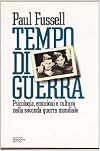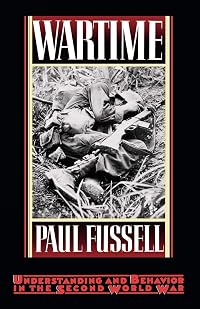
Wartime: Understanding and Behavior in the Second World War
by Paul Fussell
On This Page
Description
" ... in 'Wartime, ' Fussell turns to the Second World War, the conflict he himself fought in, to weave a narrative that is both more intensely personal and more wide-ranging ... Here Fussell examines the immediate impact of the war on common soldiers and civilians. He describes the psychological and emotional atmosphere of World War II. He analyzes the wishful thinking and the euphemisms people needed to deal with unacceptable reality (the early belief, for instance, that the war could be show more won by 'precision bombing, ' that is, by long distance); he describes the abnormally intense frustration of desire and some of the means by which desire was satisfied; and, most important, he emphasizes the damage the war did to intellect, discrimination, honesty, individuality, complexity, ambiguity and wit ... He examines ... how the great privations of wartime (when oranges would be raffled off as valued prizes) resulted in roccoco prose styles that dwelt longingly on lavish dinners, and how the 'high-mindedness' of the era and the almost pathological need to 'accentuate the positive' invited the downfall of the acerbic H.L. Mencken and the ascent of E.B. White. He also offers astute commentary on Edmund Wilson's argument with Archibald MacLeish, Cyril Connolly's 'Horizon' magazine, the war poetry of Randall Jarrell and Louis Simpson, and many other aspects of the wartime literary world ... For the past fifty years, the Allied war has been sanitized and romanticized almost beyond recognition by 'the sentimental, the loony patriotic, the ignorant, and the bloodthirsty.' Americans, he says, have never understood what the Second World War was really like ... [and] he offers such an understanding. show lessTags
Recommendations










Member Reviews
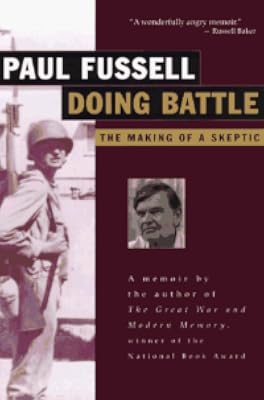
Paul Fussell's WARTIME (1989) worked well as an "in-between-books" reader for me this past week. I've admired Fussell's work since seeing him (along with his late friend, Sam Hynes) in Ken Burns' PBS special, THE WAR, some years back. I enjoyed his memoir, DOING BATTLE, immensely, and this collection of essays were nearly as good. They don't really have to be read in order either. I skipped around sampling the ones with the most intriguing titles, e.g. "Chickenshit: an Anatomy," and "Drinking Far Too Much, Copulating Too Little," or "Reading in Wartime" and others. None of these pieces disappoint. Because Fussell was there, a combat lieutenant in the European theater, who was seriously wounded, so he knows about the filth and fear, the show more mud and blood, as well as the boredom interspersed with utter terror. And after the war, like Hynes, he became a writer, professor and knowledgeable historian of his own and other wars. Many of these hard-edged and clear-eyed pieces could be prose companions to Owen's "Dulce et Decorum Est" or Remarque's ALL QUIET ON THE WESTERN FRONT, because Fussell draws many apt comparisons here, of his war to the Great War. Fussell aims to explode the myths and patriotic nonsense often glorifying war, and he succeeds to the nth degree. WARTIME deserves to stick around and be read for a long, long time. If more national leaders and politicians read books like this, and took them to heart, there would be fewer wars. Fussell is gone now, but his books will live on - I hope. Very highly recommended.
- Tim Bazzett, author of the memoir, BOOKLOVER show less
- Tim Bazzett, author of the memoir, BOOKLOVER show less
------------------------------------------------
This is my second attempt to write a responsible, but emotionally honest review of this powerful and important book.
Paul Fussell was an American Infantry Lieutenant, and a combat veteran of World War II.
This is the book that put Paul Fussel on the map for me. And, although The Great War and Modern Memory is Fussell's most acclaimed work, and is deservedly an excellent book; this book is a far greater work, in my own opinion.
He published this book in 1990 at the beginning of the (too frequently called) “Celebrations” of the 50 year anniversaries of that war in this country, more properly, called “Commemorations” or “Memorials” in other countries. My guess is that the timing of show more this publication was intentional. Paul Fussell was no fan of World War II, nor America's fatuous glamorization nor sanctification of that war. Paul Fussel, like his fellow writers and WWII combat veterans [author:Kurt Vonnegut|2778055] and [author:Howard Zinn|1899] was not at all impressed with the political piety that has come to represent that war in place of actual, accurate memory
Wartime is his extended analytic essay or collection of essays. These essays bluntly relate the on-the-ground experiences, the grotesque and demeaning experiences of those people (military and civilian) unfortunate enough to find themselves at the physical center of World War II's mass warfare. It is not a picture, which renders that experience as anything but brutal and meat-grinding. It is not a picture to inspire “Celebration”
The word "fatuous" is one that I learned from Paul Fussell. And there is no fatuous flag waving celebration of our "Greatest Generation" in this book..
Fatuous is his description of the arrogant mindless pride of those 95% American veterans who were behind the front lines and therefore ignorant of actual battle conditions. And fatuous are those flippant, self-satisfied Americans who experienced the war in their living rooms during or after the war. Fatuous were those "patriots" who did not see fellow combatants or civilians decapitated by flying body parts nor experience the horror of wading through pools of decaying human flesh saturated with tropical maggots.
Fussell pulls no punches as he deconstructs the experience of World War II as experienced by those who fought it or those who found themselves directly in its path.
This book should be required reading for any "fan" of World War II history.
Quote from the book:
"Chickenshit refers to behavior that makes military life worse than it need be: petty harassment of the weak by the strong; open scrimmage for power and authority and prestige; sadism thinly disguised as necessary discipline; a constant 'paying off of old scores'; and insistence on the letter rather than the spirit of ordinances....Chickenshit can be recognized instantly because it never has anything to do with winning the war." show less
This is my second attempt to write a responsible, but emotionally honest review of this powerful and important book.
Paul Fussell was an American Infantry Lieutenant, and a combat veteran of World War II.
This is the book that put Paul Fussel on the map for me. And, although The Great War and Modern Memory is Fussell's most acclaimed work, and is deservedly an excellent book; this book is a far greater work, in my own opinion.
He published this book in 1990 at the beginning of the (too frequently called) “Celebrations” of the 50 year anniversaries of that war in this country, more properly, called “Commemorations” or “Memorials” in other countries. My guess is that the timing of show more this publication was intentional. Paul Fussell was no fan of World War II, nor America's fatuous glamorization nor sanctification of that war. Paul Fussel, like his fellow writers and WWII combat veterans [author:Kurt Vonnegut|2778055] and [author:Howard Zinn|1899] was not at all impressed with the political piety that has come to represent that war in place of actual, accurate memory
Wartime is his extended analytic essay or collection of essays. These essays bluntly relate the on-the-ground experiences, the grotesque and demeaning experiences of those people (military and civilian) unfortunate enough to find themselves at the physical center of World War II's mass warfare. It is not a picture, which renders that experience as anything but brutal and meat-grinding. It is not a picture to inspire “Celebration”
The word "fatuous" is one that I learned from Paul Fussell. And there is no fatuous flag waving celebration of our "Greatest Generation" in this book..
Fatuous is his description of the arrogant mindless pride of those 95% American veterans who were behind the front lines and therefore ignorant of actual battle conditions. And fatuous are those flippant, self-satisfied Americans who experienced the war in their living rooms during or after the war. Fatuous were those "patriots" who did not see fellow combatants or civilians decapitated by flying body parts nor experience the horror of wading through pools of decaying human flesh saturated with tropical maggots.
Fussell pulls no punches as he deconstructs the experience of World War II as experienced by those who fought it or those who found themselves directly in its path.
This book should be required reading for any "fan" of World War II history.
Quote from the book:
"Chickenshit refers to behavior that makes military life worse than it need be: petty harassment of the weak by the strong; open scrimmage for power and authority and prestige; sadism thinly disguised as necessary discipline; a constant 'paying off of old scores'; and insistence on the letter rather than the spirit of ordinances....Chickenshit can be recognized instantly because it never has anything to do with winning the war." show less
Fussell's work is one of the best I have read on WWII. I've read some of Stephen Amborse's works and enjoyed them as well, but Fussell provides a much needed critical, even cynical - realistic -, antidote to Ambrose's telling of the story. Fussell definitely departs from the mainstream representation the war and that is immensely refreshing.
Fussell provides detailed insight into the daily lives of the average soldier, the mundane and the horrific. He tells of many errors (in fact in his view the whole war should be viewed as a series of errors) such as shooting down friendly planes and bombimg of friendly troops. Fussell discloses the tremendous amount of drinking that went on, the physical deprivations, and the cruelty of inept show more martinets that were officers. To me, the war was a just one, but that's no reason to remain ignorant of just how horrible the war was.
This book is not a telling of whole story of WWII and isn't meant to be, but it's an absolutely necessary complement to the standard histories. show less
Fussell provides detailed insight into the daily lives of the average soldier, the mundane and the horrific. He tells of many errors (in fact in his view the whole war should be viewed as a series of errors) such as shooting down friendly planes and bombimg of friendly troops. Fussell discloses the tremendous amount of drinking that went on, the physical deprivations, and the cruelty of inept show more martinets that were officers. To me, the war was a just one, but that's no reason to remain ignorant of just how horrible the war was.
This book is not a telling of whole story of WWII and isn't meant to be, but it's an absolutely necessary complement to the standard histories. show less
For North Americans, WWII took place off-stage. Only Services personnel and a small number of media people actually saw the killing part of it. For many it was related to their first job, and the first period of prosperity since 1929. Paul Fussell tries to share the home front for Americans. I think he succeeds. Also, one should read "Whistle" by James Jones.
Fussell examines the immediate impact of the war on common soldiers and civilians. He describes the psychological and emotional atmosphere of World War II. He analyzes the euphemisms people needed to deal with unacceptable reality (the early belief, for instance, that the war could be won by "precision bombing," that is, by long distance); he describes the abnormally intense frustration of desire and some of the means by which desire was satisfied; and, most important, he emphasizes the damage the war did to intellect, discrimination, honesty, individuality, complexity, ambiguity and wit. Of course, no Fussell book would be complete without some serious discussion of the literature of the time. He examines, for instance, how the great show more privations of wartime (when oranges would be raffled off as valued prizes) resulted in roccoco prose styles that dwelt longingly on lavish dinners, and how the "high-mindedness" of the era and the almost pathological need to "accentuate the positive" led to the downfall of the acerbic H.L. Mencken and the ascent of E.B. White. He also offers astute commentary on Edmund Wilson's argument with Archibald MacLeish, Cyril Connolly's Horizon magazine, the war poetry of Randall Jarrell and Louis Simpson, and many other aspects of the wartime literary world.
SEE Paul Fussell's The Great War and Modern Memory was one of the most original and gripping volumes ever written about the First World War. show less
SEE Paul Fussell's The Great War and Modern Memory was one of the most original and gripping volumes ever written about the First World War. show less
Fussell is half the literary critic here and half reporting what soldiering meant to the ordinary average soldier. He is particularly equipped for this task as both a scholar and a WW II soldier. The book has its value as both a literary work and a popular culture analysis.
distressing, but informative, view of the unknown and unsuspected effects of wartime, in particular, WW2 -- on sexuality, language, advertising, literature
Members
- Recently Added By
Lists

Books Cited in Wasteland by W. Scott Poole
120 works; 1 member
Author Information

24+ Works 7,340 Members
Paul Fussell Jr. was born in Pasadena, California on March 22, 1924. He was drafted into the Army in 1943 while attending Pomona College. During his tour of duty, he won the Bronze Star and two Purple Hearts. He returned to college in 1945. He received a bachelor of arts degree from Pomona College in 1947 and a master's degree and a doctorate in show more English from Harvard University. He taught English at Connecticut College for Women, Rutgers University, and the University of Pennsylvania. During this time he wrote several books on literary topics including The Rhetorical World of Augustan Humanism: Ethics and Imagery from Swift to Burke, Poetic Meter and Poetic Form, and Samuel Johnson and the Life of Writing. In 1975, he published The Great War and Modern Memory, which was a study of World War I and how its horrors fostered a disillusioned modernist sensibility. This book won both the National Book Critics Circle Award for Criticism and the National Book Award for Arts and Letters. His other works include Abroad: British Literary Traveling Between the Wars, Class: A Guide Through the American Status System, Wartime: Understanding and Behavior in the Second World War, BAD: Or, the Dumbing of America, and Doing Battle: The Making of a Skeptic. He died of natural causes on May 23, 2012 at the age of 88. (Bowker Author Biography) show less
Common Knowledge
- Canonical title*
- Wartime
- Alternate titles
- Wartime: Understanding and Behavior in the Second World War
- Original publication date
- 1989
- Important events
- World War II (1939 | 1945)
- Dedication
- To the memory of my mother and father, who sent socks and books
- First words
- Watching a newsreel or flipping through an illustrated magazine at the beginning of the American war, you were likely to encounter a memorable image: the newly invented jeep, an elegant, slim-barrelled 37-mm gun in tow, leapi... (show all)ng over a hillock.
- Last words
- (Click to show. Warning: May contain spoilers.)As Mailer says, you use the word "shit" so that you can use the word "noble," and you refuse to ignore the stupidity and barbarism and ignobility and poltroonery and filth of the real war so that "it is mine alone" can flash out, a bright signal in a dark time.
*Some information comes from Common Knowledge in other languages. Click "Edit" for more information.
Classifications
- Genres
- History, Nonfiction, General Nonfiction, Literature Studies and Criticism
- DDC/MDS
- 940.54 — History & geography History of Europe History of Europe 1918- Military history of World War II
- LCC
- D810 .P7 .U365 — History of Europe, Asia, Africa and Oceania History (General) World War II (1939-1945)
- BISAC
Statistics
- Members
- 785
- Popularity
- 35,745
- Reviews
- 9
- Rating
- (3.99)
- Languages
- 5 — English, Finnish, French, Italian, Spanish
- Media
- Paper, Ebook
- ISBNs
- 10
- ASINs
- 5