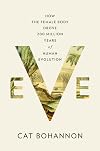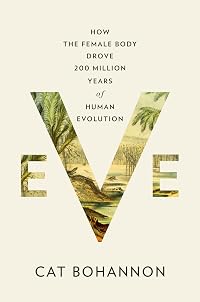
Eve: How the Female Body Drove 200 Million Years of Human Evolution
by Cat Bohannon
On This Page
Description
"In Eve, Cat Bohannon answers questions scientists should have been addressing for decades. With boundless curiosity and sharp wit, Bohannon covers the past 200 million years to explain the specific science behind the development of the female sex. Eve is not just a sweeping revision of human history, it's an urgent and necessary corrective for a world that has focused primarily on the male body for far too long. Bohannon's findings, including everything from the way C-sections in the show more industrialized world are rejiggering women's pelvic shape to the surprising similarities between pus and breast milk, will completely change what you think you know about evolution . . . and women. A 21st-century update of Our Bodies, Ourselves, Eve offers a paradigm shift in our thinking about what the female body is and why it matters"-- show lessTags
Recommendations


















Member Reviews
Eve, by Cat Bohannon, is an extremely engaging look at what we have missed, or misinterpreted, in our ideas about the evolution of homo sapiens.
This is not really an academic book though it is probably more packed with facts and figures than most popular science books. It is because of Bohannon's almost conversational tone that the reader follows along quite well, even in the sections where academic-ish detail is necessary. While I hesitate to call it academic it isn't because the information isn't very well researched and annotated but because it can be read and understood by most readers with an interest. I think her extensive use of analogy, often with a touch of humor, also makes the learning seem easier.
Looking at key moments in show more our evolution, then shifting perspective to specifically include the female body, we find that a lot of what we have thought to be true is, at best, only partially true. Looking at systems that are specific to the female body offers alternative explanations for everything from who first used tools to who, and why, we first began walking upright.
While I would highly recommend this to readers who like to keep up with new ideas in science, I think this will also be a great book for those who might be thinking about what they want to do, whether as a career or, within academia, for their next research project. There are multiple opportunities to jump into a more specific area to further our knowledge and this is a book that, while not pretending to be a "social justice" book in the sense of emphasizing it, the information here can and should be incorporated into what we are fighting for. If you want a social justice book that simplifies everything and tells you what to do, this ain't it. If you're capable of taking information and using it within your movement, this will be a valuable addition.
Reviewed from a copy made available by the publisher via NetGalley. show less
This is not really an academic book though it is probably more packed with facts and figures than most popular science books. It is because of Bohannon's almost conversational tone that the reader follows along quite well, even in the sections where academic-ish detail is necessary. While I hesitate to call it academic it isn't because the information isn't very well researched and annotated but because it can be read and understood by most readers with an interest. I think her extensive use of analogy, often with a touch of humor, also makes the learning seem easier.
Looking at key moments in show more our evolution, then shifting perspective to specifically include the female body, we find that a lot of what we have thought to be true is, at best, only partially true. Looking at systems that are specific to the female body offers alternative explanations for everything from who first used tools to who, and why, we first began walking upright.
While I would highly recommend this to readers who like to keep up with new ideas in science, I think this will also be a great book for those who might be thinking about what they want to do, whether as a career or, within academia, for their next research project. There are multiple opportunities to jump into a more specific area to further our knowledge and this is a book that, while not pretending to be a "social justice" book in the sense of emphasizing it, the information here can and should be incorporated into what we are fighting for. If you want a social justice book that simplifies everything and tells you what to do, this ain't it. If you're capable of taking information and using it within your movement, this will be a valuable addition.
Reviewed from a copy made available by the publisher via NetGalley. show less
In Eve Cat Bohannon takes us on the evolutionary journey that led to modern humans, viewed through the lens of the female body. It’s a fascinating and engaging tour. Eve is well researched and thoroughly scientific while written with the non-scientist in mind.
Bohannon herself was pursuing her PhD while writing this book. She is a researcher with a Master’s in Creative Nonfiction and a PhD in Narrative and Cognition. She is also an author. Her essays and poems have appeared in Scientific American, Mind, Science Magazine, and other periodicals. She has taught literary science writing at the Johns Hopkins Center for Talented Youth.
In the introduction to her book Bohannon talks about the absence of females from modern medical research show more (which omits women from most studies), from evolutionary theory and from modern popular cultural representation. What Eve does is places females smack dab in the middle of the story and introduces us to research supporting a more complete view of how our evolution might have happened.
The Eve of the title is actually several Eves - those first females of our evolutionary ancestors to have some aspect of our biology or some behavioral adaptation that has led to us modern humans. “Morgie” the Morganucodon - from the late Triassic period some 200 million years ago - is the first Eve that Bohannon discusses. Morgie was a small, mousey mammal and the Eve of mammalian milk. From there we move through various Eves right up to today’s “Sapiens” (Homo Sapiens) the Eve of language, menopause and modern human love and sexism.
I found Bohannan’s chapter on Tools one of the most fascinating. Perhaps the most well-known and often discussed movie intro is that of 2001: A Space Odessey, Stanley Kubrick’s adaptation of the Arthur C Clarke novel. In that opening sequence a group of our male forefathers, likely Homo Habilis, are depicted as the first toolmakers. That first tool is a bone which one of the males picks up. In his hands the bone becomes a weapon, and the weapon is used as an instrument of war. This is, obviously, a very male-centered depiction of the possible origin of tools, something Bohannon calls “Tool Triumphalism” - the male using his tools to hunt, to murder, and to dominate the Earth.
Bohannon takes that starting point and dives into biology and the study of some of our closest relatives among the primates to arrive at a different idea. Biology shows us that birthing humans, with our large baby heads, is uniquely difficult. Human babies are uniquely vulnerable and require care for far longer than other species. Yet Having babies grow to adulthood and be able to reproduce themselves is required for a species to survive.
Today there are 8 billion members of the Homo Sapiens species. How did we get here? Why are we so successful? Bohannon argues that the first human “tool”, and the basis for our success as a species is gynecology. Gynecology, which she defines as the many types of birth control, abortion and other fertility interventions, including midwifery, that allowed human reproduction to beat the odds our difficult childbearing. She finishes the chapter with a reimagined opening sequence for 2001 placing childbearing at the heart of the story.
RATING: Five Stars ⭐⭐⭐⭐⭐
Rating Comment: Cat Bohannon’s Eve will have you rethinking your understanding of what it means to have evolved to be human. The author takes you on an evolutionary journey that led to modern humans, viewed through the lens of the female body. It’s a brilliant book and the best book I’ve read so are this year. Highly recommended - Whether you were born with a female body or not.
NOTE: I read an advanced review copy courtesy of NetGalley and the publisher Alfred A. Knopf.
The book was released on October 3rd in North America in hardcover, ebook and audiobook. The paperback release is November 7th. The book will be available in the UK in hardcover, ebook and audiobook on December 10, 2023. The UK paperback releases May 5, 2024 show less
Bohannon herself was pursuing her PhD while writing this book. She is a researcher with a Master’s in Creative Nonfiction and a PhD in Narrative and Cognition. She is also an author. Her essays and poems have appeared in Scientific American, Mind, Science Magazine, and other periodicals. She has taught literary science writing at the Johns Hopkins Center for Talented Youth.
In the introduction to her book Bohannon talks about the absence of females from modern medical research show more (which omits women from most studies), from evolutionary theory and from modern popular cultural representation. What Eve does is places females smack dab in the middle of the story and introduces us to research supporting a more complete view of how our evolution might have happened.
The Eve of the title is actually several Eves - those first females of our evolutionary ancestors to have some aspect of our biology or some behavioral adaptation that has led to us modern humans. “Morgie” the Morganucodon - from the late Triassic period some 200 million years ago - is the first Eve that Bohannon discusses. Morgie was a small, mousey mammal and the Eve of mammalian milk. From there we move through various Eves right up to today’s “Sapiens” (Homo Sapiens) the Eve of language, menopause and modern human love and sexism.
I found Bohannan’s chapter on Tools one of the most fascinating. Perhaps the most well-known and often discussed movie intro is that of 2001: A Space Odessey, Stanley Kubrick’s adaptation of the Arthur C Clarke novel. In that opening sequence a group of our male forefathers, likely Homo Habilis, are depicted as the first toolmakers. That first tool is a bone which one of the males picks up. In his hands the bone becomes a weapon, and the weapon is used as an instrument of war. This is, obviously, a very male-centered depiction of the possible origin of tools, something Bohannon calls “Tool Triumphalism” - the male using his tools to hunt, to murder, and to dominate the Earth.
Bohannon takes that starting point and dives into biology and the study of some of our closest relatives among the primates to arrive at a different idea. Biology shows us that birthing humans, with our large baby heads, is uniquely difficult. Human babies are uniquely vulnerable and require care for far longer than other species. Yet Having babies grow to adulthood and be able to reproduce themselves is required for a species to survive.
Today there are 8 billion members of the Homo Sapiens species. How did we get here? Why are we so successful? Bohannon argues that the first human “tool”, and the basis for our success as a species is gynecology. Gynecology, which she defines as the many types of birth control, abortion and other fertility interventions, including midwifery, that allowed human reproduction to beat the odds our difficult childbearing. She finishes the chapter with a reimagined opening sequence for 2001 placing childbearing at the heart of the story.
RATING: Five Stars ⭐⭐⭐⭐⭐
Rating Comment: Cat Bohannon’s Eve will have you rethinking your understanding of what it means to have evolved to be human. The author takes you on an evolutionary journey that led to modern humans, viewed through the lens of the female body. It’s a brilliant book and the best book I’ve read so are this year. Highly recommended - Whether you were born with a female body or not.
NOTE: I read an advanced review copy courtesy of NetGalley and the publisher Alfred A. Knopf.
The book was released on October 3rd in North America in hardcover, ebook and audiobook. The paperback release is November 7th. The book will be available in the UK in hardcover, ebook and audiobook on December 10, 2023. The UK paperback releases May 5, 2024 show less
Eve by Cat Bohannon is a bold and fascinating deep dive into how the female body has shaped human evolution over hundreds of millions of years. The book moves far beyond the usual male-centered lens of evolutionary science, exploring how pregnancy, menopause, menstruation, and other uniquely female adaptations influenced the survival of our species. Bohannon writes with humor, intelligence, and a keen sense of justice for the overlooked female half of the human story, making complex biology and anthropology feel fresh and engaging.
What stands out is how Bohannon connects rigorous science with cultural insight, showing that understanding female biology is key to understanding humanity itself. At times the book can feel dense because of show more the sheer volume of detail, but the payoff is worth it. It challenges long-held assumptions about evolution and gives readers a richer, more complete picture of how we became who we are. Eve is both an education and a revelation, blending science and storytelling in a way that changes how you see the human body forever. show less
What stands out is how Bohannon connects rigorous science with cultural insight, showing that understanding female biology is key to understanding humanity itself. At times the book can feel dense because of show more the sheer volume of detail, but the payoff is worth it. It challenges long-held assumptions about evolution and gives readers a richer, more complete picture of how we became who we are. Eve is both an education and a revelation, blending science and storytelling in a way that changes how you see the human body forever. show less
Cat Bohannon’s Eve is ambitious, dense, and—at times—delightfully infuriating. It attempts to answer a massive question: how did the female body shape human evolution? It’s a book that dares to go where most medical research hasn’t bothered, largely because, as Bohannon points out, studying women’s bodies has often been deemed too “inconvenient.” That framing alone is enough to hook you.
Bohannon moves step-by-step through key evolutionary shifts tied to female biology—lactation, gestation, menstruation, menopause, brains, and bipedalism, among others. It’s a sprawling journey through deep time, but told in a voice that’s conversational, witty, and intentionally irreverent. She’s not afraid to throw elbows at show more long-held assumptions in medicine, science, or society.
Some chapters shine. The sections on milk production, gestation, and energy expenditure during pregnancy are fascinating and rooted in solid, well-contextualized research. They highlight just how central the female body is to the survival and success of our species—not just as baby-makers, but as evolutionary engines.
But not all arguments land. Some parts read less like science and more like cultural commentary trying to wear a lab coat. For instance, the idea that gynecology was our “first set of tools” feels more poetic than empirical. There’s a valid point buried in there about bodies shaping technology, but the evidence is thin.
Then there’s the provocative claim about human vaginas not evolving to prevent rape—a suggestion tied to the relatively low incidence of forced copulation in humans compared to other species. It’s a striking argument, and certainly memorable, but also raises a mess of ethical and evidentiary questions. Evolutionary claims about sexual violence need to be handled with precision, not just flair.
The chapter on the brain was the weakest. It felt rushed, muddled, and under-referenced—especially disappointing given the importance of the brain to the broader evolutionary story. Several times, I found myself mentally adding “citation needed” in the margins.
That said, the book is packed with ideas. It weaves together anthropology, evolutionary biology, social theory, and feminist critique in a way that’s both engaging and rare. But it doesn’t always make clear where the science ends and the speculation begins, which matters when you’re tackling a subject this loaded.
I appreciated the themed structure, though I often wished for clearer organization or a stronger through-line across chapters. The pacing can feel uneven, and the sheer volume of data—when it shows up—is a lot to absorb. It’s the kind of book you’ll need to read with your phone or a notebook nearby, just to fact-check or track side tangents.
Final thoughts:
Eve is bold, messy, and full of ambition. It raises essential questions about why women’s bodies have been left out of the scientific narrative for so long—and how that absence has warped our understanding of humanity itself. It’s not perfect. Some arguments are overstated, some data is unclear, and not every claim survives scrutiny. But it’s an important, necessary, and often thrilling contribution to the conversation. Just read it with your skeptical hat firmly on show less
Bohannon moves step-by-step through key evolutionary shifts tied to female biology—lactation, gestation, menstruation, menopause, brains, and bipedalism, among others. It’s a sprawling journey through deep time, but told in a voice that’s conversational, witty, and intentionally irreverent. She’s not afraid to throw elbows at show more long-held assumptions in medicine, science, or society.
Some chapters shine. The sections on milk production, gestation, and energy expenditure during pregnancy are fascinating and rooted in solid, well-contextualized research. They highlight just how central the female body is to the survival and success of our species—not just as baby-makers, but as evolutionary engines.
But not all arguments land. Some parts read less like science and more like cultural commentary trying to wear a lab coat. For instance, the idea that gynecology was our “first set of tools” feels more poetic than empirical. There’s a valid point buried in there about bodies shaping technology, but the evidence is thin.
Then there’s the provocative claim about human vaginas not evolving to prevent rape—a suggestion tied to the relatively low incidence of forced copulation in humans compared to other species. It’s a striking argument, and certainly memorable, but also raises a mess of ethical and evidentiary questions. Evolutionary claims about sexual violence need to be handled with precision, not just flair.
The chapter on the brain was the weakest. It felt rushed, muddled, and under-referenced—especially disappointing given the importance of the brain to the broader evolutionary story. Several times, I found myself mentally adding “citation needed” in the margins.
That said, the book is packed with ideas. It weaves together anthropology, evolutionary biology, social theory, and feminist critique in a way that’s both engaging and rare. But it doesn’t always make clear where the science ends and the speculation begins, which matters when you’re tackling a subject this loaded.
I appreciated the themed structure, though I often wished for clearer organization or a stronger through-line across chapters. The pacing can feel uneven, and the sheer volume of data—when it shows up—is a lot to absorb. It’s the kind of book you’ll need to read with your phone or a notebook nearby, just to fact-check or track side tangents.
Final thoughts:
Eve is bold, messy, and full of ambition. It raises essential questions about why women’s bodies have been left out of the scientific narrative for so long—and how that absence has warped our understanding of humanity itself. It’s not perfect. Some arguments are overstated, some data is unclear, and not every claim survives scrutiny. But it’s an important, necessary, and often thrilling contribution to the conversation. Just read it with your skeptical hat firmly on show less
this is fascinating. from beginning to end. bohannon is writing about the evolutionary biology behind sex differences, and the early females (the eves) who evolved us to what we are today, and why, and how. it's great research, well written, and so, so interesting. i was engrossed at every moment.
"I know some people still struggle with this idea, but most of the scientific community agrees that biological sex is fundamentally separate from human gender identity. The belief that the sex-typical features of a person's body inevitably assign them a gender identity and behavior to match is sometimes called biologism, or more broadly, gender essentialism. The thing about gender essentialism is that it is a natural extension of sexism. show more Societies that form deep cultural beliefs about what one or another gender should be also tend to believe that a person is one of two genders from birth, depending on how their body looks. Those societies then strongly reinforce those beliefs through various rules for each gender, ranging from the sort of fine, irritating cognitive grit of social exclusion, to incredibly violent punishment of rule breakers, and everything in between."
"The fact of the matter is that until very recently, the study of the biologically female body has lagged far behind the study of the male body. It's not simply that physicians and scientists don't bother to seek out sex specific data, it's that until all too recently, the data didn't exist. From 1996 to 2006, more than 79 percent of the animal studies published in the scientific journal Pain included only male subjects. Before the 1990s the stats were more disproportionate."
"Every power men have ever had over women is something we gave them. We just forgot. We forgot we can stop." show less
"I know some people still struggle with this idea, but most of the scientific community agrees that biological sex is fundamentally separate from human gender identity. The belief that the sex-typical features of a person's body inevitably assign them a gender identity and behavior to match is sometimes called biologism, or more broadly, gender essentialism. The thing about gender essentialism is that it is a natural extension of sexism. show more Societies that form deep cultural beliefs about what one or another gender should be also tend to believe that a person is one of two genders from birth, depending on how their body looks. Those societies then strongly reinforce those beliefs through various rules for each gender, ranging from the sort of fine, irritating cognitive grit of social exclusion, to incredibly violent punishment of rule breakers, and everything in between."
"The fact of the matter is that until very recently, the study of the biologically female body has lagged far behind the study of the male body. It's not simply that physicians and scientists don't bother to seek out sex specific data, it's that until all too recently, the data didn't exist. From 1996 to 2006, more than 79 percent of the animal studies published in the scientific journal Pain included only male subjects. Before the 1990s the stats were more disproportionate."
"Every power men have ever had over women is something we gave them. We just forgot. We forgot we can stop." show less
This is a hard book to review, and part of the reason is that I'm still not sure what exactly it was. Was it a book about evolutionary biology focused on women? An anthropological study of female/male relations? A look at modern cultural norms and how they influence our lives? Pop science? Serious science? Comedy?
Did I almost throw it aside in contempt several times? Yes. Was it also true that by reading a few more lines I was hooked back in each time? Yes. So I'm confused.
Here's what I know. Bohannon organized her book into nine sections that are loosely organized by one evolutionary step that our bodies, minds, or culture took and focuses in each on how the womens' bodily or societal needs were really the driver for that show more evolutionary step. The first section looks at developing milk glands and the ability to breastfeed. The second is about the development of our womb and growing our babies inside instead of laying eggs. The third is about our senses - much of this seems to have evolved to raise our very needy young. The fourth is about strength vs. endurance. The fifth about our use of tools. The sixth about our intelligence. The seventh about the timbre of our voice. The eighth about why in the world it would make sense from an evolutionary standpoint for women to experience menopause and lose the ability to produce offspring for such a large portion of their lives. And the last about love - monogamy, rape, sexual constraints placed on women.
I bet just reading that brief description sounds a bit overwhelming. I don't usually do a ton of highlighting in my kindle books, but in this one I highlighted 88 passages! There is a ton of interesting information in this book and I think it will end up providing a lot of background context that I use in many other places. It's one of those books that I'd love to see read and reviewed by some other LTers. I'm just not sure it achieved a cohesive tone or synthesized all the fascinating information very well. But in the end, I think I'm glad I spent the time on reading it. show less
Did I almost throw it aside in contempt several times? Yes. Was it also true that by reading a few more lines I was hooked back in each time? Yes. So I'm confused.
Here's what I know. Bohannon organized her book into nine sections that are loosely organized by one evolutionary step that our bodies, minds, or culture took and focuses in each on how the womens' bodily or societal needs were really the driver for that show more evolutionary step. The first section looks at developing milk glands and the ability to breastfeed. The second is about the development of our womb and growing our babies inside instead of laying eggs. The third is about our senses - much of this seems to have evolved to raise our very needy young. The fourth is about strength vs. endurance. The fifth about our use of tools. The sixth about our intelligence. The seventh about the timbre of our voice. The eighth about why in the world it would make sense from an evolutionary standpoint for women to experience menopause and lose the ability to produce offspring for such a large portion of their lives. And the last about love - monogamy, rape, sexual constraints placed on women.
I bet just reading that brief description sounds a bit overwhelming. I don't usually do a ton of highlighting in my kindle books, but in this one I highlighted 88 passages! There is a ton of interesting information in this book and I think it will end up providing a lot of background context that I use in many other places. It's one of those books that I'd love to see read and reviewed by some other LTers. I'm just not sure it achieved a cohesive tone or synthesized all the fascinating information very well. But in the end, I think I'm glad I spent the time on reading it. show less
Male : Female
Sapiens : Eve
Brilliant to have put forward so much info into such a succinct volume. It's a must-read page-turner that felt like a freshly squeezed orange dripping with juicy insights on every page. The fact that 437 pages of the book have 434 references says a lot about the background of this book; combining history, biology and to some extent the spiritual essence that binds humanity together - glad to have completed reading it in the days of Navratri, a festival celebrating the female Goddess!
Sapiens : Eve
Brilliant to have put forward so much info into such a succinct volume. It's a must-read page-turner that felt like a freshly squeezed orange dripping with juicy insights on every page. The fact that 437 pages of the book have 434 references says a lot about the background of this book; combining history, biology and to some extent the spiritual essence that binds humanity together - glad to have completed reading it in the days of Navratri, a festival celebrating the female Goddess!
Members
- Recently Added By
Lists

Club Read's Recommended Nonfiction Written by Women
618 works; 30 members

Books Read in 2024
4,623 works; 126 members

GraceCollection TBR/To Buy List
106 works; 1 member

Top Five Books of 2024
795 works; 264 members

LQW Research Reading List
75 works; 1 member

Read in 2025
16 works; 1 member
Author Information

3+ Works 846 Members
Some Editions
Awards and Honors
Awards
Distinctions
The Guardian Book of the Day (2023-10-10)
Common Knowledge
- Original publication date
- 2023-10-12
- Important events
- human evolution
- Dedication
- For my children, Leela and Pravin -- nothing has changed my understanding of time like the small, beautiful breaths you take, every day.
- First words
- Elizabeth Shaw has a problem.
- Last words
- (Click to show. Warning: May contain spoilers.)We forgot we can stop.
- Blurbers
- Shubin, Neil; Jahren, Hope; Mann, Charles C.; Garmus, Bonnie
- Original language
- English
Classifications
- Genres
- Science & Nature, Sexuality and Gender Studies, Anthropology, Nonfiction, General Nonfiction, History
- DDC/MDS
- 613.0424 — Applied science & technology Medicine & health Personal health and Fitness Personal health of people by gender, sex, or age group Personal health of specific sex groups Females
- LCC
- QP81.5 .B64 — Science Physiology Physiology General
- BISAC
Statistics
- Members
- 846
- Popularity
- 32,304
- Reviews
- 27
- Rating
- (4.09)
- Languages
- 8 — Dutch, English, French, German, Italian, Portuguese, Spanish, Swedish
- Media
- Paper, Audiobook, Ebook
- ISBNs
- 26
- ASINs
- 6