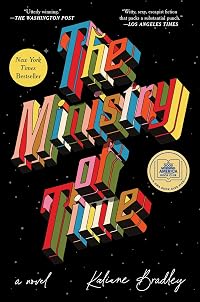
The Ministry of Time
by Kaliane Bradley
On This Page
Description
In the near future, a civil servant is offered the salary of her dreams and is, shortly afterward, told what project she'll be working on. A recently established government ministry is gathering "expats" from across history to establish whether time travel is feasible--for the body, but also for the fabric of space-time. She is tasked with working as a "bridge": living with, assisting, and monitoring the expat known as "1847" or Commander Graham Gore. As far as history is concerned, show more Commander Gore died on Sir John Franklin's doomed 1845 expedition to the Arctic, so he's a little disoriented to be living with an unmarried woman who regularly shows her calves, surrounded by outlandish concepts such as "washing machines," "Spotify," and "the collapse of the British Empire." But with an appetite for discovery, a seven-a-day cigarette habit, and the support of a charming and chaotic cast of fellow expats, he soon adjusts. Over the next year, what the bridge initially thought would be, at best, a horrifically uncomfortable roommate dynamic, evolves into something much deeper. By the time the true shape of the Ministry's project comes to light, the bridge has fallen haphazardly, fervently in love, with consequences she never could have imagined. Forced to confront the choices that brought them together, the bridge must finally reckon with how--and whether she believes--what she does next can change the future. An exquisitely original and feverishly fun fusion of genres and ideas, The Ministry of Time asks: What does it mean to defy history, when history is living in your house? Kaliane Bradley's answer is a blazing, unforgettable testament to what we owe each other in a changing world. -- show lessTags
Recommendations




























Member Recommendations

vwinsloe Time travel as a force to correct history.
nessreader Scooping historical humans into near future vis time machine, future shock, culture clash
Member Reviews
The Ministry of Time - Bradley
5 stars
This book is difficult, difficult to describe and difficult to understand. I’ll give it my best shot. The Ministry of Time is a reverse time travel, suspense spy thriller, split timeline historical love story. With biting social commentary. Does that cover it ? Yes, I think so. Also, it’s a good book. I liked it.
So. It’s ‘reverse time travel’ because characters, designated ‘expats’, come from the past to a future not far from our own present day, present day London. Each expat would have certainly died in their own time. They are removed to the future experimentally. They are guinea pigs brought forward to be studied for their possible usefulness to the Ministry. The actual function show more of the Ministry is unclear; that’s the spy thriller factor. Each expat is assigned a ‘bridge’ or agent to assist with their assimilation. The book is narrated mostly in the first person voice of the unnamed, female bridge to Commander Graham Gore. Commander Gore is removed, near death, from the doomed 1845 Franklin Arctic Expedition. The history of Gore’s arctic experience is inserted into the story with chapters headed by roman numerals.
Other expats include a delightful lesbian named Margaret, removed from the black death of 1665, and the heart breaking homosexual Arthur, removed from the battle of the Somme. The Victorian-straight Commander Gore is paired and housed with his sexually liberated, female bridge/agent. Human sexuality is definitely a topic of assimilation. It’s also the set-up for the love story.
The ridiculous nature of the forced relationships and the intelligent banter of the characters had me laughing in the early pages of the book. The humor grabbed me, but except for the wonderful Margaret, threats and conflict take over the story. The unnamed female narrator is a first generation Cambodian/English woman who struggles with the inherited trauma of her mother’s escape from genocide. The social commentary of the book becomes more serious as the suspense increases. So many issues and so much drama is packed into less than 300 pages. The ending comes on like a bucket of ice water. It didn’t feel like a cliffhanger, but it left me wanting more. show less
5 stars
This book is difficult, difficult to describe and difficult to understand. I’ll give it my best shot. The Ministry of Time is a reverse time travel, suspense spy thriller, split timeline historical love story. With biting social commentary. Does that cover it ? Yes, I think so. Also, it’s a good book. I liked it.
So. It’s ‘reverse time travel’ because characters, designated ‘expats’, come from the past to a future not far from our own present day, present day London. Each expat would have certainly died in their own time. They are removed to the future experimentally. They are guinea pigs brought forward to be studied for their possible usefulness to the Ministry. The actual function show more of the Ministry is unclear; that’s the spy thriller factor. Each expat is assigned a ‘bridge’ or agent to assist with their assimilation. The book is narrated mostly in the first person voice of the unnamed, female bridge to Commander Graham Gore. Commander Gore is removed, near death, from the doomed 1845 Franklin Arctic Expedition. The history of Gore’s arctic experience is inserted into the story with chapters headed by roman numerals.
Other expats include a delightful lesbian named Margaret, removed from the black death of 1665, and the heart breaking homosexual Arthur, removed from the battle of the Somme. The Victorian-straight Commander Gore is paired and housed with his sexually liberated, female bridge/agent. Human sexuality is definitely a topic of assimilation. It’s also the set-up for the love story.
The ridiculous nature of the forced relationships and the intelligent banter of the characters had me laughing in the early pages of the book. The humor grabbed me, but except for the wonderful Margaret, threats and conflict take over the story. The unnamed female narrator is a first generation Cambodian/English woman who struggles with the inherited trauma of her mother’s escape from genocide. The social commentary of the book becomes more serious as the suspense increases. So many issues and so much drama is packed into less than 300 pages. The ending comes on like a bucket of ice water. It didn’t feel like a cliffhanger, but it left me wanting more. show less
I've never really had much faith in the output of the contemporary publishing industry, which has always seemed to prioritise formulaic, repackaged pulp, workshopped, self-congratulatory guff and the racial, gender, sexual or celebrity identity of authors over unfashionable things like quality of writing, depth of thought, self-respect and the awareness of objective standards. But every so often in my reading I will tear myself away from the higher-calibre writing and mores of previous generations to try something of the current year that seems compelling or has been lauded. Whenever I do so, it's always with vain but genuine hope that I will find something of real worth. But even though the industry encourages and cultivates a show more battery-farm of middling, formulaic, identity-driven Creative Writing and YA dreck that people depressingly and unthinkingly process as 'consumers' rather than as 'readers', it still staggers me when I think of how many writers manage to whack their heads against a bar set so low.
Kaliane Bradley is the latest to sport a bump on her forehead; when she writes of the enthusiastic tweeting "about debut authors of colour who never seemed to publish second novels once the publicity cycle ended" (pg. 181), she is writing (hopefully with some self-awareness) about the climate in which she was able to bring about her own recent offering: the disappointing The Ministry of Time. The fatal flaw in the book is that it tries to be three completely different things at once: a meet-cute romance, a speculative sci-fi story and a mysterious thriller. It fails at all three, and that's before you also add in the book's half-hearted attempt to work through the protagonist's angst over her mixed Anglo-Cambodian heritage.
'Half-hearted' is the key word here, or perhaps 'unfocused'; The Ministry of Time doesn't satisfy from any of the angles it attempts. The speculative sci-fi angle is the most disappointing, and the laziest. Author Kaliane Bradley makes no attempt to construct an internal storytelling logic, telling the reader as early as page five: "don't worry about it. All you need to know is that in your near future, the British government developed the means to travel through time…" She sticks to this brazen lack of storytelling care throughout the book; the time-travel device is merely described as "some kind of machine" that creates a glowing blue door (pg. 198). That Bradley has enough self-awareness to describe the blue door as "a low-production cliché" (pg. 323), just as she began that early page-five caveat by admitting the logic of time-travel is "a crock of shit", in no way makes it acceptable that the author isn't bothering to adequately put together the ingredients of a story. Readers, even readers who lap up this low-grade stuff, deserve better.
This time-travel plot unravels later in the novel when Bradley clumsily tries to liven things up by turning The Ministry of Time into a thriller. Apparently, there are time-travellers from the future who are "trying to change history" (pg. 308) by disrupting the Ministry. Their motives are never expanded upon. What's worse is that the characters we have been spending time with – the unnamed protagonist, Graham Gore, and their friends – are rather underwhelmingly written too, so when the stakes are raised artificially high in the book's final third, we feel no jeopardy and little interest.
But it is the romance angle which most embarrassingly fails to spark, as it was the book's raison d'être. Bradley has said she got the idea for the book after coming across a photo of Graham Gore, an officer who died in the Arctic on the ill-fated Franklin expedition of 1845. The author thought he was attractive, and so wrote this story: one in which a protagonist (who is a blatant and undisguised author-insert) finds Gore has been brought into her own time and he falls in love with her. It reads like fan-fiction, and apparently started off as that. You look at the commissioning of such rubbish from our publishing industry and it makes you want to throw up your hands.
One inconvenient problem is that this plot scenario has already been done better elsewhere (it's literally the same plot as the Richard Matheson novel Bid Time Return, made into a good film called Somewhere in Time, starring Christopher Reeve). Another is that, in Bradley's incapable hands, it is uncomfortable to see the abuse to Gore's character. Matheson in his novel was inspired by an old photo of a beautiful woman but only based his story's object of devotion on her, creating a new character; Bradley, instead, takes the real-life Gore and has him dance like a puppet. What's the problem, you might think, surely that's the bread-and-butter of historical fiction? I agree, to an extent, but I was troubled when Bradley, on zero evidence and seemingly to satisfy her own fantasies and worldview, has her Gore 'admit' to being bisexual and making love to men on sea voyages (pg. 245). When Bradley describes, at length, Gore giving oral sex to her author-avatar protagonist (pp240-1), it began to seem a bit, well, unethical.
You may feel such a charge is harsh. Certainly, I think the minor palaver that has bubbled up online over whether Bradley plagiarised a 2014 Spanish TV show with the same title as her book (and a similar concept) to be a storm in a teacup; both plot and title are generic enough that they could have (and probably were) reached independently. But Gore was no historical figure, at least not in the way that Churchill or Napoleon were. He was a seaman, a regular man whose name is only remembered because he died, along with all of his companions, on an infamous Arctic expedition. Imagine, for a moment, if a couple of hundred years from now someone found a photo of you – for you, like Gore, would be an ordinary person – and created a story in which you fellated them and told them how much you liked it. It would seem wrong; you would not be affected, of course, being dead, but it would still seem wrong for a person, a writer, to take you like that. For Bradley to take the real-life Gore (who died tragically, let us remember, probably of starvation) and describe how he "worked well" smothered between the wet thighs of her author-insert protagonist (pg. 241) seems to be the only depth this otherwise-superficial book will plumb.
But enough on that; the book itself is poor, and that is where it can be more reliably judged, not on my perhaps hair-trigger sense of ethics. Characterisation is often superficial and the writing veers between sketchy and mealy-mouthed, betraying its fan-fic origins. The plot, little more than a sketch as it is, obliterates itself by pulling into vastly different directions – sci-fi, thriller and romance – and lacking the wit to satisfy any one of them. Bradley had good potential in the concept of a straight-laced Victorian man thrown into the undisciplined, Millennial vapidity of the current year, but fails to mine either the fish-out-of-water situation-comedy of this (despite a few half-hearted attempts), or the more sobering pathos of it. To the bafflement of his sloppy Millennial 'handler', Gore exercises, attends church on Sundays and knows their neighbours' names. One almost-rewarding passage of the book demonstrates the potential here, and also how the author threw it away:
"Gore was bored, that much was clear. Despite the amenities and pleasures of the twenty-first century, he was bored. He had been handed a plush-lined life, with time to read, to pursue thoughts to their phantasmagoric end, to take in whole seasons at the British Film Institute, to walk for miles, to master sonatas and paint to his heart's content. He did not need to work, to exchange the sweat of his brow or the creak of his mind for board and bed. And yet, he was bored of having no purpose. He was getting bored of everything. I was afraid that he was getting bored of me." (pg. 61)
Up until that final sentence, that passage demonstrates what The Ministry of Time could have been; the Victorian man who is brought into a supposedly more enlightened time only to find that people are miserable, depressed, lazy, and lacking purpose in a world where every luxury is easy and at our fingertips. In short, it could have been a useful mirror to shine on our own society, an opportunity to reflect on whether the lives we live in this modern world have the integrity and dignity for which our souls crave. Instead, in that final line of the passage, Bradley drags The Ministry of Time back down to what it is: the indulgence of its author/protagonist's neuroses, and the shallow depiction of her sexual and romantic fantasy. It's squandering like this which is why I so often turn my back on the hardbacks that the hype machine assures me are new masterpieces of culture. I feel myself like a man out of my time. show less
Kaliane Bradley is the latest to sport a bump on her forehead; when she writes of the enthusiastic tweeting "about debut authors of colour who never seemed to publish second novels once the publicity cycle ended" (pg. 181), she is writing (hopefully with some self-awareness) about the climate in which she was able to bring about her own recent offering: the disappointing The Ministry of Time. The fatal flaw in the book is that it tries to be three completely different things at once: a meet-cute romance, a speculative sci-fi story and a mysterious thriller. It fails at all three, and that's before you also add in the book's half-hearted attempt to work through the protagonist's angst over her mixed Anglo-Cambodian heritage.
'Half-hearted' is the key word here, or perhaps 'unfocused'; The Ministry of Time doesn't satisfy from any of the angles it attempts. The speculative sci-fi angle is the most disappointing, and the laziest. Author Kaliane Bradley makes no attempt to construct an internal storytelling logic, telling the reader as early as page five: "don't worry about it. All you need to know is that in your near future, the British government developed the means to travel through time…" She sticks to this brazen lack of storytelling care throughout the book; the time-travel device is merely described as "some kind of machine" that creates a glowing blue door (pg. 198). That Bradley has enough self-awareness to describe the blue door as "a low-production cliché" (pg. 323), just as she began that early page-five caveat by admitting the logic of time-travel is "a crock of shit", in no way makes it acceptable that the author isn't bothering to adequately put together the ingredients of a story. Readers, even readers who lap up this low-grade stuff, deserve better.
This time-travel plot unravels later in the novel when Bradley clumsily tries to liven things up by turning The Ministry of Time into a thriller. Apparently, there are time-travellers from the future who are "trying to change history" (pg. 308) by disrupting the Ministry. Their motives are never expanded upon. What's worse is that the characters we have been spending time with – the unnamed protagonist, Graham Gore, and their friends – are rather underwhelmingly written too, so when the stakes are raised artificially high in the book's final third, we feel no jeopardy and little interest.
But it is the romance angle which most embarrassingly fails to spark, as it was the book's raison d'être. Bradley has said she got the idea for the book after coming across a photo of Graham Gore, an officer who died in the Arctic on the ill-fated Franklin expedition of 1845. The author thought he was attractive, and so wrote this story: one in which a protagonist (who is a blatant and undisguised author-insert) finds Gore has been brought into her own time and he falls in love with her. It reads like fan-fiction, and apparently started off as that. You look at the commissioning of such rubbish from our publishing industry and it makes you want to throw up your hands.
One inconvenient problem is that this plot scenario has already been done better elsewhere (it's literally the same plot as the Richard Matheson novel Bid Time Return, made into a good film called Somewhere in Time, starring Christopher Reeve). Another is that, in Bradley's incapable hands, it is uncomfortable to see the abuse to Gore's character. Matheson in his novel was inspired by an old photo of a beautiful woman but only based his story's object of devotion on her, creating a new character; Bradley, instead, takes the real-life Gore and has him dance like a puppet. What's the problem, you might think, surely that's the bread-and-butter of historical fiction? I agree, to an extent, but I was troubled when Bradley, on zero evidence and seemingly to satisfy her own fantasies and worldview, has her Gore 'admit' to being bisexual and making love to men on sea voyages (pg. 245). When Bradley describes, at length, Gore giving oral sex to her author-avatar protagonist (pp240-1), it began to seem a bit, well, unethical.
You may feel such a charge is harsh. Certainly, I think the minor palaver that has bubbled up online over whether Bradley plagiarised a 2014 Spanish TV show with the same title as her book (and a similar concept) to be a storm in a teacup; both plot and title are generic enough that they could have (and probably were) reached independently. But Gore was no historical figure, at least not in the way that Churchill or Napoleon were. He was a seaman, a regular man whose name is only remembered because he died, along with all of his companions, on an infamous Arctic expedition. Imagine, for a moment, if a couple of hundred years from now someone found a photo of you – for you, like Gore, would be an ordinary person – and created a story in which you fellated them and told them how much you liked it. It would seem wrong; you would not be affected, of course, being dead, but it would still seem wrong for a person, a writer, to take you like that. For Bradley to take the real-life Gore (who died tragically, let us remember, probably of starvation) and describe how he "worked well" smothered between the wet thighs of her author-insert protagonist (pg. 241) seems to be the only depth this otherwise-superficial book will plumb.
But enough on that; the book itself is poor, and that is where it can be more reliably judged, not on my perhaps hair-trigger sense of ethics. Characterisation is often superficial and the writing veers between sketchy and mealy-mouthed, betraying its fan-fic origins. The plot, little more than a sketch as it is, obliterates itself by pulling into vastly different directions – sci-fi, thriller and romance – and lacking the wit to satisfy any one of them. Bradley had good potential in the concept of a straight-laced Victorian man thrown into the undisciplined, Millennial vapidity of the current year, but fails to mine either the fish-out-of-water situation-comedy of this (despite a few half-hearted attempts), or the more sobering pathos of it. To the bafflement of his sloppy Millennial 'handler', Gore exercises, attends church on Sundays and knows their neighbours' names. One almost-rewarding passage of the book demonstrates the potential here, and also how the author threw it away:
"Gore was bored, that much was clear. Despite the amenities and pleasures of the twenty-first century, he was bored. He had been handed a plush-lined life, with time to read, to pursue thoughts to their phantasmagoric end, to take in whole seasons at the British Film Institute, to walk for miles, to master sonatas and paint to his heart's content. He did not need to work, to exchange the sweat of his brow or the creak of his mind for board and bed. And yet, he was bored of having no purpose. He was getting bored of everything. I was afraid that he was getting bored of me." (pg. 61)
Up until that final sentence, that passage demonstrates what The Ministry of Time could have been; the Victorian man who is brought into a supposedly more enlightened time only to find that people are miserable, depressed, lazy, and lacking purpose in a world where every luxury is easy and at our fingertips. In short, it could have been a useful mirror to shine on our own society, an opportunity to reflect on whether the lives we live in this modern world have the integrity and dignity for which our souls crave. Instead, in that final line of the passage, Bradley drags The Ministry of Time back down to what it is: the indulgence of its author/protagonist's neuroses, and the shallow depiction of her sexual and romantic fantasy. It's squandering like this which is why I so often turn my back on the hardbacks that the hype machine assures me are new masterpieces of culture. I feel myself like a man out of my time. show less
This book should appeal to a broad range of readers, even though I don’t believe that everyone is necessarily the target audience. (White men who enjoy hard science fiction from the 1940s and 50s may be annoyed.) The Ministry of Time starts out as a romcom, soft sci-fi novel that morphs into a spy thriller. Kaliane Bradley is a skilled writer who might have pulled off an entire novel in any of these genres, but seemingly could not help but be true to herself as the daughter of an immigrant refugee in London. Her personal struggle and her authenticity shone through all the various tropes that she employed. And for me, that was clearly the underlying theme: that the act of assimilation in the dominant culture is a form of show more self-protection and denial that will inevitably result in crossing ethical boundaries. I am reminded of Kurt Vonnegut’s admonition in his WWII novel, Mother Night, to be careful what you pretend to be, because that’s what you are. show less
Sometime in the near-future, a British Cambodian civil servant gets a job to work as a "bridge" for Graham Gore, an Arctic explorer who has been brought from near-death in 1847 to the narrative present. The narrator joins other bridges and travelers from other time periods and tries to acclimate them to the present time. There are some really sweet moments and fun days while our main character falls in love with dashing, chain-smoking Gore. But there are also hints that not everything is just right at the Ministry of Time, and it's only so long that our main character can bury her head in the sand.
I really enjoyed this genre-blending tale written by an author who, like our narrator, is of British and Cambodian descent. She uses the show more narrative to explore race and ethnicity and belonging. The narrator can - and often does - blend in, where people think she's white and she's acclimated to British culture. The time travel itself becomes a way to explore this idea of a melting pot and acceptable behavior or opinions to have in a given time or place. And much like our narrator turns a blind eye to warning signs about the purpose of the work they are doing in the ministry, she also doesn't want to examine her own family's past too closely. It's a really interesting take, and I look forward to seeing what Bradley writes next. show less
I really enjoyed this genre-blending tale written by an author who, like our narrator, is of British and Cambodian descent. She uses the show more narrative to explore race and ethnicity and belonging. The narrator can - and often does - blend in, where people think she's white and she's acclimated to British culture. The time travel itself becomes a way to explore this idea of a melting pot and acceptable behavior or opinions to have in a given time or place. And much like our narrator turns a blind eye to warning signs about the purpose of the work they are doing in the ministry, she also doesn't want to examine her own family's past too closely. It's a really interesting take, and I look forward to seeing what Bradley writes next. show less
The Ministry of Time is a soft sci-fi romance between a 10-minutes-from-now modern woman and a 19th century naval officer. It is also the story of a planet in climate crisis, and it is about empire and generational trauma, and it is about breaking free of the story laid out for you. I found many parts of it compelling: the romance in particular worked for me, and I also thought a lot of the dialogue and character beats were quite funny. The book is structured with interludes after each chapter into the historical events the male main character, Commander Gore of the HMS Erebus, experienced as a part of Franklin’s lost expedition. I have more than zero knowledge of that particular incident as a fan of the TV show The Terror (much like show more the author herself), and so these interludes were of questionable utility for me. Once I read the author’s note and understood she included them partly out of deference to people who are not already familiar they made a little more sense.
Towards the end of the novel, as we careen towards a conclusion, I started to lose the plot a little – I understand everything that happened, I just am not sure I felt satisfied by the final act. I’m picky about endings though, especially for stories I enjoy, so I think that may be a personal thing. Overall this is an exciting debut from someone I share more than a few interests with, so I’m curious to see more from her in the future. show less
Towards the end of the novel, as we careen towards a conclusion, I started to lose the plot a little – I understand everything that happened, I just am not sure I felt satisfied by the final act. I’m picky about endings though, especially for stories I enjoy, so I think that may be a personal thing. Overall this is an exciting debut from someone I share more than a few interests with, so I’m curious to see more from her in the future. show less
I try to approach Hugo finalists with as few expectations as possible. If I don't know anything about a book going in, I try to keep that the case, so that the book can surprise me (for good or for ill) purely on its own terms. This was mostly true with The Ministry of Time, but I didn't quite manage it. One, I knew that some people on r/printSF didn't like it for being frivolous or lightweight, and, two, the book's own paratext gives that impression, with blurbs that say things like "An outrageously fun comedy" and "A delightfully audacious screwball comedy." Not that I don't like fun books or comedy books, I love them in fact... but I typically very much have not loved books that Hugo nominators think are fun comedies (e.g., Space show more Opera, Legends & Lattes, anything by John Scalzi), unless they're by T. Kingfisher.
Well, the blurbs are all wrong because it's not a comedy, screwball or otherwise. Bizarrely wrong. Sure, there are some good jokes—indeed, there's one thoroughly excellent one that had be guffawing—but a book can have lots of jokes and still not be a comedy, and I certainly wouldn't read this if you were looking for one. In fact, if it owes anything to any genre outside of science fiction itself, it's clearly spy fiction; the title is a tip of the hat to Graham Greene. (I haven't actually got to The Ministry of Fear yet, but I have read a lot of his other stuff, and I've never read one I haven't liked.)
I don't want to say too much about the book here because I myself think I benefited from not knowing much about it, but the basic premise is that in the near future, the UK government has the technology to pull people out of the past, and they're testing it by pulling out people who are known to have died but their bodies weren't found, thus ensuring no timeline changes; the narrator is the "bridge" assigned to help polar explorer Graham Gore acclimate to the present day. (Gore is a real person, who died trying to find the Northwest Passage; so too did everyone else on his expedition.) The narrator used to work as a translator for the UK government, dealing with refugees, and is half-Cambodian herself.
It's a time-travel story, of course, but it's also a story about translation, about resettlement, told through an sfnal lens, about how we translate ourselves, about how we assimilate to other societies. It's about the past and how its attitudes are always with us—even into the future. I found it astutely observed, lots of great character-focused scenes that were beautifully told. At the time that I read it, I had three more finalist for Best Novel to read, but it was very clear to me this would be the one to beat. This is science fiction doing what only that genre can do, but doing it in a way that isn't generic at all. It's not a book everyone would love, I think, but it's a book would love—it's not a big part of the book, but I loved how it interrogated our ideas about what it actually means to be "Victorian."
Two quibbles, one the author's fault, one not. No one in 1847 would ever use the phrase "career scientist" (p. 139). The term "scientist" was not yet widespread, and you certainly couldn't have a career as one, in fact you were much more likely to have the opposite! My second is that the note on p. 346 talks about the included illustrations, sketched by the actual Graham Gore... but my 2025 Sceptre paperback has no illustrations! I assume they were in the original hardcover edition. If you're gonna take them out, then make sure you also take out the note discussing them, guys. show less
Well, the blurbs are all wrong because it's not a comedy, screwball or otherwise. Bizarrely wrong. Sure, there are some good jokes—indeed, there's one thoroughly excellent one that had be guffawing—but a book can have lots of jokes and still not be a comedy, and I certainly wouldn't read this if you were looking for one. In fact, if it owes anything to any genre outside of science fiction itself, it's clearly spy fiction; the title is a tip of the hat to Graham Greene. (I haven't actually got to The Ministry of Fear yet, but I have read a lot of his other stuff, and I've never read one I haven't liked.)
I don't want to say too much about the book here because I myself think I benefited from not knowing much about it, but the basic premise is that in the near future, the UK government has the technology to pull people out of the past, and they're testing it by pulling out people who are known to have died but their bodies weren't found, thus ensuring no timeline changes; the narrator is the "bridge" assigned to help polar explorer Graham Gore acclimate to the present day. (Gore is a real person, who died trying to find the Northwest Passage; so too did everyone else on his expedition.) The narrator used to work as a translator for the UK government, dealing with refugees, and is half-Cambodian herself.
It's a time-travel story, of course, but it's also a story about translation, about resettlement, told through an sfnal lens, about how we translate ourselves, about how we assimilate to other societies. It's about the past and how its attitudes are always with us—even into the future. I found it astutely observed, lots of great character-focused scenes that were beautifully told. At the time that I read it, I had three more finalist for Best Novel to read, but it was very clear to me this would be the one to beat. This is science fiction doing what only that genre can do, but doing it in a way that isn't generic at all. It's not a book everyone would love, I think, but it's a book would love—it's not a big part of the book, but I loved how it interrogated our ideas about what it actually means to be "Victorian."
Two quibbles, one the author's fault, one not. No one in 1847 would ever use the phrase "career scientist" (p. 139). The term "scientist" was not yet widespread, and you certainly couldn't have a career as one, in fact you were much more likely to have the opposite! My second is that the note on p. 346 talks about the included illustrations, sketched by the actual Graham Gore... but my 2025 Sceptre paperback has no illustrations! I assume they were in the original hardcover edition. If you're gonna take them out, then make sure you also take out the note discussing them, guys. show less
I think I just inhaled this book...it was so good I could only put it down when my eyes wouldn't stay open.
Lots of action and dialogue, but enough thought-provoking ideas to challenge me. I can imagine the fun the author would have had in creating dialogue for the various eras of the time travelers.
I enjoyed the brief interludes where we share Graham Gore's memories about his Antarctic exploration with Franklin's Expedition in 1845. His character is based on a real explorer and adds another dimension to this novel.
One of the concepts for which I may need to reread this book in order to think more in depth is the idea of how we classify people (racially & culturally) by our language, by the kinds of questions we feel free to ask someone show more we perceive as different from us. The narrator has a Cambodian mother & white father, tries to pass as white and is very protective of sharing her personal history. We hear about her sister who reacts differently to her upbringing & publishes stories about the family. Should they consider themselves 'survivors' or 'refugees'? How about simply parents doing the best they can to raise a family? The Ministry calls the people they have snatched from a death in the past "ex-pats", but acknowledges that at first they may think of themselves as kidnapped. The narrator has an argument with the only other person of color on the Team about whether or not certain actions by those in charge are racist, and ends up making an enemy of her.
As far as language goes, I think it is unusual that the 'ex-pats' often call themselves by the decade they came from, and only sometimes by their names. Is this a way of trying to accept that they are out of their time? Or is it an indication by the author that some characters won't be as vital? I'm not sure...
All I can really tell you about the outcome is that there are secrets behind secrets. show less
Lots of action and dialogue, but enough thought-provoking ideas to challenge me. I can imagine the fun the author would have had in creating dialogue for the various eras of the time travelers.
I enjoyed the brief interludes where we share Graham Gore's memories about his Antarctic exploration with Franklin's Expedition in 1845. His character is based on a real explorer and adds another dimension to this novel.
One of the concepts for which I may need to reread this book in order to think more in depth is the idea of how we classify people (racially & culturally) by our language, by the kinds of questions we feel free to ask someone show more we perceive as different from us. The narrator has a Cambodian mother & white father, tries to pass as white and is very protective of sharing her personal history. We hear about her sister who reacts differently to her upbringing & publishes stories about the family. Should they consider themselves 'survivors' or 'refugees'? How about simply parents doing the best they can to raise a family? The Ministry calls the people they have snatched from a death in the past "ex-pats", but acknowledges that at first they may think of themselves as kidnapped. The narrator has an argument with the only other person of color on the Team about whether or not certain actions by those in charge are racist, and ends up making an enemy of her.
As far as language goes, I think it is unusual that the 'ex-pats' often call themselves by the decade they came from, and only sometimes by their names. Is this a way of trying to accept that they are out of their time? Or is it an indication by the author that some characters won't be as vital? I'm not sure...
All I can really tell you about the outcome is that there are secrets behind secrets. show less
Members
- Recently Added By
Lists

Best Time Travel Novels
165 works; 123 members

ALA Reading List: Science Fiction 2021-2026
30 works; 3 members

LGBTQ+ Speculative Fiction
821 works; 51 members

Indie Next Picks
196 works; 4 members

FAB 2025
14 works; 1 member

Favorite Science Fiction
456 works; 218 members

Book Riot Read Harder 2026
80 works; 1 member

Top Five Books of 2025
954 works; 303 members

Overdue Podcast
806 works; 9 members

READ 2025
190 works; 1 member

2025 Women's Prize for Fiction Longlist
16 works; 6 members

Books recommended by Barack Obama
295 works; 28 members

Books Read 2025
70 works; 2 members

Books Read in 2025
4,091 works; 97 members
Top Five Books of 2024
795 works; 264 members

Books Read in 2024
4,623 works; 126 members

2025 Hugo Awards -- Eligible Works -- Novels
33 works; 2 members

Barack Obama's Summer Reading List 2024
14 works; 2 members

The Five Books That Represent Us
391 works; 148 members
Author Information

2+ Works 3,666 Members
Some Editions
Awards and Honors
Common Knowledge
- Canonical title
- The Ministry of Time
- Original publication date
- 2024-05-07
- People/Characters
- Graham Gore; Adela; Maggie; Arthur; Cardingham; Simellia (show all 8); Quentin; The Brigadier
- Important places
- London, England, UK; King William Island, Nunavut, Canada
- Dedication
- For my parents
- First words
- Perhaps he'll die this time.
- Last words
- (Click to show. Warning: May contain spoilers.)They are time-travel.
- Blurbers
- Porter, Max; Catton, Eleanor; Quinn, Joanna; Winn, Alice; Haddon, Mark; Spufford, Francis (show all 7); Chan, Vanessa
- Original language
- English
Classifications
Statistics
- Members
- 3,629
- Popularity
- 4,481
- Reviews
- 153
- Rating
- (3.68)
- Languages
- 12 — Dutch, English, Finnish, German, Hungarian, Italian, Polish, Portuguese, Croatian, Spanish, Swedish, Ukrainian
- Media
- Paper, Audiobook, Ebook
- ISBNs
- 32
- ASINs
- 9