On This Page
Description
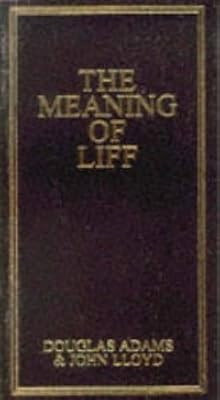
In Life* there are many hundreds of common experiences, feelings, situations and even objects which we all know and recognize, but for which no words exist.On the other hand, the world is littered with thousands of spare words which spend their time doing nothing but loafing about on signposts pointing at places."Douglas Adams and John Lloyd saw it as their job to get these words down off the signposts and into the mouths of babes and sucklings and so on, where they could start earning their show more keep in everyday conversation and make a more positive contribution to society. The Meaning of Liff was the bestselling humour book that resulted. It sold hundreds of thousands of copies and remains to this day, nearly thirty years later, a much-loved classic of its kind.*And, indeed, Liff show lessTags
Recommendations





Member Reviews
A book of neologisms pretending to stand for various human experiences, feelings, and activities for which there are no "real" words - in Adam unique style of brashness. Self-described 'radical atheist' Douglas Adams spent an inordinate amount of literary effort trying to find God. His satire is of the insightful but smugly aloof British variety; the scope of his vision is unusually broad.
I've read this book for years (while sitting on the john, mostly). Recently my friends expressed disgust at this practice and now refuse to pick up the volume when visiting. This, of course, is their loss, because this book is the next best dictionary after the OED. Impress your friends (or alienate them, depending) by displaying vocabulary for the simplest moments in daily life that never had a one-word expression before. Probably also a fun game to play while drinking (that's how the book was written, after all).
I've read this book for years (while sitting on the john, mostly). Recently my friends expressed disgust at this practice and now refuse to pick up the volume when visiting. This, of course, is their loss, because this book is the next best dictionary after the OED. Impress your friends (or alienate them, depending) by displaying vocabulary for the simplest moments in daily life that never had a one-word expression before. Probably also a fun game to play while drinking (that's how the book was written, after all).
A genius idea, which I imagine was enormous fun to create. Clearly, a dictionary is not the easiest read, but wonderful, and in parts hilarious, to dip into over a few weeks.
Douglas Adams remains dearly missed after his far-too-soon death way back at the start of this millennium. "The meaning of Liff" is one of Adams's lesser known works but is a page-turning laugh inducer.
The authors turned up a list of British town and village names and gave the words new definitions; for some reason Sidcup's definition has stayed with me and who can forget East and West Wittering's entries? As you thumb your way through the book, others will pop out and amuse you no end. It's just a shame that Adams didn't get a chance to cover Australian names; what he could do with places like Indooroopilly, Woy Woy, Woollongabba, Yarralumla et al, I can't even imagine.
The authors turned up a list of British town and village names and gave the words new definitions; for some reason Sidcup's definition has stayed with me and who can forget East and West Wittering's entries? As you thumb your way through the book, others will pop out and amuse you no end. It's just a shame that Adams didn't get a chance to cover Australian names; what he could do with places like Indooroopilly, Woy Woy, Woollongabba, Yarralumla et al, I can't even imagine.
Douglas Adams is amazing as expected. It can get a little tiresome to read this book straight through, but I think it's fantastic for random flipping. I was very impressed with how well Adams and Lloyd seemed to know the random scenarios/things which could use definitions.
Only on page 11 and find that I can safely and assuredly rate 'The Meaning of Liff' 5 out of 5. Pure humour, pure quintessential Britishness and pure, unadulterated Douglas Adams.
Members
- Recently Added By
Published Reviews
Lists place-names alphabetically, attributing to each a definition which is humorous and somehow appropriate— for example:
Kalami (n.) The ancient Eastern art of being able to
fold road-maps properly
Oshkosh (n., vb.) The noise made by someone who has just been grossly flattered and is trying to make light of it.
The final 34 pages are a (single-column) 'Index of
meanings', taking topics from the show more contents of the definitions and referring, not to the page on which they occur, but to the place-name itself—thus:
gusto, terrific, tuneless: Royston
hat behind, leaving one's: Hidcote Bartram
lawnmowers, frustrated: Trispen
madmen, departed, in toasters: Throckmorton
Topics are enhanced in the index: 'Ice, octogenarians
under the: Wivenhoe' refers to the definition, 'The cry of alacrity with which a sprightly eighty-year-old breaks the ice on the lake when going for a swim on Christmas Eve'; and 'Number, wrong, so she claims: Kurdistan' to, 'hard stare given by a husband to his wife when he notices a sharp increase in the number of times he answers the phone to be told, "Sorry, wrong number'". There are cross-references in the text; a Wembley is 'the hideous moment of confirmation that the disaster presaged in the
ely (q.v.) has actually struck'. Subheadings are used
indeed; 26 under 'objects' ('heavy, with toes on: Clun') and 31 under 'noises' ('gushing and cooing: Oshkosh').
Reference direct to place-names lends a new fascination to the index. Rarely can simple page references be perplexing in conjunction with the index entry; but why should 'fish, tropical, stupid' lead to Stoke Pogesi Why, 'pyjamas, muslim' to Albuquerque1. We glimpse a new criterion for assessment of indexes; they should make the reader eager to turn to the text cited. Can readers send us other examples of indexes that achieve this? show less
Kalami (n.) The ancient Eastern art of being able to
fold road-maps properly
Oshkosh (n., vb.) The noise made by someone who has just been grossly flattered and is trying to make light of it.
The final 34 pages are a (single-column) 'Index of
meanings', taking topics from the show more contents of the definitions and referring, not to the page on which they occur, but to the place-name itself—thus:
gusto, terrific, tuneless: Royston
hat behind, leaving one's: Hidcote Bartram
lawnmowers, frustrated: Trispen
madmen, departed, in toasters: Throckmorton
Topics are enhanced in the index: 'Ice, octogenarians
under the: Wivenhoe' refers to the definition, 'The cry of alacrity with which a sprightly eighty-year-old breaks the ice on the lake when going for a swim on Christmas Eve'; and 'Number, wrong, so she claims: Kurdistan' to, 'hard stare given by a husband to his wife when he notices a sharp increase in the number of times he answers the phone to be told, "Sorry, wrong number'". There are cross-references in the text; a Wembley is 'the hideous moment of confirmation that the disaster presaged in the
ely (q.v.) has actually struck'. Subheadings are used
indeed; 26 under 'objects' ('heavy, with toes on: Clun') and 31 under 'noises' ('gushing and cooing: Oshkosh').
Reference direct to place-names lends a new fascination to the index. Rarely can simple page references be perplexing in conjunction with the index entry; but why should 'fish, tropical, stupid' lead to Stoke Pogesi Why, 'pyjamas, muslim' to Albuquerque1. We glimpse a new criterion for assessment of indexes; they should make the reader eager to turn to the text cited. Can readers send us other examples of indexes that achieve this? show less
added by KayCliff
Author Information

91+ Works 190,662 Members
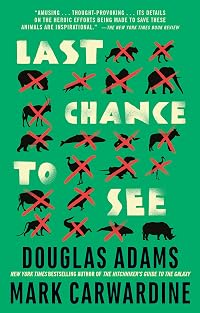
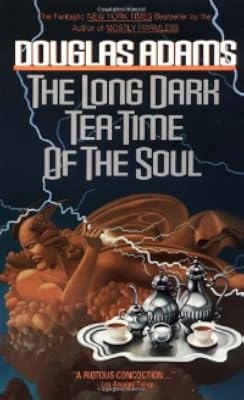
Douglas Noel Adams (sometimes referred to Bop Ad because of his distinctive signature) was born in Cambridge, England, on March 11, 1952 and educated at St. John's College at Cambridge University. He graduated with honors in English Literature in 1974. In addition to being a writer/editor for radio, television, and stage, Adams has worked as a show more hospital reporter, barn builder, and radio producer. The Hitchhiker's Guide to the Galaxy, 1979, one of his bestselling humor and science fiction novels, was originally a radio series. It was the first in a four-book series that includes The Restaurant at the End of the Universe; Life, the Universe, and Everything, and So Long, and Thanks for All the Fish. He once stated that the idea for his first novel came while he was "lying drunk in a field in Innsbruck and gazing at the stars." He pokes fun at humanity by mixing science fiction with humor. Adams's additional books include The Meaning of Liff; The Deeper Meaning of Liff; Dirk Gently's Holistic Detective Agency; The Long Dark Tea-time of the Soul; and Mostly Harmless. He has also co-authored the book Last Chance to See, about endangered species. Douglas Adams died May 11, 2001 of a heart attack in Santa Barbara, California at the age of 49. (Bowker Author Biography) show less

55+ Works 10,666 Members
John Lloyd produced Not the Nine O'Clock New, the Blackadders, and Spitting Image. (Publisher Provided)
Some Editions
Series

Work Relationships
Is contained in
Is expanded in
Inspired
Common Knowledge
- Canonical title
- The Meaning of Liff
- Original title
- The meaning of Liff
- Original publication date
- 1983-11-11
- Important places
- Sidcup; West Wittering
- First words
- Aasleagh (n.) - A liqueur made only for drinking at the end of a revoltingly long bottle party when all the drinkable drink has been drunk.
Classifications
Statistics
- Members
- 1,578
- Popularity
- 14,521
- Reviews
- 20
- Rating
- (3.78)
- Languages
- Czech, English, Finnish, Swedish
- Media
- Paper, Ebook
- ISBNs
- 9
- ASINs
- 9