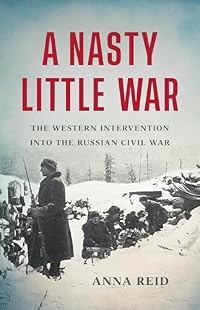
A Nasty Little War: The Western Intervention into the Russian Civil War
by Anna Reid
On This Page
Description
Overlapping with and overshadowed by the First World War, the Allied Intervention in the Russian Civil War was one of the most ambitious military ventures of the twentieth century. Launched in the summer of 1918, it drew in 180,000 troops from sixteen different countries in theaters ranging from the Caspian Sea to the Arctic and from Poland to the Pacific. Though little remembered today, it stoked global political conflict worldwide for decades to come. In A Nasty Little War, historian Anna show more Reid offers a sweeping and deeply researched account of the conflict. Initially launched to prevent Germany from exploiting the power vacuum left by the Russian Revolution, the Intervention morphed into a bid to destroy Bolshevism on the battlefield. But Allied arms and money could not prevent Russia's anti-Bolshevik armies from collapsing, and the Interventionists retreated in defeat. The humiliation checked Britain's imperial swagger, sapped American idealism, and destabilized France and Germany. Combining immersive storytelling and sharp analysis, A Nasty Little War reveals how the Allied Intervention reshaped the West's relationship with Russia. show lessTags
Recommendations












Member Reviews
If you are looking for a history of the Russian Civil War, this is not it. Nor does it say very much about the politics and diplomacy of intervention within the Western Powers. It certainly tells us virtually nothing about what Russians, whether Red or White, thought they were doing.
No, this is just a fair-minded and well-written account of what the Western Powers (then including, as now, Japan) did on the ground on Russian territory between 1918 and 1920, largely drawn from the testimonies of British and American military participants of all ranks and some civilians.
The bias is only that of the evidence which tells a military tale on four broad fronts - the almost accidental involvement of the British out of Murmansk and Archangel, show more with Kolchak in the East, with Denikin in the South and in the Baltic.
The Baltic 'show' was a success insofar as the (temporary) independence of the three Baltic Republics was secured, thanks to some very innovative special operations derring-do by British officers who were at their adventurous best.
The High Tory/NATO Baltic Russophobic love fest can perhaps be dated to this intervention, much as can the countervailing affair of the Baltic nationalists with the German Far Right whose walk-on part here is perhaps a little under-reported.
The other three interventions were fairly disastrous though they had their moments. The entire interventionary movement had begun with a misunderstanding over the utterly reasonable intention of the Czech Legion to get home and mount their own nationalist revolution.
As usual, Western desk warriors assumed that these very capable (indeed, rather admirable) soldiers would willingly become pawns in the Allied game of crushing the Reds, forgetting that the Czechs had no intrinsic interest in doing so. It was downhill from that point on.
The recognised White Government was settled in Omsk under Admiral Kolchak. The logic was for the Americans and Japanese to support it from Vladivostok. The Americans concentrated on keeping their role restricted to ensuring supply and good order for aid, including humanitarian support.
The Japanese were on a practice run for their later imperial pretensions. They backed a particularly nasty White Russian warlord - the dissolute Semyonov who is assessed to have murdered 30,000 people in one year.
Then there was the mad Baron Von Ungern-Sternberg, an unhinged Baltic German ultra-monarchist, who appears to have wanted to create a Mongolian-Buddhist proto-empire but the less said about this figure out of nightmares the better.
Other than a bit of adventuring around Baku (oil, dontcha know!), the British were primarily involved on the Ukraine and Archangel fronts which were easily as nasty as the Kolchak Front. In both cases, there were some initial advances until the Reds began to get fully organised.
The Northern Front (Archangel) was a miserable business (especially for local peasants) of forest warfare, ambushes and trying to trek along snow-bound rail lines. It got bogged down (literally) and the Front became untenable.
Karelian Nationalist aspirations here are interesting. They show that every petty nationalist (in this case, the Finns) is an imperialist at heart. The Finns decided that Karelia was theirs. The Karelians begged to disagree while the White Russians decided that Finland was theirs.
British imperialists were somewhat embarrassed by the fact that the Karelians (though probably most peasants or herders had no idea what was going on) took Woodrow Wilson's pledges seriously but they helped the Karelians fight off the Finns without making any 'commitments'.
This war was one of ideological chaos with idealistic Americans, the Communist hard boys, every type of competing ideology on the White side, European and Japanese imperialists, petty nationalists and the eternally battered Jews all attempting to pursue divergent interests or merely survive.
As to the Ukraine front, the Ukrainians scarcely get a look-in - this is mostly a brutal story of Whites massacring Jews ((who they simply assumed to be Reds) and Reds massacring Whites while British Officers looked on aghast or (in some cases) thinking the Jews had it coming to them.
The French intervention was chaotic to say the least and ended with a haphazard evacuation of Odessa as mounted Reds appeared on the horizon. The British ended up undertaking similar evacuations in a more orderly way, bringing many Whites to the West to build new lives from nothing.
This is all took place well over a century ago. Yet one reason to read this book is to contextualise what is happening now. Reid is an establishment British writer but she is a good historian. The facts she lays out should give us pause for thought as we observe today's Western adventurism.
Whatever we may think of the Communists, the Whites were a pretty vile lot filled with antisemitic obsessions and encouraging the latest round of many pogroms against the Jews. We cannot say that the British were complicit but their attitude was uncannily like that of Pontius Pilate.
This was a particularly 'nasty little war'. The Allies blundered into it, achieving little except to create just cause for Russian Red and then national paranoia about the intentions of the West. Initially 'justified' by an attempt to keep Russia in the First World War, it degenerated rapidly.
A key figure here is Winston Churchill who I am increasingly inclined to believe was not a little unhinged. Rational politics (represented by Lloyd George) was displaced by a paranoid aggressive anti-communism which still infects British policy-making today as a maniacal Russophobia.
Rationally either the West should have decided that Communism was a threat sufficient to throw everything it had into a war of conquest and try to ensure that the neo-Tsarist regime that replaced it was at least superficially liberal democratic ((fat chance of that, I am afraid) ...
... or it should have concentrated on defending the Baltic (the most successful of the interventions) and Poland, grabbed a few strategic assets in the usual imperialist way (Baku, Sevastopol, Vladivostock), helped Whites out of the country and negotiated with the Reds from strength.
The first option was dead in the water because Britain and France were financially exhausted after the First World War, the ordinary soldiery wanted demobilisation and the American public (in a genuine democracy) did not appreciate the expense of being a global policeman.
The second option or a variant of it would have required imagination and intelligence but also the sort of attention paid to the problem that Western leaders could ill afford given the complexity of the issues that needed to be dealt with at Versailles.
The eye was off the ball, giving too much leeway (as so often) to petty militarists and ideologues until the latter got the West in too deep for a quick and honourable extraction. The whole thing turned into an 'Afghanistan', a run for home to escape the chaos turning into too obvious a defeat.
The Allies had no strategy, were divided amongst themselves, led by the nose by White propaganda. had a lot of second rate officers on the ground and had neither the political or financial capital to sustain anything worthwhile.
Churchill was in full-on Gallipoli mode. As usual, one branch of the American imperial system was trying to outwit another while the Japanese were already experimenting with their own strategy of brutal imperial plunder. The Lord knows what the French were supposed to be doing there.
The effect of it all sits with us today. The pogroms were to fuel the mentality that has emerged in radical Zionism. Russians were taught not unreasonably to see Western imperialism as something very material as a threat - British soldiers in particular lodged for two years on Mother Russia's soil.
Communism was radically militarised as not merely a struggle between ideologies within Russia but as a no-holds-barred struggle with imperialists determined to destroy it. Churchill's ideological loathing for Moscow would eventually translate into the Iron Curtain Speech and the Cold War.
The testimonies are what makes this book worth reading, not only for what is said but for what is covered up only to be revealed more honestly later (especially about what amount to war crimes). No one comes out of this with particularly clean hands and certainly not on 'our side'.
The Americans, barring the policy wonk nutters who still infest that country's upper reaches, come out of this best, being restrained and more concerned with maintaining supply lines, humanitarian issues and good civilised order in East Asia and in not acting as if Russia was just the Raj with snow.
The British officers were a varied lot - some nasty anti-semites with anger management problems, some incompetent, some straight out of P G Wodehouse, some effective and competent but the overall impression one gets is of no strategic direction and a lot of soldiers busking it.
The White Russians could be monstrously arrogant and stubborn but we are getting our testimonies here from the British. I have no doubt that British NATO advisers will be as patronising in their memoirs about the Ukrainians they are currently advising.
It is books like this that make me wonder how us British, a bunch of chancers if ever there was one, managed to create the largest empire (territorially) the world has ever known but not how they kept losing chunks of it until nothing was left.
The answer lies, as it does with the US today, in the sheer scale of capital accumulation coming out of first the slave trade and then industrialisation. This meant that there was plenty of cover for the blunders of men like Churchill ... until all that capital was thrown away on those blunders.
The disturbing thing about this book is that it suggests just how much our elites cannot think outside their own history. Even today, these fools are wasting resources on trying to 'contain' other empires instead of dealing with them and their concerns on equal terms.
What is Russophobia today was only the mania of the few in 1919. Today it is general. Turning a blind eye to the murders of Jews might be seen in the context of distance and impotence. Today, Western weapons can be seen by everyone delivered in real time to Israel as children are burned in Gaza.
Our political elites on all sides are certainly not masters of history or of themselves and so of their nations. They come across as sad, ignorant and self-destructive creatures. This book gives us just one tiny part of a pattern of delusive behaviour that echoes down the decades. show less
No, this is just a fair-minded and well-written account of what the Western Powers (then including, as now, Japan) did on the ground on Russian territory between 1918 and 1920, largely drawn from the testimonies of British and American military participants of all ranks and some civilians.
The bias is only that of the evidence which tells a military tale on four broad fronts - the almost accidental involvement of the British out of Murmansk and Archangel, show more with Kolchak in the East, with Denikin in the South and in the Baltic.
The Baltic 'show' was a success insofar as the (temporary) independence of the three Baltic Republics was secured, thanks to some very innovative special operations derring-do by British officers who were at their adventurous best.
The High Tory/NATO Baltic Russophobic love fest can perhaps be dated to this intervention, much as can the countervailing affair of the Baltic nationalists with the German Far Right whose walk-on part here is perhaps a little under-reported.
The other three interventions were fairly disastrous though they had their moments. The entire interventionary movement had begun with a misunderstanding over the utterly reasonable intention of the Czech Legion to get home and mount their own nationalist revolution.
As usual, Western desk warriors assumed that these very capable (indeed, rather admirable) soldiers would willingly become pawns in the Allied game of crushing the Reds, forgetting that the Czechs had no intrinsic interest in doing so. It was downhill from that point on.
The recognised White Government was settled in Omsk under Admiral Kolchak. The logic was for the Americans and Japanese to support it from Vladivostok. The Americans concentrated on keeping their role restricted to ensuring supply and good order for aid, including humanitarian support.
The Japanese were on a practice run for their later imperial pretensions. They backed a particularly nasty White Russian warlord - the dissolute Semyonov who is assessed to have murdered 30,000 people in one year.
Then there was the mad Baron Von Ungern-Sternberg, an unhinged Baltic German ultra-monarchist, who appears to have wanted to create a Mongolian-Buddhist proto-empire but the less said about this figure out of nightmares the better.
Other than a bit of adventuring around Baku (oil, dontcha know!), the British were primarily involved on the Ukraine and Archangel fronts which were easily as nasty as the Kolchak Front. In both cases, there were some initial advances until the Reds began to get fully organised.
The Northern Front (Archangel) was a miserable business (especially for local peasants) of forest warfare, ambushes and trying to trek along snow-bound rail lines. It got bogged down (literally) and the Front became untenable.
Karelian Nationalist aspirations here are interesting. They show that every petty nationalist (in this case, the Finns) is an imperialist at heart. The Finns decided that Karelia was theirs. The Karelians begged to disagree while the White Russians decided that Finland was theirs.
British imperialists were somewhat embarrassed by the fact that the Karelians (though probably most peasants or herders had no idea what was going on) took Woodrow Wilson's pledges seriously but they helped the Karelians fight off the Finns without making any 'commitments'.
This war was one of ideological chaos with idealistic Americans, the Communist hard boys, every type of competing ideology on the White side, European and Japanese imperialists, petty nationalists and the eternally battered Jews all attempting to pursue divergent interests or merely survive.
As to the Ukraine front, the Ukrainians scarcely get a look-in - this is mostly a brutal story of Whites massacring Jews ((who they simply assumed to be Reds) and Reds massacring Whites while British Officers looked on aghast or (in some cases) thinking the Jews had it coming to them.
The French intervention was chaotic to say the least and ended with a haphazard evacuation of Odessa as mounted Reds appeared on the horizon. The British ended up undertaking similar evacuations in a more orderly way, bringing many Whites to the West to build new lives from nothing.
This is all took place well over a century ago. Yet one reason to read this book is to contextualise what is happening now. Reid is an establishment British writer but she is a good historian. The facts she lays out should give us pause for thought as we observe today's Western adventurism.
Whatever we may think of the Communists, the Whites were a pretty vile lot filled with antisemitic obsessions and encouraging the latest round of many pogroms against the Jews. We cannot say that the British were complicit but their attitude was uncannily like that of Pontius Pilate.
This was a particularly 'nasty little war'. The Allies blundered into it, achieving little except to create just cause for Russian Red and then national paranoia about the intentions of the West. Initially 'justified' by an attempt to keep Russia in the First World War, it degenerated rapidly.
A key figure here is Winston Churchill who I am increasingly inclined to believe was not a little unhinged. Rational politics (represented by Lloyd George) was displaced by a paranoid aggressive anti-communism which still infects British policy-making today as a maniacal Russophobia.
Rationally either the West should have decided that Communism was a threat sufficient to throw everything it had into a war of conquest and try to ensure that the neo-Tsarist regime that replaced it was at least superficially liberal democratic ((fat chance of that, I am afraid) ...
... or it should have concentrated on defending the Baltic (the most successful of the interventions) and Poland, grabbed a few strategic assets in the usual imperialist way (Baku, Sevastopol, Vladivostock), helped Whites out of the country and negotiated with the Reds from strength.
The first option was dead in the water because Britain and France were financially exhausted after the First World War, the ordinary soldiery wanted demobilisation and the American public (in a genuine democracy) did not appreciate the expense of being a global policeman.
The second option or a variant of it would have required imagination and intelligence but also the sort of attention paid to the problem that Western leaders could ill afford given the complexity of the issues that needed to be dealt with at Versailles.
The eye was off the ball, giving too much leeway (as so often) to petty militarists and ideologues until the latter got the West in too deep for a quick and honourable extraction. The whole thing turned into an 'Afghanistan', a run for home to escape the chaos turning into too obvious a defeat.
The Allies had no strategy, were divided amongst themselves, led by the nose by White propaganda. had a lot of second rate officers on the ground and had neither the political or financial capital to sustain anything worthwhile.
Churchill was in full-on Gallipoli mode. As usual, one branch of the American imperial system was trying to outwit another while the Japanese were already experimenting with their own strategy of brutal imperial plunder. The Lord knows what the French were supposed to be doing there.
The effect of it all sits with us today. The pogroms were to fuel the mentality that has emerged in radical Zionism. Russians were taught not unreasonably to see Western imperialism as something very material as a threat - British soldiers in particular lodged for two years on Mother Russia's soil.
Communism was radically militarised as not merely a struggle between ideologies within Russia but as a no-holds-barred struggle with imperialists determined to destroy it. Churchill's ideological loathing for Moscow would eventually translate into the Iron Curtain Speech and the Cold War.
The testimonies are what makes this book worth reading, not only for what is said but for what is covered up only to be revealed more honestly later (especially about what amount to war crimes). No one comes out of this with particularly clean hands and certainly not on 'our side'.
The Americans, barring the policy wonk nutters who still infest that country's upper reaches, come out of this best, being restrained and more concerned with maintaining supply lines, humanitarian issues and good civilised order in East Asia and in not acting as if Russia was just the Raj with snow.
The British officers were a varied lot - some nasty anti-semites with anger management problems, some incompetent, some straight out of P G Wodehouse, some effective and competent but the overall impression one gets is of no strategic direction and a lot of soldiers busking it.
The White Russians could be monstrously arrogant and stubborn but we are getting our testimonies here from the British. I have no doubt that British NATO advisers will be as patronising in their memoirs about the Ukrainians they are currently advising.
It is books like this that make me wonder how us British, a bunch of chancers if ever there was one, managed to create the largest empire (territorially) the world has ever known but not how they kept losing chunks of it until nothing was left.
The answer lies, as it does with the US today, in the sheer scale of capital accumulation coming out of first the slave trade and then industrialisation. This meant that there was plenty of cover for the blunders of men like Churchill ... until all that capital was thrown away on those blunders.
The disturbing thing about this book is that it suggests just how much our elites cannot think outside their own history. Even today, these fools are wasting resources on trying to 'contain' other empires instead of dealing with them and their concerns on equal terms.
What is Russophobia today was only the mania of the few in 1919. Today it is general. Turning a blind eye to the murders of Jews might be seen in the context of distance and impotence. Today, Western weapons can be seen by everyone delivered in real time to Israel as children are burned in Gaza.
Our political elites on all sides are certainly not masters of history or of themselves and so of their nations. They come across as sad, ignorant and self-destructive creatures. This book gives us just one tiny part of a pattern of delusive behaviour that echoes down the decades. show less
The West in Whites vs Reds
A review of the Basic Books (US) hardcover (February 6, 2024) of the original John Murray (UK) hardcover (November 9, 2023).
I may not have known very much about the ground forces, but it was definitely a part of my Estonian school upbringing to learn that the foundation of the Estonian navy was through the ships Vambola and Lennuk being turned over to Estonia in 1919 by the British forces that had captured them from the Russians.
That event is not even mentioned in this book, but there are a few instances where the Estonian part of the conflict is mentioned. For instance there was this comment by one of the former Tsarist generals, now a White Army warlord Nikolai Yudenich:
In terms of details about the conflict, I think a better overall view would likely be found in Antony Beevor's Russia: Revolution and Civil War 1917-1921 (2022). But in terms of learning about how misguided a military intervention can be, this overview by Anna Reid is well done. show less
A review of the Basic Books (US) hardcover (February 6, 2024) of the original John Murray (UK) hardcover (November 9, 2023).
With Putin’s full-scale invasion of Ukraine, history is in some ways repeating itself. Again, the West is sending weapons and money; again, it has imposed economic sanctions; again middle-class Russians are fleeing into exile. Most of all, Russia is again in the grip of a millennial ideology: its leaders denying that Ukraine exists and threatening nuclear Armageddon, its population, save for a brave few, cheering them on or burying their heads in the sand.I suspect, unlike many readers, that I had some degree of earlier knowledge about the intervention of various World War One allied show more forces into the Russian Civil War (1917-1922). That was through my knowledge about my heritage country's somewhat concurrent Estonian War of Independence (1918-1920).
I may not have known very much about the ground forces, but it was definitely a part of my Estonian school upbringing to learn that the foundation of the Estonian navy was through the ships Vambola and Lennuk being turned over to Estonia in 1919 by the British forces that had captured them from the Russians.
That event is not even mentioned in this book, but there are a few instances where the Estonian part of the conflict is mentioned. For instance there was this comment by one of the former Tsarist generals, now a White Army warlord Nikolai Yudenich:
That left the Estonians, about whom the Whites were even more emphatic. Estonia, Yudenich spluttered, was ‘a piece of Russian soil, a Russian guberniya’, and the Estonian government – led by a conservative half-Russian former newspaper editor called Konstantin Päts – ‘a gang of criminals’ with whom he could have ‘no conversation.’The other bit of Estonian trivia, was the story of how British envoy Colonel Stephen Tallent divided the town of Walk into Valga (on the Estonian side) and Valka (on the Latvian side):
His trickiest diplomatic challenge was settling the status of Walk, an ethnically mixed border town claimed by both Latvia and Estonia. After four months of deadlocked talks he lost patience and unilaterally drew a zig-zag line through the town centre. ‘I was determined not to wait and argue… So as soon as I had unrolled my map on the table, I walked quickly to the door without making any farewells, entered my car, and drove straight off.’Otherwise this book documents the somewhat hapless efforts by the Allied Forces (mostly the British, American, French and Japanese) into both arming and supplying the various former Tsarist commanders who raised forces to battle the Red Army of the Bolsheviks. This was primarily egged on by Churchill in the UK. The forces of the so-called Whites were increasingly subject to mutinies & desertions and to horrific lawless murdering, pillaging and rapes of the people in their path, particularly pogroms against the Jewish population. This is generally known as the White Terror. Of course there was an opposing Red Terror as well.
In terms of details about the conflict, I think a better overall view would likely be found in Antony Beevor's Russia: Revolution and Civil War 1917-1921 (2022). But in terms of learning about how misguided a military intervention can be, this overview by Anna Reid is well done. show less
"A Nasty Little War: The Western Intervention into the Russian Civil War" explores the chaotic and unsuccessful efforts by Western powers—mainly Britain, France, and the United States—to intervene in the Russian Civil War from 1917 to 1920. In my opinion, the book relies too much on verbatim readings of diaries and letters, but Reid's analysis exposes the West's conflicting motives, initially focused on preventing Germany from gaining power in the region, then turning into a full-fledged attempt to crush the Bolsheviks. It failed miserably, and Reid suggests that this intervention laid the groundwork for future geopolitical tensions, including those involving today's Russia and its neighbors.
Anna Reid’s compelling A Nasty Little War: The West’s Fight to Reverse the Russian Revolution (John Murray) is the first coherent account of the disastrous allied intervention in the Russian Civil War (1918-21): a warning never to intervene in others’ civil wars.
Read History Today’s Books of the Year 2024 at https://www.historytoday.com/archive/review/books-year-2024-part-1
Donald Rayfield is author of ‘A Seditious and Sinister Tribe’: The Crimean Tatars and Their Khanate (Reaktion)
Read History Today’s Books of the Year 2024 at https://www.historytoday.com/archive/review/books-year-2024-part-1
Donald Rayfield is author of ‘A Seditious and Sinister Tribe’: The Crimean Tatars and Their Khanate (Reaktion)
Ratings
Members
- Recently Added By
Published Reviews
ThingScore 100
A Nasty Little War by the historian and journalist Anna Reid brings this little-known period thrillingly back to life. It is a vivid and sparkling account, full of colour and dark drama. She chronicles the terrible moments of Russia's civil war – such as the pogroms against Jews – and the sometimes ridiculous behaviour of the interventionists. It was a "quixotic and tragic military show more adventure", she thinks. It combined – in the words of one officer – "intense seriousness" and "comic opera". . . . What lessons might we learn from the intervention, more than a century later? Reid stresses the difference between 1918 and 1920 and the post-2022 western coalition that is now supporting Ukraine. In an essay justifying his invasion, Vladimir Putin blamed the Bolsheviks for creating the Ukrainian soviet socialist republic. Its borders make up today's Ukrainian state. Russia, Belarus and Ukraine are an indivisible entity, he argues. As Reid notes, Putin is the real inheritor of the White Russian legacy. He shares the same vaulting imperial mindset and addiction to violence. Like the Whites, he is contemptuous of Ukrainians and other non-Russian peoples. show less
added by Cynfelyn
Lists

Top Five Books of 2024
795 works; 264 members
Author Information

7+ Works 1,274 Members
Common Knowledge
- Canonical title
- A Nasty Little War: The Western Intervention into the Russian Civil War
- Original title
- A Nasty Little War: The West's Fight to Reverse the Russian Revolution
- Original publication date
- 2023
- Important places
- Russian Empire; Soviet Union; Russia; Ukraine
- Important events
- Russian Civil War
- Original language
- English
Classifications
- Genres
- History, Nonfiction, General Nonfiction
- DDC/MDS
- 947.0841 — History & geography History of Europe Eastern European Counties and Russia Russian & Slavic History by Period 1855- 1917-1953 ; Communist period 1917-1924 (Kerensky, Lenin)
- LCC
- DK265.4 .R45 — History of Europe, Asia, Africa and Oceania Russia. Soviet Union. Former Soviet Republics – Poland History of Russia. Soviet Union. Former Soviet Republics History Revolution, 1917-1921
- BISAC
Statistics
- Members
- 115
- Popularity
- 282,065
- Reviews
- 4
- Rating
- (4.07)
- Languages
- English
- Media
- Paper, Audiobook, Ebook
- ISBNs
- 7
- ASINs
- 3