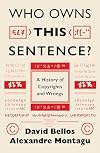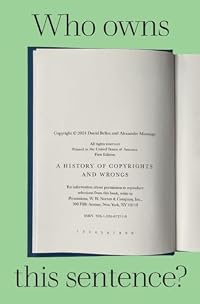
Who Owns This Sentence?: A History of Copyrights and Wrongs
by David Bellos, Alexandre Montagu
On This Page
Description
"Copyright is everywhere. Your smartphone incorporates thousands of items of intellectual property. Someone owns the reproduction rights to photographs of your dining table. At this very moment, battles are raging over copyright in the output of artificial intelligence programs. Not only books but wallpaper, computer programs, pop songs, cartoon characters, snapshots, and cuddly toys are now deemed to be intellectual properties--making copyright a labyrinthine construction of laws with show more colorful and often baffling rationales covering almost all products of human creativity. It wasn't always so. Copyright has its roots in eighteenth-century London, where it was first established to limit printers' control of books. But a handful of little-noticed changes in the late twentieth century brought about a new enclosure of the cultural commons, concentrating ownership of immaterial goods in very few hands. Copyright's metastasis can't be understood without knowing its backstory, a long tangle of high ideals, low greed, opportunism, and word-mangling that allowed poems and novels (and now, even ringtones and databases) to be treated as if they were no different from farms and houses. Principled arguments against copyright arose from the start and nearly abolished it in the nineteenth century. Nonetheless, countless revisions have made copyright ever stronger"-- show lessTags
Recommendations



Member Reviews
OK, I’m not the audience for this, but if you want a layperson-oriented book about how copyright got so bloated, you might enjoy this one. Useful statistics on just how dominant English is in terms of what gets translated from/to, and likewise the US is dominant in receiving royalties. Limiting the right to control translation, as they suggest, might change a bit of that, though copyright can’t create demand itself. The most interesting part for me was the chapter on Soviet copyright, “simultaneously wildly generous and highly dubious.” Authors couldn’t block publication and royalties were often paid to the state, but popular prose writers were entitled to at least 100 per cent of the retail price; advances and royalties were show more subject to fixed scales “based on the political standing and official position of the author.” Belonging to the Writers’ Union conferred access to better housing and luxury goods. “At its peak, the union had more than ten thousand members, who were collectively far better remunerated than any ten thousand full-time writers (if there ever were so many!) in the United States. However, works by emigrants, works not approved for publication, and works by non-Soviet authors were not remunerated at all.” Soviet poets held readings in football stadiums and new printings of classic works came out in runs of 100,000—but of course censorship and privation were also features of the system. show less
Ratings
Members
- Recently Added By
Lists

TBR of Books I Don't Own
132 works; 1 member
Author Information

14+ Works 1,551 Members
3 Works 116 Members
Awards and Honors
Distinctions
Classifications
- Genres
- Politics and Government, History, Nonfiction, General Nonfiction
- DDC/MDS
- 346.7304 — Society, Government, and Culture Law Private Law North America United States Topics of private law Property Law
- LCC
- KF2994 — Law Law of the United States Law of the United States (Federal) Intellectual property Copyright
- BISAC
Statistics
- Members
- 106
- Popularity
- 304,346
- Reviews
- 1
- Rating
- (4.30)
- Languages
- English, Italian, Spanish
- Media
- Paper, Ebook
- ISBNs
- 9
- ASINs
- 1