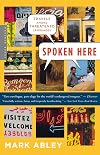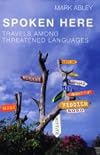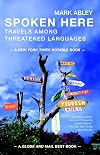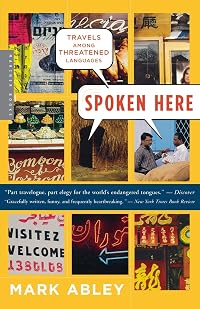
Spoken Here: Travels Among Threatened Languages
by Mark Abley
On This Page
Description
"In Spoken Here, Mark Abley journeys around the world seeking out languages in peril - Manx, Mohawk, Boro, Yiddish, and many more. Along the way he reveals delicious linguistic oddities and shows us what is lost when one of the world's six thousand tongues dies - an irreplaceable worldview and a wealth of practical knowledge. He also examines the forces, from pop culture to creoles to global politics, that threaten to wipe out 90 percent of languages by this century's end." "Abley encounters show more one of the last two speakers of an Australian language whose tribal taboos forbid them to talk to each other. He spotlights those who believe that violence is the only way to save their tongue. He meets a Yiddish novelist who writes for an audience she knows doesn't exist. He pays tribute to such strange tongues as the Amazonian language last spoken by a parrot, the Caucasian language with no vowels, and the South Asian language whose innumerable verbs include gobray (to fall in a well unknowingly) and onsra (to love for the last time)." "Each of the languages Abley spotlights, from the familiar to the foreign, exemplifies the various threats that endanger languages worldwide. But many also prove their resilience, thanks to the efforts of their determined speakers and such unlikely tools as soap operas and pop music. From the crusaders to the uncaring, Abley draws surprising insight from this centuries-old debate."--BOOK JACKET. show lessTags
Recommendations














Member Reviews
Even better than his Prodigal Tongue, Mark Abley's explorations of diminishing (and the very occasional not-yet-diminishing) languages fascinated me from beginning (aboriginal Australian) to end (Welsh). The political implications of Mohawk and Iroquois, the literary ones of Proven��al and Occitan, the religious ones of Yiddish and Hebrew (and Ladino, Judeo-Arabic, Judeo-Proven��al and Judeo-Persian, of which I had heard of only the first), are endlessly intricate and packed with meaning and possibility.
Imagine the philosophical posers that cultures with several different forms of first-person plural (they and I but not you; two others and I and you; more than two others and I and not you, and so forth) could present to the show more Indo-European language speaker. Try to grasp the mindset of a someone whose speech relies on state of being as well as, or separate from, location and linear time. Mourn the knowledge that would be lost if the words for plants and their uses specific to pinpoint locations on the edges of maps were forgotten. Wonder how four different words for pre-dawn light can remain useful if their speakers sleep indoors. show less
Imagine the philosophical posers that cultures with several different forms of first-person plural (they and I but not you; two others and I and you; more than two others and I and not you, and so forth) could present to the show more Indo-European language speaker. Try to grasp the mindset of a someone whose speech relies on state of being as well as, or separate from, location and linear time. Mourn the knowledge that would be lost if the words for plants and their uses specific to pinpoint locations on the edges of maps were forgotten. Wonder how four different words for pre-dawn light can remain useful if their speakers sleep indoors. show less
Very interesting book. Mark Abley travels to several parts of the world where languages are nearing extinction, including the Isle of Man, and Indian Reserves in Quebec. I especially enjoyed his discussions of how different languages express different world views -- we are at risk of losing more than a few minority languages, we are really at risk of losing diverse perspectives.
Easy to read, thought-provoking and you will learn something. Perfect combination!
Easy to read, thought-provoking and you will learn something. Perfect combination!
This was really quite a fascinating book. Mark Abley tours the world, seeking languages that are disappearing as their last native speakers pass away. It was surprising how many of these there are.
Some of the most interesting aspects of the book were the times when he was able to explain how another language could express concepts that we find troubling or awkward to express in English, or when the language embodied a different world view.
Some of the most interesting aspects of the book were the times when he was able to explain how another language could express concepts that we find troubling or awkward to express in English, or when the language embodied a different world view.
Interesting and very accessible travelogue about endangered languages. Abley spends a fair amount of time making the "why should we care" case, which would be useful for readers who had never considered the issue before, but which I found somewhat tiresome -- I wouldn't have picked up the book if I weren't concerned with disappearing languages, so I would have rather seen that space devoted to more about the actual languages themselves. The structure of the book -- a portrait of a languages and its speakers, followed by a brief interlude about more general topics -- lends itself well to being read piecemeal, and the final chapters about languages making a recovery makes this less bleak than it could have been.
Because I had an English education, I don't speak any language other than English, but I am fascinated by languages, and eager to learn about them if not actually to learn them. This book is an excellent tour d'horizon of languages whose existence is threatened (mainly by mine). It has much to say about the structure of languages, and why diversity is important, and is written in an accessible, readable manner. Recommended to anyone with an interest in language and languages.
Abley takes us around the globe to sample life in remote areas where native languages are threatened. He doesn't just address the language itself, but shows why the language matters . . . showing glimpses of residents' lives, filling out "issues" with flesh and blood. The end result is a mix of travelogue and commentary on linguistic food chain processes.
This was a very interesting book about language and culture. I especially liked the chapters about the Isle of Man and the Yuchi Indians.
Members
- Recently Added By
Lists

Great Books About Language
73 works; 45 members
Author Information

18+ Works 1,021 Members
Mark Abley was born in England but grew up in western Canada. A Rhodes scholar at Oxford, he has been a books columnist at the Montreal Gazette and winner of a National Newspaper Award for critical writing. He continues to work at the Gazette as a features writer. He lives with his wife and two daughters in Pointe Claire, Quebec.
Some Editions
Awards and Honors
Common Knowledge
- Canonical title
- Spoken Here: Travels Among Threatened Languages
- Original publication date
- 2003
- Epigraph
- Hey now, you got me by the tongue
I feel like, there's nowhere I belong.
—David Gray, Faster, Sooner, Now
The dark soft languages... (show all) are being silenced:
Mothertongue Mothertongue Mothertongue
falling one by one back into the moon.
—Margaret Atwood, Marsh Languages
O felix peccatum Babel!
—J.R.R. Tolkien, "English and Welsh" - Dedication
- This book is for Annie
- First words
- 1
Patrick's Language
An old man watches a milky ocean roll in to the shore. High above the waterline, two children are skipping barefoot along an otherwise empty beach, its contours defined and guareded by a pair o... (show all)f mangrove swamps. A long, low island nudges the western horizon. This could be an afternoon scene on almost any tropical coast: the heat rising off the sand, a hawk scouring the sky. In fact, the surf is brushing a remote edge of northern Australia—remote, that is, except to the old man's people, the Mati Ke, who may have lived in the area for tens of thousands of years. - Last words
- (Click to show. Warning: May contain spoilers.)I mean, he didn't need to worry. I mean, he could relax.
- Original language
- English
- Canonical DDC/MDS
- 409
Classifications
Statistics
- Members
- 672
- Popularity
- 43,013
- Reviews
- 9
- Rating
- (3.72)
- Languages
- English, French, Spanish
- Media
- Paper, Ebook
- ISBNs
- 12
- UPCs
- 2
- ASINs
- 4