On This Page
Description
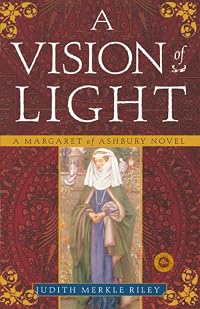
The first book in the series, this bestselling novel introduces Margaret of Ashbury, a fourteenth-century Englishwoman with mystical abilitiesMargaret of Ashbury wants to write her life story. However, like most women in fourteenth-century England, she is illiterate. Three clerics contemptuously decline to be Margaret’s scribe, and only the threat of starvation persuades Brother Gregory, a Carthusian friar with a mysterious past, to take on the task.
As she narrates her life, we discover show more a woman of startling resourcefulness. Married off at the age of fourteen to a merchant reputed to be the Devil himself, Margaret was left for dead during the Black Plague. Incredibly, she survived, was apprenticed to an herbalist, and became a midwife. But most astonishing of all, Margaret has experienced a Mystic Union—a Vision of Light that endows her with the miraculous gift of healing. Because of this ability, Margaret has become suddenly different—to her tradition-bound parents, to the bishop’s court that tries her for heresy, and ultimately to the man who falls in love with her. show less
Tags
Recommendations











Member Reviews
Protagonist: Margaret of Ashbury, a midwife and herbalist
Setting: 14th century London, England
Series: #1 of a trilogy
First Line: In the year of our Lord 1355, three days after the Feast of the Epiphany, God put in my mind that I must write a book.
Margaret of Ashbury heeds a "voice" commanding her to compose her life story. Unable to write, she hires Brother Gregory to record her memories. He is contemptuous of her ambition but hungry enough to accept her offer. Riley's plot alternates between Margaret's and Gregory's clashes in the present and her telling of her past. The story is fast paced, and the medieval setting is authentically portrayed, whether Riley is describing life on London Bridge, alchemy, or the Black Death.
I loved this show more book. The setting felt so real that I wanted to adjust my wimple, and the voices of Margaret and Gregory were perfect: Margaret seeing things as they never were and asking why, and Gregory wanting change in his own life--but not for women! Will I be reading the other two books in the trilogy? You can take it to the bank! show less
Setting: 14th century London, England
Series: #1 of a trilogy
First Line: In the year of our Lord 1355, three days after the Feast of the Epiphany, God put in my mind that I must write a book.
Margaret of Ashbury heeds a "voice" commanding her to compose her life story. Unable to write, she hires Brother Gregory to record her memories. He is contemptuous of her ambition but hungry enough to accept her offer. Riley's plot alternates between Margaret's and Gregory's clashes in the present and her telling of her past. The story is fast paced, and the medieval setting is authentically portrayed, whether Riley is describing life on London Bridge, alchemy, or the Black Death.
I loved this show more book. The setting felt so real that I wanted to adjust my wimple, and the voices of Margaret and Gregory were perfect: Margaret seeing things as they never were and asking why, and Gregory wanting change in his own life--but not for women! Will I be reading the other two books in the trilogy? You can take it to the bank! show less
“A Vision of Light” starts the Margaret of Ashbury trilogy. Set in the mid-1300s, the story starts with Margaret as a child, the daughter of a very poor but free born man. In her early teens, she is married against her will to a miserable sadist who makes her life a living hell and puts a fear of marriage into her. When the plague hits England- and her- she gets free of the marriage, or so she thinks. She takes up a new life as a healer and midwife, which works fine for awhile, until the Church comes after her for dealing with the devil. They forbid her to deal in her profession any longer, as midwives are in league with the devil. This leaves her with no way of earning her living….
Margaret’s life has many ups and downs, from show more complete wretchedness to bliss. She’s an intelligent, hard working woman who has a special gift- she can heal people, not just with herbs, but by channeling energy through her hands. And she speaks with a Voice, who she identifies as God.
The book is rich in historic detail, both the pretty and the ugly. Riley brings the era to life. The characters are mostly well done; while Margaret is strong on wanting to earn her own living and not be dependent on a man, she is still a product of her time and society. I have only one big problem with the book, and I cannot say exactly what it is without giving a spoiler. Suffice it to say that at the very end, Margaret accepts something without a struggle, which seems very much out of character for her. show less
Margaret’s life has many ups and downs, from show more complete wretchedness to bliss. She’s an intelligent, hard working woman who has a special gift- she can heal people, not just with herbs, but by channeling energy through her hands. And she speaks with a Voice, who she identifies as God.
The book is rich in historic detail, both the pretty and the ugly. Riley brings the era to life. The characters are mostly well done; while Margaret is strong on wanting to earn her own living and not be dependent on a man, she is still a product of her time and society. I have only one big problem with the book, and I cannot say exactly what it is without giving a spoiler. Suffice it to say that at the very end, Margaret accepts something without a struggle, which seems very much out of character for her. show less
This novel was a pleasure to read. Not that I can't find fault. Margaret of Ashbury, the wife of a rich merchant, hires a clerk to dictate her memoirs in the year 1355. The narrative switches between the present day and her experiences with her amanuensis, Brother Gregory in third person, and her own story told by her first person. Whenever we hear her own story in her own voice, I found the story absolutely engrossing. I was less taken at first with the third person parts, more than anything because within it, without the restraint of first person, Riley can't hold point of view, sometimes hopping heads within a paragraph.
Yet I forgive what I often find a deal breaker, because the story of Brother Gregory and his interaction with the show more unorthodox Margaret is so compelling in its own right and compliments the story she's telling; it illuminates the misogyny of the day, especially among the religious, who don't see women as capable of reason or whose only possible virtue is obedience.
The story is told with wonderful period detail bringing 14th Century England--the period of the Black Plague and its aftermath to life--lives high and low, from the nobility of the castle to rich merchants, clergy, even robber bands and traveling minstrels. And there's a winning humor lacing the entire tale throughout.
There's also a thread of the fantastical that tempts me to tag this as fantasy--as Margaret has a "vision of light" and afterwards develops powers of healing. But then that could be seen as not out of place in a century that produced such mystics as Birgitta of Sweden, Julian of Norwich, Catherine of Siena, and particularly Margery Kempe. Kempe dictated to scribes what is considered the first autobiography in the English language and her life has several points in common with the story of Margaret of Ashbury.
I feel mixed about the ending. Part of me wishes it has ended when Margaret put a "finis" on her memoirs--though it does end on a good note for further books in the series--I saw two more on the bookstore shelf. After this first book, I'll certainly be picking more up someday. And that very last line is perfect. show less
Yet I forgive what I often find a deal breaker, because the story of Brother Gregory and his interaction with the show more unorthodox Margaret is so compelling in its own right and compliments the story she's telling; it illuminates the misogyny of the day, especially among the religious, who don't see women as capable of reason or whose only possible virtue is obedience.
The story is told with wonderful period detail bringing 14th Century England--the period of the Black Plague and its aftermath to life--lives high and low, from the nobility of the castle to rich merchants, clergy, even robber bands and traveling minstrels. And there's a winning humor lacing the entire tale throughout.
There's also a thread of the fantastical that tempts me to tag this as fantasy--as Margaret has a "vision of light" and afterwards develops powers of healing. But then that could be seen as not out of place in a century that produced such mystics as Birgitta of Sweden, Julian of Norwich, Catherine of Siena, and particularly Margery Kempe. Kempe dictated to scribes what is considered the first autobiography in the English language and her life has several points in common with the story of Margaret of Ashbury.
I feel mixed about the ending. Part of me wishes it has ended when Margaret put a "finis" on her memoirs--though it does end on a good note for further books in the series--I saw two more on the bookstore shelf. After this first book, I'll certainly be picking more up someday. And that very last line is perfect. show less
Judith Merkle Riley's A Vision of Light is one of my favorite novels, and Margaret of Ashbury is probably the literary character I'd most like to be.
Riley's Margaret is so alive! This 14th-century Englishwoman is inspired in a "vision of light" to write her memoirs and do the unheard of - tell a woman's story. Because is she unable to write, she hires the ever-hungry, every-grumpy Brother Gregory to record her memories. Contemptuous of her ambition, he is nevertheless hungry enough to accept her offer. The story then alternates between Margaret's and Gregory's exchanges in the present and her telling the story of her life and adventures.
It's a fast-paced and interesting novel; most of all it's fun. It's also well-researched and show more authentic, but Riley's research is never a burden for the reader. Her touch is light, and her characters charming. show less
Riley's Margaret is so alive! This 14th-century Englishwoman is inspired in a "vision of light" to write her memoirs and do the unheard of - tell a woman's story. Because is she unable to write, she hires the ever-hungry, every-grumpy Brother Gregory to record her memories. Contemptuous of her ambition, he is nevertheless hungry enough to accept her offer. The story then alternates between Margaret's and Gregory's exchanges in the present and her telling the story of her life and adventures.
It's a fast-paced and interesting novel; most of all it's fun. It's also well-researched and show more authentic, but Riley's research is never a burden for the reader. Her touch is light, and her characters charming. show less
I loved those books as a teenager back in the days, and when I had a look at my library of what to read next, I saw my overly "zerlesende" (aka, I read them so much that they are falling apart) editions of the Margaret of Ashbury novels. Instead of bothering with the German translations, I took the opportunity and got the English ebooks and it was not a disappointment.
Yes, Ms Merkle Riley was a bit lenient with historical facts, I already knew as a teenager of thirteen that witches weren't burnt in the medieval times and other little things which were added because it fitted the narration better.
But honestly, I still love the story, it is such a nice feel good book, that didn't loose any of its charm in the nearly thirty years since I show more read it first. The story itself might not be something extraordinary special but the wit and humor make it a fine read. show less
Yes, Ms Merkle Riley was a bit lenient with historical facts, I already knew as a teenager of thirteen that witches weren't burnt in the medieval times and other little things which were added because it fitted the narration better.
But honestly, I still love the story, it is such a nice feel good book, that didn't loose any of its charm in the nearly thirty years since I show more read it first. The story itself might not be something extraordinary special but the wit and humor make it a fine read. show less
There are lots of tropes I truly hate in this book: rape, abuse, death of a child, incest, death of a spouse, men with too much power hurting women and children and lots more - and still, I love this book. Margaret is such a beautiful person, I fell in love with her. Five stars.
I don't give up on books very often, but I gave up on this one. It just didn't seem worth the bother.
I should know better than to read medieval historical fiction: I am a medieval historian, and a historical novel has to be really REALLY good before it can distract me from its historical inaccuracies (or at the very least, it has to be clear to me from a literary standpoint why the inaccuracies were necessary). All in all, Riley did her research well, but there were still some really big historical inaccuracies that didn't need to be there. To name just a few: women in the 14th century generally didn't marry until their late teens or early twenties (not 14, like Margaret); the witch scare didn't begin until the 16th century, so all the show more fear of witchcraft in the book is an anachronism; there was a good legal system in England, and lords couldn't just punish people however they wanted to; women had legal rights to inherit, so Margaret could have had her first husband punished and inherited his fortune (and they did not make people walk on hot coals to test if they were guilty!).
But historical inaccuracies aside, I just didn't enjoy the book. It seems like there's a rape or a wife-beating on every other page, which gets depressing and tedious. The theological/philosophical discussions seem trite and forced (Riley just seems to be quoting basic textbooks about medieval theology, instead of really understanding the debates). The story was entirely uninteresting, but I just never knew where it was going. The characters were likable (well, the ones who weren't wife-beating rapists), but not very original (the wise old midwife, the hypocritical cleric, etc.) I thought there was lots of room for interesting development with Margaret's visions and her gift for healing, but Riley never took it anywhere.
So all in all, this book just didn't seem worth the bother to me. show less
I should know better than to read medieval historical fiction: I am a medieval historian, and a historical novel has to be really REALLY good before it can distract me from its historical inaccuracies (or at the very least, it has to be clear to me from a literary standpoint why the inaccuracies were necessary). All in all, Riley did her research well, but there were still some really big historical inaccuracies that didn't need to be there. To name just a few: women in the 14th century generally didn't marry until their late teens or early twenties (not 14, like Margaret); the witch scare didn't begin until the 16th century, so all the show more fear of witchcraft in the book is an anachronism; there was a good legal system in England, and lords couldn't just punish people however they wanted to; women had legal rights to inherit, so Margaret could have had her first husband punished and inherited his fortune (and they did not make people walk on hot coals to test if they were guilty!).
But historical inaccuracies aside, I just didn't enjoy the book. It seems like there's a rape or a wife-beating on every other page, which gets depressing and tedious. The theological/philosophical discussions seem trite and forced (Riley just seems to be quoting basic textbooks about medieval theology, instead of really understanding the debates). The story was entirely uninteresting, but I just never knew where it was going. The characters were likable (well, the ones who weren't wife-beating rapists), but not very original (the wise old midwife, the hypocritical cleric, etc.) I thought there was lots of room for interesting development with Margaret's visions and her gift for healing, but Riley never took it anywhere.
So all in all, this book just didn't seem worth the bother to me. show less
Members
- Recently Added By
Lists

Historical Fiction
889 works; 91 members
First Novels
373 works; 17 members

KayStJ's to-read list
1,616 works; 11 members

Book Worlds We'd Like To Visit
322 works; 158 members
Talk Discussions
Past Discussions
Historical Fiction-Illiterate Medieval woman dictates life story to a scribe in Name that Book (July 2010)
Author Information

Some Editions
Series

Belongs to Publisher Series
Ullstein (25103)
Common Knowledge
- Canonical title
- A Vision of Light
- Original title
- A Vision of Light
- Original publication date
- 1989-01
- People/Characters
- Margaret of Ashbury; Gilbert de Vilers, Brother Gregory
- Important places*
- London, England, Storbritannien
- First words
- In the year of Our Lord 1355, three days after the Feast of the Epiphany, God put in my mind that I must write a book. (prologue)
*Some information comes from Common Knowledge in other languages. Click "Edit" for more information.
Classifications
- Genres
- Fiction and Literature, General Fiction, Historical Fiction, Fantasy, Romance
- DDC/MDS
- 813.54 — Literature & rhetoric American literature in English American fiction in English 1900-1999 1945-1999
- LCC
- PS3568 .I3794 .V5 — Language and Literature American literature American literature Individual authors 1961-
- BISAC
Statistics
- Members
- 735
- Popularity
- 38,439
- Reviews
- 23
- Rating
- (4.00)
- Languages
- 5 — Dutch, English, German, Spanish, Swedish
- Media
- Paper, Ebook
- ISBNs
- 22
- ASINs
- 9