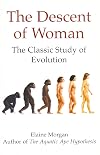
The Descent of Woman
by Elaine Morgan
On This Page
Description
This pioneering work, originally published in 1972, was the first to argue irrefutably the equal role of women in human evolution.Tags
Recommendations


























Member Reviews
Basically, her proposition is that hominid evolutionary thought is all male-centered and thus ignores obvious physiological and behavioral evidence that suggests a semi-aquatic hominid period during the millions of years of Pliocene drought. I don’t know enough evolutionary biology to pick a side, but I love reading her sassy and well-considered retorts to conventional evolutionary models.
I can't say I am convinced Morgan's innovations on basic evolutionary theory are completely convincing, but I appreciate that they are imaginative, cogent, and thought-provoking. Wedding feminism and primate development, still to this day Morgan's images of semi-aquatic apes losing their hair in watershedding patterns and anacient mothers embedding a show more genetic fear of spider-like motion from crabs nearing her young still stays with me and strikes me a decade and a half after I read this important work.
As I say, I don't know enough about evolutionary biology to fact-check or challenge her, but this second reading of the book is still a complete joy to ready her smart and sassy, imaginative and piercing attacks on the theories injected into primate evolution by men thinking only of men and when thinking of women, thinking of the only in subordinate roles. This feminist critique of classic Homo Sapiens evolution is an enlightening and entertaining read. show less
I can't say I am convinced Morgan's innovations on basic evolutionary theory are completely convincing, but I appreciate that they are imaginative, cogent, and thought-provoking. Wedding feminism and primate development, still to this day Morgan's images of semi-aquatic apes losing their hair in watershedding patterns and anacient mothers embedding a show more genetic fear of spider-like motion from crabs nearing her young still stays with me and strikes me a decade and a half after I read this important work.
As I say, I don't know enough about evolutionary biology to fact-check or challenge her, but this second reading of the book is still a complete joy to ready her smart and sassy, imaginative and piercing attacks on the theories injected into primate evolution by men thinking only of men and when thinking of women, thinking of the only in subordinate roles. This feminist critique of classic Homo Sapiens evolution is an enlightening and entertaining read. show less
I was intrigued by the references to this book in Peter Dickinson's [A Bone From a Dry Sea]. While Dickinson's story only nibbled at the edges of the theories of Morgan's treatise, The Descent of Woman delves fully into a feminist interpretation of the evolutionary and cultural aspects of human evolution.
For my money, the science behind the author's premise was flimsy, perhaps even the source of unfounded speculation that wound its way into Morgan's narrative. Interpretations and theory in human evolution have sparked tremendous controversy, as different agencies favour their preferred view point. Using the biblical Genesis story does little to promote credibility for how the females actually lived. And therein lies a great flaw to a show more supposedly academic text.
One never 'proves' a theory and my reading of this book begs the question why were other interpretations of the evolution of humans not discussed? Those may counter the author's point of view, but there was nothing written to convince the reader that Morgan's ideas have superior merit. The attitudes expressed came across as an agenda to promote female equality, yet the ancient historical record is not of the quality to establish the life females lived on the basis of a societal culture. show less
For my money, the science behind the author's premise was flimsy, perhaps even the source of unfounded speculation that wound its way into Morgan's narrative. Interpretations and theory in human evolution have sparked tremendous controversy, as different agencies favour their preferred view point. Using the biblical Genesis story does little to promote credibility for how the females actually lived. And therein lies a great flaw to a show more supposedly academic text.
One never 'proves' a theory and my reading of this book begs the question why were other interpretations of the evolution of humans not discussed? Those may counter the author's point of view, but there was nothing written to convince the reader that Morgan's ideas have superior merit. The attitudes expressed came across as an agenda to promote female equality, yet the ancient historical record is not of the quality to establish the life females lived on the basis of a societal culture. show less
You find very few amateur theorists on stellar nucleosynthesis or fluid dynamics or molecular biology. However, evolution is fair game for philosophers (Darwinian Fairytales) and seems to be especially attractive to screenwriters: (The Territorial Imperative and The Descent of Woman).
I’m not even considering the legions of Creationists and Intelligent Designers, who come from just about every field except evolutionary biology; the three examples cited above are people who accept organic evolution through natural selection, they just don’t understand it.
I suppose that’s because on the surface it seems so simple; but alas, sometimes the simplest things turn out to be the most complicated.
The particular amateur under consideration is show more Elaine Morgan; in The Descent of Woman she makes the classic mistake that nonscientists do when dealing with science: the assumption that scientific arguments are about logic and plausibility rather than evidence and testing. Some background:
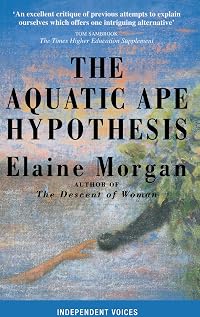
Morgan’s first foray into evolutionary theory was The Aquatic Ape Hypothesis, which was the claim that there was a period in hominid evolution when our ancestors spent their time wading around the seashore. In her hands this explains everything about hominid evolution – bipedalism (for wading in the water to escape predators); hairlessness (for streamlining when swimming); and the missionary position (I won’t go into details but it has to do with sand getting into everything). This is all done with rhetoric; Morgan sets up straw men, over generalizes, begs the question, and does all the other logical tricks. And, of course, she proposes no way her hypothesis could be tested. Further, most of her arguments are focused against other evolution populizers, particularly Robert Ardrey and Desmond Morris. While I’m not a particular fan of Stephen Jay Gould, his comment that a lot of evolutionary psychology consists of “just so stories” should always be held in mind when contemplating a seemingly plausible hypothesis.
In The Descent of Woman the aquatic apes now get more developed and coupled to the evolution of hominid females. To be fair, there is one extremely valid point; a lot of popular evolutionary psychology focuses solely on male evolution – discussions of aggression and territoriality and sexual selection and hunting often assume the females were just patiently waiting in the cave for Og to come home with some newly evolved traits. That much of The Descent of Woman is perfectly valid; all gender and developmental stages of an organism – male, female, adult, young, sperm, egg – have to be adapted to their environment or nothing is going to work. That complaint, however, could be summarized in a paragraph or so without going into a whole volume.
Morgan takes on some of the feminists who have bought into the “demonic male” arguments (without, of course, offering any actual evidence that men are or are not more violent than women); she gets sidetracked on “equal pay for equal work; and her treatment of male/female relationship psychology hinges – without the slightest hint of a contrary opinion – on the assumption that all the men and women in the world are upper-class Western Europeans. This last is especially ironic because of her complaint that anthropologists ignore the women when studying primitive cultures.
Still, as befits a screenwriter, her prose is light and breezy and quite readable. The book’s a little out of date now; first published in 1972 the edition I read has a 1985 epilogue. Although it’s good to be reminded that there’s a legitimate concern about woman’s place in evolutionary theorizing, the main value of the book is as test of the reader’s ability to spot logical fallacies and errors of fact. show less
I’m not even considering the legions of Creationists and Intelligent Designers, who come from just about every field except evolutionary biology; the three examples cited above are people who accept organic evolution through natural selection, they just don’t understand it.
I suppose that’s because on the surface it seems so simple; but alas, sometimes the simplest things turn out to be the most complicated.
The particular amateur under consideration is show more Elaine Morgan; in The Descent of Woman she makes the classic mistake that nonscientists do when dealing with science: the assumption that scientific arguments are about logic and plausibility rather than evidence and testing. Some background:
Morgan’s first foray into evolutionary theory was The Aquatic Ape Hypothesis, which was the claim that there was a period in hominid evolution when our ancestors spent their time wading around the seashore. In her hands this explains everything about hominid evolution – bipedalism (for wading in the water to escape predators); hairlessness (for streamlining when swimming); and the missionary position (I won’t go into details but it has to do with sand getting into everything). This is all done with rhetoric; Morgan sets up straw men, over generalizes, begs the question, and does all the other logical tricks. And, of course, she proposes no way her hypothesis could be tested. Further, most of her arguments are focused against other evolution populizers, particularly Robert Ardrey and Desmond Morris. While I’m not a particular fan of Stephen Jay Gould, his comment that a lot of evolutionary psychology consists of “just so stories” should always be held in mind when contemplating a seemingly plausible hypothesis.
In The Descent of Woman the aquatic apes now get more developed and coupled to the evolution of hominid females. To be fair, there is one extremely valid point; a lot of popular evolutionary psychology focuses solely on male evolution – discussions of aggression and territoriality and sexual selection and hunting often assume the females were just patiently waiting in the cave for Og to come home with some newly evolved traits. That much of The Descent of Woman is perfectly valid; all gender and developmental stages of an organism – male, female, adult, young, sperm, egg – have to be adapted to their environment or nothing is going to work. That complaint, however, could be summarized in a paragraph or so without going into a whole volume.
Morgan takes on some of the feminists who have bought into the “demonic male” arguments (without, of course, offering any actual evidence that men are or are not more violent than women); she gets sidetracked on “equal pay for equal work; and her treatment of male/female relationship psychology hinges – without the slightest hint of a contrary opinion – on the assumption that all the men and women in the world are upper-class Western Europeans. This last is especially ironic because of her complaint that anthropologists ignore the women when studying primitive cultures.
Still, as befits a screenwriter, her prose is light and breezy and quite readable. The book’s a little out of date now; first published in 1972 the edition I read has a 1985 epilogue. Although it’s good to be reminded that there’s a legitimate concern about woman’s place in evolutionary theorizing, the main value of the book is as test of the reader’s ability to spot logical fallacies and errors of fact. show less
A re-read of something read many years ago, and I've discovered during this read, the subject of a lot of controversy. The author based a lot of this book on the theory set forward around 1960 in an article in 'The New Scientist' by marine biologist, Alistair Hardy (her own book was published in the early 1970s). It seems she wrote to Desmond Morris, author of a popular work, 'The Naked Ape', which she had a lot of disagreements with, and asked why he had dismissed the theory in a page or so. He explained that it was actually based on Hardy's paper.
I won't go over the various aspects of humanity which the author says are unique to ourselves and which authors in the scientific community say are not (she had no scientific background, but show more instead hailed from the humanities). It's hard to know how much credit to give the book despite the website I found which rebuts all its claims and those of later books by herself and other authors. Having moved on to read a couple more of hers, she did modify her ideas somewhat: for example, accepting that locomotion on two legs came millions of years before some of the other developments that in this book were all supposed to result from an aquatic existence for an ancestor of humankind and to have developed all at the same time.
Also, it's clear that Hardy himself did not claim this ancestor became fully aquatic - which would have involved our legs atrophying as they did in dolphins and other sea-going mammals, rather than remaining the long 'primitive' legs of a primate which did not specialise in tree dwelling unlike chimpanzees etc. Instead, he said they would have spent five or so hours a day in water and the rest of the time roamed the shore to gather other foodstuffs etc (the author's follow-up publishes his article as an appendix).
One aspect of the book is the author's rallying cry against the male-centric nature of much of palaeontology at the time and this is of more interest. The style is popularist and irreverent, in contrast to her later, more academic sounding works. Altogether I would give it around 2.5 stars, rounded up to 3. show less
I won't go over the various aspects of humanity which the author says are unique to ourselves and which authors in the scientific community say are not (she had no scientific background, but show more instead hailed from the humanities). It's hard to know how much credit to give the book despite the website I found which rebuts all its claims and those of later books by herself and other authors. Having moved on to read a couple more of hers, she did modify her ideas somewhat: for example, accepting that locomotion on two legs came millions of years before some of the other developments that in this book were all supposed to result from an aquatic existence for an ancestor of humankind and to have developed all at the same time.
Also, it's clear that Hardy himself did not claim this ancestor became fully aquatic - which would have involved our legs atrophying as they did in dolphins and other sea-going mammals, rather than remaining the long 'primitive' legs of a primate which did not specialise in tree dwelling unlike chimpanzees etc. Instead, he said they would have spent five or so hours a day in water and the rest of the time roamed the shore to gather other foodstuffs etc (the author's follow-up publishes his article as an appendix).
One aspect of the book is the author's rallying cry against the male-centric nature of much of palaeontology at the time and this is of more interest. The style is popularist and irreverent, in contrast to her later, more academic sounding works. Altogether I would give it around 2.5 stars, rounded up to 3. show less
What struck me the most in this book was, not the feminist angle, but the Aquatic Ape hypothesis. The aquatic evidence is convincing, and it makes more sense than the usual weak explanation of -- he stood up in a field of tall grass to stalk his prey.
So I thought "The Naked Ape" was a great way to look at early human evolution, but Elaine Morgan totally tears it apart. She evaluates different possibilities with a logic that can't be denied or ignored- this is worth a read for everyone. It was a fascinating look at evolution and early civilization.
Groundbreaking as the first book which pointed out that human evolution might well be influenced by how hominid females dealt with challenges. Some of the ideas proposed are a bit fantastic, but Morgan did get evolutionary scientists to acknowledge that how women survived and evolved might just be at least as important as the contribution of men.
Members
- Recently Added By
Lists

The Mother of All Questions
10 works; 1 member
Talk Discussions
Past Discussions
Found: Prehistory, female perspective in Name that Book (December 2021)
Author Information

25+ Works 1,139 Members
Awards and Honors
Distinctions
Common Knowledge
- Canonical title
- The Descent of Woman
- Alternate titles
- The Descent of Woman
- Original publication date
- 1972
Classifications
- Genres
- Anthropology, Science & Nature, Nonfiction, General Nonfiction, Sexuality and Gender Studies
- DDC/MDS
- 573.2 — Natural sciences & mathematics Biology Specific physiological systems in animals, regional histology and physiology in animals Origin of man
- LCC
- GN281 .M6 — Geography, Anthropology and Recreation Anthropology Anthropology Physical anthropology. Somatology Human evolution
- BISAC
Statistics
- Members
- 630
- Popularity
- 46,251
- Reviews
- 11
- Rating
- (4.00)
- Languages
- 9 — Danish, Dutch, English, Finnish, German, Italian, Polish, Spanish, Swedish
- Media
- Paper, Ebook
- ISBNs
- 27
- ASINs
- 12