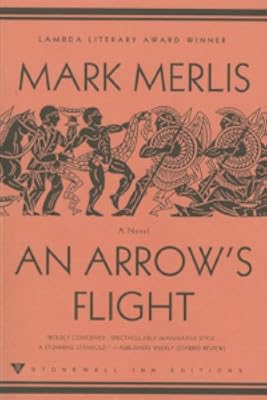
An Arrow's Flight
by Mark Merlis
On This Page
Description
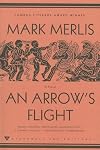
Pyrrhus is a male stripper in a bar in Ancient Greece. However, destiny has scheduled him for a career change. For Pyrrhus is the son of Achilles, and the oracle has proclaimed that he will lead the Myrmidons to victory.Tags
Recommendations










































Member Recommendations

Member Reviews
Really pretty stunning. It would, of course, have to end with HIV, although the refiguring of the sack of Troy (which never happens here) is one of the more original and interesting takes on the beginning of HIV that there is. The writing is witty and comes at the reader with great velocity - I can't think of a better way to describe it. The story is almost always breathless. This is an erudite, playful, thought-provoking book, and is sending me back to read the Aeneid for the first time in a decade.
As to all the *sex,* either you're a gay man, in which case the descriptions of sex are overwrought but onto something deep, or you're not a gay man, in which case you ought to deal since gay men deal with depictions of everyone else in the show more world having sex all the time. show less
As to all the *sex,* either you're a gay man, in which case the descriptions of sex are overwrought but onto something deep, or you're not a gay man, in which case you ought to deal since gay men deal with depictions of everyone else in the show more world having sex all the time. show less
The best book of the 1990s. An alternate history placing the Trojan Wars in modern times, and based on the myth of the success of the Greeks in the Trojan War being dependent on Neoptolemus (son of Achilles, called Pyrrhus) bringing Philoctetes' bow (a gift from Heracles) to Troy. This version of the myth depicts Pyrrhus as a stripper in a gay bar, hired by Odysseus to seduce Philoctetes as a means of getting the bow. Philoctetes' injury, the snake bite, takes the place of HIV/AIDS. Moving, vivid, the language bridges the classic and modern.
Tells the story of Pyrrhus/Neoptolemus, the son of Achilles, you know, the one who finally does sack Troy (and kills old Priam in such bloody detail in Book II of the Aeneid). That's fine. The neat thing about it is the "the time is now; the place, Ancient Greece" conceit that Merlis uses to tell the story, and that it's a very (very) gay Pyrrhus who is our (anti-)hero. Pyrrhus, abandoned by his father at a young age, has run away from his island home and his responsibilities as prince, angry at the world (and especially his father), and gone to the big city, where he's working as a go-go boy and hustler. Into his bar walks aged Phoenix, a eunuch in this tale, come to inform Pyrrhus of his destiny to sack Troy, and to drag him, kicking show more and screaming if need be, to the fight in Troy. While on board Odysseus' ship (a modern one, of course, in a modern navy), they must stop and pick up Philoctetes, also prophesied to be key to the fall of Troy. The novel does a fascinating job of integrating the ancient and the modern, swords and gods with stereos and agnostics. Lemnos is refigured as a gay resort town; the age of heroes is the age before AIDS. It's not an easy fit, always, and you're not, I think, meant to stop noticing it; it's *supposed* to be jarring, to make you stop, and it is, and you do. What better way to problematize the notion of the relevance of Classical literature? Although the work is clearly aimed at a gay male audience (the internal audience, often addressed with a second person "you," is always figured as a gay male), and although there were rather more boy bits than I personally like to think about, it was an incredible, erudite, interesting, literary work. Very worth reading. show less
I love this book, in part because of Merlis's use of anachronism, which some people find gimmicky. I don't care. He uses the story of the Trojan War to talk about AIDS and the "gay community" and I just found it really moving.
Brilliant from beginning to end.
I have never read a book where the narrator so clearly and personally addresses himself to his gay male audience as this one.
There is more than a bit of sex in this book but it is realistic and not gratuitous. Overall, it is a very thoughtful book that explores the theme of destiny.
Its playful anachronisms (set in ancient Greece but with all the modern conveniences) never gets boring (unlike some other books that try this) but also in my mind applies the ancient themes of fate to modern times. Who doesn't know a Pyrrhus? Young, beautiful, indestructible (or thinks he is), escapes from the family home to a flat in the big city, sex, drugs, like an arrows flight.
I have never read a book where the narrator so clearly and personally addresses himself to his gay male audience as this one.
There is more than a bit of sex in this book but it is realistic and not gratuitous. Overall, it is a very thoughtful book that explores the theme of destiny.
Its playful anachronisms (set in ancient Greece but with all the modern conveniences) never gets boring (unlike some other books that try this) but also in my mind applies the ancient themes of fate to modern times. Who doesn't know a Pyrrhus? Young, beautiful, indestructible (or thinks he is), escapes from the family home to a flat in the big city, sex, drugs, like an arrows flight.
Merlis did well developing characters and blending the Trojan war with a modern urban world. Though his decision to use a contemporary attitude toward sexuality was very distracting for me, I can understand why he did so, and his use of metaphor was well-woven. His narrative attitude was enhanced by moments of direct address to the reader by the narrator, which provided perspective on the events and characters, and an awareness that made the book more enjoyable.
For someone who does not know much about Greek history and the myth, this book is an eye-opener. Never knew there was a continuation after Achilles and Troy saga. This book was written brilliantly, if not deep, with a good play of words and humor. So, the story continued after Achilles was brought down, with the main character being Achilles's son - Pyrrhus, who hustled for money to pay for his freedom from his castle life. And then came the message that he was supposed to lead the war to win the battle against Troy. The fun had already begun even before the ship sailed off, with Pyrrhus.
Members
- Recently Added By
Lists

Best Fantasy Novels
821 works; 357 members

20th Century Literature
1,161 works; 54 members

Five star books
1,757 works; 108 members

Publishing Triangle 100 Best Lesbian and Gay Novels
97 works; 6 members

LGBTQ+ Speculative Fiction
821 works; 51 members
Speculative Fiction to Read
706 works; 32 members

Good LGBT fiction for LGBT folk and friends
546 works; 54 members

The Trojan War
109 works; 13 members
Books We Love to Reread
688 works; 296 members

Books Read in 1998
14 works; 1 member
Author Information

4+ Works 874 Members
Awards and Honors
Awards
Notable Lists
Series
Belongs to Publisher Series
Common Knowledge
- Canonical title
- An Arrow's Flight
- Alternate titles
- Pyrrhus
- Original publication date
- 1998
- Blurbers
- Plunket, Robert; Heim, Scott; Russel, Paul
Classifications
- Genres
- LGBTQ+, Fiction and Literature, General Fiction, Historical Fiction, Fantasy
- DDC/MDS
- 813.54 — Literature & rhetoric American literature in English American fiction in English 1900-1999 1945-1999
- LCC
- PS3563 .E7422 .A89 — Language and Literature American literature American literature Individual authors 1961-
- BISAC
Statistics
- Members
- 411
- Popularity
- 75,499
- Reviews
- 11
- Rating
- (3.90)
- Languages
- English
- Media
- Paper, Ebook
- ISBNs
- 6
- ASINs
- 3