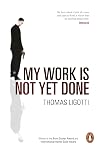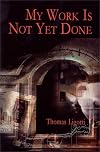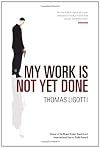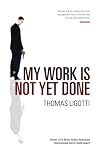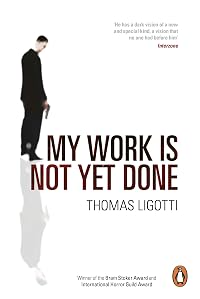
My Work Is Not Yet Done
by Thomas Ligotti
On This Page
Description
When junior manager Frank Dominio is suddenly demoted and then sacked it seems there was more than a grain of truth to his persecution fantasies. But as he prepares to even the score with those responsible for his demise, he unwittingly finds an ally in a dark and malevolent force that grants him supernatural powers. Frank takes his revenge in the most ghastly ways imaginable - but there will be a terrible price to pay once his work is done.Destined to be a cult classic, this tale of show more corporate horror and demonic retribution will strike a chord with anyone who has ever been disgruntled at work. show lessTags
Recommendations
















Member Reviews
Two of these "three tales of corporate horror" will fascinate many of those who have spent time as symbol manipulators in the offices of large corporations.
The collection's titular short novel and "I Have a Special Plan for This World" expand on the themes of "Our Temporary Supervior" and "The Town Manager", two of the best stories in Ligotti's Teatro Grottesco. The narrators here work for companies whose ultimate goal is to produce nothing or baleful somethings and undertake a literally inhuman replacement of their workforce, the logical end to all this being a structure that is more shaped by an invisible tentacle than capitalism's invisible hand.
The narrator of "My Work Is Not Yet Done" is a supervisor, Dominio by name though his show more boss Richard keeps calling him Domino. Said boss and six fellow supervisors become the target of Dominio's revenge after getting him fired from the company. But on the way back from the gun store in preparation for his upcoming rampage - and Ligotti has the narrator wryly and concisely sum up all the reasons usually given for such rampages, something mysterious happens. Dominio's vengeance takes an increasingly bizarre and supernatural turn, the world literally darkening with each killing. The novel ends with a surprising confrontation with Richard and attendant revelations.
The company employing the narrator of "I Have a Special Plan for This World" specializes in "manipulating documents", and its founder undertakes an ambitious plan to become a "dominant presence in the world marketplace" via a radical restructuring. And, soon, supervisors and employees show up dead - all unremarked upon under the yellowing skies of Golden City, formerly known as Murder Town before Chamber of Commerce rebranding.
Both these stories are told with Ligotti's precision prose with its deliberate, incantory repetitions. Besides sinister companies, these stories have other characteristic Ligotti images: doppelgangers of a sort, puppets and mannequins, settings specifically described but tied to nothing in the real world, and abandoned buildings. In these stories, cosmic horror touches us in the work place, the horror of a meaningless existence underpinned by dark, malevolent forces. Ligotti's world is dark, nihilistic to the core. These stories are not tragedies since that implies competing goods. There is no good in these stories, no joys shortened by the encroaching horror. But Ligotti's style makes them palatable. As well as the rage and isolation, there is dark wit in "My Work Is Not Yet Done". However, I think he makes a slight plot misstep by introducing a too banal motive for the Seven, and Dominio's frequent use of the derogatory "swine" seems too antiquated for a narrator, unlike many of Ligotti's, who inhabitants an explicitly contemporary setting.
The third story, "The Nightmare Network", is a fairly radical departure in Ligotti's style. It reminded me somewhat of the condensed novels of J. G. Ballard. Frankly, I found the story of two megacorporations seemingly warring across time, largely incomprehensible. However, I did like the ending with the companies allegedly merging at end, but it really being a cover for espionage, subversion, and double agentry - another Ligotti parable for life I suspect. An interesting failure. show less
The collection's titular short novel and "I Have a Special Plan for This World" expand on the themes of "Our Temporary Supervior" and "The Town Manager", two of the best stories in Ligotti's Teatro Grottesco. The narrators here work for companies whose ultimate goal is to produce nothing or baleful somethings and undertake a literally inhuman replacement of their workforce, the logical end to all this being a structure that is more shaped by an invisible tentacle than capitalism's invisible hand.
The narrator of "My Work Is Not Yet Done" is a supervisor, Dominio by name though his show more boss Richard keeps calling him Domino. Said boss and six fellow supervisors become the target of Dominio's revenge after getting him fired from the company. But on the way back from the gun store in preparation for his upcoming rampage - and Ligotti has the narrator wryly and concisely sum up all the reasons usually given for such rampages, something mysterious happens. Dominio's vengeance takes an increasingly bizarre and supernatural turn, the world literally darkening with each killing. The novel ends with a surprising confrontation with Richard and attendant revelations.
The company employing the narrator of "I Have a Special Plan for This World" specializes in "manipulating documents", and its founder undertakes an ambitious plan to become a "dominant presence in the world marketplace" via a radical restructuring. And, soon, supervisors and employees show up dead - all unremarked upon under the yellowing skies of Golden City, formerly known as Murder Town before Chamber of Commerce rebranding.
Both these stories are told with Ligotti's precision prose with its deliberate, incantory repetitions. Besides sinister companies, these stories have other characteristic Ligotti images: doppelgangers of a sort, puppets and mannequins, settings specifically described but tied to nothing in the real world, and abandoned buildings. In these stories, cosmic horror touches us in the work place, the horror of a meaningless existence underpinned by dark, malevolent forces. Ligotti's world is dark, nihilistic to the core. These stories are not tragedies since that implies competing goods. There is no good in these stories, no joys shortened by the encroaching horror. But Ligotti's style makes them palatable. As well as the rage and isolation, there is dark wit in "My Work Is Not Yet Done". However, I think he makes a slight plot misstep by introducing a too banal motive for the Seven, and Dominio's frequent use of the derogatory "swine" seems too antiquated for a narrator, unlike many of Ligotti's, who inhabitants an explicitly contemporary setting.
The third story, "The Nightmare Network", is a fairly radical departure in Ligotti's style. It reminded me somewhat of the condensed novels of J. G. Ballard. Frankly, I found the story of two megacorporations seemingly warring across time, largely incomprehensible. However, I did like the ending with the companies allegedly merging at end, but it really being a cover for espionage, subversion, and double agentry - another Ligotti parable for life I suspect. An interesting failure. show less
This was an interesting one for me. Ligotti is an author who can consistently be counted on to utterly confound my expectations.
I came into this one knowing it was a workplace revenge tale, and I fully expected it to go to some very weird places.
And the damn thing is, it does. It gets very weird. But, I don't know if it was a different direction of weird, or that it was too weird, or not weird enough. I will say that there were times when it felt almost a little undercooked. For example, Ligotti has Detectives Black and White jumping all over the case for a bit, then they just kind of...go away.
There's times when truly bizarre stuff happens—this IS Ligotti, after all—and the weirdness is not really addressed for pages and pages and show more pages afterward. That part? I'm fine with that. But it's the fact that Ligotti sorta kinda alludes that this is weird and there's probably an explanation, but then basically says, whatever that explanation is, we don't know it.
I'd have almost preferred that he just let it be bizarre without even considering an explanation.
Finally, I do have to say that he paints a very accurate depiction of the corporate world, right down to the "let's reorganize just for the sake of reorganization" and "we only work to make the most money off the least product" things. Very well observed.
So, in the end, I guess Ligotti was successful in confounding my expectations yet again. I guess I was just hoping for more impact with that. Definitely not my favourite by him. show less
I came into this one knowing it was a workplace revenge tale, and I fully expected it to go to some very weird places.
And the damn thing is, it does. It gets very weird. But, I don't know if it was a different direction of weird, or that it was too weird, or not weird enough. I will say that there were times when it felt almost a little undercooked. For example, Ligotti has Detectives Black and White jumping all over the case for a bit, then they just kind of...go away.
There's times when truly bizarre stuff happens—this IS Ligotti, after all—and the weirdness is not really addressed for pages and pages and show more pages afterward. That part? I'm fine with that. But it's the fact that Ligotti sorta kinda alludes that this is weird and there's probably an explanation, but then basically says, whatever that explanation is, we don't know it.
I'd have almost preferred that he just let it be bizarre without even considering an explanation.
Finally, I do have to say that he paints a very accurate depiction of the corporate world, right down to the "let's reorganize just for the sake of reorganization" and "we only work to make the most money off the least product" things. Very well observed.
So, in the end, I guess Ligotti was successful in confounding my expectations yet again. I guess I was just hoping for more impact with that. Definitely not my favourite by him. show less
Frank Dominio is Dotoevsky's Underground Man reincarnated with demonic powers, and far more cynical and suicidal. As someone who recently had an acrimonious break with an employer, the satire resonated with me. This is the first I've read of Ligotti, and he lives up to his bleak reputation; it definitely won't be the last I read of him.
This book did, in all honesty, give, or at least contribute to, nightmares. The sheer viciousness of the evil acts of the protagonist of the main novella might be enough to do that for some people ... but the real nightmare, as always with Ligotti, lies in his dark vision of existence.
My more considered opinion on Thomas Ligotti's place in contemporary culture is to be found elsewhere - http://asithappens.tppr.info/journal/2008/9/12/literature-as-catharsis-the-place.... - but this book adds to the canon.
The book is slim - really it is a novella with two short stories attached, culled from previous journal publication. Ligotti does not do extended narrative in general.
He is not entirely comfortable with plot or characterisation though show more he is not bad at it either. The main title 'My Work Is Not Yet Done' seems to stretch him to his limits though it cannot be said that he fails in what he wishes to achieve.
As always, we are wary of spoilers so the main guidelines here are that these stories take us into the world of the modern corporation which he has handled elsewhere - see our review at http://www.goodreads.com/book/show/2452401.Teatro_Grottesco - but that the horror is more obviously cosmic.
These may be counted as tales of both demonic possession and of human evil. The novella in its first section gets closer imaginatively to the mind-set of a person 'going postal' than anything I have read before (although I suspect no killer is quite this self aware).
What Ligotti does is turn creation into a 'great black swine', a blind thrashing animal of destruction, while everything that we do with our consciousness is just a puppet play, theatre: " ... only costumes and masks, the inventory of an ancient and still flourishing theatrical supply company'.
In this world, the obsessive-compulsive personality (as he refers to it) simply wants to tidy things up. Things can only be tidied if everything is destroyed. This stance is truly pathological and not within the normal imaginative range of the vast majority of non-adolescent humanity but he takes 'rage against the machine' and recrafts it.
Ligotti's use of the corporation as the site for his horrors (with the caveats outlined below) is not quite so modern as it appears. Big lumbering corporations are now being displaced by the very different creative chaos of the internet, much as industrial society had long since replaced the castles by the time that castles had become the centre of Gothic writing.
Horror, even Stephen King's small town settings, generally positions itself in what is passing, even when the subject is future apocalypse, and less frequently in what is now or is to come.
It is as if horror writers are anxious about being confused with their brother, dystopian science fiction. They must articulate one of the primal cores of their art - anxiety about change and modernisation. To do that, they have to set the horror where things are being lost and not where they are being created.
However, in his final short tale ['The Nightmare Network':], Ligotti does switch gear with a deliberately confused picture of all human consciousness as struggling brutal competition within one massive oneiric/nightmare corporation spreading outwards - reversing his usual Lovecraftian position that brute cosmic matter, working out its 'swinish' anti-human destiny, is the blackness of evil in order to make its counterpart, collective human consciousness, equally chaotic, cruel and expansionist.
By this point, while he does not state this, his world-view seems to shift from humans as puppets in a black universe to that black universe and the collective of humanity competing to be chaotic evil - doubling the chaos and doubling the horror.
And the role of the person in all this? "I - and you - now understood: We would be pulled back into the flowing blackness only when we had done all the damage we were allowed to do, only when our work is done. The work of you against me ... and me against you."
Mind you, anyone who is not American and who has worked 'with' or for Americans in business and politics will know what he is getting at. American individualism can seem incredibly counter-productive and unnecessarily time-consuming. No wonder American executives rarely get a proper holiday ...
Between the main novella and the 'oneiric' nightmare lies a more familiar style of Ligotti story ['I Have A Special Plan For The World':] bridging the tale of the demonisation of the human and the demonic nature of the human with a sense of the demonic in the world, a demonic that may not be human at all.
The story is worth reading just for the use of the metaphor of haze, a worthy successor to Dickens' use of fog in 'Bleak House'. It is the obfuscation, crass politics and isolation of life in that sort of corporation where things just happen and one knows not why. The blurring of perception and ignorance are made physical in the most remarkable way.
As the story progresses, the haze is linked to the construction of a false (whether theatrical or public relations) reality by corporatism to cover up what actually happens in the world - in this case, 'murders'. This is a very subtle story, if written in that formal style that, derived from Poe and Lovecraft, positions Ligotti within a specific tradition.
Taken as a whole, in this book we have a ruthless competitive individualism (people only combine to effect a conspiracy) operating within seas of ignorance although, by placing detectives and waitresses outside this system, Ligotti uncharacteristically suggests that, though no doubt swine' at their core, 'ordinary people' at least are not directly complicit in this machinery of corporate horror.
Ligotti appears to hate any claim to organisation whatsoever and sees it as lying cover for underlying soul-destroying chaos (yep, he has definitely had a job in a real Western capitalist corporation!). His contempt for the expansionary and acquisitive plans of the various corporations and executives in his stories are manifest in this volume.
Although written at the height of global happy-clappy capitalist Friedmanism in 2002, their release more widely by Random House in 2009 might well express a new mood after the credit crunch has created a growing sense of a capitalist system out of control and run by incompetent buffoons.
Let us return to the third story to get a feel for this. A 'Memo from the CEO' states: "As the forces operating in today's marketplace become more shadowy and incomprehensible we must recommit ourselves every second of our day to a ceaseless striving for that elusive dream which we all share and which none of us can remember, if it ever existed in the first place." Yes, well, that pretty well fits corporate life for many people.
The last two pages of the last story pull together these themes in a transition from horror to science fiction, a flip from a Lovecraftian resistance to the modern and to a dark observation of where we are heading ... I won't spoil it. show less
My more considered opinion on Thomas Ligotti's place in contemporary culture is to be found elsewhere - http://asithappens.tppr.info/journal/2008/9/12/literature-as-catharsis-the-place.... - but this book adds to the canon.
The book is slim - really it is a novella with two short stories attached, culled from previous journal publication. Ligotti does not do extended narrative in general.
He is not entirely comfortable with plot or characterisation though show more he is not bad at it either. The main title 'My Work Is Not Yet Done' seems to stretch him to his limits though it cannot be said that he fails in what he wishes to achieve.
As always, we are wary of spoilers so the main guidelines here are that these stories take us into the world of the modern corporation which he has handled elsewhere - see our review at http://www.goodreads.com/book/show/2452401.Teatro_Grottesco - but that the horror is more obviously cosmic.
These may be counted as tales of both demonic possession and of human evil. The novella in its first section gets closer imaginatively to the mind-set of a person 'going postal' than anything I have read before (although I suspect no killer is quite this self aware).
What Ligotti does is turn creation into a 'great black swine', a blind thrashing animal of destruction, while everything that we do with our consciousness is just a puppet play, theatre: " ... only costumes and masks, the inventory of an ancient and still flourishing theatrical supply company'.
In this world, the obsessive-compulsive personality (as he refers to it) simply wants to tidy things up. Things can only be tidied if everything is destroyed. This stance is truly pathological and not within the normal imaginative range of the vast majority of non-adolescent humanity but he takes 'rage against the machine' and recrafts it.
Ligotti's use of the corporation as the site for his horrors (with the caveats outlined below) is not quite so modern as it appears. Big lumbering corporations are now being displaced by the very different creative chaos of the internet, much as industrial society had long since replaced the castles by the time that castles had become the centre of Gothic writing.
Horror, even Stephen King's small town settings, generally positions itself in what is passing, even when the subject is future apocalypse, and less frequently in what is now or is to come.
It is as if horror writers are anxious about being confused with their brother, dystopian science fiction. They must articulate one of the primal cores of their art - anxiety about change and modernisation. To do that, they have to set the horror where things are being lost and not where they are being created.
However, in his final short tale ['The Nightmare Network':], Ligotti does switch gear with a deliberately confused picture of all human consciousness as struggling brutal competition within one massive oneiric/nightmare corporation spreading outwards - reversing his usual Lovecraftian position that brute cosmic matter, working out its 'swinish' anti-human destiny, is the blackness of evil in order to make its counterpart, collective human consciousness, equally chaotic, cruel and expansionist.
By this point, while he does not state this, his world-view seems to shift from humans as puppets in a black universe to that black universe and the collective of humanity competing to be chaotic evil - doubling the chaos and doubling the horror.
And the role of the person in all this? "I - and you - now understood: We would be pulled back into the flowing blackness only when we had done all the damage we were allowed to do, only when our work is done. The work of you against me ... and me against you."
Mind you, anyone who is not American and who has worked 'with' or for Americans in business and politics will know what he is getting at. American individualism can seem incredibly counter-productive and unnecessarily time-consuming. No wonder American executives rarely get a proper holiday ...
Between the main novella and the 'oneiric' nightmare lies a more familiar style of Ligotti story ['I Have A Special Plan For The World':] bridging the tale of the demonisation of the human and the demonic nature of the human with a sense of the demonic in the world, a demonic that may not be human at all.
The story is worth reading just for the use of the metaphor of haze, a worthy successor to Dickens' use of fog in 'Bleak House'. It is the obfuscation, crass politics and isolation of life in that sort of corporation where things just happen and one knows not why. The blurring of perception and ignorance are made physical in the most remarkable way.
As the story progresses, the haze is linked to the construction of a false (whether theatrical or public relations) reality by corporatism to cover up what actually happens in the world - in this case, 'murders'. This is a very subtle story, if written in that formal style that, derived from Poe and Lovecraft, positions Ligotti within a specific tradition.
Taken as a whole, in this book we have a ruthless competitive individualism (people only combine to effect a conspiracy) operating within seas of ignorance although, by placing detectives and waitresses outside this system, Ligotti uncharacteristically suggests that, though no doubt swine' at their core, 'ordinary people' at least are not directly complicit in this machinery of corporate horror.
Ligotti appears to hate any claim to organisation whatsoever and sees it as lying cover for underlying soul-destroying chaos (yep, he has definitely had a job in a real Western capitalist corporation!). His contempt for the expansionary and acquisitive plans of the various corporations and executives in his stories are manifest in this volume.
Although written at the height of global happy-clappy capitalist Friedmanism in 2002, their release more widely by Random House in 2009 might well express a new mood after the credit crunch has created a growing sense of a capitalist system out of control and run by incompetent buffoons.
Let us return to the third story to get a feel for this. A 'Memo from the CEO' states: "As the forces operating in today's marketplace become more shadowy and incomprehensible we must recommit ourselves every second of our day to a ceaseless striving for that elusive dream which we all share and which none of us can remember, if it ever existed in the first place." Yes, well, that pretty well fits corporate life for many people.
The last two pages of the last story pull together these themes in a transition from horror to science fiction, a flip from a Lovecraftian resistance to the modern and to a dark observation of where we are heading ... I won't spoil it. show less
Despite being a very short volume, this was a very satisfying book. Ligotti provides us with three stories: The first, the title story, is mostly realistic, concerning an office drone with scores to settle (or at least it starts that way). The second, "I Have a Special Plan for This World," drifts more into the realm of the fantastic dream-like millueu that Ligotti used so effectively in Grimscribe. The third, "The Nightmare Network," is in the experimental style which I have not seen Ligotti use since "Professor Nobody's Little Lectures on Supernatural Horror" and is made up of a series of memos, short scenes, press releases, ending with the most cosmically nihilistic ending I have ever read. Ligotti's use of divergent story-telling show more styles allows him to tell three tales of horror in the workplace from three very different angles. I also think there was a certain direction to the order of stories, moving from the personal to the universal.
The first story (MWINYD) appears to be at first a story of a man, Frank, who doesn't completely fit in among his peers at work, gets pushed out, then proceeds to "go postal." However, he undergoes a sudden transformation which places him in an ontologically indeterminable state; far from stopping his vengance, it transforms it into something more fascinating. (This character is in some ways a throwback to the evil first person narrators of early Ligotti, ie. "The Chymists", "The Eyes of the Lynx," etc.)
However, it is not only Frank's victims who get bled, as Ligotti proceeds to eviscerate and mutilate every last bit of sympathy we could have, both for the narrator and the human race. It is one of Thom's strange talents that his writing appears to be able to move in two directions at once. (Witness for example, how he mocks the hackneyed quality of horror stories in "Nethescurial" as a way of setting up one of the most chilling horror stories I've ever read/listened to.) The less Frank insists that he deserves our sympathy or any sympathy whatsoever, the more interesting and engaging I found him. In some ways, Frank strikes me as analogous to the John Doe character from "The Frolic," full of evil, primal power yet fully aware of how little that means, all the more fascinating for his terrible self-awareness. show less
The first story (MWINYD) appears to be at first a story of a man, Frank, who doesn't completely fit in among his peers at work, gets pushed out, then proceeds to "go postal." However, he undergoes a sudden transformation which places him in an ontologically indeterminable state; far from stopping his vengance, it transforms it into something more fascinating. (This character is in some ways a throwback to the evil first person narrators of early Ligotti, ie. "The Chymists", "The Eyes of the Lynx," etc.)
However, it is not only Frank's victims who get bled, as Ligotti proceeds to eviscerate and mutilate every last bit of sympathy we could have, both for the narrator and the human race. It is one of Thom's strange talents that his writing appears to be able to move in two directions at once. (Witness for example, how he mocks the hackneyed quality of horror stories in "Nethescurial" as a way of setting up one of the most chilling horror stories I've ever read/listened to.) The less Frank insists that he deserves our sympathy or any sympathy whatsoever, the more interesting and engaging I found him. In some ways, Frank strikes me as analogous to the John Doe character from "The Frolic," full of evil, primal power yet fully aware of how little that means, all the more fascinating for his terrible self-awareness. show less
(Reprinted from the Chicago Center for Literature and Photography [cclapcenter.com]. I am the original author of this essay, as well as the owner of CCLaP; it is not being reprinted illegally.)
Regular readers will remember that I recently read the new In the Mountains of Madness by W. Scott Poole, which is not just a biography of horror writer HP Lovecraft but also an examination of the "Lovecraftian" culture that has built up around his work since his death; and that got me interested not only in reading the entire oeuvre of Lovecraft for the first time (a process I'm in the middle of right now), but also checking out some of the contemporary authors who write in Lovecraft's vein, and who are helping to carry and extend the "Cthulhu show more Mythos" into the 21st century. So for advice with that I turned to an acquaintance of mine, Chicago horror author Richard Thomas; and among the other contemporary writers he encouraged me to sample was Thomas Ligotti, who I had already vaguely heard of as, alternatively, "The best horror writer you've never heard of" and "the horror writer all the other horror writers wished they were."
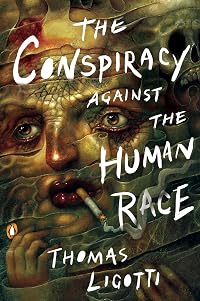
Several of his fictional works struck my fancy when first looking through his bibliography; but what stuck out much more in my mind when coming across it, and what I ended up taking on first, was actually a nonfiction book he wrote back in 2011 with the intriguing title The Conspiracy Against the Human Race. It's essentially a Philosophy 101 survey of all the various deep thinkers throughout history who have espoused what Ligotti calls a "philosophy of pessimism," which he then examines and weaves together to present a sort of unified narrative story about what all these philosophers had in common, and the 3,000-year-old lesson they've been trying to teach us the whole time. It essentially starts with the idea that no living creatures in the universe were ever meant to have self-sentient consciousness, and that the fact that humans do is actually an aberration and a curse, not some sort of gift from a benevolent god; because with this self-sentient consciousness, we're then compelled to spend our lives searching for a meaning to our existence, but are saddled with the knowledge that there is no meaning to existence, that the universe is quite simply an infinitely large void of constant chaos and random violence, bereft of any human-invented quality like "equality" or "fairness," and that each of our lives are nothing but insignificant specks in the cosmic scale, in which we change not a single thing about the universe in our lifetimes and then are promptly forgotten by the human race a mere generation or two after our deaths.
That's the "conspiracy" of the book's title, the idea that someone is perpetrating a grand cruel joke on humanity at all our expenses; for anyone who looks too closely at this unvarnished truth about the universe, one that we were born with the ability to easily see, ends up going violently insane (or in other words, suicide victims and serial killers are simply the people who see the universe as it really is), which means that to stay sane, productive members of society, we must literally spend our entire lives making up pretty little lies about existence (that there is a cosmic order to it, that there is an inherent sense of justice, that we were purposely born on this planet for a specific reason), and then spend every ounce of our energy brainwashing ourselves into believing these lies, despite the fact that we can quite easily see with our rational minds just how much we're deluding ourselves when we tell ourselves these things. That's essentially the basis behind every horror story ever written, Ligotti argues, the schism between the lies we tell ourselves about an orderly, fair universe and the unending parade of chaos and violence that we glimpse when we stop telling ourselves these lies; and he then spends the length of his book hopping from one famous thinker to another over the course of written history, showing how there have always been select philosophers and authors around, from the ancient Greeks to the Renaissance to the Victorian Age to now, who have used this same basic set of principles as the basis behind every treatise and manifesto they ever wrote.
Yeah, pretty dark and heady stuff, making it no surprise that True Detective creator Nic Pizzolatto has admitted in interviews that he based Matthew McConaughey's season 1 antihero Rush Cohle directly on the theories being discussed in this book; and it also goes a long way towards explaining why a genre writer like Ligotti cites as some of his favorite authors such surprising non-horror people as Arthur Schopenhauer, Vladimir Nabokov, and Samuel Beckett. So after this, then, I jumped right into the only book-length fictional piece Ligotti has ever written, 2002's My Work Is Not Yet Done, republished in 2009 for a larger audience by hipster British press Virgin Books (all the rest of his books are short-story collections), which unsurprisingly reads like a fictional version of all the nonfiction theories being banded about in Conspiracy. It's essentially the tale of an intellectual malcontent and mentally imbalanced loner working a faceless middle-management job at a blandly nondescript corporation; when he's railroaded by scheming co-workers into getting unfairly fired, he makes plans to launch into the violent act of retribution you would expect from such a person, but then a sudden dark cloud that envelops the city that night imbues him with a malevolent supernatural spirit that suddenly makes the story go in a much different and weirder direction.
I'll let the rest of this delightfully crackpot story remain a surprise, although I will mention that the scope of the narrative gets a lot bigger and grander than you would expect by the time the story is over, and that it's also obvious in this book why so many people call Ligotti the natural heir to Lovecraft and his obsession for all-powerful creatures who regard humans as little more than gnats to be flicked at in annoyance. What may be the most clever thing of all about about My Work, however, is that it's also an astute examination of the former industrial powerhouses of the American Midwest, and the ignoble corrosion they have faced in the post-Industrial age (Ligotti was born and raised in Detroit, and the unnamed city where My Work takes place feels an awful lot like it, although you could also substitute in such cities as Cleveland, Indianapolis or St. Louis), as well as a gleefully cynical takedown of the misguided attempts to transform these cities in the 21st century into shining creative-class destinations full of coffeehouses, bike paths and loft condos. (In fact, in a way you can see the main theme in My Work manifested as the question, "What if literal demons were behind the urban gentrification movement?")
It's been a darkly exhilarating experience for the last few weeks, being stuck so deep in Ligotti's unrelentingly nihilistic universe, a writer who after thirty years of professional publishing just now seems to be starting to come into his own as a popular public figure. (He's one of only ten living writers on the planet who's been republished by Penguin Classics, a feat which only happened a year and a half ago, at which point the Washington Post called him "the best-kept secret in contemporary horror fiction.") If you yourself are looking for a refreshingly chilling alternative to the played-out "ghosts in the suburbs" trope of Stephen King and other Postmodernist horror authors, I suggest you give Ligotti a whirl yourself. show less
Regular readers will remember that I recently read the new In the Mountains of Madness by W. Scott Poole, which is not just a biography of horror writer HP Lovecraft but also an examination of the "Lovecraftian" culture that has built up around his work since his death; and that got me interested not only in reading the entire oeuvre of Lovecraft for the first time (a process I'm in the middle of right now), but also checking out some of the contemporary authors who write in Lovecraft's vein, and who are helping to carry and extend the "Cthulhu show more Mythos" into the 21st century. So for advice with that I turned to an acquaintance of mine, Chicago horror author Richard Thomas; and among the other contemporary writers he encouraged me to sample was Thomas Ligotti, who I had already vaguely heard of as, alternatively, "The best horror writer you've never heard of" and "the horror writer all the other horror writers wished they were."
Several of his fictional works struck my fancy when first looking through his bibliography; but what stuck out much more in my mind when coming across it, and what I ended up taking on first, was actually a nonfiction book he wrote back in 2011 with the intriguing title The Conspiracy Against the Human Race. It's essentially a Philosophy 101 survey of all the various deep thinkers throughout history who have espoused what Ligotti calls a "philosophy of pessimism," which he then examines and weaves together to present a sort of unified narrative story about what all these philosophers had in common, and the 3,000-year-old lesson they've been trying to teach us the whole time. It essentially starts with the idea that no living creatures in the universe were ever meant to have self-sentient consciousness, and that the fact that humans do is actually an aberration and a curse, not some sort of gift from a benevolent god; because with this self-sentient consciousness, we're then compelled to spend our lives searching for a meaning to our existence, but are saddled with the knowledge that there is no meaning to existence, that the universe is quite simply an infinitely large void of constant chaos and random violence, bereft of any human-invented quality like "equality" or "fairness," and that each of our lives are nothing but insignificant specks in the cosmic scale, in which we change not a single thing about the universe in our lifetimes and then are promptly forgotten by the human race a mere generation or two after our deaths.
That's the "conspiracy" of the book's title, the idea that someone is perpetrating a grand cruel joke on humanity at all our expenses; for anyone who looks too closely at this unvarnished truth about the universe, one that we were born with the ability to easily see, ends up going violently insane (or in other words, suicide victims and serial killers are simply the people who see the universe as it really is), which means that to stay sane, productive members of society, we must literally spend our entire lives making up pretty little lies about existence (that there is a cosmic order to it, that there is an inherent sense of justice, that we were purposely born on this planet for a specific reason), and then spend every ounce of our energy brainwashing ourselves into believing these lies, despite the fact that we can quite easily see with our rational minds just how much we're deluding ourselves when we tell ourselves these things. That's essentially the basis behind every horror story ever written, Ligotti argues, the schism between the lies we tell ourselves about an orderly, fair universe and the unending parade of chaos and violence that we glimpse when we stop telling ourselves these lies; and he then spends the length of his book hopping from one famous thinker to another over the course of written history, showing how there have always been select philosophers and authors around, from the ancient Greeks to the Renaissance to the Victorian Age to now, who have used this same basic set of principles as the basis behind every treatise and manifesto they ever wrote.
Yeah, pretty dark and heady stuff, making it no surprise that True Detective creator Nic Pizzolatto has admitted in interviews that he based Matthew McConaughey's season 1 antihero Rush Cohle directly on the theories being discussed in this book; and it also goes a long way towards explaining why a genre writer like Ligotti cites as some of his favorite authors such surprising non-horror people as Arthur Schopenhauer, Vladimir Nabokov, and Samuel Beckett. So after this, then, I jumped right into the only book-length fictional piece Ligotti has ever written, 2002's My Work Is Not Yet Done, republished in 2009 for a larger audience by hipster British press Virgin Books (all the rest of his books are short-story collections), which unsurprisingly reads like a fictional version of all the nonfiction theories being banded about in Conspiracy. It's essentially the tale of an intellectual malcontent and mentally imbalanced loner working a faceless middle-management job at a blandly nondescript corporation; when he's railroaded by scheming co-workers into getting unfairly fired, he makes plans to launch into the violent act of retribution you would expect from such a person, but then a sudden dark cloud that envelops the city that night imbues him with a malevolent supernatural spirit that suddenly makes the story go in a much different and weirder direction.
I'll let the rest of this delightfully crackpot story remain a surprise, although I will mention that the scope of the narrative gets a lot bigger and grander than you would expect by the time the story is over, and that it's also obvious in this book why so many people call Ligotti the natural heir to Lovecraft and his obsession for all-powerful creatures who regard humans as little more than gnats to be flicked at in annoyance. What may be the most clever thing of all about about My Work, however, is that it's also an astute examination of the former industrial powerhouses of the American Midwest, and the ignoble corrosion they have faced in the post-Industrial age (Ligotti was born and raised in Detroit, and the unnamed city where My Work takes place feels an awful lot like it, although you could also substitute in such cities as Cleveland, Indianapolis or St. Louis), as well as a gleefully cynical takedown of the misguided attempts to transform these cities in the 21st century into shining creative-class destinations full of coffeehouses, bike paths and loft condos. (In fact, in a way you can see the main theme in My Work manifested as the question, "What if literal demons were behind the urban gentrification movement?")
It's been a darkly exhilarating experience for the last few weeks, being stuck so deep in Ligotti's unrelentingly nihilistic universe, a writer who after thirty years of professional publishing just now seems to be starting to come into his own as a popular public figure. (He's one of only ten living writers on the planet who's been republished by Penguin Classics, a feat which only happened a year and a half ago, at which point the Washington Post called him "the best-kept secret in contemporary horror fiction.") If you yourself are looking for a refreshingly chilling alternative to the played-out "ghosts in the suburbs" trope of Stephen King and other Postmodernist horror authors, I suggest you give Ligotti a whirl yourself. show less
I've read some of Ligotti's other work and been looking for more. That being said, the first two stories feel different in style and narration than his previous stories that I have read.
I think this book could really turn people off, but I also think there's some brilliant touches of dark humor in the first story in particular. The writing style, flow, and even the printing of the book all reminded me of some of the less than wonderful management books I have read that have been full of crap. I don't know of Ligotti intended to satire books like Managing by Values, Who Moved My Cheese or if it's just due to the nature of the material.
If, like me, you occasionally need a break from consultants and management styles, the first story in show more this book is a humorous, but incredibly disturbing and violent dark wish fulfillment. show less
I think this book could really turn people off, but I also think there's some brilliant touches of dark humor in the first story in particular. The writing style, flow, and even the printing of the book all reminded me of some of the less than wonderful management books I have read that have been full of crap. I don't know of Ligotti intended to satire books like Managing by Values, Who Moved My Cheese or if it's just due to the nature of the material.
If, like me, you occasionally need a break from consultants and management styles, the first story in show more this book is a humorous, but incredibly disturbing and violent dark wish fulfillment. show less
Members
- Recently Added By
Lists

Weird and Weirder Fiction
270 works; 35 members

Ten+ Books About the Afterlife
13 works; 2 members

Bram Stoker Award
238 works; 5 members
Author Information

82+ Works 6,247 Members
Awards and Honors
Series
Belongs to Publisher Series
Common Knowledge
- Canonical title
- My Work Is Not Yet Done
- People/Characters
- Frank Dominio; Lillian Hayes; Perry Stokowski; Sherry Mercer; Harry Smith-Jones; Barry Edwins (show all 13); Mary Dreller; Kerrie Keene; Henry Winston; U. G. Blaine; Ian Macbean; J. B. Carper; Philip Browning
Classifications
Statistics
- Members
- 465
- Popularity
- 65,696
- Reviews
- 15
- Rating
- (3.81)
- Languages
- English, German, Italian
- Media
- Paper, Ebook
- ISBNs
- 6
- UPCs
- 1
- ASINs
- 4