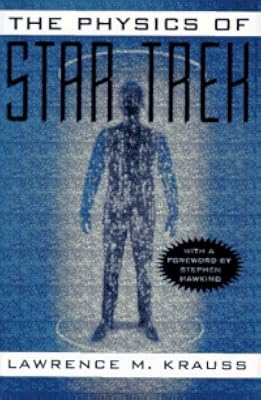
The Physics of Star Trek
by Lawrence M. Krauss
On This Page
Description
Fully revised and updated to include the latest discoveries in cosmic scienceTags
Recommendations





















Member Recommendations


fulner Rolling Stones predates Star Trek by 15 years. Yet the story of the Martian Flat Cat is so similar to the "Trouble with Tribbles" I can't imagine it wasn't referenced. The Rolling Stones deals with math, like real math, on how the space travel is possible. It is great and I think if you like Star Trek, especially the science of Star Trek, this is for you.
Member Reviews
One could almost believe this book is contemporary, with the recent Star Trek reboot movie bringing Trek back into popular culture, but alas, this book is from 1995. (It would have been really interesting to see what Krauss would have done with all that black hole sloppiness in J.J. Abram's movie.) But I finally got around to reading this, partially thanks to the TBR pile and Science reading challenges. It's not good to let books sit ignored for so long!
Reading this book, as with most popular science books, was an interesting experience. At one time, not so far distant, I had a really good grasp on most of the concepts explored in this book. But really, it's been years since I've thought of most of it in any sort of sustained way. So on show more one level, it was a light and interesting romp through some of the most profound concepts of physics, using the storytelling of the Trek universe to illustrate the implications. But on another level, I kept getting stuck, demanding my brain return to an earlier condition in which all of this was as native and easy to understand as my frivolous Facebook game strategies are now. But that state is hard to achieve when you're only getting to read the book in two-minute snatches, having to reread as much to remember where you were as you read new in any given sitting.
Sigh.
This book is dated and yet not. Engaging and easy one moment and mind-twisting the next. It would be very interesting to see an updated edition -- to bring into account the new movie as well as the detectors that Krauss mentions being built as he is writing that now have recently started producing interesting results. Amazon suggests there is a Kindle version revised in 2007, but the movie came out in 2009. I say another edition is due!
Interesting, but I will probably be releasing into the wilds of paperbackswap, as I have plenty of other reference physics texts. show less
Reading this book, as with most popular science books, was an interesting experience. At one time, not so far distant, I had a really good grasp on most of the concepts explored in this book. But really, it's been years since I've thought of most of it in any sort of sustained way. So on show more one level, it was a light and interesting romp through some of the most profound concepts of physics, using the storytelling of the Trek universe to illustrate the implications. But on another level, I kept getting stuck, demanding my brain return to an earlier condition in which all of this was as native and easy to understand as my frivolous Facebook game strategies are now. But that state is hard to achieve when you're only getting to read the book in two-minute snatches, having to reread as much to remember where you were as you read new in any given sitting.
Sigh.
This book is dated and yet not. Engaging and easy one moment and mind-twisting the next. It would be very interesting to see an updated edition -- to bring into account the new movie as well as the detectors that Krauss mentions being built as he is writing that now have recently started producing interesting results. Amazon suggests there is a Kindle version revised in 2007, but the movie came out in 2009. I say another edition is due!
Interesting, but I will probably be releasing into the wilds of paperbackswap, as I have plenty of other reference physics texts. show less
About sixteen years old, some of the commentary here features the present absence of later advances on exoplanets, etc. However, it is still an enjoyable romp through science-related plot points of Star Trek movies and series including Deep Space Nine and Voyager. Much of the focus is on relativistic realities around distance and time (the universe is bigger than even this cinematic universe suggests) as well as electromagnetic properties such as no one would really be able to see a phase blast if it is an energy beam and not a particle beam, etc.
When I read this book, as I have done from time to time the last year, I can't avoid being struck by how much our understanding of space has changed in just a decade. Or possibly Krauss' understanding was already a bit dated.
To start from the beginning, the book compares physics as described in Star Trek, movies and TV series, and physics as we understand it, including theories that are not known or even thought to be true. Sometimes Star Trek is strangely close to concurrent or even later discoveries, and sometimes ideas will violate everything we know.
The value of the book is mostly hearing about what is possible and not, and about our understanding of the universe, but for that I can't recommend the book. It's somewhat entertaining, show more but why not spend the time with [b:A Short History of Nearly Everything|21|A Short History of Nearly Everything|Bill Bryson|https://d2arxad8u2l0g7.cloudfront.net/books/1433086293s/21.jpg|2305997] instead?
The book concludes with a short chapter about things the Star Trek directors and writers got completely wrong. Maybe the most interesting chapter because it mentioned something I have been annoyed at. How do we see laser beams and how do we hear explosions? show less
To start from the beginning, the book compares physics as described in Star Trek, movies and TV series, and physics as we understand it, including theories that are not known or even thought to be true. Sometimes Star Trek is strangely close to concurrent or even later discoveries, and sometimes ideas will violate everything we know.
The value of the book is mostly hearing about what is possible and not, and about our understanding of the universe, but for that I can't recommend the book. It's somewhat entertaining, show more but why not spend the time with [b:A Short History of Nearly Everything|21|A Short History of Nearly Everything|Bill Bryson|https://d2arxad8u2l0g7.cloudfront.net/books/1433086293s/21.jpg|2305997] instead?
The book concludes with a short chapter about things the Star Trek directors and writers got completely wrong. Maybe the most interesting chapter because it mentioned something I have been annoyed at. How do we see laser beams and how do we hear explosions? show less
“The curvature of spacetime is determined by the distribution of matter and energy in the universe, but this distribution is in turn governed by the curvature of space. It is like the chicken and the egg. Which was there first? Matter acts as the source of curvature, which in turn determines how matter evolves, which in turn alters the curvature, and so on. Indeed, this may be perhaps the most important single aspect of general relativity as far as Star Trek concerned. [...] It is these exotic possibilities [which general relativity does not rule out] that are the grist of Star Trek’s mill.”
In “The Physics of Star Trek” Lawrence M. Krauss
Teleporting an object using entangled particles involves taking it apart, transferring the show more state of each sub-atomic particle to the receiving end, than building duplicate atoms to assemble a duplicate object using those particles. The duplicate would be identical to the original, but a ridiculous amount of computing power is required to keep track of which bit goes where and enough separated entangled particles need to be in storage at each end to disintegrate the original and to build the duplicate. And also we’d need lots of energy to make it happen like Krauss states. The original is destroyed in the process. Call me a luddite, but I think I will stick with my car.
Strangely, Krauss does not say anything about Quantum Entanglement. There is a perfectly good term for quantum entanglement- it's quantum entanglement! This doesn't effectively transport the particle, it is only a transfer of a quantum state. If you're looking for some decent science stuff, I can sell you an article on a perpetual motion machine that's guaranteed to work and has been proven to generate more energy than put in. It's only the petrol industry blocking it that has stopped me publishing it before.
Quantum entanglement has been amply demonstrated, though were the applied science will take us remains to be seen. I think that calling it "teleportation" raises images that are misleading. I'm not a physicist but it seems to me that entanglement is unaffected by distance, at least on the scales we have observed. It's not technically moving anything (except apparently information) even though it is linked to what can be observed from quantum objects in another place. That's the spooky part. That's somewhat reminiscent of Star Trek, but mostly different.
In Krauss’s book it's not so much that everything is explained, because it talks about things that are unknown. It's that it gives hints of how to think about these things: it's a good read, and though it needs attention, it's meant for a general audience (not just for the Trekkie; as an obsessed but ineffectual hacker I can't believe I've been wasting my time whenever I've tried to eavesdrop to measure photons’ states without disturbing them and revealing their presence when all the while it's been impossible. Back to the drawing board).
After a youth watching Star Trek, one of the biggest disappointments of my life is that we cannot teleport…was so looking forward to it (or after a youth watching Star Trek one of the biggest disappointments of my life is that the crew did not have to teleport naked.. was so looking forward to it too).
But in the end, forget about Krauss' book in terms of Quantum Entanglement and the understanding Teleporting. Think of it like this: you and your wife say goodbye in the morning and leave home from work. When you arrive at work you realise that you forgot to put the rubbish out that morning. At that exact moment your wife rings you to tell you that you forgot to put the rubbish out. That's quantum entanglement for you. The word 'teleportation' is really unhelpful, because of its Star Trek connotations. It's nothing like that. 'Entanglement' is a bit like a spinning coin - both sides are present but unresolved. In entanglement one might say two particles are linked in an analogous way. Stop one that shows 'heads' and you instantly know the other shows 'tails'. Oh, and you only know that if a classical (e.g. radio) signal is sent to communicate the fact - hence ensuring that nothing exceeds the speed of light. People believe whatever they want to believe. Facts don't mean anything. It's all about feeling and when you say something people don't want to hear, they won't hear it, no matter how much sense it would make with all feelings set aside.
Krauss also dabbles in the fine-tuning argument which is something close to his hearth... One of the fundamental problems with the fine tuning argument is that it relies on the language of odds - i.e. that the odds of such a finely balanced universe are so fantastically small as to warrant a divine creator. But the concept of odds only makes sense if you have a number of cases to compare - e.g. you calculate the odds that somebody might die from smoking by studying numerous individuals in control groups over an extended period of time. But when it comes to the universe we can only observe one. So it might well be that there are millions of other universes and that ours is the only one capable of supporting life - in which case the fine tuning argument works. But it might also be the case that they can all support life, in which case it fails. But we could only work out the odds by observing them. And since we can't, all talk of odds - and hence the fine tuning argument - is pointless. Personally I prefer the infinite improbability drive… Or maybe even that is already outdated. Bistromaths is the way forward now. Maybe that forms the theoretical basis of the infinite improbability drive… I saw a puddle the other day. It was sitting in a pot hole, and the hole was exactly the shape of the puddle sitting in it. Honestly, that hole was precisely fine-tuned for that puddle. There is no other explanation.
NB: Something between teleportation and entangled quantum states was a basis for Clifford Simak's 1963 novel “Way Station” (does anyone still remember this novel?). The 'original' galactic traveler remains at origin. The original body dies in situ at origin. At destination, the 'copy' galactic traveler continues life. This was the routine means of transport for an individual over long distances. One of the fundamental problems with the fine tuning argument is that it relies on the language of odds - i.e. that the odds of such a finely balanced universe are so fantastically small as to warrant a divine creator. But the concept of odds only makes sense if you have a number of cases to compare - e.g. you calculate the odds that somebody might die from smoking by studying numerous individuals in control groups over an extended period of time. But when it comes to the universe we can only observe one. So it might well be that there are millions of other universes and that ours is the only one capable of supporting life - in which case the fine tuning argument works. But it might also be the case that they can all support life, in which case it fails. But we could only work out the odds by observing them. And since we can't, all talk of odds - and hence the fine tuning argument - is pointless. A more interesting metaphor might be finding a puddle in a pot hole in an otherwise infinite near-flat plane (e.g. z = -exp( -(x^2+y^2) ) ) and when you calculate all other possible universes it turns out they are exactly flat. That makes us feel lucky in a way that physicists are uncomfortable with because, historically, whenever we've appeared to be that special, it turns out we've misunderstood the physics. Right Krauss?
NB: For anyone interested, Feynman's "The Character of Physical law" goes into this in a relatively clear way, where I say "relatively (and no pun intended) because nobody understands it, and his explanation is about as clear as one can get without knowing why it happens. Feynman shows it can't be any other way - the entanglement, that is. Except he doesn't exactly talk of entanglement, he talks about simultaneous events (around page 64 and then page 92). show less
In “The Physics of Star Trek” Lawrence M. Krauss
Teleporting an object using entangled particles involves taking it apart, transferring the show more state of each sub-atomic particle to the receiving end, than building duplicate atoms to assemble a duplicate object using those particles. The duplicate would be identical to the original, but a ridiculous amount of computing power is required to keep track of which bit goes where and enough separated entangled particles need to be in storage at each end to disintegrate the original and to build the duplicate. And also we’d need lots of energy to make it happen like Krauss states. The original is destroyed in the process. Call me a luddite, but I think I will stick with my car.
Strangely, Krauss does not say anything about Quantum Entanglement. There is a perfectly good term for quantum entanglement- it's quantum entanglement! This doesn't effectively transport the particle, it is only a transfer of a quantum state. If you're looking for some decent science stuff, I can sell you an article on a perpetual motion machine that's guaranteed to work and has been proven to generate more energy than put in. It's only the petrol industry blocking it that has stopped me publishing it before.
Quantum entanglement has been amply demonstrated, though were the applied science will take us remains to be seen. I think that calling it "teleportation" raises images that are misleading. I'm not a physicist but it seems to me that entanglement is unaffected by distance, at least on the scales we have observed. It's not technically moving anything (except apparently information) even though it is linked to what can be observed from quantum objects in another place. That's the spooky part. That's somewhat reminiscent of Star Trek, but mostly different.
In Krauss’s book it's not so much that everything is explained, because it talks about things that are unknown. It's that it gives hints of how to think about these things: it's a good read, and though it needs attention, it's meant for a general audience (not just for the Trekkie; as an obsessed but ineffectual hacker I can't believe I've been wasting my time whenever I've tried to eavesdrop to measure photons’ states without disturbing them and revealing their presence when all the while it's been impossible. Back to the drawing board).
After a youth watching Star Trek, one of the biggest disappointments of my life is that we cannot teleport…was so looking forward to it (or after a youth watching Star Trek one of the biggest disappointments of my life is that the crew did not have to teleport naked.. was so looking forward to it too).
But in the end, forget about Krauss' book in terms of Quantum Entanglement and the understanding Teleporting. Think of it like this: you and your wife say goodbye in the morning and leave home from work. When you arrive at work you realise that you forgot to put the rubbish out that morning. At that exact moment your wife rings you to tell you that you forgot to put the rubbish out. That's quantum entanglement for you. The word 'teleportation' is really unhelpful, because of its Star Trek connotations. It's nothing like that. 'Entanglement' is a bit like a spinning coin - both sides are present but unresolved. In entanglement one might say two particles are linked in an analogous way. Stop one that shows 'heads' and you instantly know the other shows 'tails'. Oh, and you only know that if a classical (e.g. radio) signal is sent to communicate the fact - hence ensuring that nothing exceeds the speed of light. People believe whatever they want to believe. Facts don't mean anything. It's all about feeling and when you say something people don't want to hear, they won't hear it, no matter how much sense it would make with all feelings set aside.
Krauss also dabbles in the fine-tuning argument which is something close to his hearth... One of the fundamental problems with the fine tuning argument is that it relies on the language of odds - i.e. that the odds of such a finely balanced universe are so fantastically small as to warrant a divine creator. But the concept of odds only makes sense if you have a number of cases to compare - e.g. you calculate the odds that somebody might die from smoking by studying numerous individuals in control groups over an extended period of time. But when it comes to the universe we can only observe one. So it might well be that there are millions of other universes and that ours is the only one capable of supporting life - in which case the fine tuning argument works. But it might also be the case that they can all support life, in which case it fails. But we could only work out the odds by observing them. And since we can't, all talk of odds - and hence the fine tuning argument - is pointless. Personally I prefer the infinite improbability drive… Or maybe even that is already outdated. Bistromaths is the way forward now. Maybe that forms the theoretical basis of the infinite improbability drive… I saw a puddle the other day. It was sitting in a pot hole, and the hole was exactly the shape of the puddle sitting in it. Honestly, that hole was precisely fine-tuned for that puddle. There is no other explanation.
NB: Something between teleportation and entangled quantum states was a basis for Clifford Simak's 1963 novel “Way Station” (does anyone still remember this novel?). The 'original' galactic traveler remains at origin. The original body dies in situ at origin. At destination, the 'copy' galactic traveler continues life. This was the routine means of transport for an individual over long distances. One of the fundamental problems with the fine tuning argument is that it relies on the language of odds - i.e. that the odds of such a finely balanced universe are so fantastically small as to warrant a divine creator. But the concept of odds only makes sense if you have a number of cases to compare - e.g. you calculate the odds that somebody might die from smoking by studying numerous individuals in control groups over an extended period of time. But when it comes to the universe we can only observe one. So it might well be that there are millions of other universes and that ours is the only one capable of supporting life - in which case the fine tuning argument works. But it might also be the case that they can all support life, in which case it fails. But we could only work out the odds by observing them. And since we can't, all talk of odds - and hence the fine tuning argument - is pointless. A more interesting metaphor might be finding a puddle in a pot hole in an otherwise infinite near-flat plane (e.g. z = -exp( -(x^2+y^2) ) ) and when you calculate all other possible universes it turns out they are exactly flat. That makes us feel lucky in a way that physicists are uncomfortable with because, historically, whenever we've appeared to be that special, it turns out we've misunderstood the physics. Right Krauss?
NB: For anyone interested, Feynman's "The Character of Physical law" goes into this in a relatively clear way, where I say "relatively (and no pun intended) because nobody understands it, and his explanation is about as clear as one can get without knowing why it happens. Feynman shows it can't be any other way - the entanglement, that is. Except he doesn't exactly talk of entanglement, he talks about simultaneous events (around page 64 and then page 92). show less
Excellent discussion of how Star Trek (and its ilk) mangled physics generally, while managing to predict advances and use them before the scientists did.
Readers know that today’s science fiction often becomes tomorrow’s science fact. But how does “Star Trek” stack up against the real universe? As readers explore the concepts, they will discover what science the creators of the series got right . . . and not so right . . . in the “Star Trek” future. Written by a theoretical physicist, readers will find much to ponder in the discussion of physics as it is known today and the suggestions of what it might one day become.
For fans of the series as well as for those with an interest in physics, this is a voyage filled with fascination.
Recommended.
For fans of the series as well as for those with an interest in physics, this is a voyage filled with fascination.
Recommended.
Excellent scientific text, although it is somewhat out of date. I read it in the early 2010s as part of an honors assignment in my university physics class. I was a physics major, but the book doesn't contain the same level of detail as a book written for specialists; this book can be understood by non-physicists. For example, I am currently using this text with an 8th grader who loves science and wants to be an engineer. The author provides detailed explanations of the plausibility of the technology used in Star Trek. It is very interesting. Perfect gift for an educated Star Trek lover.
Members
- Recently Added By
Lists

Best Science Books for Non-Scientists
113 works; 57 members

Non-fiction that you shouldn't waste your time on
45 works; 15 members
Author Information

19+ Works 6,720 Members
Lawrence Krauss is a theoretical physicist. Krauss is professor of physics, Foundation Professor of the School of Earth and Space Exploration, and director of the Origins Project at Arizona State University. He is the only physicist to have received awards from all three major U.S. physics societies: the American Physical Society, the American show more Association of Physics Teachers, and the American Institute of Physics. Lawrence Krauss received undergraduate degrees in mathematics and physics from Carleton University and his Ph.D. in physics from MIT. Krauss taught at Yale University and was Chairman of the Physics Department at Case Western Reserve University. Krauss is the author of several bestselling books, including The Fifth Essence (1991), Fear of Physics (1994), The Physics of Star Trek (1995), Beyond Star Trek (1997), Quintessence (2001), Atom (2002), Hiding in the Mirror (2005), Quantum Man: Richard Feynman's Life in Science (2010), and A Universe from Nothing: Why There Is Something Rather Than Nothing (2012). (Bowker Author Biography) Lawrence M. Krauss is the bestselling author of "The Physics of Star Trek", among others. He received his Ph.D. in physics from MIT & now chairs the Department of Physics at Case Western Reserve University. (Publisher Provided) show less
Some Editions
Common Knowledge
- Canonical title
- The Physics of Star Trek
- Original title
- The Physics of Star Trek
- Original publication date
- 1995
- Epigraph
- "But I canna change the laws of physics, Captain!"
(Scotty, to Kirk, innumerable times) - Dedication
- To my family
- First words
- I was very pleased that Data decided to call Newton, Einstein, and me for a game of poker aboard the Enterprise.
Foreword
Why the physics of Star Trek?
Preface
You are at the helm of the starship Defiant (NCC-1764), currently in orbit around the planet Iconia, near the Neutral Zone. - Last words
- (Click to show. Warning: May contain spoilers.)"The human race is a remarkable creature, one with great potential, and I hope that Star Trek has helped to show us what we can be if we believe in ourselves and our abilities."
- Blurbers
- Hawking, Stephen
- Original language
- English
- Disambiguation notice
- This is not a part of the Star Trek series, but a book about the science of Star Trek.
Classifications
- Genres
- Science & Nature, General Nonfiction, Nonfiction
- DDC/MDS
- 791.4572 — Arts & recreation Recreation, sports, and performing arts Public performances Motion pictures, radio, television, podcasting Television Programs; television plays Single programs
- LCC
- QB500 .K65 — Science Astronomy Astronomy Descriptive astronomy Solar system
- BISAC
Statistics
- Members
- 2,170
- Popularity
- 9,430
- Reviews
- 18
- Rating
- (3.56)
- Languages
- 12 — Dutch, English, French, German, Greek, Hungarian, Italian, Polish, Portuguese, Croatian, Spanish, Swedish
- Media
- Paper, Audiobook, Ebook
- ISBNs
- 29
- ASINs
- 14