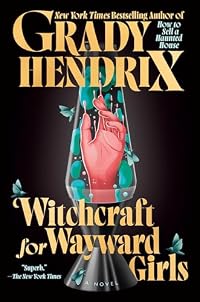
Witchcraft for Wayward Girls
by Grady Hendrix 
On This Page
Description
There’s power in a book…They call them wayward girls. Loose girls. Girls who grew up too fast. And they’re sent to Wellwood House in St. Augustine, Florida, where unwed mothers are hidden by their families to have their babies in secret, to give them up for adoption, and most important of all, to forget any of it ever happened.
Fifteen-year-old Fern arrives at the home in the sweltering summer of 1970, pregnant, terrified and alone. Under the watchful eye of the stern Miss show more Wellwood, she meets a dozen other girls in the same predicament. There’s Rose, a hippie who insists she’s going to find a way to keep her baby and escape to a commune. And Zinnia, a budding musician who plans to marry her baby’s father. And Holly, a wisp of a girl, barely fourteen, mute and pregnant by no-one-knows-who.
Everything the girls eat, every moment of their waking day, and everything they’re allowed to talk about is strictly controlled by adults who claim they know what’s best for them. Then Fern meets a librarian who gives her an occult book about witchcraft, and power is in the hands of the girls for the first time in their lives. But power can destroy as easily as it creates, and it’s never given freely. There’s always a price to be paid...and it’s usually paid in blood.
In Witchcraft for Wayward Girls, the author of How to Sell a Haunted House and The Final Girl Support Group delivers another searing, completely original novel and further cements his status as a “horror master” (NPR). show less
Tags
Recommendations



Member Reviews
WITCHCRAFT FOR WAYWARD GIRLS is Grady Hendrix's best novel so far. This is for several reasons. Sure, setting the story in a Pre-Roe and still segregated South helps with his messaging. There is just enough distance to comfortably declare that what happens is the past and things are better now. Yet, there is plenty of uncertainty today around women's rights, especially medical. This uncertainty creates a frisson of discomfort while reading.
To that, he layers on the fantastical elements of the story. He uses characters, one generation removed from enslavement and their strong belief system in Hoodooism, to build an atmosphere where it is difficult to separate fantasy and fiction, real and magic. Nothing of what the girls experience is show more implausible. If anything, you can logically explain every "otherworldly" scene in the book. But that setting, summer in the Deep South, living in an old plantation, a Mammy-like figure who is just as likely to smack you as help you but who firmly believes in magic, it all converges into a film that blurs the finest of details and makes the impossible possible.
If that weren't enough, Mr. Hendrix uses the real-life historical horrors of being unmarried and pregnant in the early seventies. While it is easy to say you understand the pressures women faced to remain "pure" and the depths to which society kept girls and women ignorant of simple biology. It is another thing entirely to see it happen over and over again, and that is just what Mr. Hendrix does.
It doesn't matter the age or the fact that the girl might have a serious boyfriend. Every girl is in that home because their family cannot bear the consequences of having an unwed pregnant daughter. It doesn't matter how a girl gets pregnant in WITCHCRAFT FOR WAYWARD GIRLS. There is no such thing as rape. Every girl got pregnant simply because they were wicked or bad or promiscuous or troubled or slutty. The levels of disgust you feel from Mr. Hendrix's words are beyond expectations.
Yet, for all those layers upon layers of the story he weaves into WITCHCRAFT FOR WAYWARD GIRLS, Mr. Hendrix's true magic lays in the mirror he holds up to the hypocrisy of a patriarchal, Christian, and righteous society. The only allies the girls have are each other and the one or two individuals they meet who do not conform to the patriarchal and Christian parts of that society. The girls face anger, disgust, condescension, fear, and a shit-ton of mansplaining almost every minute of every day, and therein lies the true horror of the story. It is not in the supernatural and scary parts of the story. It is in the fact that girls really did experience that smugness of religious "purity" and that we are one small step away from having to endure it all again.
I could go on to say how I loved how Mr. Hendrix played around with the narrator, sliding seamlessly from one point of view to another as the main character drifted into and around the action. I could say that the feelings Mr. Hendrix brings to the story are so vivid and so extreme that my stomach gets upset just thinking about certain scenes (SO. MUCH. ANGER. Deserved but still.) In the end, what makes WITCHCRAFT FOR WAYWARD GIRLS so impressive a story is that you could take away the witch stuff and it would still be a horror story. Because men have always been more vicious and crueler than any mythical beast, and they do so with smiles on their faces and benevolence in their hearts.
WITCHCRAFT FOR WAYWARD GIRLS was, for me, a novel that devoured me as much as I devoured it. The story took me in and spat me out, emotionally drained and terrified. Terrified of the past and what women went through simply to give birth, let alone if you were a teen mom-to-be. Petrified of a future that sees those sentiments, the ignorance, and the lack of agency arise again. Powerful. Masterful. WITCHCRAFT FOR WAYWARD GIRLS is a must-read for all. show less
To that, he layers on the fantastical elements of the story. He uses characters, one generation removed from enslavement and their strong belief system in Hoodooism, to build an atmosphere where it is difficult to separate fantasy and fiction, real and magic. Nothing of what the girls experience is show more implausible. If anything, you can logically explain every "otherworldly" scene in the book. But that setting, summer in the Deep South, living in an old plantation, a Mammy-like figure who is just as likely to smack you as help you but who firmly believes in magic, it all converges into a film that blurs the finest of details and makes the impossible possible.
If that weren't enough, Mr. Hendrix uses the real-life historical horrors of being unmarried and pregnant in the early seventies. While it is easy to say you understand the pressures women faced to remain "pure" and the depths to which society kept girls and women ignorant of simple biology. It is another thing entirely to see it happen over and over again, and that is just what Mr. Hendrix does.
It doesn't matter the age or the fact that the girl might have a serious boyfriend. Every girl is in that home because their family cannot bear the consequences of having an unwed pregnant daughter. It doesn't matter how a girl gets pregnant in WITCHCRAFT FOR WAYWARD GIRLS. There is no such thing as rape. Every girl got pregnant simply because they were wicked or bad or promiscuous or troubled or slutty. The levels of disgust you feel from Mr. Hendrix's words are beyond expectations.
Yet, for all those layers upon layers of the story he weaves into WITCHCRAFT FOR WAYWARD GIRLS, Mr. Hendrix's true magic lays in the mirror he holds up to the hypocrisy of a patriarchal, Christian, and righteous society. The only allies the girls have are each other and the one or two individuals they meet who do not conform to the patriarchal and Christian parts of that society. The girls face anger, disgust, condescension, fear, and a shit-ton of mansplaining almost every minute of every day, and therein lies the true horror of the story. It is not in the supernatural and scary parts of the story. It is in the fact that girls really did experience that smugness of religious "purity" and that we are one small step away from having to endure it all again.
I could go on to say how I loved how Mr. Hendrix played around with the narrator, sliding seamlessly from one point of view to another as the main character drifted into and around the action. I could say that the feelings Mr. Hendrix brings to the story are so vivid and so extreme that my stomach gets upset just thinking about certain scenes (SO. MUCH. ANGER. Deserved but still.) In the end, what makes WITCHCRAFT FOR WAYWARD GIRLS so impressive a story is that you could take away the witch stuff and it would still be a horror story. Because men have always been more vicious and crueler than any mythical beast, and they do so with smiles on their faces and benevolence in their hearts.
WITCHCRAFT FOR WAYWARD GIRLS was, for me, a novel that devoured me as much as I devoured it. The story took me in and spat me out, emotionally drained and terrified. Terrified of the past and what women went through simply to give birth, let alone if you were a teen mom-to-be. Petrified of a future that sees those sentiments, the ignorance, and the lack of agency arise again. Powerful. Masterful. WITCHCRAFT FOR WAYWARD GIRLS is a must-read for all. show less
I have loved every book written so far by Grady Hendrix. I love how perfectly he captures his southern settings (no shocker, considering he grew up here) and I’m consistently impressed by how well he writes women. His protagonists are usually southern women, and none of the creepy, leering, obsessed-with-her-looks kind of characterization here. Did he grow up with five sisters or something? Because he is SPOT ON, every time. These characters feel like women I know, women I grew up with.
This is even more impressive in Witchcraft for Wayward Girls. It’s 1970, and teenage girls who’re unwed and pregnant are sent by their ashamed families to group homes far away, to bear their children in secret before coming home to pretend nothing show more ever happened. (Thanks, complete lack of sex education!) Fern is one such unlucky girl, but she finds far more that summer at Wellwood House than she expected. She comes into possession of a book of witchcraft, and in a place where every hour of their day is tightly controlled, where every bite of food is strictly watched, the girls jump at the chance to claw back some semblance of control. But power is never free.
This feels like a different kind of horror than we usually get from Hendrix. It’s dark and occult, but I feel like the horror is more psychological and emotional. (Although there’s an element of physical terror/body horror that goes along with pregnancy, especially for an unprepared teenager, and how did a man capture that fear, from a woman's perspective, so well?!! Well done!!) This book is about betrayal, power, isolation, loss and grief, love, and found family. It was powerful, the ending was so perfect, and it’s a fantastic witchy horror.
Thank you NetGalley and Berkley Publishing Group for an advanced copy in exchange for my honest review! show less
This is even more impressive in Witchcraft for Wayward Girls. It’s 1970, and teenage girls who’re unwed and pregnant are sent by their ashamed families to group homes far away, to bear their children in secret before coming home to pretend nothing show more ever happened. (Thanks, complete lack of sex education!) Fern is one such unlucky girl, but she finds far more that summer at Wellwood House than she expected. She comes into possession of a book of witchcraft, and in a place where every hour of their day is tightly controlled, where every bite of food is strictly watched, the girls jump at the chance to claw back some semblance of control. But power is never free.
This feels like a different kind of horror than we usually get from Hendrix. It’s dark and occult, but I feel like the horror is more psychological and emotional. (Although there’s an element of physical terror/body horror that goes along with pregnancy, especially for an unprepared teenager, and how did a man capture that fear, from a woman's perspective, so well?!! Well done!!) This book is about betrayal, power, isolation, loss and grief, love, and found family. It was powerful, the ending was so perfect, and it’s a fantastic witchy horror.
Thank you NetGalley and Berkley Publishing Group for an advanced copy in exchange for my honest review! show less
They call them wayward girls. Loose girls. Girls who grew up too fast. And they’re sent to Wellwood House in St. Augustine, Florida, where unwed mothers are hidden by their families to have their babies in secret, to give them up for adoption, and most important of all, to forget any of it ever happened.
I honestly didn't know where to start reviewing this book. First of all, know that I really, really like this author. I recently saw him at my local library and so enjoyed his presentation of his book How To Sell A Haunted House, so when I saw this one...I thought "Great...another good book by this really talented author" I'm not at all intending to downgrade his writing ability or the books worthiness, but this book is absolutely NOT show more going to be the favorite that his others have been. 15-year-old Fern is pregnant in the pre-Roe vs. Wade era, (1970's) and she is sent to a home that basically is a warehouse for pregnant teenagers. They’re kept out of sight, away from the judgement of their hometown residents, until their babies are born and adopted out to more “worthy” parents. You can imagine how Fern feels. Absolutely hopeless and very, very bored...until a librarian gives her a book on witchcraft. When Fern learns that one of her fellow teen mothers needs help escaping a desperate situation, she thinks casting a spell just might be the only way to save her new friend. However, Fern soon learns that magic and freedom come at a terrific price....and that price is always collected. This book seemed set to appeal to a particular audience and is certainly not for everyone. Bleak, dark, emotionally intense and sometimes heartbreaking, requiring a great amount of patience...would best describe it. Is it a bad story? Diffidently not. You'll learn that the attitudes held at that time about unwed mothers haven't changed much in 50-years in some places, and those judgments are sometimes grim and depressing, but yet, still fascinating, as we are reminded that this is something that women to this day are still sometimes harshly judged for. Could it be that these girls were not so much "wayward", but victims of the adult world? show less
I honestly didn't know where to start reviewing this book. First of all, know that I really, really like this author. I recently saw him at my local library and so enjoyed his presentation of his book How To Sell A Haunted House, so when I saw this one...I thought "Great...another good book by this really talented author" I'm not at all intending to downgrade his writing ability or the books worthiness, but this book is absolutely NOT show more going to be the favorite that his others have been. 15-year-old Fern is pregnant in the pre-Roe vs. Wade era, (1970's) and she is sent to a home that basically is a warehouse for pregnant teenagers. They’re kept out of sight, away from the judgement of their hometown residents, until their babies are born and adopted out to more “worthy” parents. You can imagine how Fern feels. Absolutely hopeless and very, very bored...until a librarian gives her a book on witchcraft. When Fern learns that one of her fellow teen mothers needs help escaping a desperate situation, she thinks casting a spell just might be the only way to save her new friend. However, Fern soon learns that magic and freedom come at a terrific price....and that price is always collected. This book seemed set to appeal to a particular audience and is certainly not for everyone. Bleak, dark, emotionally intense and sometimes heartbreaking, requiring a great amount of patience...would best describe it. Is it a bad story? Diffidently not. You'll learn that the attitudes held at that time about unwed mothers haven't changed much in 50-years in some places, and those judgments are sometimes grim and depressing, but yet, still fascinating, as we are reminded that this is something that women to this day are still sometimes harshly judged for. Could it be that these girls were not so much "wayward", but victims of the adult world? show less
I am SO happy that this won the best-of for horror this year. It means that more people will be reading and understanding what happened to girls during the Baby Scoop Era (link goes to Wikipedia), both in the United States and abroad. Make no mistake about the horror of this book: The characters of this book are girls on the cusp of adulthood. They are forced to make a sacrifice that will change their lives in profound ways, and then told they will forget it ever happened. The black magic resides within the adults who turn their backs on them. The horror is the abuse and gaslighting they must endure to carry on. The girls engage in witchcraft of revenge and small comforts to bond and cope together.
Enjoy the book as horror, but also as a show more little known part of history. Adoption has always had a dark and horrific side, contrary to the soft, rose-colored picture painted by society. In many places, adoptees are still fighting for the right to obtain our original birth certificates and know about our original identities. The secrets and lies spun during that era were insidious and hurt every member of the adoption triad deeply.
Original review --->
This is not a fantasy-horror book about girl-boss witchcraft. It's historical fiction, and yet, it's still horror.
This is a book about being an unmarried American girl, who becomes pregnant before Roe v. Wade. Girls without power or agency in their lives who are forced to make a profound, life-altering decision early in their lives. That's where the real horror lies. The horror does not live in the witchcraft. The horror is the adults telling the girls that they will go home after the birth and forget this ever happened.
Hendrix writes a wonderful conclusion at the end of this book. He based the book upon two outstanding nonfiction books: Wake Up Little Susie: Single Pregnancy and Race Before Roe v. Wade and The Girls Who Went Away: The Hidden History of Women Who Surrendered Children for Adoption in the Decades Before Roe v. Wade in addition to the experiences within his own family. He was introduced to the topic when two of his own relatives revealed that they went to maternity homes during that era.
I'm an adoptee. So, I knew I was taking a huge risk, reading a book about a member of the adoption triad. I get super mad over the blind justifications that society dances around to justify the practice. Usually they are filled with romantic tripe about “chosen children”, “brave birthmothers who made the loving choice”, and the last member of the triad, prospective adoptive parents who are told they are doing it as a charitable act rather than considering the real-life consequences of what they are doing. No one involved ever wondered what would happen 50+ years later. Hendrix saw through that in this book, and he made most of the appropriate character designations. He saw through to the reality. He even made a good deal of it ironically funny.
I have many other notes from this, but I'm starting to feel that familiar knot in my throat again. I'm not going to proof this. show less
Enjoy the book as horror, but also as a show more little known part of history. Adoption has always had a dark and horrific side, contrary to the soft, rose-colored picture painted by society. In many places, adoptees are still fighting for the right to obtain our original birth certificates and know about our original identities. The secrets and lies spun during that era were insidious and hurt every member of the adoption triad deeply.
Original review --->
This is not a fantasy-horror book about girl-boss witchcraft. It's historical fiction, and yet, it's still horror.
This is a book about being an unmarried American girl, who becomes pregnant before Roe v. Wade. Girls without power or agency in their lives who are forced to make a profound, life-altering decision early in their lives. That's where the real horror lies. The horror does not live in the witchcraft. The horror is the adults telling the girls that they will go home after the birth and forget this ever happened.
Hendrix writes a wonderful conclusion at the end of this book. He based the book upon two outstanding nonfiction books: Wake Up Little Susie: Single Pregnancy and Race Before Roe v. Wade and The Girls Who Went Away: The Hidden History of Women Who Surrendered Children for Adoption in the Decades Before Roe v. Wade in addition to the experiences within his own family. He was introduced to the topic when two of his own relatives revealed that they went to maternity homes during that era.
I'm an adoptee. So, I knew I was taking a huge risk, reading a book about a member of the adoption triad. I get super mad over the blind justifications that society dances around to justify the practice. Usually they are filled with romantic tripe about “chosen children”, “brave birthmothers who made the loving choice”, and the last member of the triad, prospective adoptive parents who are told they are doing it as a charitable act rather than considering the real-life consequences of what they are doing. No one involved ever wondered what would happen 50+ years later. Hendrix saw through that in this book, and he made most of the appropriate character designations. He saw through to the reality. He even made a good deal of it ironically funny.
I have many other notes from this, but I'm starting to feel that familiar knot in my throat again. I'm not going to proof this. show less
Grady Hendrix hurts me. I have never (nor do I ever) plan on having children, but everything felt so realistic. The way society treated those girls from the second they got pregnant to when they gave up those children was horrible, balancing telling them how they should know everything and they'll be fine because motherhood is natural to telling them they're horrible stupid girls for getting pregnant. And Holly... gosh don't get me started on her.
But as much as this story made my stomach turn and made me want to scream, it was wonderfully written. It was a great mix of descriptive while moving the plot further. I'm still going through Grady's books, but this one is my favorite so far.
Edit Review
But as much as this story made my stomach turn and made me want to scream, it was wonderfully written. It was a great mix of descriptive while moving the plot further. I'm still going through Grady's books, but this one is my favorite so far.
Edit Review
Oh wow, I was not expecting this book to be so darn awesome! It takes place in the 1970's and portrays a group of teenage girls who end up in a "home" for pregnant teenagers. Initially I picked this up because I loved the title, and though I generally do not like horror, I was literally swept away, I really was. I blazed through it in two-ish days, and it's hefty - almost 500 pages - but it gripped me from the very beginning and did not let go. It's compulsively readable, the characters were intriguing and well defined, and there's unpredictable plot lines that veer out of nowhere. It's an artful mishmash of V.C. Andrews, Lois Duncan, and Ira Levin's Rosemary's Baby. I so thoroughly enjoyed this book I am planning to check out The show more Southern Book Club's Guide to Slaying Vampires (another title that reeled me in). Highly recommended! show less
Grady Hendrix, the maestro of horror, does it again in his latest novel, Witchcraft for Wayward Girls. Part horror, part historical commentary, and part V.C. Andrews fever dream, this book is a pretty devastating exploration of control, agency, and the unspeakable horrors of being young, female, and pregnant in pre-Roe v. Wade America. Add a splash of occultism, a dash of teenage rebellion, and Hendrix’s signature wit, and you’ve got a novel as irreverent as it is thought-provoking. This isn’t your average witch story. This is a black-magic middle finger to the patriarchy—and it’s glorious.
The year is 1970. Meet Fern, Rose, Holly, and Zinnia, four unfortunate souls shipped off to the Wellwood Home for Unwed Mothers, a prison show more masquerading as a place of redemption. Here, girls are renamed, stripped of autonomy, and taught that their bodies—and by extension, their lives—are society’s to command. Enter Miss Parcae, a mysterious bookmobile librarian with a penchant for meddling and a gift for delivering How to Be a Groovy Witch into the hands of our heroines. What begins as a quirky diversion soon becomes a lifeline as the girls learn to weaponize their shared trauma and a dash of black magic against the forces that oppress them. But power, as the book reminds us, always comes with a price—and it’s usually paid in blood.
Hendrix’s knack for weaving societal critique into his horror is unparalleled, and Witchcraft for Wayward Girls is no exception. While his past works (The Southern Book Club’s Guide to Slaying Vampires and My Best Friend’s Exorcism) flirted with themes of friendship and feminism, this novel grabs those concepts by the throat and shakes until the teeth rattle. Hendrix’s research into the dark history of maternity homes and the abuses of the era elevates the narrative from eerie fiction to gut-wrenching plausibility. Yet, he doesn’t wallow in despair; his writing strikes a precarious balance between seething rage and biting humor. As he told NPR, “This isn’t just a book about witches. It’s a book about how fucked up society can be when it’s convinced it’s doing the right thing.”
At its core, Witchcraft for Wayward Girls is a story about power—who has it, who’s denied it, and what it costs to take it back. The novel’s most chilling aspect isn’t the witchcraft (although that gets delightfully gnarly) but the real-world horrors of misogyny, systemic abuse, and societal control. Hendrix’s depiction of childbirth in a pre-Roe world is graphic and unflinching, reminding readers that the scariest monsters are often human. Yet, amidst the darkness, there’s an undercurrent of resilience and solidarity. The girls’ makeshift coven isn’t just about casting spells; it’s about reclaiming agency in a world hellbent on taking it from them.
Hendrix’s prose is a cocktail of sardonic wit and emotional gut punches. One moment you’re laughing at a Pepto-Bismol-colored carpet described as “like walking through the inside of someone’s ear”; the next, you’re fuming over a doctor’s casual cruelty or crying as a girl clutches her stolen child’s blanket. The dialogue crackles with authenticity, especially among the girls. Rose’s hippie bravado, Holly’s fragile silence, and Fern’s simmering anger create a dynamic ensemble that feels heartbreakingly real.
Hendrix’s greatest strength lies in his characters. These aren’t cookie-cutter horror tropes; they’re messy, complicated, and painfully human. Fern’s journey from scared teenager to reluctant leader is beautifully layered, while supporting characters like Zinnia and Miss Parcae add depth and intrigue. The novel’s pacing mirrors a thunderstorm—slow-building tension that erupts into chaotic, cathartic release. And while the supernatural elements are compelling, it’s the human drama that lingers.
If there’s a flaw in Hendrix’s cauldron, it’s the uneven pacing. The first half takes its sweet time setting the stage, and while this groundwork pays off, some readers might find themselves antsy for the magic to begin. Additionally, the novel’s epilogue, while emotionally satisfying, feels almost too tidy given the messy realities it explores.
Witchcraft for Wayward Girls is a battle cry. Hendrix has crafted a story that’s equal parts rage and redemption, humor and heartbreak. It’s a reminder that while magic might not be real, the power of solidarity and rebellion sure as hell is. Whether you’re a die-hard Hendrix fan or a newcomer to his work, this novel deserves a spot on your shelf—and maybe a lock of hair, just in case you feel like trying a spell or two yourself. Just don’t forget: power always comes with a price.
So, grab a drink, light a candle, and dive into Hendrix’s latest novel. But fair warning: you might come out of it angrier and just a little more ready to hex the patriarchy. show less
The year is 1970. Meet Fern, Rose, Holly, and Zinnia, four unfortunate souls shipped off to the Wellwood Home for Unwed Mothers, a prison show more masquerading as a place of redemption. Here, girls are renamed, stripped of autonomy, and taught that their bodies—and by extension, their lives—are society’s to command. Enter Miss Parcae, a mysterious bookmobile librarian with a penchant for meddling and a gift for delivering How to Be a Groovy Witch into the hands of our heroines. What begins as a quirky diversion soon becomes a lifeline as the girls learn to weaponize their shared trauma and a dash of black magic against the forces that oppress them. But power, as the book reminds us, always comes with a price—and it’s usually paid in blood.
Hendrix’s knack for weaving societal critique into his horror is unparalleled, and Witchcraft for Wayward Girls is no exception. While his past works (The Southern Book Club’s Guide to Slaying Vampires and My Best Friend’s Exorcism) flirted with themes of friendship and feminism, this novel grabs those concepts by the throat and shakes until the teeth rattle. Hendrix’s research into the dark history of maternity homes and the abuses of the era elevates the narrative from eerie fiction to gut-wrenching plausibility. Yet, he doesn’t wallow in despair; his writing strikes a precarious balance between seething rage and biting humor. As he told NPR, “This isn’t just a book about witches. It’s a book about how fucked up society can be when it’s convinced it’s doing the right thing.”
At its core, Witchcraft for Wayward Girls is a story about power—who has it, who’s denied it, and what it costs to take it back. The novel’s most chilling aspect isn’t the witchcraft (although that gets delightfully gnarly) but the real-world horrors of misogyny, systemic abuse, and societal control. Hendrix’s depiction of childbirth in a pre-Roe world is graphic and unflinching, reminding readers that the scariest monsters are often human. Yet, amidst the darkness, there’s an undercurrent of resilience and solidarity. The girls’ makeshift coven isn’t just about casting spells; it’s about reclaiming agency in a world hellbent on taking it from them.
Hendrix’s prose is a cocktail of sardonic wit and emotional gut punches. One moment you’re laughing at a Pepto-Bismol-colored carpet described as “like walking through the inside of someone’s ear”; the next, you’re fuming over a doctor’s casual cruelty or crying as a girl clutches her stolen child’s blanket. The dialogue crackles with authenticity, especially among the girls. Rose’s hippie bravado, Holly’s fragile silence, and Fern’s simmering anger create a dynamic ensemble that feels heartbreakingly real.
Hendrix’s greatest strength lies in his characters. These aren’t cookie-cutter horror tropes; they’re messy, complicated, and painfully human. Fern’s journey from scared teenager to reluctant leader is beautifully layered, while supporting characters like Zinnia and Miss Parcae add depth and intrigue. The novel’s pacing mirrors a thunderstorm—slow-building tension that erupts into chaotic, cathartic release. And while the supernatural elements are compelling, it’s the human drama that lingers.
If there’s a flaw in Hendrix’s cauldron, it’s the uneven pacing. The first half takes its sweet time setting the stage, and while this groundwork pays off, some readers might find themselves antsy for the magic to begin. Additionally, the novel’s epilogue, while emotionally satisfying, feels almost too tidy given the messy realities it explores.
Witchcraft for Wayward Girls is a battle cry. Hendrix has crafted a story that’s equal parts rage and redemption, humor and heartbreak. It’s a reminder that while magic might not be real, the power of solidarity and rebellion sure as hell is. Whether you’re a die-hard Hendrix fan or a newcomer to his work, this novel deserves a spot on your shelf—and maybe a lock of hair, just in case you feel like trying a spell or two yourself. Just don’t forget: power always comes with a price.
So, grab a drink, light a candle, and dive into Hendrix’s latest novel. But fair warning: you might come out of it angrier and just a little more ready to hex the patriarchy. show less
Members
- Recently Added By
Lists

LoanStars | Adult List: January 2025
10 works; 1 member

Fiction: Crime, Detective, Mystery
350 works; 3 members

Books Read in 2025
4,090 works; 97 members

Books Set in Florida
25 works; 8 members

Literature About Women and Girls
391 works; 39 members

Fiction Published in 2025
6 works; 1 member
Shirley Jackson Award Shortlist 2025
6 works; 1 member

Horror (Owned TBR)
60 works; 1 member
Author Information

28+ Works 22,428 Members
Grady Hendrix is a LibraryThing Author, an author who lists their personal library on LibraryThing.
Awards and Honors
Awards
Distinctions
Notable Lists
Common Knowledge
- Canonical title
- Witchcraft for Wayward Girls
- Original title
- Witchcraft for Wayward Girls
- Original publication date
- 2025-01-14
- People/Characters
- Fern
- Important places
- St Augustine, Florida, USA
- Dedication
- Amanda,
You look at life
Through the eyes of a child,
And I don't know where you got them,
And it's making me very uncomfortable.
Please, stop. - First words
- Sit.
- Quotations
- Maternity homes existed in America since the nineteenth century, but they became widespread between 1945 and 1973 ... While their secrecy makes numbers hard to come by, it's estimated that at least two million babies were sur... (show all)rendered for adoption in the United States during that period ...
- Last words
- (Click to show. Warning: May contain spoilers.)But the workings of a witch are never in vain.
Classifications
Statistics
- Members
- 1,581
- Popularity
- 14,296
- Reviews
- 49
- Rating
- (3.94)
- Languages
- English, Polish
- Media
- Paper, Audiobook, Ebook
- ISBNs
- 24
- ASINs
- 3