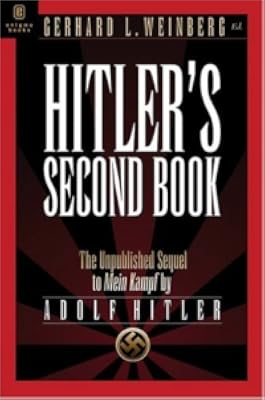
Hitler's Second Book: The Unpublished Sequel to Mein Kampf
by Adolf Hitler
On This Page
Description
"Provides a valuable insight into the development of ideas that were to shape Hitler's foreign policy after 1933."—Jeremy Noakes, The Times Literary Supplement“The text bears all of Hitler's hallmarks, along with a terrifying, sustained belief in war and violence as a means to ensure that Germany would flourish."—Publishers Weekly
“He envisaged the German people becoming involved in a series of wars for Lebensraum culminating in an epic battle against America."—Michael Smith, show more Daily Telegraph
“The Second Book is in many ways more important than Mein Kampf."—Guardian
“I have never known anyone to say this is a forged document."—Volker Berghahn, The New York Times
“Hitler admires the 'young, racially select' American people and the nation's restrictive immigration policies at the time."—The New York Times
“Far more than Mein Kampf, the Second Book establishes the grandiose scale of Hitler's ambitions."—Dennis Showalter, Colorado College
“More clearly than ever, Hitler sketched out the worldwide struggle against the Jews which he and his party had to lead."—Richard Overy, Guardian
Hitler's Second Book is the first complete and annotated edition of the manuscript Hitler dictated shortly before his rise to power four year after publishing Mein Kampf. It contains a catalog of shocking policy statements and previously undisclosed plans of world conquest at the core of Nazi ideology that Hitler concluded were too provocative for publication.
. Nonfiction. Scholarly. History. show less
Tags
Recommendations


















Member Reviews
Hitlers Zweites Buch ("Second Book"), published in English as Hitler's Secret Book and later as Hitler's Second Book, consists of Adolf Hitler's unedited thoughts on foreign policy in 1928. Written after Mein Kampf, it was not published in his lifetime. Gerhard Weinberg – who edited and annotated the German & English editions – speculates that the Zweites Buch was not published in 1928 because Mein Kampf did not sell well at that time and Hitler's publisher, the Franz-Eher-Verlag, may have told Hitler that a second book would hinder sales even more. Zweites Buch was written after the Nazi Party's poor showing in the 1928 German elections, which Hitler believed was caused by the public's misunderstanding of his ideas on War and show more Peace,
The Necessity of Strife, Race and Will in the Struggle for Power, Foreign Policy, Nazism & retrospective Policies of the Second Reich (Bismarck's) Anyway, Adolf Hitler is widely considered one of the greatest monsters and villains in history, responsible for the deaths of millions of people, including the Holocaust and World War II. As leader of Nazi Germany, he orchestrated the systematic genocide of Jews and other groups, being the architect of organized destruction and madness. To say he's a lousy author is of course an understatement. show less
The Necessity of Strife, Race and Will in the Struggle for Power, Foreign Policy, Nazism & retrospective Policies of the Second Reich (Bismarck's) Anyway, Adolf Hitler is widely considered one of the greatest monsters and villains in history, responsible for the deaths of millions of people, including the Holocaust and World War II. As leader of Nazi Germany, he orchestrated the systematic genocide of Jews and other groups, being the architect of organized destruction and madness. To say he's a lousy author is of course an understatement. show less
May 7, 2026English (UK)
Ratings
Members
- Recently Added By
Author Information

199+ Works 5,907 Members
Adolf Hilter was born in Austria on April 20, 1889. As a young man, he wanted to become an artist, but was rejected twice by the Academy of Fine Arts Vienna. While in Vienna, he worked as a struggling painter copying scenes from postcards and selling his paintings to merchants and tourists. He served in the Bavarian army during World War I and show more received two Iron Crosses for his service. He was discharged from the army in March 1920. On April 1, 1924, he was sentenced to five years in Landsberg prison for the crime of conspiracy to commit treason. While there, he dictated his political book Mein Kampf (My Struggle) to his deputy Rudolf Hess. He was released in December 1924 because he was considered relatively harmless. He was the leader of the Nazi party and gained political power using oratory and propaganda, appealing to economic need, nationalism, and anti-Semitism during a time Germany was in crisis. He became a German citizen in 1932, the Chancellor of Germany in 1933, and the Fuhrer of Germany in 1934. He started World War II by invading other countries in order to expand Germany. He murdered millions of people considered undesirable to his view of an ideal race, which is now referred to as the Holocaust. This genocide lead to the deaths of approximately 11 million people including but not limited to Jews, communists, homosexuals, Roma, Jehovah's Witnesses, and prisoners-of-war. Hitler committed suicide in his underground bunker in Berlin on April 30, 1945. (Bowker Author Biography) show less
Some Editions
Common Knowledge
- Canonical title
- Hitler's Second Book: The Unpublished Sequel to Mein Kampf
- Original title
- Hitlers zweites Buch
- Alternate titles
- Hitler's Secret Book
Classifications
- Genres
- Nonfiction, History, General Nonfiction, Politics and Government, Biography & Memoir
- DDC/MDS
- 943.086 — History & geography History of Europe Central Europe: Germany, Austria, Switzerland, Czech, Poland, Hungary Historical periods of Germany Germany 1866- Third Reich 1933-1945
- LCC
- DD247 .H5 .A365 — History of Europe, Asia, Africa and Oceania Germany History of Germany History By period Modern, 1519- 19th-20th centuries Revolution and Republic, 1918-
- BISAC
Statistics
- Members
- 197
- Popularity
- 165,829
- Reviews
- 1
- Rating
- (2.67)
- Languages
- 5 — Danish, English, Finnish, German, Swedish
- Media
- Paper, Ebook
- ISBNs
- 14
- ASINs
- 5