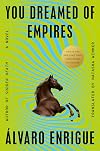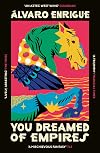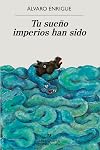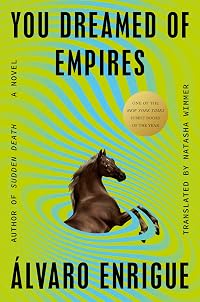
You Dreamed of Empires
by Álvaro Enrigue
On This Page
Description
From the visionary author of Sudden Death, a hallucinatory, revelatory, colonial revenge story. One morning in 1519, conquistador Hernan Cortes entered the city of Tenochtitlan - today's Mexico City. Later that day, he would meet the emperor Moctezuma in a collision of two worlds, two empires, two languages, two possible futures. Cortes was accompanied by his nine captains, his troops, and his two translators: Friar Aguilar, a taciturn, former slave, and Malinalli, a strategic, former show more princess. Greeted at a ceremonial welcome meal by the steely princess Atotoxli, sister and wife of Moctezuma, the Spanish nearly bungle their entrance to the city. As they await their meeting with Moctezuma - who is at a political, spiritual, and physical crossroads, and relies on hallucinogens to get himself through the day and in quest for any kind of answer from the gods - the Spanish are ensconced in the labyrinthine palace. Soon, one of Cortes's captains, Jazmin Caldera, overwhelmed by the grandeur of the city, begins to question the ease with which they were welcomed into the city, and wonders at the risks of getting out alive, much less conquering the empire. You Dreamed of Empires brings to life Tenochtitlan at its height, and reimagines its destiny. The incomparably original Alvaro Enrigue sets afire the moment of conquest and turns it into a moment of revolution, a restitutive, fantastical counter-attack, in a novel so electric and so unique that it feels like a dream. show lessTags
Recommendations














Member Reviews
A densely-packed story, set between lunch and dinner on the momentous eighth of November, 1519, when Hernan Cortés arrives in Mexico City as the guest — or prisoner? — of the emperor Moctezuma. We follow the principal characters — the emperor and his sister, the mayor of the city, Cortés and his mistress/interpreter and a (fictional) captain in his small party of Castilian adventurers — through the confusing corridors of the palaces and temples, in a situation where no-one quite knows what is going on or what (if anything) the emperor is trying to achieve. Hallucinogenic drugs come into it too, of course, and only confuse things further.
Enrigue is playing with our ideas about the inevitability of past events, of course. Few show more big events in history have ever been as contingent as Cortés’s more or less accidental “conquest” of Mexico, and it’s pretty clear that in the world of this novel, it isn’t necessarily going to come out the way we think it did in “real life”. Whatever that is.
There’s a lot of things going on under the surface here — Enrigue goes to some length to de-hispanisize (is that a word?) names and concepts from pre-colonial Mexican culture, so even with the quick glossary he gives us in his preface we are often struggling to work out what people are talking about, and then we get odd bits of destabilising content, like the T-Rex song Moctezuma finds himself jiving along to four and a half centuries too early in one of his trances. Obviously significant, but we’re left to ourselves to work out why… show less
Enrigue is playing with our ideas about the inevitability of past events, of course. Few show more big events in history have ever been as contingent as Cortés’s more or less accidental “conquest” of Mexico, and it’s pretty clear that in the world of this novel, it isn’t necessarily going to come out the way we think it did in “real life”. Whatever that is.
There’s a lot of things going on under the surface here — Enrigue goes to some length to de-hispanisize (is that a word?) names and concepts from pre-colonial Mexican culture, so even with the quick glossary he gives us in his preface we are often struggling to work out what people are talking about, and then we get odd bits of destabilising content, like the T-Rex song Moctezuma finds himself jiving along to four and a half centuries too early in one of his trances. Obviously significant, but we’re left to ourselves to work out why… show less
A historical dramatization that essentially takes place all on a single fateful day, November 8, 1519, when the Spanish, led by Cortes, were invited into the island city of Tenochtitlan by Moctezuma. With chapter titles like “Before the Nap,” “Moctezuma’s Nap,” etc, I have to say, there were times when I felt like I would have preferred a narrative that covered more of the Spanish conquest, despite the glimpses we got into the broader context through flashbacks and flashforwards (including one to Enrigue writing the book). On the other hand, it immersed me into the world of the Colhua and Mexica natives (who would come to be called Aztecs by English historians in the 19th century “who really had no clue”), their show more extraordinary city of Tenochtitlan, and the culture clash with the greedy, brutal Spaniards. This feels like a must read to anyone interested in this period of history, especially as the perspective is shifted and Enrigue is so balanced in his account.
There is certainly violence here, and we see both the cruelty of the natives’ human sacrifices, as well as the cruelty of the conquistadors’ massacres, an example of the latter of which is recounted with an interspersed prayer to Jesus Christ, the hypocrisy of which can’t be clearer. Enrigue exercises masterful restraint, however, and I loved all of the bits of historical detail he got in here. The Colhua’s use of hallucinogenic mushrooms because they wished to catch glimpses of the ethereal gods they believed roamed the world, and their overuse by Moctezuma. To see horses for the first time and be mesmerized by them. To use braziers to light rooms because candles had not been invented in this part of the world. To see “shit as a treasure” in inland farming regions, where absent cow and sheep, human feces was used diligently as fertilizer. And so on.
Meanwhile, the Spaniards had no grand plan, described in one place as “No one had any thought then of reaching Tenoxtitlan, but they really had no clear idea about anything. … They were making things up as they went along, with extraordinary results.” It’s a little confusing at times, but Enrigue effectively makes us feel the politics of other city states in the region, the fracturing of which was exploited. We also get little details like needing to use a dagger to cut toenails, and the Spaniards reeking to high heaven, resulting in the Colhua approaching them with flowers held to their noses. Even the double translation required, from Nahuatl to Mayan, then Mayan to Spanish (Castilian) to communicate reveals just how jarring this interaction was, something hard to fathom today.
It's an intelligent, fantastic read, and the only thing I really didn’t care for was the scene with Malintzin (La Malinche), the translator who would have a child by Cortes, recovering from her sodomization by him and passing gas in the tub, even though it was brief and amplified the sense of what Cortes was doing to all of these people. On the other hand, in her murmured line “Just wait, son of a bitch, just wait,” we get a nice bit of foreshadowing to the cathartic finale. If only this was how it turned out, if only this had been just the beginning of a unified, strong response to the invasion. It’s fascinating to think about.
A few quotes, the first, on European behavior in the New World:
“Things happened to people when they got to the Indies, anyway. The prospect of owning human souls without any accountability brought out the dark side in some: they set their dogs on their Tainos for the slightest fault, watching with glee as they were devoured. Others, given their own room and bed in the Indies for perhaps the first time in their lives, embarked on erotic journeys that in Extremadura would have led to beatings and public shaming at the very least. Others turned mystical, believing that the inhabitants of the land belonged to the lost tribe of Israel. In this context, Aguilar’s eccentricities – tattoos aside – were even praiseworthy: he bathed every day, he abhorred alcohol, he dosed himself with mushrooms, which made everyone happy, and not magic cacti, which drove them mad.”
And this even longer one, on the roughly 40,000 skulls strung up to make rattles in the temple; which I thought was brilliant:
“It would have been amazing if while Caldera stared at the huey tzompantli, lost in the malign daze produced by this display of the banality of life, a breeze had sprung up: the gentle clatter of the skulls and vertebrae would have become a clacking buzz, a roar, a clamor of flutes and rattles; the depraved music of a priestly caste and a political class anointed by fear, maybe, but also a grandly formal reflection on the foundations of any system of religious thought: we don’t last.
Seen from the twenty-first century – a century terrified by the finitude of the body – a temple like this is first and foremost an affront. For a sixteenth-century Spaniard, who had witnessed wars and auto-da-fe and seen the rebels of his time die, rot, and wither in cages hanging at the gates of cities, it would have also been astonishingly hygienic in its presentation of the macabre realities of life. The white floors; the skulls, bleached and bare. All sanctified by a tidy geometry. It wasn’t an edifying display of the suffering to which errors in conduct would lead, but a representation of things as they are: inside each of us is a skull, and that’s all that will be left of use when we’re gone; thanks for your participation.
If Caldera had taken his walk dressed in Castilian fashion and in the company of other captains, he would have had to shake his head in disapproval, proclaim his horror, cross himself. Alone and dressed as a Colhua, he would have seen the hey tzompantli as intensely Christian – dust we be – and illuminating, as perhaps we too if we could shed the moral superiority of societies that do their killing out of sight. He would have seen it for what it is: a triumph of design.” show less
There is certainly violence here, and we see both the cruelty of the natives’ human sacrifices, as well as the cruelty of the conquistadors’ massacres, an example of the latter of which is recounted with an interspersed prayer to Jesus Christ, the hypocrisy of which can’t be clearer. Enrigue exercises masterful restraint, however, and I loved all of the bits of historical detail he got in here. The Colhua’s use of hallucinogenic mushrooms because they wished to catch glimpses of the ethereal gods they believed roamed the world, and their overuse by Moctezuma. To see horses for the first time and be mesmerized by them. To use braziers to light rooms because candles had not been invented in this part of the world. To see “shit as a treasure” in inland farming regions, where absent cow and sheep, human feces was used diligently as fertilizer. And so on.
Meanwhile, the Spaniards had no grand plan, described in one place as “No one had any thought then of reaching Tenoxtitlan, but they really had no clear idea about anything. … They were making things up as they went along, with extraordinary results.” It’s a little confusing at times, but Enrigue effectively makes us feel the politics of other city states in the region, the fracturing of which was exploited. We also get little details like needing to use a dagger to cut toenails, and the Spaniards reeking to high heaven, resulting in the Colhua approaching them with flowers held to their noses. Even the double translation required, from Nahuatl to Mayan, then Mayan to Spanish (Castilian) to communicate reveals just how jarring this interaction was, something hard to fathom today.
It's an intelligent, fantastic read, and the only thing I really didn’t care for was the scene with Malintzin (La Malinche), the translator who would have a child by Cortes, recovering from her sodomization by him and passing gas in the tub, even though it was brief and amplified the sense of what Cortes was doing to all of these people. On the other hand, in her murmured line “Just wait, son of a bitch, just wait,” we get a nice bit of foreshadowing to the cathartic finale. If only this was how it turned out, if only this had been just the beginning of a unified, strong response to the invasion. It’s fascinating to think about.
A few quotes, the first, on European behavior in the New World:
“Things happened to people when they got to the Indies, anyway. The prospect of owning human souls without any accountability brought out the dark side in some: they set their dogs on their Tainos for the slightest fault, watching with glee as they were devoured. Others, given their own room and bed in the Indies for perhaps the first time in their lives, embarked on erotic journeys that in Extremadura would have led to beatings and public shaming at the very least. Others turned mystical, believing that the inhabitants of the land belonged to the lost tribe of Israel. In this context, Aguilar’s eccentricities – tattoos aside – were even praiseworthy: he bathed every day, he abhorred alcohol, he dosed himself with mushrooms, which made everyone happy, and not magic cacti, which drove them mad.”
And this even longer one, on the roughly 40,000 skulls strung up to make rattles in the temple; which I thought was brilliant:
“It would have been amazing if while Caldera stared at the huey tzompantli, lost in the malign daze produced by this display of the banality of life, a breeze had sprung up: the gentle clatter of the skulls and vertebrae would have become a clacking buzz, a roar, a clamor of flutes and rattles; the depraved music of a priestly caste and a political class anointed by fear, maybe, but also a grandly formal reflection on the foundations of any system of religious thought: we don’t last.
Seen from the twenty-first century – a century terrified by the finitude of the body – a temple like this is first and foremost an affront. For a sixteenth-century Spaniard, who had witnessed wars and auto-da-fe and seen the rebels of his time die, rot, and wither in cages hanging at the gates of cities, it would have also been astonishingly hygienic in its presentation of the macabre realities of life. The white floors; the skulls, bleached and bare. All sanctified by a tidy geometry. It wasn’t an edifying display of the suffering to which errors in conduct would lead, but a representation of things as they are: inside each of us is a skull, and that’s all that will be left of use when we’re gone; thanks for your participation.
If Caldera had taken his walk dressed in Castilian fashion and in the company of other captains, he would have had to shake his head in disapproval, proclaim his horror, cross himself. Alone and dressed as a Colhua, he would have seen the hey tzompantli as intensely Christian – dust we be – and illuminating, as perhaps we too if we could shed the moral superiority of societies that do their killing out of sight. He would have seen it for what it is: a triumph of design.” show less
This novel explores a historical event almost totally unfamiliar to me as a U.S. reader -- a single afternoon when explorer Hernan Cortes and his Castilian soldiers meet the emperor Moctezuma and his court and subjects. Moctezuma is the ruler of a society entangled in elaborate hierarchies, stifling etiquette, ritual murders and frequent consumption of hallucinogenic drugs; Cortes and his men are crass opportunists who have killed their way to the capital city of Tenochitlan and recruited a trailing army of locals itching to overthrow their Aztec rulers. As these leaders meet and attempt to understand each other, we see the dawn of New World colonialism play out -- and the other possible paths that this encounter could have taken become show more increasingly clear.
As someone who doesn't know much about Mexican history, I found this book easy to jump into but fairly difficult to read. Alvaro Enrigue excels at making his characters recognizably human even in the context of a culture that functions very differently from how we live today. I definitely appreciated the author's note to his translator at the beginning of the book which helped make the Aztec names more readable; however, I still had to pay close attention to sort out the long similar-looking names and titles. Fortunately, Enrigue's prose is so well-written that paying close attention is a pleasure. And as the narrative continues, it gradually begins to detach from the past in surprising ways.
Enrigue provides much more than a simple historical recreation here. Enrigue's history is like Moctezuma's palace at Tenochitlan -- disorienting, not following any observable plan but instead breaking off into corridors and courtyards and reception rooms that don't seem to have any purpose and then doubling back on itself to take you somewhere that looks familiar but may be a new wing entirely. It's a fascinating way of reconsidering the events of that long-ago afternoon and their meaning to the people who were there and the people that we have become since. show less
As someone who doesn't know much about Mexican history, I found this book easy to jump into but fairly difficult to read. Alvaro Enrigue excels at making his characters recognizably human even in the context of a culture that functions very differently from how we live today. I definitely appreciated the author's note to his translator at the beginning of the book which helped make the Aztec names more readable; however, I still had to pay close attention to sort out the long similar-looking names and titles. Fortunately, Enrigue's prose is so well-written that paying close attention is a pleasure. And as the narrative continues, it gradually begins to detach from the past in surprising ways.
Enrigue provides much more than a simple historical recreation here. Enrigue's history is like Moctezuma's palace at Tenochitlan -- disorienting, not following any observable plan but instead breaking off into corridors and courtyards and reception rooms that don't seem to have any purpose and then doubling back on itself to take you somewhere that looks familiar but may be a new wing entirely. It's a fascinating way of reconsidering the events of that long-ago afternoon and their meaning to the people who were there and the people that we have become since. show less
I've been on a lovely roll with books lately, and Álvaro Enrigue's You Dreamed of Empires is keeping my winning streak going. You Dreamed of Empires is an imaginative recounting of single day: the day when Hernán Cortés met Moctezuma. Since actual accounts of that event are pretty much nonexistent, Enrigue gives himself permission to create his own truth about that day. This works well in two ways.
First, it means readers, even if they know the "standard" story of Moctezuma and Cortés, don't have any sort of certainty. Enrigue will take his tale in the directions he chooses, which means a) this book continually surprises and b) it offers an interesting thought experiment of ways this meeting might have played out. Second, as the show more novel progresses, the narrator becomes more active. What begins as fairly straightforward story becomes richer as it probes the various chains of action that could have been possible.
You Dreamed of Empires was written in Spanish, and I so wish my Spanish were good enough that I could read it in the original. I kept experiencing tantalizing glimpses of what the Spanish must have read like. The good news is that the translation is brilliant. This is a book that makes use of voice, and Natasha Wimmer lets that voice expand in wonderful ways as the book progresses.
You dreamed of empires can be a quick read, but move through it slowly enough to let yourself savor it. Enrigue makes use of a good bit of Aztec vocabulary, which can make some monolingual readers feel a bit panicky. Read the introduction to the book (presented as a letter from Enrigue to Wimmer). Pay attention to both suggestions about pronunciation and also to Enrigue's notes on why understanding all this vocabulary does/doesn't matter. I tend to read at speaking speed, saying the words aloud in my head as I move along. This means I'm limited in terms of reading speed, but it has the benefit of letting me "hear" as my eyes move across the page. Finding my ways to pronounce those words (I did try my best to follow Engrigue's suggestions) and encountering them over and over again made the book seem accessible in a way it otherwise might not have.
Whether you buy it from your local independent bookseller or request it from your local library, this is a book you should keep an eye out for. I don't know quite how to say this, but I'll give it a go: beyond the story, the act of reading this text is transformative in ways that can carry over into the reader's viewing of the world.
I received a free electronic review copy of this title from the publisher via Edelweiss; the opinions are my own. show less
First, it means readers, even if they know the "standard" story of Moctezuma and Cortés, don't have any sort of certainty. Enrigue will take his tale in the directions he chooses, which means a) this book continually surprises and b) it offers an interesting thought experiment of ways this meeting might have played out. Second, as the show more novel progresses, the narrator becomes more active. What begins as fairly straightforward story becomes richer as it probes the various chains of action that could have been possible.
You Dreamed of Empires was written in Spanish, and I so wish my Spanish were good enough that I could read it in the original. I kept experiencing tantalizing glimpses of what the Spanish must have read like. The good news is that the translation is brilliant. This is a book that makes use of voice, and Natasha Wimmer lets that voice expand in wonderful ways as the book progresses.
You dreamed of empires can be a quick read, but move through it slowly enough to let yourself savor it. Enrigue makes use of a good bit of Aztec vocabulary, which can make some monolingual readers feel a bit panicky. Read the introduction to the book (presented as a letter from Enrigue to Wimmer). Pay attention to both suggestions about pronunciation and also to Enrigue's notes on why understanding all this vocabulary does/doesn't matter. I tend to read at speaking speed, saying the words aloud in my head as I move along. This means I'm limited in terms of reading speed, but it has the benefit of letting me "hear" as my eyes move across the page. Finding my ways to pronounce those words (I did try my best to follow Engrigue's suggestions) and encountering them over and over again made the book seem accessible in a way it otherwise might not have.
Whether you buy it from your local independent bookseller or request it from your local library, this is a book you should keep an eye out for. I don't know quite how to say this, but I'll give it a go: beyond the story, the act of reading this text is transformative in ways that can carry over into the reader's viewing of the world.
I received a free electronic review copy of this title from the publisher via Edelweiss; the opinions are my own. show less
You Dreamed of Empires is certainly a strange novel.
It takes place on the day Hernán Cortés arrives in Tenoxtitlan (Enrigue’s preferred spelling rather than Tenochtitlan) and describes the meeting between the Colhuas or “Aztecs” and the Spanish.
The cast of characters felt enormous, perhaps because the names are so unfamiliar. Luckily Enrigue provides a list of the characters, and I referred to this list constantly, otherwise I would have been completely lost. The POV shifts rapidly, sometimes on the same page. Due to the constantly shifting perspectives, I was kept a little off-balance, which reflects what the Spanish were feeling, so I got used to this sort of crooked feeling. It added to the reading experience for me.
The show more novel describes two cultures, both steeped in violence. Both cultures have religiously based violence—Moctezuma’s are human sacrifices to the gods and Cortés’ the Inquisition—and the violence of war. In both cultures there are characters who sort of roll their eyes at the demands of official religion. And neither culture quite understands the other, and on Moctezuma’s side there is no real attempt to do so. He is in control in Tenoxtitlan not the Spanish.
At times the author breaks the “fourth wall” and speaks directly to reader about the novel and what is going on. All very meta if I understand the meaning of meta. I enjoyed these interludes.
When reading novels of this sort I am constantly looking up characters online. Is this character based on a real person, did that battle really take place, was the city as clean as it is depicted. However, I felt no need to do it for this story. I just let the book carry me wherever it wanted to go.
I loved the ending, and I loved the description of Moctezuma as being constantly high on mushrooms.
I don’t think this book will be for everyone, but I enjoyed the time I spent with it. show less
It takes place on the day Hernán Cortés arrives in Tenoxtitlan (Enrigue’s preferred spelling rather than Tenochtitlan) and describes the meeting between the Colhuas or “Aztecs” and the Spanish.
The cast of characters felt enormous, perhaps because the names are so unfamiliar. Luckily Enrigue provides a list of the characters, and I referred to this list constantly, otherwise I would have been completely lost. The POV shifts rapidly, sometimes on the same page. Due to the constantly shifting perspectives, I was kept a little off-balance, which reflects what the Spanish were feeling, so I got used to this sort of crooked feeling. It added to the reading experience for me.
The show more novel describes two cultures, both steeped in violence. Both cultures have religiously based violence—Moctezuma’s are human sacrifices to the gods and Cortés’ the Inquisition—and the violence of war. In both cultures there are characters who sort of roll their eyes at the demands of official religion. And neither culture quite understands the other, and on Moctezuma’s side there is no real attempt to do so. He is in control in Tenoxtitlan not the Spanish.
At times the author breaks the “fourth wall” and speaks directly to reader about the novel and what is going on. All very meta if I understand the meaning of meta. I enjoyed these interludes.
When reading novels of this sort I am constantly looking up characters online. Is this character based on a real person, did that battle really take place, was the city as clean as it is depicted. However, I felt no need to do it for this story. I just let the book carry me wherever it wanted to go.
I loved the ending, and I loved the description of Moctezuma as being constantly high on mushrooms.
I don’t think this book will be for everyone, but I enjoyed the time I spent with it. show less
This novel takes place over the course of a day, reimagining a pivotal moment in our history. I can't think of the last time I knew I'd love a book from the first paragraph of the introduction. It's compelling and mesmerizing and even maybe hypnotic, like a fever dream but with a bit more sense. Such a beautiful reimagining, smart and surreal and hopeful. I'm a little in love with this story.
I don't know how to do this justice in a review, but I will keep this in a small but growing collection of books that are nourishing at times like this, books that remind you.
I don't know how to do this justice in a review, but I will keep this in a small but growing collection of books that are nourishing at times like this, books that remind you.
You Dreamed of Empires is a hallucinatory, counterfactual novel reimagining the day Hernán Cortés first met Aztec Emperor Moctezuma in 1519 Tenochtitlan, focusing on the political, personal, and spiritual clash through Moctezuma's drug-fueled perspective, exploring "what-ifs" about conquest, language, and destiny with witty, bawdy detail, and highlighting the crucial roles of female figures like Malinalli.
Members
- Recently Added By
Published Reviews
ThingScore 100
Throughout the book, Enrigue (and in English his excellent translator, Natasha Wimmer) boldly uses modern language to recreate the past [...]. Parts of the novel play like an Aztec West Wing, taking us deep into the political manoeuvrings of the royal court but blending its particularities with 21st-century psychology. It’s a rich approach that achieves a hallucinatory vividness.
added by Nevov
Lists

Phi Beta Kappa reading list
260 works; 8 members

Fiction: Historical
288 works; 3 members

Top Five Books of 2024
795 works; 264 members

Books Read in 2025
4,128 works; 98 members

TBR of Books I Don't Own
132 works; 1 member
Top Five Books of 2025
954 works; 303 members
Author Information

12+ Works 1,419 Members
Some Editions
Awards and Honors
Common Knowledge
- Canonical title
- You Dreamed of Empires
- Original title
- Tu sueño imperios han sido
- Original publication date
- 2022
- People/Characters
- Hernán Cortés; Moctezuma II; Jazmin Caldera; Atotoxli; Malinalli; Tlilpotonqui
- Important places
- Tenochtitlán, Mexica Empire
- Original language
- Spanish
Classifications
- Genres
- General Fiction, Fiction and Literature, Historical Fiction
- DDC/MDS
- 863.64 — Literature & rhetoric Spanish Literature Spanish fiction 20th Century 1945-2000
- LCC
- PQ7298.15 .N636 .T813 — Language and Literature French, Italian, Spanish and Portuguese literatures Spanish literature Provincial, local, colonial, etc. Spanish America
- BISAC
Statistics
- Members
- 607
- Popularity
- 48,189
- Reviews
- 22
- Rating
- (3.76)
- Languages
- English, German, Spanish
- Media
- Paper, Audiobook, Ebook
- ISBNs
- 11
- ASINs
- 4