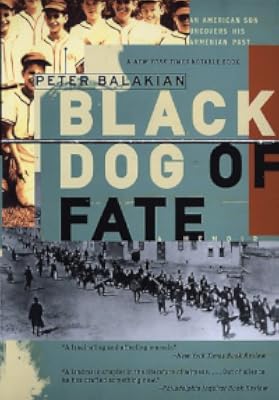
Black Dog of Fate: An American Son Uncovers His Armenian Past
by Peter Balakian
On This Page
Description
In this tenth anniversary edition of his award-winning memoir, New York Times bestselling author Peter Balakian has expanded his compelling story about growing up in the baby-boom suburbs of the '50s and '60s and coming to understand what happened to his family in the first genocide of the twentieth century-the Ottoman Turkish government's extermination of more than one million Armenians in 1915. In this new edition, Balakian continues his exploration of the Armenian Genocide with new show more chapters about his journey to Aleppo and his trip to the Der Zor desert of Syria in his pursuit of his grandmother's life, bringing us closer to the twentieth century's first genocide. show lessTags
Recommendations




























Member Reviews
Published in 1997, this book is Peter Balakian’s memoir of his time growing up in New Jersey in the 1950s-1970. It relates how he eventually traced his family’s tragic stories that occurred during the Armenian genocide in Turkey in 1915. He grew up mostly unaware of his family’s experiences. His older relatives had been reluctant to discuss the past, believing young people should be shielded from these harsh realities, and Balakian had only some hints that unsettled him. He eventually read a book about the massacre of Armenians in Turkey, written by the American Ambassador to the Ottomon Empire, Henry Morgenthau. He also obtained family legal documents that shed light on what had happened to his ancestors.
The first half of the show more book is focused on the author’s early interactions with his grandmother. They live in suburban neighborhood, and bond over a shared love of baseball. She tells him stories, one of which is a parable about the titular black dog, and says, “Appearances are deceiving. The world is not what you think.” Balakian selects episodes that illustrate his family’s preservation of the Armenian culture.
There are a number of literary references in this work – Armenian authors and artists – as well as Armenian cuisine and religion. He confronts genocide deniers. He links the Armenian genocide to what happened later in Nazi Germany and addresses the dangers of nationalistic thinking – an issue we still deal with today.
It is beautifully written. Balakian is a distinguished poet, and it shows in his writing. A few poems relating to his heritage are included. I was expecting that the author would have travelled to the region, but if he did, it is not part of this memoir. show less
The first half of the show more book is focused on the author’s early interactions with his grandmother. They live in suburban neighborhood, and bond over a shared love of baseball. She tells him stories, one of which is a parable about the titular black dog, and says, “Appearances are deceiving. The world is not what you think.” Balakian selects episodes that illustrate his family’s preservation of the Armenian culture.
There are a number of literary references in this work – Armenian authors and artists – as well as Armenian cuisine and religion. He confronts genocide deniers. He links the Armenian genocide to what happened later in Nazi Germany and addresses the dangers of nationalistic thinking – an issue we still deal with today.
It is beautifully written. Balakian is a distinguished poet, and it shows in his writing. A few poems relating to his heritage are included. I was expecting that the author would have travelled to the region, but if he did, it is not part of this memoir. show less
Published in 1997, this book is Peter Balakian’s memoir of his time growing up in New Jersey in the 1950s-1970. It relates how he eventually traced his family’s tragic stories that occurred during the Armenian genocide in Turkey in 1915. He grew up mostly unaware of his family’s experiences. His older relatives had been reluctant to discuss the past, believing young people should be shielded from these harsh realities, and Balakian had only some hints that unsettled him. He eventually read a book about the massacre of Armenians in Turkey, written by the American Ambassador to the Ottomon Empire, Henry Morgenthau. He also obtained family legal documents that shed light on what had happened to his ancestors.
The first half of the show more book is focused on the author’s early interactions with his grandmother. They live in suburban neighborhood, and bond over a shared love of baseball. She tells him stories, one of which is a parable about the titular black dog, and says, “Appearances are deceiving. The world is not what you think.” Balakian selects episodes that illustrate his family’s preservation of the Armenian culture.
There are a number of literary references in this work – Armenian authors and artists – as well as Armenian cuisine and religion. He confronts genocide deniers. He links the Armenian genocide to what happened later in Nazi Germany and addresses the dangers of nationalistic thinking – an issue we still deal with today.
It is beautifully written. Balakian is a distinguished poet, and it shows in his writing. A few poems relating to his heritage are included. I was expecting that the author would have travelled to the region, but if he did, it is not part of this memoir. show less
The first half of the show more book is focused on the author’s early interactions with his grandmother. They live in suburban neighborhood, and bond over a shared love of baseball. She tells him stories, one of which is a parable about the titular black dog, and says, “Appearances are deceiving. The world is not what you think.” Balakian selects episodes that illustrate his family’s preservation of the Armenian culture.
There are a number of literary references in this work – Armenian authors and artists – as well as Armenian cuisine and religion. He confronts genocide deniers. He links the Armenian genocide to what happened later in Nazi Germany and addresses the dangers of nationalistic thinking – an issue we still deal with today.
It is beautifully written. Balakian is a distinguished poet, and it shows in his writing. A few poems relating to his heritage are included. I was expecting that the author would have travelled to the region, but if he did, it is not part of this memoir. show less
This story is a slow build, starts with the author's childhood in New Jersey and how his Armenian roots are sprinkled into the background of his personal story for years, until he begins to come to grips with the true story of what happened to his family in 1915 after some members of his family are more forthcoming about what they know, and the documents they possess that are revealed to him. It is compelling, disturbing, and absolutely necessary. I write this twenty five years on from its publication date, but that doesn't really matter to the story itself.
From 1914-23, the Ottoman Empire, the predecessor of modern Turkey, carried out the systematic state-organized policy of physical annihilation of its indigenous Greek and Armenian civilian populations. I was aware of some of the history of the Armenian genocide from my familiarity of the Greek genocide as a descendant of Asia Minor (on my maternal grandmother’s side)—but this does not make a book like Black Dog of Fate easy to get through and I struggled to finish it. It is not only about the atrocities committed at the hands of the Turkish government-- but it is also a beautiful book about discovering one’s heritage. Not an easy read but an important one.
[This review also appears on FingerFlow.com, a site for review and discussion of creative works.]
In Black Dog of Fate, Peter Balakian describes his life growing up in the suburbs of New Jersey and slowly discovering the horrible event that his family tries to protect him from: the Armenian genocide conducted by the Turkish government of 1915.
The memoir relates many of the adolescent experiences that American readers are familiar with: high school football, teenage rebellion, girlfriends, etc. However, Balakian also describes the rich Armenian cultural heritage he grew up with, particularly the language and the cuisine of his people.
In college, Balakian became aware of the massacre that his grandparents and parents had escaped from show more before coming to America and struggles to understand why this important event in the history of his people was never spoken of amongst his immediate and extended family.
This book is a great read for anyone who is interested in learning about Armenian culture or simply in reading about the lives of Armenians who managed to assimilate in American society while retaining most of their cultural heritage. More importantly, this book is a great starting point for learning about the Armenian genocide and the subsequent denial by the Turkish government that it ever occurred. Balakian's memoir deserves a place next to the witness testimonies of the Holocaust and other state-sponsored mass murders; the purpose of a book like this is to make sure that genocide is never forgotten. show less
In Black Dog of Fate, Peter Balakian describes his life growing up in the suburbs of New Jersey and slowly discovering the horrible event that his family tries to protect him from: the Armenian genocide conducted by the Turkish government of 1915.
The memoir relates many of the adolescent experiences that American readers are familiar with: high school football, teenage rebellion, girlfriends, etc. However, Balakian also describes the rich Armenian cultural heritage he grew up with, particularly the language and the cuisine of his people.
In college, Balakian became aware of the massacre that his grandparents and parents had escaped from show more before coming to America and struggles to understand why this important event in the history of his people was never spoken of amongst his immediate and extended family.
This book is a great read for anyone who is interested in learning about Armenian culture or simply in reading about the lives of Armenians who managed to assimilate in American society while retaining most of their cultural heritage. More importantly, this book is a great starting point for learning about the Armenian genocide and the subsequent denial by the Turkish government that it ever occurred. Balakian's memoir deserves a place next to the witness testimonies of the Holocaust and other state-sponsored mass murders; the purpose of a book like this is to make sure that genocide is never forgotten. show less
Peter Balakian gives an account of the Armenian Genocide from the memories of his grandmother as well as other survivors he has encountered. Within this story, he also searches for his own sense of identity within his family and his heritage.
I read this in a course called "Literature of the Holocausts," a course that changed my life forever. It is one of the best books I read as an undergrad and I encourage everyone to read it.
I read this in a course called "Literature of the Holocausts," a course that changed my life forever. It is one of the best books I read as an undergrad and I encourage everyone to read it.
It's been a long time, but I remember being absolutely floored by this book.
Members
- Recently Added By
Author Information

17+ Works 986 Members
Peter Balakian was born in Teaneck, New Jersey on June 13, 1951. He received a B.A. from Bucknell University, a M.A. from New York University, and a Ph.D. in American civilization from Brown University. He has been an English professor at Colgate University since 1980. His collections of poetry including Father Fisheye, Sad Days of Light, Reply show more from Wilderness Island, Dyer's Thistle, June-Tree: New and Selected Poems 1974-2000, Ziggurat, and Ozone Journal, which won the 2016 Pulitzer Prize for poetry. He has also written works of nonfiction including Theodore Roethke's Far Fields and The Burning Tigris: The Armenian Genocide and America's Response. His memoir, Black Dog of Fate, won the PEN/Albrand Prize for memoir. (Bowker Author Biography) show less
Awards and Honors
Common Knowledge
- Original publication date
- 1997
- Important places
- Armenia
Classifications
Statistics
- Members
- 355
- Popularity
- 88,755
- Reviews
- 8
- Rating
- (4.01)
- Languages
- Dutch, English
- Media
- Paper, Ebook
- ISBNs
- 5
- ASINs
- 5