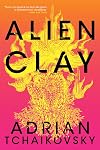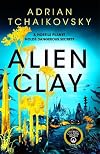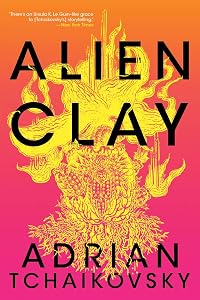
Alien Clay
by Adrian Tchaikovsky
On This Page
Description
From Arthur C. Clarke Award-winning author Adrian Tchaikovsky comes a far-future epic that confirms his place as a modern master of science fiction, in which a political prisoner must unlock the secrets of a strange and dangerous planet. The planet of Kiln is where the tyrannical Mandate keeps its prison colony, and for inmates, the journey there is always a one-way trip. One such prisoner is Professor Arton Daghdev, xeno-ecologist and political dissident. Soon after arrival, he discovers show more that Kiln has a secret. Humanity is not the first intelligent life to set foot there. In the midst of a ravenous, chaotic ecosystem are the ruins of a civilization, but who were the vanished builders and where did they go? If he can survive both the harsh rule of the camp commandant and the alien horrors of the world around him, then Arton has a chance at making a discovery that might just transform not only Kiln, but distant Earth as well. This audiobook edition includes an exclusive interview between Ben Allen and Adrian Tchaikovsky. show lessTags
Recommendations










Member Reviews
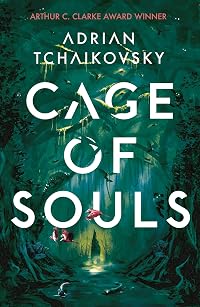
Adrian Tchaikovsky seems fascinated by prisons for political dissidents. In Cage of Souls (2019), he put them on a mechanical island. In Alien Clay (2024), freeze-dried political prisoners land on the planet of Kiln in pods designed to self-destruct as they enter the atmosphere. Twenty percent of the prisoners, labeled “Acceptable Wastage,” don’t make it. The opening scene, in which the protagonist, Professor Daghdev, regains consciousness while his pod comes apart, is worth reading as a standalone scene.
Tchaikovsky also has fun with the planet’s ecology. It is uncannily alien, and we follow along as Daghdev struggles to decipher it before it kills him. Kiln life interacts with human biology in unpredictable ways, and its show more dangerous critters rate high on the yuck scale: “The appalling, crouching legginess of it, bristling, eclipsing the prefab prison cell it crouches on. Its limbs crook, high-kneed, around it. I have no sense of how far its reach might extend if it lashed them out straight.” show less
Tchaikovsky also has fun with the planet’s ecology. It is uncannily alien, and we follow along as Daghdev struggles to decipher it before it kills him. Kiln life interacts with human biology in unpredictable ways, and its show more dangerous critters rate high on the yuck scale: “The appalling, crouching legginess of it, bristling, eclipsing the prefab prison cell it crouches on. Its limbs crook, high-kneed, around it. I have no sense of how far its reach might extend if it lashed them out straight.” show less
This is a first-person novel about a biologist exiled to a labor camp on a recently discovered alien planet by an oppressive government. He must navigate the politics and personalities of his new environment, while also trying to understand the strangeness of this bizarre ecosystem.
I thought the novel opened very strongly, with an arrestingly written description of the pods carrying the political prisoners down to the planet. I liked the depiction of the prison colony a lot, and the discussion of the politics seemed pretty well done, especially the tension in how an oppressive government might see the value of science... but only if science affirms how it wants to see itself. It's a tension, all to unfortunately, that we've been seeing show more in the United States in 2025. I particularly liked the character of the prison warden, a man who sees himself as an intellectual but is still the instrument of a brutal, repressive regime. The biology is, I assume, well thought out, but well thought out biology doesn't interest me for its own sake.
Unfortunately, as it went on, I got less interested in it. I don't think protagonists have to have "character development" per se (surely an overrated idea among amateur critics if there ever was one), but I do think there needs to be some kind of interesting push-and-pull to them, a feeling of things being in tension that the narrative explores. I never really felt this with the narrator, who kind of just does his thing until the book ends. I wanted to feel like more was at stake for him. Specifically, he seems to be a guy with a bit of an ego (he is a scientist with a successful career, after all), but he's also part of a movement and undergoes a transformation that both seem like they involve denying the self somewhat, and I never really had a sense of conflict here—and surely that would be relevant to the novel's themes about how we need to learn to not see ourselves and our assumptions in what we study. (It is, to be honest, a bit Solaris-y, but Tchaikovsky goes in a very different direction to Lem or Tarkovsky, so I don't mind; sf is full of variations on themes.) By the end, despite the strong opening, I was a little bored, feeling like Tchaikovsky didn't totally deliver on the interesting ideas he set up at the beginning. show less
I thought the novel opened very strongly, with an arrestingly written description of the pods carrying the political prisoners down to the planet. I liked the depiction of the prison colony a lot, and the discussion of the politics seemed pretty well done, especially the tension in how an oppressive government might see the value of science... but only if science affirms how it wants to see itself. It's a tension, all to unfortunately, that we've been seeing show more in the United States in 2025. I particularly liked the character of the prison warden, a man who sees himself as an intellectual but is still the instrument of a brutal, repressive regime. The biology is, I assume, well thought out, but well thought out biology doesn't interest me for its own sake.
Unfortunately, as it went on, I got less interested in it. I don't think protagonists have to have "character development" per se (surely an overrated idea among amateur critics if there ever was one), but I do think there needs to be some kind of interesting push-and-pull to them, a feeling of things being in tension that the narrative explores. I never really felt this with the narrator, who kind of just does his thing until the book ends. I wanted to feel like more was at stake for him. Specifically, he seems to be a guy with a bit of an ego (he is a scientist with a successful career, after all), but he's also part of a movement and undergoes a transformation that both seem like they involve denying the self somewhat, and I never really had a sense of conflict here—and surely that would be relevant to the novel's themes about how we need to learn to not see ourselves and our assumptions in what we study. (It is, to be honest, a bit Solaris-y, but Tchaikovsky goes in a very different direction to Lem or Tarkovsky, so I don't mind; sf is full of variations on themes.) By the end, despite the strong opening, I was a little bored, feeling like Tchaikovsky didn't totally deliver on the interesting ideas he set up at the beginning. show less
Lots of body horror! Rebels against an authoritarian human government are exiled to an alien world where they will die as manual labor supporting scientific investigations into the incredibly complex biology of that world. But the alien biome wants to colonize its human invaders as much as the humans in charge want to dissect and control the biome. Can people who’ve never succeeded at rebellion—because they were betrayed or afraid of being betrayed or just too isolated among compliance—find a way through? Can you truly understand anything of which you are not a part? I sort of wonder if the current vogue for fungi in sf influenced this book as well.
How must it feel to be a biologist studying alien life, for a government that wants you to find intelligent life, but a government that also has an almost religious human-centric mandate that requires you find evident to support their conclusions, rather than the other way around? With deadly consequences for anyone who doesn't toe the company line?
This is the predicament Professor Anton Daghdev finds himself in. He's been sentenced to a penal colony on the planet Kiln for political dissidence. Pro: He gets to keep studying alien life, up close, an incredible opportunity! Con: The entire planet's ecosystem is symbiotic and is trying to get into, and colonize, their bodies on a daily basis, turning them into raving, inhuman lunatics. show more
There are ancient alien ruins on Kiln, and despite the dangers from both human soliders and alien life, Anton has a chance to make a discovery that could change humanity forever. For better, or for worse. If he can just live that long.
I am partial to scifi where our main character is a researcher of some sort, a biologist or linguist. I love the framework of really digging into the meat of what makes something alien. In terms of pacing this book was a fast read and there was never a significant slowdown in the action, and the way we got a back-and-forth in the timeline nearer to the end helped ramp everything up for the conclusion. Tchaikovsky's writing is absolutely beautiful. He's the kind of author that makes it look easy, even though you know it really isn't. His prose flows in a way that is inspiring to see. And the world of Kiln! So lushly and descriptively written that it's easy to picture in your mind, even as some of it makes you shudder with the same instinctive response as when you see a pile of centipedes with no discernible beginning or end.
The first half of this book was a solid 4.5 and had my interest entirely. The plot did not go quite where I expected; it was very good, and I think it's a solid end, but it started to get very repetitive in Anton's internal monologue. That very well may have been on purpose, to emphasize what was going on, but extreme repetition always rubs me the wrong way and takes me out of the story.
Overall I'd rate this a 3.75. It's gorgeously written, and it's weird and wonderful and very, very alien. If you want scifi that regularly makes you put your book down, stare off into space and THINK about what you just read, then I strongly recommend this.
Thank you to NetGalley and Tor for a digital copy in exchange for my honest review! show less
This is the predicament Professor Anton Daghdev finds himself in. He's been sentenced to a penal colony on the planet Kiln for political dissidence. Pro: He gets to keep studying alien life, up close, an incredible opportunity! Con: The entire planet's ecosystem is symbiotic and is trying to get into, and colonize, their bodies on a daily basis, turning them into raving, inhuman lunatics. show more
There are ancient alien ruins on Kiln, and despite the dangers from both human soliders and alien life, Anton has a chance to make a discovery that could change humanity forever. For better, or for worse. If he can just live that long.
I am partial to scifi where our main character is a researcher of some sort, a biologist or linguist. I love the framework of really digging into the meat of what makes something alien. In terms of pacing this book was a fast read and there was never a significant slowdown in the action, and the way we got a back-and-forth in the timeline nearer to the end helped ramp everything up for the conclusion. Tchaikovsky's writing is absolutely beautiful. He's the kind of author that makes it look easy, even though you know it really isn't. His prose flows in a way that is inspiring to see. And the world of Kiln! So lushly and descriptively written that it's easy to picture in your mind, even as some of it makes you shudder with the same instinctive response as when you see a pile of centipedes with no discernible beginning or end.
The first half of this book was a solid 4.5 and had my interest entirely. The plot did not go quite where I expected; it was very good, and I think it's a solid end, but it started to get very repetitive in Anton's internal monologue. That very well may have been on purpose, to emphasize what was going on, but extreme repetition always rubs me the wrong way and takes me out of the story.
Overall I'd rate this a 3.75. It's gorgeously written, and it's weird and wonderful and very, very alien. If you want scifi that regularly makes you put your book down, stare off into space and THINK about what you just read, then I strongly recommend this.
Thank you to NetGalley and Tor for a digital copy in exchange for my honest review! show less
A book club pick :)
All right, this was very interesting. It’s probably one of the more interesting “Tchaikovskys” I’ve read so far. I liked it a lot, with some reservations that I have so far had trouble articulating. Writing things down usually helps, so here we go.
The totalitarian state of this universe has labour camps on planets it wants to explore. Convicts are shipped there, as cheaply as possible. (Me: labour camps on Earth are cheaper.) The author obviously knows about sharashkas of the Soviet Gulag – and the main character is to help the research into the alien artefacts of Kiln. (The research findings need to confirm to the state doctrine, of course.) The artefacts are creepy and fascinating and seem to have been show more made by a vanished civilization. I like this kind of mystery.
The labour camp dynamics and horrors were written well, yet there was a sarcastic detachment that bothered me. It is a legitimate narrative choice; it has been done before. It is just that in this particular case I had trouble feeling, experiencing, diving in. Things were happening, I wanted to know what would happen next, so on I read, that’s it. It also made the characters more puppet-like, and the beginning of the book had led to me to expect a more character-driven story…
I really liked the subversive nods to the French Revolution, as parts 1, 2, and 3 are Liberté-Égalité-Fraternité. As you read, it becomes more and more subversive and twisted. I loved that!
The world of Kiln is fascinating and amazing, truly alien, with frighteningly different (to conservative humans, that is) genetics and ecology. The references to Hieronymus Bosch are the loveliest things. I didn’t know I wanted a Boschian alien world in my books, but suddenly, there is was, and I happily ate it all up. The true nature of Kiln wasn’t that much of surprise, but Tchaikovsky is doing ambitious, ambiguous stuff here, so kudos to him. Is our narrator reliable, by the way? Ha! But I am always eager to see another take on the “there are many ways of being human (post-human?)” theme. (Also me, screaming: doesn’t anyone in this labour camp have an immune system??? Me, having caught my breath: ok, so Kiln stuff is good it adaptation, so maybe it fools the human immune system. But do mention it specifically, please?) The ending is not unexpected. Is it satisfying or horrific? It depends.
Quotes that I liked:
“Just because the tyrant dresses like a clown doesn’t mean he’s funny.”
“The greatest privilege of power is being able to overlook the fact that you’re even wielding it.” show less
All right, this was very interesting. It’s probably one of the more interesting “Tchaikovskys” I’ve read so far. I liked it a lot, with some reservations that I have so far had trouble articulating. Writing things down usually helps, so here we go.
The totalitarian state of this universe has labour camps on planets it wants to explore. Convicts are shipped there, as cheaply as possible. (Me: labour camps on Earth are cheaper.) The author obviously knows about sharashkas of the Soviet Gulag – and the main character is to help the research into the alien artefacts of Kiln. (The research findings need to confirm to the state doctrine, of course.) The artefacts are creepy and fascinating and seem to have been show more made by a vanished civilization. I like this kind of mystery.
The labour camp dynamics and horrors were written well, yet there was a sarcastic detachment that bothered me. It is a legitimate narrative choice; it has been done before. It is just that in this particular case I had trouble feeling, experiencing, diving in. Things were happening, I wanted to know what would happen next, so on I read, that’s it. It also made the characters more puppet-like, and the beginning of the book had led to me to expect a more character-driven story…
I really liked the subversive nods to the French Revolution, as parts 1, 2, and 3 are Liberté-Égalité-Fraternité. As you read, it becomes more and more subversive and twisted. I loved that!
The world of Kiln is fascinating and amazing, truly alien, with frighteningly different (to conservative humans, that is) genetics and ecology. The references to Hieronymus Bosch are the loveliest things. I didn’t know I wanted a Boschian alien world in my books, but suddenly, there is was, and I happily ate it all up. The true nature of Kiln wasn’t that much of surprise, but Tchaikovsky is doing ambitious, ambiguous stuff here, so kudos to him. Is our narrator reliable, by the way? Ha! But I am always eager to see another take on the “there are many ways of being human (post-human?)” theme. (Also me, screaming: doesn’t anyone in this labour camp have an immune system??? Me, having caught my breath: ok, so Kiln stuff is good it adaptation, so maybe it fools the human immune system. But do mention it specifically, please?) The ending is not unexpected. Is it satisfying or horrific? It depends.
Quotes that I liked:
“Just because the tyrant dresses like a clown doesn’t mean he’s funny.”
“The greatest privilege of power is being able to overlook the fact that you’re even wielding it.” show less
Alien Clay was a beautifully written book with a well delivered and relevant message about community and resistance, and what it means to be human. I think it had the perfect amount of 4th wall breaking, the perfect amount of nonlinear and omniscient moments, and soooo much world building which i loved (if you don't love heavy amounts of world building and lore dumping this may not be for you). It was a meaningful exploration on the importance of community and interdependence. The biology, ecology, etc of the kiln was well thought through and magnificently built. The writing itself was masterfully done and i thoroughly enjoyed this book.
Echoes of [Solaris] but with less effort to be inscrutable and difficult. Tchaikovsky still gives all the strangeness and otherness and things to think about, with a handy serving of story, personality, and even humor. Likely worth a second or third read.
Members
- Recently Added By
Lists

Truly alien aliens (SF)
42 works; 3 members

2025 Hugo Awards -- Eligible Works -- Novels
33 works; 2 members

Books Read in 2025
4,091 works; 97 members

Library Fantasy/Science Fiction
159 works; 2 members
Author Information

133+ Works 27,874 Members
Adrian Tchaikovsky is a British fantasy and science fiction author, born on June 14, 1972 in Woodhall Spa, Lincolnshire. He studied Zoology and Psychology at the University of Reading. His career focus changed to law and has worked as a Legal Executive in both Reading and Leeds. He's the author of the Shadows of the Apt series, and his standalone show more novel Children of Time is the winner of the 2016 Arthur C Clarke Award for Best Science Fiction Novel. (Bowker Author Biography) show less
Some Editions
Awards and Honors
Awards
Common Knowledge
- Original publication date
- 2024
- People/Characters
- Arton Daghdev; Vertegio Keev; Nimell Primatt; Vessikhan; Ylse Rasmussen; Clemmish Berudha (show all 8); Ilmus Itrin; Commandant Terolan
- Dedication
- To Everyone Fighting The Mandate
- First words
- They say never start a story with a waking, but when you've been hard asleep for thirty years it's difficult to know where else to begin.
- Quotations
- So they love science, because it gives them permission to do all the shit they do. Right up to the point someone puts together an inconvenient but cogent argument that gets in the way of how they want the universe to be. They... (show all) want very specific answers from science. Black and white answers to complex questions. Everything sorted into predetermined boxes.”
It's not enough to be able to do a thing. People, human people, want to be able to believe it's right to do so. The first thing those in authority do, after they've used main force and brutality to take over, is paper over ev... (show all)erything with reasons why they were right to do it.
It's amazing how many different religious start-points quickly find the same old stress fractures which allow the cult leader to sleep with a lot of young women and take a lot of drugs, while everyone else is permitted to ear... (show all)n sanctity through adulation and slavish obedience. - Last words
- (Click to show. Warning: May contain spoilers.)We brought Kiln back to an awareness of itself. Maybe we can do the same with Earth. Start with a waking, end with an awakening.
- Original language
- English UK
- Canonical LCC
- 978-1035013746
Classifications
Statistics
- Members
- 693
- Popularity
- 41,331
- Reviews
- 31
- Rating
- (3.87)
- Languages
- English
- Media
- Paper, Audiobook, Ebook
- ISBNs
- 13
- ASINs
- 5