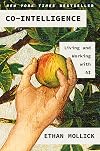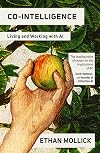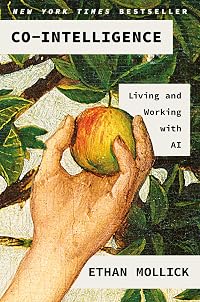
Co-Intelligence: Living and Working with AI
by Ethan Mollick
On This Page
Description
"From Wharton professor and author of the popular One Useful Thing Substack newsletter Ethan Mollick comes the definitive playbook for working, learning, and living in the new age of AI The release of generative AI-from LLMs like ChatGPT to image generators like DALL-E-marks a new era. We have invented technologies that boost our physical capabilities and others that automate complex tasks, but never, until now, have we created a technology that can boost our intelligence-with an impact on show more work and life that researchers project will be greater than that of steam power or the internet. Mollick urges us not to turn away from AI, and instead to invite AI tools to the table. He demonstrates how AI can amplify our own capacities, acting in roles from brainstorming partner to cowriter to tutor to coach, and assesses its surprising, positive impact on business and organizations. Marshalling original research from workers and teams who are leading the rest of us in embracing and leveraging AI, Mollick cuts through the hype to make a frank and eye-opening case for the real value of AI tools. Moreover, Mollick argues that the long-term impact of AI will be different from what we expect, advantaging English majors and art history experts more than coders, and impacting knowledge workers more than blue-collar workers. Co-Intelligence shows what it means for individuals and for society to think together with smart machines, and why it's imperative that we all master that skill. Co-Intelligence challenges us to utilize AI's power without losing our identity, learn from it without being misled, and harness its gifts to create a better human future. Thought-provoking, optimistic, and lucid, Co-Intelligence reveals the promise and power of generative AI"-- show lessTags
Recommendations






Member Reviews
Probably not a bad starting place, if you've been studiously avoiding all discussion of generative AI. That said, if you've read more than a couple articles about the benefits and dangers, there's not a lot that's new here. My experience was that most of the first third of the book felt like a rehash of things I'd already read in the news and on blogs, and the conclusion felt a little bit like "well, things sure are gonna be different."
That said, I think there were a couple of things in the section on creativity which were interesting. I'm still thinking about Mollick's assertion that one of the functions of a letter of recommendation is that someone burned their time to write it, as a sign of how much they like the applicant. I'm not show more sure I accept it entirely, but it's a fascinating lens on human creative activity. It may have been more true when the old-boys'-network approach to hiring had fewer bureaucratic checks, but I think it's worth noting that it treats recommendations as creative activity, so the idea applies very widely. How much of the "touch of the human" (as opposed to anything mass produced) is about recognizing time invested?
In the jobs section, I thought Mollick's construction of tasks, systems, and jobs could be very useful, maybe the most useful thought tool in the book. I like his assertion that the biggest economic benefits will accrue to those companies who approach AI democratically, working with employees to determine the best way to use AI in pursuit of more interesting jobs and better products or services. I don't *believe* it, or more accurately I don't believe that corporate culture can survive getting scooped up by larger companies and venture capital, but I sure do like the dream.
A format note: I listened to the audiobook, which Mollick narates himself. I liked the human touch of his accent, even if it meant he didn't enunciate as clearly or speak as slowly as a professional voice actor would. On the other hand, it was sometimes clear that a take or recording session had gone on too long; he didn't have the skill of presenting a consistent level of personal energy across the whole text. I bring this up because, in the last year or so, I've listened to 3 audiobooks written by authors whose speaking voices I know well, and been frustrated at points when the voice actor made choices which I believe are at odds with how the author meant a passage. This was useful in reminding me what professionals bring to the table. (Though it still makes me wonder about the use of AI voice clones...) show less
That said, I think there were a couple of things in the section on creativity which were interesting. I'm still thinking about Mollick's assertion that one of the functions of a letter of recommendation is that someone burned their time to write it, as a sign of how much they like the applicant. I'm not show more sure I accept it entirely, but it's a fascinating lens on human creative activity. It may have been more true when the old-boys'-network approach to hiring had fewer bureaucratic checks, but I think it's worth noting that it treats recommendations as creative activity, so the idea applies very widely. How much of the "touch of the human" (as opposed to anything mass produced) is about recognizing time invested?
In the jobs section, I thought Mollick's construction of tasks, systems, and jobs could be very useful, maybe the most useful thought tool in the book. I like his assertion that the biggest economic benefits will accrue to those companies who approach AI democratically, working with employees to determine the best way to use AI in pursuit of more interesting jobs and better products or services. I don't *believe* it, or more accurately I don't believe that corporate culture can survive getting scooped up by larger companies and venture capital, but I sure do like the dream.
A format note: I listened to the audiobook, which Mollick narates himself. I liked the human touch of his accent, even if it meant he didn't enunciate as clearly or speak as slowly as a professional voice actor would. On the other hand, it was sometimes clear that a take or recording session had gone on too long; he didn't have the skill of presenting a consistent level of personal energy across the whole text. I bring this up because, in the last year or so, I've listened to 3 audiobooks written by authors whose speaking voices I know well, and been frustrated at points when the voice actor made choices which I believe are at odds with how the author meant a passage. This was useful in reminding me what professionals bring to the table. (Though it still makes me wonder about the use of AI voice clones...) show less
Artificial Intelligence (AI) is a hot topic on today’s news pages. Some fear that AI will take over the world and replace it in some dystopian society. Others take its evolution in stride. What’s becoming clear is that life will change in a revolutionary way. Ethan Mollick agrees and also points to opportunities individuals can take to use AI to create a better life and a better workplace.
Mollick has used AI to teach business schools at the prestigious Wharton School of Business. He shares many of his observations from using AI in classroom assignments. For instance, he’s seen that after learning about AI, students ask less questions in class because they are more comfortable asking a bot instead of raising their hand. He’s also show more seen the quality of assignments improve as students learn to collaborate with AI technology.
“Co-intelligence” aptly describes Mollick’s general approach. The winners in the AI game, he says, are going to be those who make the most of AI to enhance their personal expertise. Human expertise will continue to be crucial – even more crucial – but must somehow learn to work with AI supplemental role. Educationally, he compares AI to the use of calculators in the classroom decades ago. As with mathematics, students still need to learn how things work, but they must also learn how to maximize AI’s assistance in those tasks.
As a software developer, I am fascinated by the ways that programming can enhance human life. Good computational assistance can reduce the tedious tasks of life and enhance life’s quality. But computers and AI can also be wrongly used narrowly to cut down costs – replacing, rather than aiding, human effort. Mollick is not blind to these effects and wants to push us in a healthier direction. Of course, we must take his bait.
Anyone interested in building a better social future with AI will find this book intriguing. While, as the title alludes, life does play a role in this book, Mollick’s business professor persona shines strongly. Work has a predominant place in most of our lives, and AI has creatively disrupted and will continue to disrupt this space. Only attentive effort will build a better future for us. Although I don’t embrace the dystopian view of AI’s future, it certainly is a possibility without focused effort. I’m grateful that Mollick gave me some nuggets to ponder as I build my own future. show less
Mollick has used AI to teach business schools at the prestigious Wharton School of Business. He shares many of his observations from using AI in classroom assignments. For instance, he’s seen that after learning about AI, students ask less questions in class because they are more comfortable asking a bot instead of raising their hand. He’s also show more seen the quality of assignments improve as students learn to collaborate with AI technology.
“Co-intelligence” aptly describes Mollick’s general approach. The winners in the AI game, he says, are going to be those who make the most of AI to enhance their personal expertise. Human expertise will continue to be crucial – even more crucial – but must somehow learn to work with AI supplemental role. Educationally, he compares AI to the use of calculators in the classroom decades ago. As with mathematics, students still need to learn how things work, but they must also learn how to maximize AI’s assistance in those tasks.
As a software developer, I am fascinated by the ways that programming can enhance human life. Good computational assistance can reduce the tedious tasks of life and enhance life’s quality. But computers and AI can also be wrongly used narrowly to cut down costs – replacing, rather than aiding, human effort. Mollick is not blind to these effects and wants to push us in a healthier direction. Of course, we must take his bait.
Anyone interested in building a better social future with AI will find this book intriguing. While, as the title alludes, life does play a role in this book, Mollick’s business professor persona shines strongly. Work has a predominant place in most of our lives, and AI has creatively disrupted and will continue to disrupt this space. Only attentive effort will build a better future for us. Although I don’t embrace the dystopian view of AI’s future, it certainly is a possibility without focused effort. I’m grateful that Mollick gave me some nuggets to ponder as I build my own future. show less
As others have noted, this is a very, very pro-AI book, which is not bad in and of itself, but the author hand-waves over a lot of potential problems with AI and completely - as it not even bring it into the discussion - ignores the environmental impacts of AI. Read with a critical eye.
As someone who keeps up with Ethan Mollick's Substack and as someone who's quite interested in AI, I picked up this book instantly.
It's a solid layman's introduction to the current state of LLMs. Well-written, but if you've been playing around with AI yourself, there's likely nothing new here. This book is written for the rank beginner and does a good job at highlighting all the different ways LLMs can be used today, with examples.
Personally I was disappointed with how the book seemed content to give only a broad surface level overview of the state of LLMs. It would have been interesting for it to have dived deeper into the differences between Claude, GPT-4, Gemini etc, and it would've also been cool if it touched upon the implications show more of local models. However, I understand also that it's a rapidly changing space and devoting too much time to the nitty-gritty of what's happening today runs the risk of making the book obsolete in a few months. And to be fair, Ethan Mollick does in fact give his thoughts on the current frontier models on his Substack: https://open.substack.com/pub/oneusefulthing/p/which-ai-should-i-use-superpowers....
All in all, it does what it does well. If I were to meet someone who is completely ignorant about LLMs and what can be done with LLMs today, I'd recommend this book.
For more detailed dives on AI, I'd recommend reading the articles on Mollick's Substack as well as keeping up with TheZvi's weekly AI roundup. show less
It's a solid layman's introduction to the current state of LLMs. Well-written, but if you've been playing around with AI yourself, there's likely nothing new here. This book is written for the rank beginner and does a good job at highlighting all the different ways LLMs can be used today, with examples.
Personally I was disappointed with how the book seemed content to give only a broad surface level overview of the state of LLMs. It would have been interesting for it to have dived deeper into the differences between Claude, GPT-4, Gemini etc, and it would've also been cool if it touched upon the implications show more of local models. However, I understand also that it's a rapidly changing space and devoting too much time to the nitty-gritty of what's happening today runs the risk of making the book obsolete in a few months. And to be fair, Ethan Mollick does in fact give his thoughts on the current frontier models on his Substack: https://open.substack.com/pub/oneusefulthing/p/which-ai-should-i-use-superpowers....
All in all, it does what it does well. If I were to meet someone who is completely ignorant about LLMs and what can be done with LLMs today, I'd recommend this book.
For more detailed dives on AI, I'd recommend reading the articles on Mollick's Substack as well as keeping up with TheZvi's weekly AI roundup. show less
Narrated by the author. Excellent introduction to the AI landscape. I highly recommend to anyone curious about AI. The author makes the case for why we need to understand how to live and work with AI. There are good and bad out there but also the potential for improving how we work and create. Thought-provoking! The author reads his own work (was his voice AI-generated??) which did not work for me; he read rapidly, has a nasal voice, and sometimes swallowed his words. I had to reduce the speed on Libby so I could understand. The four-star rating is just for content.
An honest look on integrating AI, what the future may look like, and how to stay practical with the many promises and predictions that are bandied about.
Recommended for anyone interested in learning more about AI and how it will (or does) affect you.
Recommended for anyone interested in learning more about AI and how it will (or does) affect you.
Some interesting ideas, but overall underwhelming. It's the tylical New Yorker book: An idea that's great for a long-form article is stretched to book length through repetition and tedious examples.
Members
- Recently Added By
Author Information

6 Works 472 Members
Awards and Honors
Distinctions
Notable Lists
Classifications
- Genres
- Technology, General Nonfiction, Business, Nonfiction
- DDC/MDS
- 303.48 — Society, government, & culture Social sciences, sociology & anthropology Social processes Social change Causes of change
- LCC
- QA76.76 .E95 .M655 — Science Mathematics Mathematics Instruments and machines Calculating machines Electronic computers. Computer science Computer software
- BISAC
Statistics
- Members
- 463
- Popularity
- 65,914
- Reviews
- 13
- Rating
- (3.60)
- Languages
- Dutch, English, German, Spanish
- Media
- Paper, Audiobook, Ebook
- ISBNs
- 12
- ASINs
- 10