On This Page
Description
A London detective investigates when a troubled Scottish laird takes a fall in this classic British mystery by the author of Hamlet, Revenge!. Strange things are happening around the remote Castle Erchany, located in the Scottish Highlands. The miserly and reclusive laird, Ranald Guthrie, roams the castle's freezing halls, reciting an old poem over and over: Timor mortis conturbat me. Fear of death disturbs me . . . Then on a wild winter night, Guthrie plummets to his death from his castle's show more tower. Was it an accident? Was it suicide? Or was it murder? Suspicion falls on a local man, but when Insp. John Appleby arrives from the Met in London, he doubts this solution. To discover the truth, Appleby immerses himself in the dead man's final days in a gloomy, gothic castle. Of course, he must be on his guard, because there's no telling whether someone else might fall victim to another "accident." "The simple-seeming and single-seeming plot of Lament for a Maker holds about as many layers of complication as a first-class mystery story could well hold without bursting, and . . . Michael Innes manages this complication with the lucidity of a master." -The Observer "Magnificently written." -The Times Literary Supplement "A grand and ghastly tale with a surprising double climax." -The New Yorker. show lessTags
Recommendations













Member Reviews
It becomes clear pretty quickly why this is often considered Michael Innes' best mystery novel. Though Appleby makes an appearance, it comes very late in the epistolary style novel and only for a few chapters. Almost the first half is in Scottish dialect, and reads so much like a tale from the mid 1800s that it's a shock when motorcars appear. The book as a whole is classic gothic, with a decaying castle, a mad laird, a frail maiden, and three crazy servants. But it isn't silly, and when the laird falls -- or is pushed -- to his death at the midpoint (but foreshadowed at the very start) the narration moves to standard English and detection begins. This would be above average Innes just for the setup, but the mystery of the suicide? show more murder? is also stellar, with multiple twists and surprises.
Note: I have the Bantam leather-bound Mystery Classics edition with the foreword by Michael Gilbert. DO NOT READ the foreword until the end. It gives away almost the entire plot.
If you read only one Innes, this is the one. Highly recommended. show less
Note: I have the Bantam leather-bound Mystery Classics edition with the foreword by Michael Gilbert. DO NOT READ the foreword until the end. It gives away almost the entire plot.
If you read only one Innes, this is the one. Highly recommended. show less
A good Christmastime read. The actions occurs during the days just before and after Christmas, but there is no celebration in the book. Noel Gylby is traveling to a Christmas gathering when he is benighted at the castle which proves to be the scene of the murder. Aljo Wedderburn packs his family off to the Christmas pantomime and himself heads to the library to work on his monograph on the history of Scottish property law. There is a good deal of snow and Scottishness.
Unfortunately, Innes saw a bit too much humor in the possibility or actuality of rape. And the grand passion of two of the characters is unconvincing or perhaps just an easily used literary convention of the time which is now obtrusively dated.
But the different narrators show more have distinct voices, and much humor can be found in their remarks, generally censorious or dismissive. One makes a disparaging remark about the Inneses, considered Flemish.
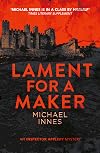
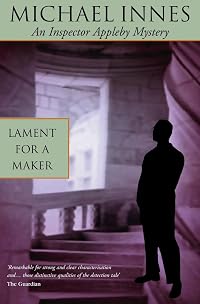
The cover on my edition, which shows a falling body wearing a bright red tie, is not congruous with the tale. Much better are the covers that feature the castle more prominently, like the Dodd, Mead and Co. hardcover illustration. show less
Unfortunately, Innes saw a bit too much humor in the possibility or actuality of rape. And the grand passion of two of the characters is unconvincing or perhaps just an easily used literary convention of the time which is now obtrusively dated.
But the different narrators show more have distinct voices, and much humor can be found in their remarks, generally censorious or dismissive. One makes a disparaging remark about the Inneses, considered Flemish.
The cover on my edition, which shows a falling body wearing a bright red tie, is not congruous with the tale. Much better are the covers that feature the castle more prominently, like the Dodd, Mead and Co. hardcover illustration. show less
Six-word review: Far-fetched murder puzzle with unguessable ending.
Extended review:
Most detective fiction strains the bounds of credulity a little bit, but this one does involve some breakage. Even though no supernatural elements are involved, I would place this tale pretty close to the boundary of fantasy.
That doesn't mean it isn't entertaining. The subtle connivance of the villain and victim, the characters of the witnesses, the increasingly complex theories of the successive narrators, and the atmospheric setting combine to create an absorbing and diverting narrative. I don't require my mystery reading to describe a sequence of events that could play out believably next door.
And this tale is anything but: set in a moody and menacing show more castle brooding over a snowbound Scottish landscape, it features a diverse cast of characters whose interaction is very much more complex than it appears at first, second, or third view. Wending our way to the conclusion takes us through some dark territory, dark but hardly featureless. I enjoyed the trip. show less
Extended review:
Most detective fiction strains the bounds of credulity a little bit, but this one does involve some breakage. Even though no supernatural elements are involved, I would place this tale pretty close to the boundary of fantasy.
That doesn't mean it isn't entertaining. The subtle connivance of the villain and victim, the characters of the witnesses, the increasingly complex theories of the successive narrators, and the atmospheric setting combine to create an absorbing and diverting narrative. I don't require my mystery reading to describe a sequence of events that could play out believably next door.
And this tale is anything but: set in a moody and menacing show more castle brooding over a snowbound Scottish landscape, it features a diverse cast of characters whose interaction is very much more complex than it appears at first, second, or third view. Wending our way to the conclusion takes us through some dark territory, dark but hardly featureless. I enjoyed the trip. show less
Not an easy book to review. Innes uses multiple narrators to tell a complex (and confusing) story about a reclusive miser who meets an untimely end from the tower of his family castle.
The characters are developed with Innes’s usual skill and wit, and they make the novel go. The setting, that classic closed-in-by-a-blizzard country house, is nicely creepy. The plot and the mystery, however...
Did Ronald Guthrie throw himself off the parapet? Was he pushed? If so, by whom?
I’ve grown to dislike the “Look! Here’s the solution! Wait. No, this is it. Er, no, no quite: you haven’t considered this information you have no way to know about!” sort of endings to mysteries. Of that type, this is fairly well-done, but the final show more denouement stretches the reader’s credulity to the breaking point.
A modest three stars. show less
The characters are developed with Innes’s usual skill and wit, and they make the novel go. The setting, that classic closed-in-by-a-blizzard country house, is nicely creepy. The plot and the mystery, however...
Did Ronald Guthrie throw himself off the parapet? Was he pushed? If so, by whom?
I’ve grown to dislike the “Look! Here’s the solution! Wait. No, this is it. Er, no, no quite: you haven’t considered this information you have no way to know about!” sort of endings to mysteries. Of that type, this is fairly well-done, but the final show more denouement stretches the reader’s credulity to the breaking point.
A modest three stars. show less
I have never read Michael Innes before, so I was not prepared for this book at all. It is wonderfully complex, and the characterizations are truly masterful. The setting of the book is also noteworthy since it takes place at a remote Scottish castle right at Christmastime. The book does not spare the reader. It will take you on an emotional roller-coaster ride that never ends until the very last page. Innes' portrayal of a a mad Scottish lord is chilling. And Innes' detective John Appleby has to be one of the the most unique in the whole industry. I cannot say enough good things about this book, and about Michael Innes. Whatever you do try to find it and read it, read it, read it. I got my copy from the library. Luckily one library in show more our wonderful system saw the merits of keeping this very old book. show less
This 3rd book in the Inspector Appleby series is very different in style from the first two. This style is similar to Wilkie Collins; the story is told in a series of first person narratives. Unfortunately, the first narrative by Ewan Bell is written in a Scots English that almost made me give up on this before I had read 25 pages. I am so glad that I didn't! The case kept getting more and more complex and the ending was a great surprise - Innes really came up with a wonderful plot.
When Erchany castle is isolated by snow during a hard winter, the laird falls to his death from the battlements. Was it suicide or murder by the crofter lad who is eloping with the laird's ward or what?
Events are told by a series of narrators, and it has to be said the sutor's Doric did get a bit much at times. I found some of the psychologising a bit implausible but the ending where the theories flowed thick and fast was terrific.
Events are told by a series of narrators, and it has to be said the sutor's Doric did get a bit much at times. I found some of the psychologising a bit implausible but the ending where the theories flowed thick and fast was terrific.
Members
- Recently Added By
Lists

Haycraft Queen Cornerstones
181 works; 3 members

Must Read Detective Stories (Nick Fuller)
278 works; 2 members
Art Bourgeau's Favorites [Mystery Lovers Companion, 1986]
124 works; 2 members
Author Information

103+ Works 10,661 Members
John Innes Mackintosh Stewart was born in Edinburgh. He attended Oxford where he studied English. He taught English in universities at the University of Adelaide, in South Australia. Stewart published novels, short stories, studies in literature, biographies, and plays. Under his name, he wrote scholarly works such as Character and Motive in show more Shakespeare, Rudyard Kipling, and Thomas Hardy. As Michael Innes, he wrote over fifty detective novels with Inspector John Appleby of Scotland Yard in London as the main character. These titles include Death at the President's Lodging, The Journeying Boy, Lament for a Maker, Operation Pax, the Crabtree Affair and Silence Observed. Stewart died on November 12, 1994. (Bowker Author Biography) show less
Some Editions
Awards and Honors
Distinctions
Notable Lists
Series

Belongs to Publisher Series
Common Knowledge
- Canonical title
- Lament for a Maker
- Original title
- Lament for a Maker
- Original publication date
- 1938
- People/Characters
- Ranald Guthrie; John Appleby
- Important places
- Scotland, UK
- First words
- It will appear full plain in this narrative that Mr Wedderburn, the writer from Edinburgh, is as guileful as he's douce - and that he has need of all the guile that Eve passed on from the Serpent may be supposed, him with his... (show all) living to make among the lawyers.
- Last words
- (Click to show. Warning: May contain spoilers.)And yet - because it rises joyous and full-throated from the earth - I hear it as an enduring song.
Classifications
Statistics
- Members
- 297
- Popularity
- 108,017
- Reviews
- 16
- Rating
- (3.92)
- Languages
- 7 — English, French, German, Japanese, Portuguese, Spanish, Swedish
- Media
- Paper, Ebook
- ISBNs
- 20
- ASINs
- 8