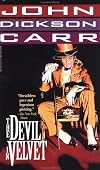
The Devil in Velvet
by John Dickson Carr
On This Page
Description
HTML:To solve a centuries-old crime, a man makes a deal with the devil: "The fantasy, the murder and the historical action are . . . all wonderful" (San Francisco Chronicle). An aging scholar of Restoration history, Nicholas Fenton has long dreamed of traveling into the past. He has a date in mind—May 10, 1675—as well as a purpose: to solve the murder case of the woman he loves, his rakehell ancestor's lovely wife. Obsessed with delivering her from danger, he turns to an unlikely show more accomplice: the devil. After striking a bargain with the prince of darkness, Fenton awakens in the seventeenth century in the much-younger body of dashing Sir Nick Fenton. In an era when gentlemen died by the blade, Fenton is handy with a rapier, and his knowledge of local history gives him a leg up on the swashbucklers who would have his hide. But while his sword may help him rescue his beloved, it will take more than that to save his soul. Even in 1675, the devil is in the details. Historical Fiction. Thriller. Fiction. Mystery. show lessTags
Recommendations




















Member Reviews
An older (1953) title by a prolific and masterful storyteller, this is the spiritual ancestor of [Outlander]...love, lust, and what happens when the two intersect with foreknowledge. Carr's pithy aperçus and aphorisms, aka dialogue, are a joy to this jaded reader's palate. Expect a tight plot, a heady obsessive love, and political intrigues with dark motives all set in seventeenth-century London.
Some typical lines:
The great age mentioned above? Sixty. *snort* show less
Some typical lines:
A man of great age sees clearly only the past; that is green, that is bright; and he sees, with helpless clarity, the man he might have been. Perhaps, if you add old thin blood, that is why his emotions are so close to the surface.show more
–and–
Again, a true booklover requires only that the book be old and full of good-for-nothing
lore.
The great age mentioned above? Sixty. *snort* show less
Reading thematically has piqued my interest over the last few years, but it can lead to a lack of reading variety. Several themes on the go at one time can solve this problem and one of my favourite themes is to pick a year and read a selection of books from that year. My selections depend on availability and cost and this is important if the year selected still has copyright restrictions. My year this year for general novel reading is 1951 and it has already thrown up some surprises like The Devil in Velvet by John Dickson Carr. Carr was famous for his detective stories and is acknowledged as one of the most influential writers in the Golden Age mysteries genre, however in this book he ventures into the genre of historical fiction with show more surprisingly good results, so good in fact that I could have been reading a novel by C J Sansom my current favourite author in the genre.
The book starts with Nicholas Fenton a 58 year old professor of history who wants to solve a murder allegedly carried out by one of his ancestors. He makes a pact with the devil to sell his soul for the privilege of being transported back in time. After this rather preposterous framework the book settles down to being an excellent historical mystery. Professor Fenton is transported to the house in London of his ancestor in 1675. He inhabits the body of Sir Nick Fenton a youthful 33 year old and must adapt quickly to the pace of life of a prosperous young nobleman in the reign of Charles II. The murder in question is that of Sir Nick's' wife with whom the professor soon finds himself falling in love. He knows the date of the murder and works hard to prevent it happening, but he has the problem of keeping the character of Sir Nick reasserting itself in the body that he inhabits.
While the tale is fanciful the atmosphere and world building of London in 1675 is the star of this novel. From the moment that professor Fenton wakes up Carr manages to create a believable world that the reader sees through Fentons eyes. The large house that backs onto the lane that is Pall Mall, the household of servants that work to the wishes of Sir Nick in their own fashion and the dangers and dirt of crowded London streets. There is sword play and a pitched battle in the streets as Sir Nick a supporter of the royalist cause battles against the Country Part led by Lord Shaftesbury. Carr paces the mystery well and there are some memorable moments like the assignation in the London Pleasure gardens and Sir Nicks interview with Charles II, but most of the pleasure is derived by Carr's evocation of the sights, sounds and smells of London just after the Restoration.
I know the descriptions and atmosphere created are a little superficial, but they are convincing enough for me to believe that I was reading about life in 17th century London and that together with an unsolved mystery and an adventure story leads me to rate this at 3.5 stars. show less
The book starts with Nicholas Fenton a 58 year old professor of history who wants to solve a murder allegedly carried out by one of his ancestors. He makes a pact with the devil to sell his soul for the privilege of being transported back in time. After this rather preposterous framework the book settles down to being an excellent historical mystery. Professor Fenton is transported to the house in London of his ancestor in 1675. He inhabits the body of Sir Nick Fenton a youthful 33 year old and must adapt quickly to the pace of life of a prosperous young nobleman in the reign of Charles II. The murder in question is that of Sir Nick's' wife with whom the professor soon finds himself falling in love. He knows the date of the murder and works hard to prevent it happening, but he has the problem of keeping the character of Sir Nick reasserting itself in the body that he inhabits.
While the tale is fanciful the atmosphere and world building of London in 1675 is the star of this novel. From the moment that professor Fenton wakes up Carr manages to create a believable world that the reader sees through Fentons eyes. The large house that backs onto the lane that is Pall Mall, the household of servants that work to the wishes of Sir Nick in their own fashion and the dangers and dirt of crowded London streets. There is sword play and a pitched battle in the streets as Sir Nick a supporter of the royalist cause battles against the Country Part led by Lord Shaftesbury. Carr paces the mystery well and there are some memorable moments like the assignation in the London Pleasure gardens and Sir Nicks interview with Charles II, but most of the pleasure is derived by Carr's evocation of the sights, sounds and smells of London just after the Restoration.
I know the descriptions and atmosphere created are a little superficial, but they are convincing enough for me to believe that I was reading about life in 17th century London and that together with an unsolved mystery and an adventure story leads me to rate this at 3.5 stars. show less
John Dickson Carr is best known as the master of the locked-room mystery. In this book, he tries something different: the tale of Nicholas Fenton, a history professor who makes a deal with the Devil to return to Restoration England and find out who killed Lydia Fenton, the wife of Sir Nicholas Fenton (no relation). It’s an engrossing read; Carr has done his research well and employs it with the best effect. The supernatural bits are spooky enough that I read them on the bus in broad daylight, rather than at home, but the rest of the story was fine. It was tense though! Very suspenseful. Carr also touches on a variety of issues surrounding time travel — mastering the accents, warning people about the future, and placing yourself in show more danger from doing the wrong thing at the wrong time. And at the heart of this story is the question “can you really change history?”
My rating is 4 stars for the mystery itself, with an extra half star for the suspenseful atmosphere and the brief but informative afterword.
The Devil in Velvet would appeal to fans of mysteries, historical fiction, the history of the Restoration, or time travel. show less
My rating is 4 stars for the mystery itself, with an extra half star for the suspenseful atmosphere and the brief but informative afterword.
The Devil in Velvet would appeal to fans of mysteries, historical fiction, the history of the Restoration, or time travel. show less
In 1926 Cambridge history don and Restoration buff Nicholas Felton does a deal with the Devil to be allowed to go back in time to 1675, to take over the body and temporarily the life of his ancestor, Sir Nick Felton, a staunch Royalist but also, as Felton (to distinguish from Sir Nick) soon discovers, an ogre. Luckily, it's the more urbane Felton who's normally in charge of the proceedings as he swaggers and swordplays his way through the London of Charles II's time; occasionally, however, in times of great emotional stress (usually rage) the monstrous Sir Nick takes over and Felton blacks out, to be told afterwards of what havoc Sir Nick might have wrought.
Felton's ostensible purpose in coming back to 1675 is to try to solve the show more mystery of who killed Sir Nick's wife Lydia -- and soon, as he becomes completely infatuated, physically and otherwise, with Lydia, his more important self-appointed task is to prevent the murder happening at all. And at first it seems he has succeeded: he identifies the servant who has been feeding Lydia a slow, subcritical diet of arsenic, and the trick whereby it's being done. Yet he exhibits mercy toward the culprit, knowing she was but someone else's catspaw. Because of his decency in this unmerciful age, he soon becomes and object of devotion for his servants. They approve, too, of his ejecting from the household one Meg York, Sir Nick's unconcealed mistress this past while, and who bears a quite astonishing resemblance to demure Mary Grenville, the daughter of a friend of Felton's back in 1925.
There's lots of swashbucklery, and by book's end all the machinations of the plot to kill Lydia (and other plots, equally murderous) have been exposed and satisfactorily explained.
John Dickson Carr is perhaps my favourite of the classic detective writers, and so obviously I read this book decades ago. All I could remember of it were the vague general setup and that it had taken me quite a time before the novel started gripping me. Exactly the same happened this time. Carr evidently did huge amounts of research for this, his second historical novel (his first, The Bride of Newgate was a straightforward historical; two more timeslip fantasies followed The Devil in Velvet, and I shall be reading them shortly). That research shows, oh gawd does it show. Aside from frequent pauses (at least during the earlier part of the book) to offer minute descriptions of architectural features or niceties of attire, the characters all speak in a vocabulary that I'm sure is filled with lots of authentic flourishes but is a bit bloody boring to wade through. Still, once the author gets over the fact that he needs to impress us with his historical erudition, things start zipping along merrily enough, in true Carr style.
One interesting aspect of the book: Occasionally Felton, using his deep historical knowledge of the period, attempts to warn his new contemporaries -- including Charles II during an audience at Buck House -- of events that lie in their near future; of course, no one believes him, as otherwise history would be altered. Yet such alterations seem permissible in a small way. When Felton warns Charles of the Popish Plot,* that warning actually contributes to making the true plotters' duplicity yet more effective. It's a nice touch: you can't change history except to make it even more so, as it were.
* The Popish Plot was a wheeze dreamt up by unscrupulous politicians/courtiers, primarily Protestants, to cause civil turmoil through making up out of whole cloth a conspiracy by Catholics to overthrow the monarchy. That way they could cruelly persecute Catholics, get rid of a bunch of adversaries whose loyalty to the Catholic Charles was a nuisance, etc. Hello to the FOX News of the 17th century. show less
Felton's ostensible purpose in coming back to 1675 is to try to solve the show more mystery of who killed Sir Nick's wife Lydia -- and soon, as he becomes completely infatuated, physically and otherwise, with Lydia, his more important self-appointed task is to prevent the murder happening at all. And at first it seems he has succeeded: he identifies the servant who has been feeding Lydia a slow, subcritical diet of arsenic, and the trick whereby it's being done. Yet he exhibits mercy toward the culprit, knowing she was but someone else's catspaw. Because of his decency in this unmerciful age, he soon becomes and object of devotion for his servants. They approve, too, of his ejecting from the household one Meg York, Sir Nick's unconcealed mistress this past while, and who bears a quite astonishing resemblance to demure Mary Grenville, the daughter of a friend of Felton's back in 1925.
There's lots of swashbucklery, and by book's end all the machinations of the plot to kill Lydia (and other plots, equally murderous) have been exposed and satisfactorily explained.
John Dickson Carr is perhaps my favourite of the classic detective writers, and so obviously I read this book decades ago. All I could remember of it were the vague general setup and that it had taken me quite a time before the novel started gripping me. Exactly the same happened this time. Carr evidently did huge amounts of research for this, his second historical novel (his first, The Bride of Newgate was a straightforward historical; two more timeslip fantasies followed The Devil in Velvet, and I shall be reading them shortly). That research shows, oh gawd does it show. Aside from frequent pauses (at least during the earlier part of the book) to offer minute descriptions of architectural features or niceties of attire, the characters all speak in a vocabulary that I'm sure is filled with lots of authentic flourishes but is a bit bloody boring to wade through. Still, once the author gets over the fact that he needs to impress us with his historical erudition, things start zipping along merrily enough, in true Carr style.
One interesting aspect of the book: Occasionally Felton, using his deep historical knowledge of the period, attempts to warn his new contemporaries -- including Charles II during an audience at Buck House -- of events that lie in their near future; of course, no one believes him, as otherwise history would be altered. Yet such alterations seem permissible in a small way. When Felton warns Charles of the Popish Plot,* that warning actually contributes to making the true plotters' duplicity yet more effective. It's a nice touch: you can't change history except to make it even more so, as it were.
* The Popish Plot was a wheeze dreamt up by unscrupulous politicians/courtiers, primarily Protestants, to cause civil turmoil through making up out of whole cloth a conspiracy by Catholics to overthrow the monarchy. That way they could cruelly persecute Catholics, get rid of a bunch of adversaries whose loyalty to the Catholic Charles was a nuisance, etc. Hello to the FOX News of the 17th century. show less
One of John Dickson Carr's historicals + mystery + fantasy. Nicholas Fenton, an historian, wants to solve the mystery of who poisoned the wife of his ancestor of the same name 2 centuries earlier, so he makes a literal deal with devil. The deal with devil is the weakest part of the book. Exactly how he made contact is left vague, and the devil, while threateningly portrayed, is omniscient at some points and conveniently blind at other points. The mystery is likewise relatively thin. Fenton does a few bits of puzzle solving, but eventually the key mystery is just revealed to him. The historical adventure aspects are the main reason to read this novel. Carr did his homework -- detailed in an appendix -- and works hard to portray a show more malodorous 1700s London not at all like what we know today. It's interesting to see how he both emphasizes the bawdy aspects of the time while never actually describing anything to offend the readers of 1951.
Recommended as a historical diversion. show less
Recommended as a historical diversion. show less
This type of book is quite different for John Dickson Carr, but he has done a superb job of creating a travel-back-in-time tale that takes a man from the 1920's into the era of Charles II. (spring of 1675 to be exact). A college history professor makes a deal with the devil to go back in time and assume the character of one of his own relatives. He goes back to prevent a murder that he has read about in his history books, and finds himself in the middle of political upheaval. Restoration England was riff with espionage and secrets, and Professor Nicholas Fenton finds he's having to defend himself and his household from all these outside influences that threaten them. The plot is ingenious, and the action never stops in this book. Poor show more Nicholas Fenton has no idea who to trust in the seething turmoil around him. Good stuff here! show less
Great fun, and great fantasy for the aging intellectual -- a mild-mannered professor makes a deal with the Devil, and goes back in time! His destination? London in the era of Charles II, and the town is jumping, swords slashing, thugs thugging, and beauties bevying. There are mysteries to resolve, but the atmosphere is the main point.
Members
- Recently Added By
Lists

The Top 100 Crime Novels of All Time
100 works; 15 members

Murder Mysteries
57 works; 11 members

Cawthorn and Moorcock's Fantasy: The 100 Best Books
110 works; 7 members

Must Read Detective Stories (Nick Fuller)
278 works; 2 members
Author Information

231+ Works 18,989 Members
John Dickson Carr, the master of locked room mysteries, was born in Uniontown, Pennsylvania, in 1906. He was educated at Haverford College and the Sorbonne in Paris. Carr is a prolific writer with more than 80 novels and collections of short stories to his credit. He began his writing career at the age of 26 with his first published novel, It show more Walks At Night. Some of his most popular works are The Three Coffins (1935), The Burning Coat (1937), and The Bride of Newgate (1951). Carr also collaborated with Adrian Doyle, the son of Sir Arthur Conan Doyle in The Exploits of Sherlock Holmes (1954). Carr met his wife in 1932 and settled in England in 1933. He was drafted by the United States military in World War II, and was ordered to remain in England and work with the BBC. He lived in many cities throughout the world until 1967, when he permanently moved to Greenville, South Carolina. John Dickson Carr also wrote mystery novels under the name Carter Dickson. He died in Greenville in 1977. (Bowker Author Biography) show less
Some Editions
Awards and Honors
Series
Belongs to Publisher Series
Common Knowledge
- Canonical title*
- Il diavolo vestito di velluto
- Original publication date
- 1951
- People/Characters
- Lord Shaftestbury; Charles II, King of England, Scotland, and Ireland; Nicholas Fenton
- Important places
- London, England, UK
- Dedication
- For
Lillian de la Torre - First words
- Something woke him in the middle of the night.
- Quotations
- Under it she wore so many satin petticoats that, when she moved, she sounded like a wandering rain shower.
- Last words
- (Click to show. Warning: May contain spoilers.)And the Clemens Hornn sword still swung at his hip as he climbed the ladder to safety.
*Some information comes from Common Knowledge in other languages. Click "Edit" for more information.
Classifications
- Genres
- Fiction and Literature, Mystery, Historical Fiction, Science Fiction, Fantasy
- DDC/MDS
- 813.54 — Literature & rhetoric American literature in English American fiction in English 1900-1999 1945-1999
- LCC
- PZ3 .C2317 — Language and Literature Fiction and juvenile belles lettres Fiction and juvenile belles lettres Fiction in English
- BISAC
Statistics
- Members
- 273
- Popularity
- 118,578
- Reviews
- 8
- Rating
- (3.73)
- Languages
- 6 — English, French, German, Italian, Polish, Swedish
- Media
- Paper, Ebook
- ISBNs
- 10
- ASINs
- 17