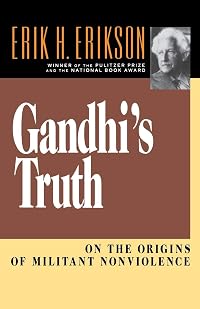
Gandhi's Truth: On the Origins of Militant Nonviolence
by Erik H. Erikson
On This Page
Description
In this study of Mahatma Gandhi, psychoanalyst Erik H. Erikson explores how Gandhi succeeded in mobilizing the Indian people both spiritually and politically as he became the revolutionary innovator of militant non-violence and India became the motherland of large-scale civil disobedience.Tags
Recommendations























Member Reviews
The descriptions on this site and on the book-cover itself are terribly misleading. This is much less an examination of the rise of militant non-violence as a social phenomenon than it is a Freudian examination of Gandhi himself. It offers some interesting reflexions on Gandhi's motivations, and I like the focus of the book on a seemingly minor strike in Amedhabad. Erikson's writing style is also a plus, as he is very conversational and humble while otherwise strongly criticizing one of history's most beloved figures. Unfortunately, most of the book is so steeped in Freudian psycho-babble as to be not only significantly dated, but also really boring.
Eriksen assumes that the reader already knows Gandhi’s timeline, achievements, and autobiography so he throws around terms and names that never get defined. He is trying to search Gandhi’s childhood for the (Freudian) psychoanalytic seeds of the man’s later nonviolence methods. Much of the connections seem forced. Erickson apparently could not conceive of a time when his two favorite men, Gandhi and Freud, were not universally worshipped.
Mentioned in The Princessa: Machiavelli for Women by Harriet Rubin.
> LA VÉRITÉ DE GANDHI Les origines de la non-violence, par Erik H. Erikson ;
L’ENSEIGNEMENT DE MÂ ANANDA MOYÎ, par Josette Herbert (trad)
Se reporter au compte rendu de Germain Gabriel
In: Revue Esprit, No. 442 (Janvier 1975), pp. 155-156. … ; (en ligne),
URL : https://esprit.presse.fr/article/germain-gabriel/erik-h-erikson-la-verite-de-gan...
L’ENSEIGNEMENT DE MÂ ANANDA MOYÎ, par Josette Herbert (trad)
Se reporter au compte rendu de Germain Gabriel
In: Revue Esprit, No. 442 (Janvier 1975), pp. 155-156. … ; (en ligne),
URL : https://esprit.presse.fr/article/germain-gabriel/erik-h-erikson-la-verite-de-gan...
Oct 18, 2019 (Edited)French
Ratings
Members
- Recently Added By
Lists

Books Referenced by Izetbegovic's Islam Between East and West
233 works; 2 members
Author Information

34+ Works 4,261 Members
Erik H. Erikson, a German-born American psychologist and psychoanalyst, developed theories about the sequence of human development that have had an impact on clinical psychoanalysis, ethics, history, literature, child care, and the emerging interdisciplinary study of the life course. Erikson was an art student, but after undergoing psychoanalysis show more by Anna Freud in Vienna in 1927, he turned to the field of psychology. According to Erikson's life-cycle theory, first published in Childhood and Society (1950), there are eight developmental stages, which are biologically determined but environmentally shaped: infancy, early childhood, play age, school age, adolescence, young adulthood, mature adulthood, and old age. Each of these stages is associated with a particular crisis that the individual must successfully resolve in order to proceed normally to the next stage-for example, identity versus confusion in adolescence. The concept of the identity crisis is now firmly embedded in psychiatric theory. Erikson also studied the relationship between a person's life and the times in which he or she lives; and his historical-biographical studies of Luther and Gandhi are outstanding products of this inquiry. Erikson taught at Harvard University for 30 years (Bowker Author Biography) show less
Awards and Honors
Awards
Distinctions
Notable Lists
Common Knowledge
- People/Characters
- Mohandas Gandhi
Classifications
- Genres
- Nonfiction, General Nonfiction, Biography & Memoir, History, Philosophy, Religion & Spirituality
- DDC/MDS
- 323.2 — Society, government, & culture Political science Civil Rights & Liberties/ Human Rights Rebellion
- LCC
- DS481 .G3 .E7 — History of Europe, Asia, Africa and Oceania Asia History of Asia India (Bharat) History
- BISAC
Statistics
- Members
- 530
- Popularity
- 56,498
- Reviews
- 4
- Rating
- (3.20)
- Languages
- Chinese, English, French
- Media
- Paper, Ebook
- ISBNs
- 10
- ASINs
- 9