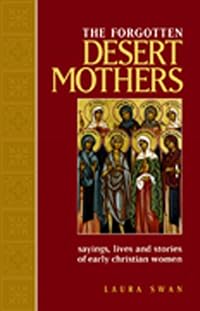
The Forgotten Desert Mothers: Sayings, Lives, and Stories of Early Christian Women
by Laura Swan 
On This Page
Description
This book explores the engagement of women with the Catholic Social Tradition, focusing on solidarity and the common good. Edited by Erin M. Brigham and Mary Johnson, it addresses the historical oversight of women's roles in Catholic teachings and highlights their contributions to social justice. The text examines topics such as labor migration, nonviolent leadership, and the intersection of race and gender within the Church. Aimed at expanding knowledge and action, the book calls for show more recognition of women's voices in shaping Catholic Social Teaching, emphasizing principles of human dignity and solidarity. show lessTags
Recommendations

Member Reviews
This is an interesting collection of sayings from female ascetics in early Christianity -- interspersed with meditations on their modern meaning by Laura Swan.
Her commentary is devotional rather than scholarly. She sees desert asceticism as a way to revitalize the modern Christian community and restore an authentic faith and a sense of a God who “does not want to be tamed, controlled, or pasteurized” (157). However, the value of her meditations is dependent upon want a reader wants from the book.
Given the difficultly of digging out the Lives of female ascetics from under the mountain of hagiography of male ascetics, Swan's work is valuable as a collection. Unfortunately, her summaries of the lives and sayings of the desert mothers, show more while accessible, feel overly simplified. All of the information is filtered through Swan’s vision and this adds another degree of separation on top of the separations already created by years of oral transmission and then the hagiography of the early church. Ultimately, we are further removed from the desert mothers than they would have otherwise been.
Swan makes a critical error when she lumps desert ascetics, urban ascetics, and deaconesses together under the term desert mothers. This imposes an artificial unity of thought, belief, practice, context, and experience on the women of the early Christianity. This error is similar to the tendency of modern feminist scholarship to group all women together in this vague category of women’s experience with little regard for the differences in experiences that are created by socio-economic class, race, ethnicity, sexuality, nationality, and – in feminist theology – in which branch of Christianity a woman is located. This false grouping forces homogenization of ideas rather than the “prophetic freedom” Swan praises in her epilogue. While she has taken steps toward prophetic freedom in recognizes that the gender of the desert mothers differentiates their experience and message from that of the men of the time, she has not in this book truly allowed the women of early Christianity to speak for themselves. show less
Her commentary is devotional rather than scholarly. She sees desert asceticism as a way to revitalize the modern Christian community and restore an authentic faith and a sense of a God who “does not want to be tamed, controlled, or pasteurized” (157). However, the value of her meditations is dependent upon want a reader wants from the book.
Given the difficultly of digging out the Lives of female ascetics from under the mountain of hagiography of male ascetics, Swan's work is valuable as a collection. Unfortunately, her summaries of the lives and sayings of the desert mothers, show more while accessible, feel overly simplified. All of the information is filtered through Swan’s vision and this adds another degree of separation on top of the separations already created by years of oral transmission and then the hagiography of the early church. Ultimately, we are further removed from the desert mothers than they would have otherwise been.
Swan makes a critical error when she lumps desert ascetics, urban ascetics, and deaconesses together under the term desert mothers. This imposes an artificial unity of thought, belief, practice, context, and experience on the women of the early Christianity. This error is similar to the tendency of modern feminist scholarship to group all women together in this vague category of women’s experience with little regard for the differences in experiences that are created by socio-economic class, race, ethnicity, sexuality, nationality, and – in feminist theology – in which branch of Christianity a woman is located. This false grouping forces homogenization of ideas rather than the “prophetic freedom” Swan praises in her epilogue. While she has taken steps toward prophetic freedom in recognizes that the gender of the desert mothers differentiates their experience and message from that of the men of the time, she has not in this book truly allowed the women of early Christianity to speak for themselves. show less
This is a great collection of sayings from the desert mothers. Unfortunately, the writer Laura Swan tends to be both preachy and too facile with popular psychobabble. I skipped Swan's ruminations on the desert mothers to read only the mothers' words themselves -- and was amply rewarded.
An introduction to the sayings, lives, stories, and spirituality of women in the postbiblical, early Christian movement.
Sayings, lives, and stories of early Christian women.
Ratings
Members
- Recently Added By
Lists

The Essential Western Mystics
66 works; 4 members
Author Information

15 Works 560 Members
Laura Swan has for many years studied and written about the history of women's spirituality and the monastic life. She is the associate editor of Magistra: A Journal of Women's Spirituality in History and adjunct professor of religious studies at Saint Martin's University in Washington State. A member and former prioress of St. Placid Priory, a show more community of Benedictine women in the Pacific Northwest, her books include The Forgotten Desert Mothers and Engaging Benedict. show less
Laura Swan is a LibraryThing Author, an author who lists their personal library on LibraryThing.
Classifications
- Genres
- Religion & Spirituality, Nonfiction, History, Sexuality and Gender Studies, General Nonfiction
- DDC/MDS
- 270.2082 — Religion History of Christianity History, geographic treatment, biography of Christianity Period of ecumenic councils; Centralization (325-787)
- LCC
- BR195 .M65 .S93 — Philosophy, Psychology and Religion Christianity Christianity History By period Early and medieval
- BISAC
Statistics
- Members
- 330
- Popularity
- 95,413
- Reviews
- 4
- Rating
- (4.00)
- Languages
- English, Swedish
- Media
- Paper, Ebook
- ISBNs
- 5