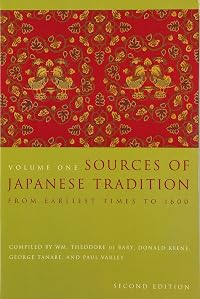
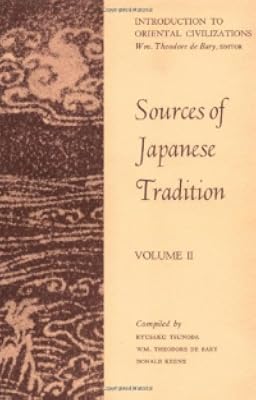
Sources of Japanese Tradition, Vol. 1: From Earliest Times to 1600
by Ryusaku Tsunoda (Editor), William Theodore De Bary (Editor), Donald Keene (Editor)
Sources of Japanese Tradition (to 1600)
On This Page
Description
Sources of Japanese Tradition is a best-selling classic, unrivaled for its wide selection of source readings on history, society, politics, education, philosophy, and religion in the Land of the Rising Sun. In this long-awaited second edition, the editors have revised or retranslated most of the texts in the original 1958 edition, and added a great many selections not included or translated before. They have also restructured volume 1 to span the period from the early Japanese chronicles to show more the end of the sixteenth century. New additions include: * readings on early and medieval Shinto and on the tea ceremony, * readings on state Buddhism and Chinese political thought influential in Japan, and * sections on women's education, medieval innovations in the uses of history, and laws and precepts of the medieval warrior houses. Together, the selections shed light on the development of Japanese civilization in its own terms, without reference to Western parallels, and will continue to assist generations of students and lay readers in understanding Japanese culture. show lessTags
Recommendations






















Member Reviews
Huge book; short review.
Voluminous, informed ... but kinda boring: how was all that made so ... boring? Good passages, but overall just too much work. Look at how many other reviewers gave up on "A Distant Mirror" (I finished)
Structurally, the problem is that no real superstructure was presented, just a long disconnected series of follies, deaths & betrothments. One hundred years war, the plague shouldn't be boring, but successfully, they were.
5 stars for content
2 stars for interest, reader captivation
3 stars for me.
Voluminous, informed ... but kinda boring: how was all that made so ... boring? Good passages, but overall just too much work. Look at how many other reviewers gave up on "A Distant Mirror" (I finished)
Structurally, the problem is that no real superstructure was presented, just a long disconnected series of follies, deaths & betrothments. One hundred years war, the plague shouldn't be boring, but successfully, they were.
5 stars for content
2 stars for interest, reader captivation
3 stars for me.
A Distant Mirrorr by Barbara W. Tuchman is, on one level, a seven hundred page encyclopedia of the 14th century’s political, military, religious, social, cultural and economic history. Since Ms. Tuchman is a first-rate writer, on still another level, the book is a compelling, personalized account of individual men and women living through these turbulent, disastrous times, especially one Enguerrand de Coucy V11 (1340-1397), a high-ranking noble, heralded as “the most experienced and skillful of all the knights of France”. The focus on Lord Coucy is supremely appropriate since this nobleman repeatedly pops up as a prime player in many of the century’s key events.
The 14th century witnessed ongoing devastation, including the little show more ice age, the hundred years’ war, the papal schism, the peasant’s revolt and, most dramatically, the black death of 1348-1350, which depopulated Europe by as much as half. Ms. Tuchman’s book covers it all in twenty-seven chapters, chapter with such headings as Decapitated France: The Bourgeois Rising and the Jacquerie, The Papal Schism, The Worms of the Earth Against the Lions and Dance Macabre.
Many pages are filled with the color and morbidity of the times. By way of example, here is one memorable happening where the French Queen gave a masquerade to celebrate the wedding of a twice widowed lady-in-waiting: six young noblemen, including the King who recently recovered from a bout of madness, disguised themselves as wood savages and entered the masked ball making lewd gestures and howling like wolves as they paraded and capered in the middle of the revelers. When one of the noble spectators came too close with his torch, a spark fell and a few moments later the wood savages, with the exception of the King, were engulfed in flames. Afterwards, the French populace was horrified by this ghastly tragedy, a perverse playing on the edge of madness and death nearly killing their King.
And here is what the author has to say about the young man who concocted the wood savage idea, “The deviser of the affair “cruelest and most insolent of men,” was one Huguet de Guisay, favored in the royal circle for his outrageous schemes. He was a man of “wicked life” who “corrupted and schooled youth in debaucheries,” and held commoners and the poor in hatred and contempt. He called them dogs, and with blows of sword and whip took pleasure in forcing them to imitate barking. If a servant displeased him, he would force the man to lie on the ground and, standing on his back, would kick him with spurs, crying, “Bark, dog!” in response to his cries of pain.” All of the chapters are chock full with such sadistic and violent sketches.
Speaking of the populate, there is plenty of detail on the habits and round of daily life of the common people. And, of course, there is a plethora of detail on the lives of the upper classes. Here is a snippet of one description: “In the evening minstrels played with lutes and harps, reed pipes, bagpipes, trumpets, kettle drums, and cymbals. In the blossoming of secular music as an art in the 14th century, as many as thirty-six different instruments had come into use. If no concert or performance was scheduled after the evening meal, the company entertained each other with song and conversation, tales of the day’s hunting, “graceful questions” on the conventions of live, and verbal games.”
As in any age, it makes for more comfortable living being at the top rather than at the bottom of the social scale. And all those musical instruments speak volumes about how the 14th century was a world away from the plainchant of the early middle ages. In a way, the 14th century musical avant-garde fit in well with the fashions of the times: extravagant headdresses, multicolored, bejeweled jackets and long pointed shoes. For those who had the florins, overindulgence was all the rage.
Ms. Tuchman offers ongoing commentary: for example, regarding military engagement, she cites how the 14th century nobility was too wedded to the idea of glory and riding horses on the battlefield to be effective against the new technology of the long-bow and foot soldiers with pikes. And here is a general, overarching comment about the age, “The times were not static. Loss of confidence in the guarantors of order opened the way to demands for change, and miseria gave force to the impulse. The oppressed were no longer enduring but rebelling, although, like the bourgeois who tried to compel reform, they were inadequate, unready, and unequipped for the task.” Indeed, reading about 14th century economic upheaval one is reminded of Karl Marx’s scathing observations four hundred years later.
On a personal note, my primary interests are literature and philosophy; I usually do not read history. However, if I were to recommend one history book, this is the book. Why? Because Ms. Tuchman’s work is not only extremely well written and covers many aspects of the period’s art, music, literature, religion and mysticism, but the turbulent, transitional 14th century does truly mirror our modern world. Quite a time to be alive. show less
Ratings
Members
- Recently Added By
Author Information

Donald Keene was born in Brooklyn, New York on June 18, 1922. He was a child prodigy and entered Columbia University on scholarship in 1938 at the age of 16. He received a bachelor's degree in 1942, a master's degree in 1947, and a doctoral degree in 1951 from Columbia. Shortly after Pearl Harbor, he enlisted in the Navy and volunteered to study show more Japanese. His first experience as a translator came in Hawaii, where he worked on routine military reports captured from Japanese units in the Pacific theater. He then became a wartime interrogator after the battle in Okinawa on April 1, 1945. After he was discharged, he taught at Columbia University for 56 years. Over his career, he translated many of the most important works of Japanese literature into English. He also wrote numerous books in both English and Japanese including Dawn to the West and Travelers of the Ages. In 1985, he became the first non-Japanese to receive the Yomiuri Prize for Literature for literary criticism. He became a Japanese citizen in 2012. He died on February 24, 2019 at the age of 96. (Bowker Author Biography) show less
All Editions
Series

Belongs to Publisher Series
Introduction to Asian Civilizations (Japan v. 1)
Common Knowledge
- Canonical title
- Sources of Japanese Tradition, Vol. 1: From Earliest Times to 1600
- Original publication date
- 1958
- Important places
- Japan
- Dedication
- Dedicated to the memory of
Ryūsaku Tsunoda
Pioneer teacher of Japanese
Studies in America - Original language
- English
Classifications
Statistics
- Members
- 285
- Popularity
- 113,456
- Reviews
- 3
- Rating
- (3.82)
- Languages
- English
- Media
- Paper, Ebook
- ISBNs
- 5
- ASINs
- 5