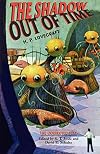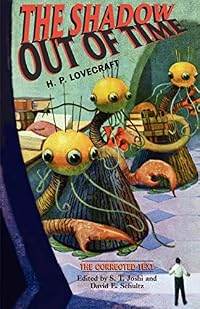
The Shadow Out of Time (Hippocampus Press annotated edition)
by H. P. Lovecraft
On This Page
Description
Voted one of the top ten Science Fiction and Fantasy Books of 2001 by Cinescape Magazine."The Shadow out of Time" is H. P. Lovecraft's last major story. It was first published in Astounding Stories for June 1936. And yet, this text has never been published as Lovecraft wrote it--until now. The recent discovery of Lovecraft's handwritten manuscript allows readers to appreciate this magnificently cosmic story exactly as originally written.All previous editions of the story contain hundreds of show more serious errors, including errors in paragraphing, omissions and mistranscriptions of many words and passages, and erroneous punctuation. Leading Lovecraft scholars S. T. Joshi and David E. Schultz have provided an exhaustive introduction and commentary on the story, elucidating names, places and other elements in this richly evocative story. A must for all devotees of Lovecraft and weird fiction show lessTags
Recommendations




















Member Reviews
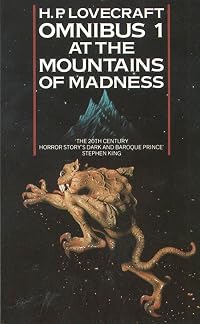
During his heyday, Lovecraft really knew how to set a scene. Consider, for example, the opening sentence of "The Colour Out of Space" (arguably HPL's finest story): "West of Arkham the hills rise wild, and there are valleys with deep woods that no axe has ever cut." Vivid, evocative, ominous. Sadly, "The Shadow Out of Time" lacks such vital touches. Written near the end of his life, this roughly sixty-page novella finds Lovecraft merely plodding through the motions; his fertile imagination had not abandoned him (that much is obvious from his description of the tentacled, bobble-headed members of the Great Race), but his ability to transform story elements into an actual story had suffered. This is a static, awkwardly formal tale, show more reading like a lengthy synopsis that the author never got around to fleshing out. Content-wise, it's just a reiteration of themes that HPL had explored in earlier (and superior) works like "Imprisoned with the Pharaohs," "The Shadow Over Innsmouth" and At the Mountains of Madness: terrifyingly ancient alien civilizations, the disquieting sense of being an "other," the plunge into a subterranean realm where some dreadful, implacable secret awaits.
I'm a big Lovecraft fan and therefore find it impossible to give any of his work a rating of less than three stars, but readers should know that "The Shadow Out of Time" represents HPL past his prime. Even the customarily florid language seems halfhearted, as though Lovecraft himself realized he was overworking his adjectives but simply couldn't break out of the rut. For completists only. (A word of warning: the long introduction to the Hippocampus Press edition contains major spoilers, so skip the intro if you've never read the novella itself! Editors Joshi and Schultz assume that you're already familiar with it.) show less
I'm a big Lovecraft fan and therefore find it impossible to give any of his work a rating of less than three stars, but readers should know that "The Shadow Out of Time" represents HPL past his prime. Even the customarily florid language seems halfhearted, as though Lovecraft himself realized he was overworking his adjectives but simply couldn't break out of the rut. For completists only. (A word of warning: the long introduction to the Hippocampus Press edition contains major spoilers, so skip the intro if you've never read the novella itself! Editors Joshi and Schultz assume that you're already familiar with it.) show less
This wee book was the first publication of this remarkable and excellent story since the discovery of Lovecraft's original handwritten manuscript. Leading Lovecraft scholars S. T. Joshi and David E. Schultz have provided an exhaustive introduction and commentary on this rich evocative story. S. T. Joshi is mistaken when he writes, in his biography of Lovecraft, "...his life as a fiction writer ends, and ends fittingly, with 'The Shadow out of Time'" -- such a statement seems to dismiss Lovecraft's final solo effort, "The Haunter of the Dark," which is a Gothic masterpiece. But "The Shadow out of Time" is certainly magnificent in every way, conjuring as it does, brilliantly, an incredible past and those "alien" races with whom the insect show more Man shares history. Lovecraft's imagination was original in every way, and although his creations are fantastic (his aliens are authentically so), he writes of them with conviction and verve.
"Had I come upon a whole buried world of unholy archaism? Could I still find the house of the writing-master, and the tower where S'gg'ha, a captive mind from the star-headed vegetable carnivores of Antarctica, had chiseled certain pictures on the blank spaces of walls? Would the passage at the second level down, to the hall of alien minds, be still unchoked and traversable? In that hall the captive mind of an incredible entity -- a half-plastic denizen of the hollow interior of an unknown trans-Plutonian planet eitheen million years in the future -- had kept a certain thing which it had modelled from clay."
In that excellent passage we find much of what is superb in Lovecraft. One of the amazing gifts that makes him still relevant is his ingenious combining of supernatural horror motifs with what was then the new and budding genre of science-fiction. I leave to others the discussion of the social commentary implications of THE SHADOW OUT OF TIME and how such relates to a shift in Lovecraft's politics. For me, the grandeur of THE SHADOW OUT OF TIME comes from the staggering implications of the worlds that it conveys, and the perfect prose in which the story is written. The story shews Lovecraft as an absolute master of his narrative style.
One of the story's finest representations is as a radio drama available on audio cd from the H. P. Lovecraft Historical Society. This stunning recording is close to perfection, and that part of the story wherein its accursed hero feels the lurking menace of the creatures that were intensely feared by the Great Race itself is one of the most effective moments of pure horror that I have ever experience.
"I dreaded having to re-pass through that black basalt crypt that was older than the city itself, where cold draughts welled up from unguarded depths. I thought of that which the Great Race had feared, and of what might still be lurking -- be it ever so weak and dying -- down there. I thought of those possible five-circle prints and of what my dreams had told me of such prints -- of strange winds and whistling noises associated with them."
The horror described in that effective passage is brought to eldritch life in the radio drama. Again, this small booklet is the definitive publication of Lovecraft's masterpiece, published here, for the first time, exactly as Lovecraft wrote it, sans editorial "corrections" and modifications. This corrected text may also be found in the Penguin Classics edition, THE DREAMS IN THE WITCH HOUSE AND OTHER WEIRD STORIES. It is appropriate that the story shou'd be included in editions publish'd by Penguin and The Library of America, and soon to be publish'd in a new folio edition, THE NEW ANNOTATED H. P. LOVECRAFT, from W. W. Morton -- for H. P. Lovecraft is Literature, excellent in every way. show less
"Had I come upon a whole buried world of unholy archaism? Could I still find the house of the writing-master, and the tower where S'gg'ha, a captive mind from the star-headed vegetable carnivores of Antarctica, had chiseled certain pictures on the blank spaces of walls? Would the passage at the second level down, to the hall of alien minds, be still unchoked and traversable? In that hall the captive mind of an incredible entity -- a half-plastic denizen of the hollow interior of an unknown trans-Plutonian planet eitheen million years in the future -- had kept a certain thing which it had modelled from clay."
In that excellent passage we find much of what is superb in Lovecraft. One of the amazing gifts that makes him still relevant is his ingenious combining of supernatural horror motifs with what was then the new and budding genre of science-fiction. I leave to others the discussion of the social commentary implications of THE SHADOW OUT OF TIME and how such relates to a shift in Lovecraft's politics. For me, the grandeur of THE SHADOW OUT OF TIME comes from the staggering implications of the worlds that it conveys, and the perfect prose in which the story is written. The story shews Lovecraft as an absolute master of his narrative style.
One of the story's finest representations is as a radio drama available on audio cd from the H. P. Lovecraft Historical Society. This stunning recording is close to perfection, and that part of the story wherein its accursed hero feels the lurking menace of the creatures that were intensely feared by the Great Race itself is one of the most effective moments of pure horror that I have ever experience.
"I dreaded having to re-pass through that black basalt crypt that was older than the city itself, where cold draughts welled up from unguarded depths. I thought of that which the Great Race had feared, and of what might still be lurking -- be it ever so weak and dying -- down there. I thought of those possible five-circle prints and of what my dreams had told me of such prints -- of strange winds and whistling noises associated with them."
The horror described in that effective passage is brought to eldritch life in the radio drama. Again, this small booklet is the definitive publication of Lovecraft's masterpiece, published here, for the first time, exactly as Lovecraft wrote it, sans editorial "corrections" and modifications. This corrected text may also be found in the Penguin Classics edition, THE DREAMS IN THE WITCH HOUSE AND OTHER WEIRD STORIES. It is appropriate that the story shou'd be included in editions publish'd by Penguin and The Library of America, and soon to be publish'd in a new folio edition, THE NEW ANNOTATED H. P. LOVECRAFT, from W. W. Morton -- for H. P. Lovecraft is Literature, excellent in every way. show less
A Shadow Out of Time is a brief novella, but its span is great: through vast reaches of time and space, all guided by H P Lovecraft’s inimitable, portentous prose.
The premise here is quite complex: an American university prof has experienced an inexplicable period of amnesia, throughout which his body continued to function, but seemingly under alien control.
In retrospect, having recovered his faculties, our protagonist is haunted by bizarre memories of strange creatures living in dark, unnerving cities that he somehow recognizes were part of Earth’s deep past. And then a discovery is made in the Australian outback . . . .
If you like scifi/horror combos (a la some of Stephen King’s books such as The Tommyknockers), then going back show more to the ur-texts from one of the early masters such as Lovecraft is good fun.
Recommended. show less
The premise here is quite complex: an American university prof has experienced an inexplicable period of amnesia, throughout which his body continued to function, but seemingly under alien control.
In retrospect, having recovered his faculties, our protagonist is haunted by bizarre memories of strange creatures living in dark, unnerving cities that he somehow recognizes were part of Earth’s deep past. And then a discovery is made in the Australian outback . . . .
If you like scifi/horror combos (a la some of Stephen King’s books such as The Tommyknockers), then going back show more to the ur-texts from one of the early masters such as Lovecraft is good fun.
Recommended. show less
While this story wouldn't be the entry I'd recommend to Lovecraft, it is definitely one of his major works. And this edition is worth reading for the beginning and hardcore fan.
The editors' introduction details how long Lovecraft had been considering this story, his inspirations, and how he, as before in his great creative year of 1927, undertook a reading program to sharpen his style and improve his writing before starting it, his most science-fictional, tale. They also offer some intriguing observations about the specific dates in protagonist Peaslee's life and their significance to Lovecraft's.
As to the annotations, it's not the largely unnecessary vocabulary lessons that Joshi and Schultz offer that are valueable, but how they show more point out similarities in motifs and language to other Lovecraft works, specific factual sources Lovecraft used, and the many links between this and other Cthulhu Mythos stories of Lovecraft and his friends. Even fans who have read this story more than once will probably learn something new in these notes.
I can't say as I noticed any difference between the corrected text and earlier versions of the story, but then I didn't look at the appendix showing all the textual variations. But it's there for the really hardcore Lovecraft fan and scholar. show less
The editors' introduction details how long Lovecraft had been considering this story, his inspirations, and how he, as before in his great creative year of 1927, undertook a reading program to sharpen his style and improve his writing before starting it, his most science-fictional, tale. They also offer some intriguing observations about the specific dates in protagonist Peaslee's life and their significance to Lovecraft's.
As to the annotations, it's not the largely unnecessary vocabulary lessons that Joshi and Schultz offer that are valueable, but how they show more point out similarities in motifs and language to other Lovecraft works, specific factual sources Lovecraft used, and the many links between this and other Cthulhu Mythos stories of Lovecraft and his friends. Even fans who have read this story more than once will probably learn something new in these notes.
I can't say as I noticed any difference between the corrected text and earlier versions of the story, but then I didn't look at the appendix showing all the textual variations. But it's there for the really hardcore Lovecraft fan and scholar. show less
Lovecraft classic, a little weird, but then his stories tend to be weird, lol.
Fantastic and original concept! Super-eerie!
Members
- Recently Added By
Lists

Books Read By artturnerjr - 2013
24 works; 1 member
Author Information

1,907+ Works 73,557 Members
Howard Phillips Lovecraft, 1890 - 1937 H. P. Lovecraft was born on August 20, 1890 in Providence, Rhode Island. His mother was Sarah Susan Phillips Lovecraft and his father was Winfield Scott Lovecraft, a traveling salesman for Gorham & Co. Silversmtihs. Lovecraft was reciting poetry at the age of two and when he was three years old, his father show more suffered a mental breakdown and was admitted to Butler Hospital. He spent five years there before dying on July 19, 1898 of paresis, a form of neurosyphillis. During those five years, Lovecraft was told that his father was paralyzed and in a coma, which was not the case. His mother, two aunts and grandfather were now bringing up Lovecraft. He suffered from frequent illnesses as a boy, many of which were psychological. He began writing between the ages of six and seven and, at about the age of eight, he discovered science. He began to produce the hectographed journals, "The Scientific Gazette" (1899-1907) and "The Rhode Island Journal of Astronomy" (1903-07). His first appearance in print happened, in 1906, when he wrote a letter on an astronomical matter to The Providence Sunday Journal. A short time later, he began writing a monthly astronomy column for The Pawtuxet Valley Gleaner - a rural paper. He also wrote columns for The Providence Tribune (1906-08), The Providence Evening News (1914-18), The Asheville (N.C.) Gazette-News (1915). In 1904, his grandfather died and the family suffered severe financial difficulties, which forced him and his mother to move out of their Victorian home. Devastated by this, he apparently contemplated suicide. In 1908, before graduating from high school, he suffered a nervous breakdown. He didn't receive a diploma and failed to get into Brown University, both of which caused him great shame. Lovecraft was not heard from for five years, re-emerging because of a letter he wrote in protest to Fred Jackson's love story in The Argosy. His letter was published in 1913 and caused great controversy, which was noted by Edward F. Daas, President of the United Amateur Press Association (UAPA). Daas invited Lovecraft to join the UAPA, which he did in early 1914. He eventually became President and Official Editor of the UAPA and served briefly as President of the rival National Amateur Press Association (NAPA). He published thirteen issues of his own paper, The Conservative (1915-23) and contributed poetry and essays to other journals. He also wrote some fiction which titles include "The Beast in the Cave" (1905), "The Alchemist" (1908), "The Tomb" and "Dagon" (1917). In 1919, Lovecraft's mother was deteriorating, mentally and physically, and was admitted to Butler Hospital. On May 24, 1921, his mother died from a gall bladder operation. While attending an amateur journalism convention in Boston, Lovecraft met his future wife Sonia Haft Greene, a Russian Jew. They were married on March 3, 1924 and Lovecraft moved to her apartment in Brooklyn. Sonia had a shop on Fifth Avenue that went bankrupt. In 1925, Sonia went to Cleveland for a job and Lovecraft moved to a smaller apartment in the Red Hook district of Brooklyn. In 1926, he decided to move back to Providence. Lovecraft had his aunts bar his wife, Sonia, from going to Providence to start a business because he couldn't have the stigma of a tradeswoman wife. They were divorced in 1929. After his return to Providence, he wrote his greatest fiction, which included the titles "The Call of Cthulhu" (1926), "At the Mountains of Madness" (1931), and "The Shadow Out of Time" (1934-35). In 1932, his aunt, Mrs. Clark, died; and he moved in with his other aunt, Mrs. Gamwell, in 1933. Suffering from cancer of the intestine, Lovecraft was admitted to Jane Brown Memorial Hospital and on March 15, 1937 he died. (Bowker Author Biography) show less
Common Knowledge
- Canonical title
- The Shadow Out of Time (Hippocampus Press annotated edition) (Hippocampus Press annotated edition)
- Original publication date
- 2001 (corrected and annotated text) (corrected and annotated text)
- Disambiguation notice
- The 2001 edition by Hippocampus Press features commentary and a corrected text that isn't often found in other editions. Please do not combine with other editions.
Classifications
Statistics
- Members
- 131
- Popularity
- 248,231
- Reviews
- 7
- Rating
- (3.92)
- Languages
- English
- Media
- Paper, Ebook
- ISBNs
- 2
- ASINs
- 1