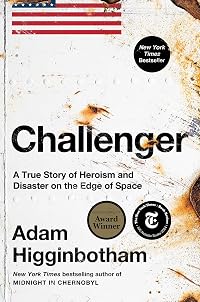
Challenger: A True Story of Heroism and Disaster on the Edge of Space
by Adam Higginbotham
On This Page
Description
Winner of the 2024 Kirkus Nonfiction Prize-
A New York Times Notable Book of 2024
NEW YORK TIMES BESTSELLER - "Stunning...A heart-pounding thriller...Challenger is a remarkable book." —The Atlantic
- "Devastating...A universal story that transcends time." —The New York Times
-
"Dramatic...a moving narrative." —The Wall Street Journal
From the New York Times bestselling author of Midnight in Chernobyl comes the
On January 28, 1986, just seventy-three seconds into flight, the space shuttle Challenger broke apart over the Atlantic Ocean, killing all seven people on board. Millions of Americans witnessed the tragic deaths of the crew, which included New Hampshire schoolteacher Christa McAuliffe. Like the assassination of JFK, the Challenger disaster is a defining moment in 20th-century history—one that forever changed the way America thought of itself and its optimistic view of the future. Yet the full story of what happened, and why, has never been told.
Based on extensive archival research and meticulous, original reporting, Challenger: A True Story of Heroism and Disaster on the Edge of Space follows a handful of central protagonists—including each of the seven members of the doomed crew—through the years leading up to the accident, and offers a detailed account of the tragedy itself and the investigation afterward. It's a compelling tale of ambition and ingenuity undermined by political cynicism and cost-cutting in the interests of burnishing national prestige; of hubris and heroism; and of an investigation driven by leakers and whistleblowers determined to bring the truth to light. Throughout, there are the ominous warning signs of a tragedy to come, recognized but then ignored, and later hidden from the public.
Higginbotham reveals the history of the shuttle program and the lives of men and women whose stories have been overshadowed by the disaster, as well as the designers, engineers, and test pilots who struggled against the odds to get the first shuttle into space. A masterful blend of riveting human drama and fascinating and absorbing science, Challenger identifies a turning point in history—and brings to life an even more complex and astonishing story than we remember. . show less
Tags
Recommendations




































Member Reviews
At a surface level Challenger is a history of the engineering issues faced by NASA up until the eponymous disaster. A little deeper, it ends up being more of a look into failures of project management when it comes to the space missions.
When it comes to the individuals involved, the book is almost universally positive in its depictions (with the possible exception of a few execs/politicians).
When it comes to the bigger picture though. Higginbotham describes a flawed system of government bureaucracy. Hours to get approval to remove a bolt and simultaneously failing to listen to a clear warning of danger.
Its no push for privatization though -- we also see a systemic ignoring and rationalization of a clear (admittedly more so in hindsight) show more problem. Sweeping life or death issues under the rug when they don't fit business objectives is hard to watch.
As someone in the software industry, we frequently joke about not being "real engineers". While I imagine that's still pretty accurate, compared to the rocket engineers working on the space shuttles, it was eerie to see some of the same patterns of engineering dysfunction. The promotion of a fluke error to the status of "longstanding bug", by virtue of the fact that nothing seemed to break catastrophically, gradually moving the line of what is acceptable risk. Treating designed systems as black boxes and inventing terms or concepts to explain away their idiosyncrasies.
Obviously no project management effort is going to be immune to failures, and NASA also made some pretty huge achievements along the way. Still, it seems like a good reminder to keep an eye out for these "Fifth Risk"-style dysfunctions, and remember that an organization filled with exceedingly competent and kind-hearted individuals has the potential to make bad decisions.
PS
OK confession time -- I had to get halfway through this book before remembering that Challenger and Columbia were different shuttle (disaster)s. I didn't know much about either story going into this book, so thought it went long, I appreciated all the context. Also, I'll be lucky if I remember three names out of the hundred (more?) people talked about throughout the book. show less
When it comes to the individuals involved, the book is almost universally positive in its depictions (with the possible exception of a few execs/politicians).
When it comes to the bigger picture though. Higginbotham describes a flawed system of government bureaucracy. Hours to get approval to remove a bolt and simultaneously failing to listen to a clear warning of danger.
Its no push for privatization though -- we also see a systemic ignoring and rationalization of a clear (admittedly more so in hindsight) show more problem. Sweeping life or death issues under the rug when they don't fit business objectives is hard to watch.
As someone in the software industry, we frequently joke about not being "real engineers". While I imagine that's still pretty accurate, compared to the rocket engineers working on the space shuttles, it was eerie to see some of the same patterns of engineering dysfunction. The promotion of a fluke error to the status of "longstanding bug", by virtue of the fact that nothing seemed to break catastrophically, gradually moving the line of what is acceptable risk. Treating designed systems as black boxes and inventing terms or concepts to explain away their idiosyncrasies.
Obviously no project management effort is going to be immune to failures, and NASA also made some pretty huge achievements along the way. Still, it seems like a good reminder to keep an eye out for these "Fifth Risk"-style dysfunctions, and remember that an organization filled with exceedingly competent and kind-hearted individuals has the potential to make bad decisions.
PS
OK confession time -- I had to get halfway through this book before remembering that Challenger and Columbia were different shuttle (disaster)s. I didn't know much about either story going into this book, so thought it went long, I appreciated all the context. Also, I'll be lucky if I remember three names out of the hundred (more?) people talked about throughout the book. show less
This book will leave you heartbroken, tired, and absolutely enraged. Seven brilliant people died not because of the vagaries of nature but due to amazing human hubris. Many narratives of tragedies spend their page count on the disaster and the gory aftermath. Challenger spends the vast majority of the time explaining not why Challenger happened but leaving the reader wondering how it didn't happen much sooner. Higginbotham is one of the few writers who can make even a boring science discussion seem propulsive. In fact, the book almost feels like a horror story at certain points as the author clearly leaves clues on what will ultimately be more casualties than just the crew of the Challenger.
The first part of the book was devoted to the tragedy of Apollo 1, in which Roger Chaffee, Gus Grissom, and Ed White burned to death in a "routine" pre-mission test on the launch pad. In 1967, as a school child obsessed by space exploration, I was deeply upset by that tragedy. My understanding from news reports at the time, and brief references I've seen over the years, was that the conflagration was caused by the pure oxygen atmosphere in the capsule, but Higginbotham dug deeper and brought forward information that was not widely publicized or not emphasized at the time. The cabin was festooned with bundles of wires (surely they couldn't have intended to fly it like that!), some frayed or poorly connected. After the blaze, everything show more was so destroyed that there was no way of telling the actual cause, but it was probably a spark from a short that ignited the blaze. Then, the heavy door of the capsule was located *behind the commander's couch* and he had to reach over his head and around his back to undo *seven latches* to open it. It would have taken something like 40 seconds or more, and the crew didn't have anywhere near that amount of time. So there was bad design (the hatch), cost and weight cutting (the atmosphere mix), and slipshod construction.
There's a quote from an astronaut in the book -- quickly searching online attributes it to Alan Shepard -- When reporters asked Shepard what he thought about as he sat atop the Redstone rocket, waiting for liftoff, he had replied, 'The fact that every part of this ship was built by the lowest bidder.' (as quoted in Failure Is Not an Option by Gene Kranz)
This sums up both Apollo and the Shuttle project rather well.
The tragedy of Apollo 1 serves as an introduction to more of the same in the shuttle program. Again, the ship was designed without any easy method of escape, for the same reasons. Cost and weight. Cost and weight also played into the solid fuel boosters and O-rings that ultimately caused the Challenger explosion, but the truly chilling part of the story that was NOT publicized at the time is that the crew survived the initial explosion and the control capsule fell from the sky for two, almost three minutes with no way to eject, no parachutes. At least one member of the crew was alive when they hit the water.
The launch should have been put off, but there was serious pressure from bureaucrats to keep to the schedule (as indeed with Apollo 1). So engineers' concerns were ignored. In Chapter 7, speaking of the shuttle program in general, Higginbotham says "[T]he development plans for each of the engineering challenges involved" (many of which were impossible to meet at all without major scientific and engineering breakthroughs) "-- which NASA managers had based on the appealing and financially expedient expectation that their work would proceed without a single failure or setback -- had proved to be wildly optimistic." This also sums up the problems with the space program rather well.
And Columbia was more of the same. Engineers on the ground asked for photos of the damage thought to have been incurred during the launch, but their requests were three times denied or ignored.
This was quite a disturbing book. But it's well written and extremely well researched. Five stars. show less
There's a quote from an astronaut in the book -- quickly searching online attributes it to Alan Shepard -- When reporters asked Shepard what he thought about as he sat atop the Redstone rocket, waiting for liftoff, he had replied, 'The fact that every part of this ship was built by the lowest bidder.' (as quoted in Failure Is Not an Option by Gene Kranz)
This sums up both Apollo and the Shuttle project rather well.
The tragedy of Apollo 1 serves as an introduction to more of the same in the shuttle program. Again, the ship was designed without any easy method of escape, for the same reasons. Cost and weight. Cost and weight also played into the solid fuel boosters and O-rings that ultimately caused the Challenger explosion, but the truly chilling part of the story that was NOT publicized at the time is that the crew survived the initial explosion and the control capsule fell from the sky for two, almost three minutes with no way to eject, no parachutes. At least one member of the crew was alive when they hit the water.
The launch should have been put off, but there was serious pressure from bureaucrats to keep to the schedule (as indeed with Apollo 1). So engineers' concerns were ignored. In Chapter 7, speaking of the shuttle program in general, Higginbotham says "[T]he development plans for each of the engineering challenges involved" (many of which were impossible to meet at all without major scientific and engineering breakthroughs) "-- which NASA managers had based on the appealing and financially expedient expectation that their work would proceed without a single failure or setback -- had proved to be wildly optimistic." This also sums up the problems with the space program rather well.
And Columbia was more of the same. Engineers on the ground asked for photos of the damage thought to have been incurred during the launch, but their requests were three times denied or ignored.
This was quite a disturbing book. But it's well written and extremely well researched. Five stars. show less
Summary: The heroism of the seven Challenger crew members and why a critical design flaw was ignored, resulting in their deaths.
I wanted to engage in some “magical thinking” in reading this book. The images of the Challenger explosion played over and over on our TV screens on January 28, 1986. We realized we were watching seven human beings come to a sudden end to their high aspirations. Or as it turned out, tumbling in an intact cockpit to an ocean impact and watery grave.
Adam Higginbotham didn’t allow me to engage that magical thinking. In the Prologue, through the eyes and words of public affairs announcer Steve Nesbitt, the disaster replays, underscored by his understatement, “Obviously a major malfunction.” Still, I show more wanted it to be different.
First, Higginbotham takes us back to the Apollo program, begun disastrously in the capsule fire that killed three astronauts. He traces the response and the subsequent successes of the program. And then the questioning of what NASA should do next. It was a time when government wanted to scale back the massive spending of the Apollo program rather than embark on further grandiose adventures.
And so the idea of a reusable space plane won approval, sold as a way to make space flight routine. But budget constraints resulted in the design decision to deploy reusable Solid Rocket Boosters (SRBs) to launch the shuttle into orbit. No manned space flight had used solid boosters. But the Titan missiles used them successfully, manufactured by Morton Thiokol, who won the contract for the shuttle boosters. However, these were much larger, and needed to be assembled in sections with the joints sealed by an asbestos putty and two concentric O-rings.
In testing, engineers found that on ignition, the joints flexed in a way where a gap in the seal occurred momentarily, allowing hot gasses to escape, to burn through. These charred some of the inner O-rings but did not get past the outer O-ring, and the joint sealed. There were other problems. Valves and turbine blades in the liquid fuel main booster. And hear resistant tiles that would fall off, exposing shuttle surfaces to potential “burn through” on re-entry. Engineers found fixes, including storage and assembly procedures for the SRBs. And the shuttles were approved for flight.
Higginbotham profiles each of the people who made up the crew of Challenger. Along the way, we learn the name of George Abbey, the NASA administrator who made the final call in astronaut selection and personally contacted each person. He introduces each individual: Ron McNair, Ellison Onizuka, Judy Resnik, Dick Scobee, Mike Smith, Greg Jarvis, and Christa McAuliffe, the school teacher who had prepared to teach lessons from space. He traces the career trajectory that led to each being assigned to the Challenger launch.
As the astronauts are training, Higginbotham takes us behind the scenes as concerns mount about the SRB joints. The engineering team at Morton Thiokol, working under Allan McDonald, Director of the program, and Roger Boisjoly, the senior scientist on the project, find more evidence of failures of the joints to fully seal. After a cold weather launch of Discovery in 1985, a significant breach of the inner ring and major charring of the outer ring were found. The joint had held, but barely. Management delayed a redesign of the joint. Boisjoly started studying the cold weather properties of the O-rings, finding they ceased to work at cold temperatures.
In some ways, the tragic climax of the book is the night before what would be a launch in record cold temperatures. The Morton Thiokol engineers unanimously recommended “do not launch.” I kept hoping they would listen and postpone the launch. But senior executives at Morton Thiokol, under pressure by administrators at NASA overrode that recommendation. The saddest moment for me was when Boisjoly, persuaded by colleagues to watch, saw the explosion. He was never the same, despite courageous testimony before the Rogers Commission.
Finally, Higginbotham takes us through the aftermath. This includes the Rogers Commission and the effort to cover up the engineers “do not launch” recommendation. But thanks to the courage of McDonald and Boisjoly, the truth came out. Also, Higginbotham documents the recovery efforts, including the recovery of the burnt through joint of the right booster. And the recovery of the cabin, flight recorder, and remains, confirming that the cabin was intact until it hit the ocean. And at least Mike Smith was conscious to the end.
What Higginbotham traces through his book is what can happen when a corporate culture turns toxic and dysfunctional. Specifically, we see what happens when the best interests of astronauts are over-ridden by political and profit pressures. But we also see the courage coupled with hard work of the seven who flew that fatal mission. We only wish the administrators had matched their courage and integrity.. Because ultimately, it wasn’t merely a powerful rocket that failed, but rather a group of powerful people. show less
I wanted to engage in some “magical thinking” in reading this book. The images of the Challenger explosion played over and over on our TV screens on January 28, 1986. We realized we were watching seven human beings come to a sudden end to their high aspirations. Or as it turned out, tumbling in an intact cockpit to an ocean impact and watery grave.
Adam Higginbotham didn’t allow me to engage that magical thinking. In the Prologue, through the eyes and words of public affairs announcer Steve Nesbitt, the disaster replays, underscored by his understatement, “Obviously a major malfunction.” Still, I show more wanted it to be different.
First, Higginbotham takes us back to the Apollo program, begun disastrously in the capsule fire that killed three astronauts. He traces the response and the subsequent successes of the program. And then the questioning of what NASA should do next. It was a time when government wanted to scale back the massive spending of the Apollo program rather than embark on further grandiose adventures.
And so the idea of a reusable space plane won approval, sold as a way to make space flight routine. But budget constraints resulted in the design decision to deploy reusable Solid Rocket Boosters (SRBs) to launch the shuttle into orbit. No manned space flight had used solid boosters. But the Titan missiles used them successfully, manufactured by Morton Thiokol, who won the contract for the shuttle boosters. However, these were much larger, and needed to be assembled in sections with the joints sealed by an asbestos putty and two concentric O-rings.
In testing, engineers found that on ignition, the joints flexed in a way where a gap in the seal occurred momentarily, allowing hot gasses to escape, to burn through. These charred some of the inner O-rings but did not get past the outer O-ring, and the joint sealed. There were other problems. Valves and turbine blades in the liquid fuel main booster. And hear resistant tiles that would fall off, exposing shuttle surfaces to potential “burn through” on re-entry. Engineers found fixes, including storage and assembly procedures for the SRBs. And the shuttles were approved for flight.
Higginbotham profiles each of the people who made up the crew of Challenger. Along the way, we learn the name of George Abbey, the NASA administrator who made the final call in astronaut selection and personally contacted each person. He introduces each individual: Ron McNair, Ellison Onizuka, Judy Resnik, Dick Scobee, Mike Smith, Greg Jarvis, and Christa McAuliffe, the school teacher who had prepared to teach lessons from space. He traces the career trajectory that led to each being assigned to the Challenger launch.
As the astronauts are training, Higginbotham takes us behind the scenes as concerns mount about the SRB joints. The engineering team at Morton Thiokol, working under Allan McDonald, Director of the program, and Roger Boisjoly, the senior scientist on the project, find more evidence of failures of the joints to fully seal. After a cold weather launch of Discovery in 1985, a significant breach of the inner ring and major charring of the outer ring were found. The joint had held, but barely. Management delayed a redesign of the joint. Boisjoly started studying the cold weather properties of the O-rings, finding they ceased to work at cold temperatures.
In some ways, the tragic climax of the book is the night before what would be a launch in record cold temperatures. The Morton Thiokol engineers unanimously recommended “do not launch.” I kept hoping they would listen and postpone the launch. But senior executives at Morton Thiokol, under pressure by administrators at NASA overrode that recommendation. The saddest moment for me was when Boisjoly, persuaded by colleagues to watch, saw the explosion. He was never the same, despite courageous testimony before the Rogers Commission.
Finally, Higginbotham takes us through the aftermath. This includes the Rogers Commission and the effort to cover up the engineers “do not launch” recommendation. But thanks to the courage of McDonald and Boisjoly, the truth came out. Also, Higginbotham documents the recovery efforts, including the recovery of the burnt through joint of the right booster. And the recovery of the cabin, flight recorder, and remains, confirming that the cabin was intact until it hit the ocean. And at least Mike Smith was conscious to the end.
What Higginbotham traces through his book is what can happen when a corporate culture turns toxic and dysfunctional. Specifically, we see what happens when the best interests of astronauts are over-ridden by political and profit pressures. But we also see the courage coupled with hard work of the seven who flew that fatal mission. We only wish the administrators had matched their courage and integrity.. Because ultimately, it wasn’t merely a powerful rocket that failed, but rather a group of powerful people. show less
Great read. The science/technology sections slowed me down a bit, but the fact that I was still able to mostly understand how one of the most complicated machines ever works is a credit to the author. What really makes this book shine though is the characters and storytelling. I've always thought space travel was one of the coolest things human beings have ever done, but now that I understand better how insanely risky and expensive it is—and how often good old human error causes deadly disasters—I feel a little complicit now, even though my only role in space travel has been from the consumer/entertainment side (i.e, museums and sci-fi novels). Have we learned valuable things from our space explorations? Absolutely. Should humans show more keep trying to conquer the great space frontier? I'm not so sure. show less
In Challenger: A True Story of Heroism and Disaster on the Edge of Space, Adam Higginbotham examines the history of the Space Shuttle from its initial concept and early experiments conducted by Maxime Faget and Dottie Lee through the selection of Astronaut Group 8, nicknamed “TFNG,” which included the first American woman in space with Sally Ride, the first African-American man in space with Guion Bluford, the first American woman to perform a spacewalk with Kathryn Sullivan, and the first Asian-American in space with Ellison Onizuka. After the wind-down from Apollo and the Moon, the Shuttle opened up a new way for Americans to envision space. Despite technical and historic achievements, the portrayal of the Shuttle as safe and show more entirely reliable by NASA, its contractors, and politicians belied the complex system at the Shuttle’s heart and how thoroughly it depended upon new technologies with little to no room for error. Higginbotham continues to demonstrate how Morton Thiokol underestimated the danger of their O-ring system at a management level while NASA’s own management sought to meet impossible launch schedules in order to appease government and private interests. Of a Morton Thiokol presentation on O-rings, Higginbotham writes, “obscured amid the blizzard of charts, data-filled binders, and Viewgraph slides, the rocket engineers failed to realize that they had reached a critical inflection point. Over the course of the years they had been developing and flying the solid rocket motors, the men at Thiokol and Marshall had slowly expanded the parameters of what they regarded as acceptable risk in the joints” (p. 206). Even when the quick-thinking of Jenny Howard saved a Shuttle launch with an abort-to-orbit, NASA did not pause to seriously examine and reconsider every part of the launch equipment (p. 239). In the end, Richard Feynman’s conclusion proved particularly prescient given the latter disaster involving the Columbia: “For a successful technology, reality must take precedence over public relations… for nature cannot be fooled” (p. 450). Higginbotham’s book is an authoritative account of the Challenger disaster for those who don’t remember it or who want a book that explains the technical information without aiming for a technical audience. Eminently readable, he manages to balance a cast of hundreds and weave their narratives together as part of an organic whole that inexorably led to disaster amid institutional failures. Challenger is a warning to all such institutions to carefully examine their systems and avoid allowing outside pressures from business or politics to influence their decision-making away from safety. show less
This is a thoroughly comprehensive and riveting description of the Challenger space shuttle disaster. The first part describes the origins of the Space Shuttle programme itself, focusing on the politics and the technological difficulties, and on the flight crews, particularly the careers of the seven astronauts who ended up on Challenger itself. The second part describes what happened immediately prior to the launch - the arguments and wrangling about whether the shuttle should launch in such cold conditions. The third part describes the failure itself and the immediate aftermath. The fourth, the enquiries into what and why it happened. A poignant coda gives us brief biographies of the key players once the furore died down.
Although show more there is nothing new in this book - no new revelations or conspiracies - it is a magnificent record of what actually happened. The Shuttle programme was operating on a knife-edge, with never enough money, people, spare parts or a solid enough design to deliver the kind of 'delivery truck' workhorse everyone expected. Before Challenger there had been other incidents that brought the Shuttle very close to disaster.
Higginbotham does an excellent job in presenting this long chain of decisions made over many years that not only led to the inclusion of technology that would fail so spectacularly, but also brought people to make those decisions based on careers and contracts and saving face, rather than the safety of the crew and the programme.
The book reads like a thriller and becomes a page-turner as the horror unfolds in front of us. Very highly recommended. show less
Although show more there is nothing new in this book - no new revelations or conspiracies - it is a magnificent record of what actually happened. The Shuttle programme was operating on a knife-edge, with never enough money, people, spare parts or a solid enough design to deliver the kind of 'delivery truck' workhorse everyone expected. Before Challenger there had been other incidents that brought the Shuttle very close to disaster.
Higginbotham does an excellent job in presenting this long chain of decisions made over many years that not only led to the inclusion of technology that would fail so spectacularly, but also brought people to make those decisions based on careers and contracts and saving face, rather than the safety of the crew and the programme.
The book reads like a thriller and becomes a page-turner as the horror unfolds in front of us. Very highly recommended. show less
Members
- Recently Added By
Lists

Top Five Books of 2024
795 works; 264 members
2025 Notable Books for Adults
26 works; 1 member

Library Non-Fiction
164 works; 1 member

Governerds Insider
32 works; 1 member
Top Five Books of 2025
954 works; 303 members
Author Information

3+ Works 3,563 Members
Adam Higginbotham writes for The New Yorker, New York Times Magazine, Wired, GQ, and Smithsonian. He lives in New York City.
Some Editions
Awards and Honors
Awards
Distinctions
Common Knowledge
- Original publication date
- 2024
- First words
- Flight Control Room Two
Johnson Space Center, Houston
January 28, 1986, 8:30 a.m.
The coffee, as usual, was terrible: bitter and thin, the color of tea; almost certainly undrinkable. He filled a cup anyway, re... (show all)turned to his console, and plugged in his headset. It promised to be alog morning. -Prologue
Martha Chaffee was in her kitchen, making hot dogs for the kids' dinner, when she saw Michael Collins at the front door; in that moment she realized she was a widow. The astronauts and their families formed a small, tight gro... (show all)up in the neighborhood - "Togetherville," they called it - and that evening a few of the wives were already gathering in the living room of the Chaffee's yellow-rick house on Barbuda Lane. Someone had mentioned an accident, but at first there seemed no reason for Martha to worry: the cars pulling up on the street outside could be part of the routine Friday-evening exodus from work. Besides, although Martha's husband, Roger, was away, training down at Cape Canaveral, he wasn't even scheduled to fly. Yet now Collins was standing on her doorstep, solemn and alone. There could be only one explanation.
"I know, Mike," she said. "But you've got to tell me."
She turned, and Collins followed her silently down the narrow hallway. In the den where her two children were watching TV, someone reached over to turn it off before the news bulletins began. It was January 27, 1967 -Chapter One, Fire on Pad 34 - Canonical DDC/MDS
- 363.12
- Canonical LCC
- L867.H54
Classifications
- Genres
- General Nonfiction, Nonfiction, Science & Nature, History
- DDC/MDS
- 363.12 — Society, government, & culture Social problems and social services Public Safety - Police, Crime Investigation Public safety from hazards Transportation
- LCC
- L867 .H54 — Education Education (General) Educational exhibitions and museums
- BISAC
Statistics
- Members
- 786
- Popularity
- 35,552
- Reviews
- 24
- Rating
- (4.34)
- Languages
- English, Polish
- Media
- Paper, Audiobook, Ebook
- ISBNs
- 12
- ASINs
- 5