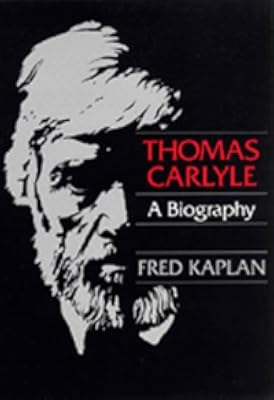
Thomas Carlyle: A Biography
by Fred Kaplan
On This Page
Description
The National Book Critics Circle Award-winning portrait of the Victorian writer and historian Thomas CarlyleA Pulitzer finalist that draws upon years of research and unpublished letters, Thomas Carlyle examines the life of the Victorian genius. Carlyle was the author of Sartor Resartus and The French Revolution: A History, and he possessed one of literature's most flamboyant prose styles. Despite a childhood beset by anxiety and illness, Carlyle was indefatigable in his literary production. show more Fred Kaplan delves into the author's intense personal life, which includes his turbulent marriage to aut show lessTags
Recommendations

















Member Reviews
Thomas Carlyle (1795-1881) was a man always in revolution. He revolted against the religion of the day, against the industrialist and capitalist social structure, and against the idea that a lifelong marriage should be intensely and continuously happy. He was an ardent Calvinist, but struggled with many accepted religious truths. He championed the introduction of German Romantic literature to the British and penned a masterful history of the French Revolution. He was irascible and crotchety, but many flocked to his ideas. Fred Kaplan’s Thomas Carlyle is a unique and thorough biography of this ideological pioneer.
Fred Kaplan’s Pulitzer Prize-nominated biography of Carlyle is as researched as it is long. At 600 pages, it covers the show more entirety of the life of the noted Scottish essayist and philosopher. While it incorporates a great deal of his correspondence and others’ notes on Carlyle, Kaplan tends to stay away from literary analyses of Carlyle’s writings. Very few other details are spared, however, as Kaplan does a very good job of fleshing out this long-dead thinker. This is a 30th anniversary re-issue of the work, but I think it would hold up against modern biographies. A splendid and absorbing book. show less
Fred Kaplan’s Pulitzer Prize-nominated biography of Carlyle is as researched as it is long. At 600 pages, it covers the show more entirety of the life of the noted Scottish essayist and philosopher. While it incorporates a great deal of his correspondence and others’ notes on Carlyle, Kaplan tends to stay away from literary analyses of Carlyle’s writings. Very few other details are spared, however, as Kaplan does a very good job of fleshing out this long-dead thinker. This is a 30th anniversary re-issue of the work, but I think it would hold up against modern biographies. A splendid and absorbing book. show less
As a writer and historian, Thomas Carlyle stands as one of the dominant figures of Victorian literature. Growing up in Scotland, he was a shy boy who studied for the ministry and the law before deciding to embark on a career as a writer. After starting out as a literary critic he moved on to become a historian, outlining a vision of history as a chronicle of heroes who shaped events - a view that alienated him from the growing liberal and democratic trends of his time.
Drawing upon Carlyle's enormous correspondence and personal writings, Fred Kaplan provides a detailed study of the man. Much of Carlyle's life is uninteresting, coming across as constant intellectual anxiety and a never-ending concern about illness, frequently punctuated show more in his early years by moves in search of a more congenial locale. Yet Kaplan describes it in a surprisingly readable manner, one that moves the reader smoothly through what might otherwise be turgid stretches. His examination of Carlyle's tense marriage is especially strong; a woman of considerable gifts in her own right, she proved as popular in London's literary circles as Carlyle himself, though the pleasure she drew from this was often offset by her own frequent illnesses and fights with her husband. Punctuating all of this is Kaplan's analysis of Carlyle's ideas, which he often develops within the context of the historian's many contacts with the leading literary figures of his day - a perspective that adds further to his insights into his personality.
Yet while Kaplan's biography provides an excellent portrait of Carlyle's personal life, it lacks an examination of the very thing that makes him worthy of study: his writings. Kaplan does recount Carlyle's efforts to write his many books and essays, but the finished products themselves are never analyzed for what they said or how they were received by the reading public. This is a glaring omission in what is otherwise a fine study of an important Victorian historian, one whose work had a significant impact on the thought of his era. show less
Drawing upon Carlyle's enormous correspondence and personal writings, Fred Kaplan provides a detailed study of the man. Much of Carlyle's life is uninteresting, coming across as constant intellectual anxiety and a never-ending concern about illness, frequently punctuated show more in his early years by moves in search of a more congenial locale. Yet Kaplan describes it in a surprisingly readable manner, one that moves the reader smoothly through what might otherwise be turgid stretches. His examination of Carlyle's tense marriage is especially strong; a woman of considerable gifts in her own right, she proved as popular in London's literary circles as Carlyle himself, though the pleasure she drew from this was often offset by her own frequent illnesses and fights with her husband. Punctuating all of this is Kaplan's analysis of Carlyle's ideas, which he often develops within the context of the historian's many contacts with the leading literary figures of his day - a perspective that adds further to his insights into his personality.
Yet while Kaplan's biography provides an excellent portrait of Carlyle's personal life, it lacks an examination of the very thing that makes him worthy of study: his writings. Kaplan does recount Carlyle's efforts to write his many books and essays, but the finished products themselves are never analyzed for what they said or how they were received by the reading public. This is a glaring omission in what is otherwise a fine study of an important Victorian historian, one whose work had a significant impact on the thought of his era. show less
Members
- Recently Added By
Lists

Works Cited in The History of White People by Nell Irvin Painter
321 works; 2 members
Author Information

15+ Works 1,771 Members
Fred Kaplan teaches at Queens College and the Graduate Center of CUNY. He is the editor of The Essential Gore Vidal and the author of the biographies Henry James, Dickens, and Thomas Carlyle, which was nominated for a National Book Critics Circle Award and the Pulitzer Prize. Kaplan lives in Brooklyn, New York. (Publisher Provided) Fred Kaplan show more (born 1937) is distinguished Professor Emeritus of English at Queens College and the Graduate Center of the City University of New York. Kaplan grew up in the Bronx and attended Lafayette High School and Brooklyn College. He is the author of several biographies, including his book Thomas Carlyle which was a finalist for the National Book Critics Circle Award, and the Pulitzer Prize. In 2015, his biography of John Quincy Adams: American Visionary, became listed on the New York Times bestseller list. (Bowker Author Biography) show less
Awards and Honors
Classifications
- Genres
- Fiction and Literature, Biography & Memoir, Literature Studies and Criticism
- DDC/MDS
- 824.8 — Literature & rhetoric English & Old English literatures English essays Victorian period 1837–1900
- LCC
- PR4433 .K3 — Language and Literature English English Literature 19th century , 1770/1800-1890/1900
- BISAC
Statistics
- Members
- 53
- Popularity
- 572,709
- Reviews
- 2
- Rating
- (2.75)
- Languages
- English
- Media
- Paper, Ebook
- ISBNs
- 5
- ASINs
- 1