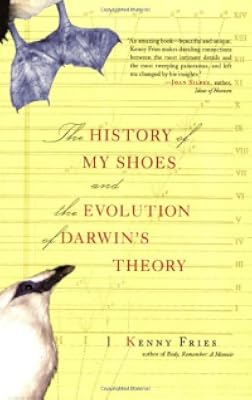
The History of My Shoes and the Evolution of Darwin's Theory
by Fries Kenny
On This Page
Description
A searing, imaginative memoir that pairs two stories, the author's budding self-realization and the race to formulate the theory of evolution.Tags
Recommendations
















Member Reviews
http://thegimpparade.blogspot.com/2007/10/history-of-my-shoes-and-evolution-of.h...
Excerpt from my review:
Disability is all about adaptation. That's not news to me. As performance artist Neil Marcus has said, "Disability is an art—an ingenious way to live." It's improv, sometimes all day long, when out in the public environment built primarily for nondisabled folks. I suspect that's not news to most disabled people either.
But Kenny Fries' newest book, The History of My Shoes and the Evolution of Darwin's Theory, combines musings on adaptation and the life and science of Charles Darwin with personal memoir and travel diary in unique and thoughtful ways. One thing Fries notes, particularly in regard to Darwin and his success as a show more scientist, is that interdependence (and sometimes dependence) is a natural part of human interaction and achievement. show less
Excerpt from my review:
Disability is all about adaptation. That's not news to me. As performance artist Neil Marcus has said, "Disability is an art—an ingenious way to live." It's improv, sometimes all day long, when out in the public environment built primarily for nondisabled folks. I suspect that's not news to most disabled people either.
But Kenny Fries' newest book, The History of My Shoes and the Evolution of Darwin's Theory, combines musings on adaptation and the life and science of Charles Darwin with personal memoir and travel diary in unique and thoughtful ways. One thing Fries notes, particularly in regard to Darwin and his success as a show more scientist, is that interdependence (and sometimes dependence) is a natural part of human interaction and achievement. show less
Disabled from birth due to missing legbones, Fries still has an active, participatory life including adventure travel. This memoir interleaves his life journey with an overview of the history of the evolution of Evolution: That is the development of the theory largely by Wallace and Darwin and their interactions. It feels as id the evolution history part is a dodge, like changing the subject from an uncomfortable topic. It is when reflecting upon and articulating his experience as a differently abled person that he makes observations more than any of the historical review:
Evolution as interpreted in the Gilded Age leading to US/Europe-spawned organized killing and harming that we can see some relevance.
Throughout my life, friends and strangers have asked me "What happened to your legs?" There was a time earlier in my life when I, too, could not stop asking why atshow more
birth I was missing bones in my legs. Chance, the fuel of natural selection, was not at that time a satisfactory explanation.
Disability studies theorist Lennard J. Davis echoes Bagemihl, showing how, when we speak of disability, we associate it with a story, place it in a narrative. A person became deaf, became blind, was born blind, became quadriplegic. The impairment becomes part of a sequential narrative.
By doing this we think of disability as linked to individualism and the individual story. What is actually a physical fact becomes a story with a hero or a victim. Disability becomes divorced from the cultural context, and becomes the problem of the individual, not a category defined by the society. The dialectic of normalcy-for someone to be normal, someone has to be not normal is kept intact.
Evolution as interpreted in the Gilded Age leading to US/Europe-spawned organized killing and harming that we can see some relevance.
The global economic recession of the 1870s encouraged the view of societies in competition in a hostile world. In the United States, business leaders such as Andrew Carnegie believed that unrestrained competition was natural selection at work. Human intervention could not mitigate the struggle for existence.show less
In the United States toward the end of the nineteenth century, Social Darwinism transformed into eugenics. Whereas Spencer and the Social Darwinists advocated a laissez-faire policy, sup-porting the status quo of the economic and social hierarchy, eugenicists advocated an active governmental and institutional role in "purifying" society of perceived "weakness."
In 1881, Alexander Graham Bell, inventor of the telephone, researched deafness in Martha's Vineyard, Massachusetts. He concluded that deafness was hereditary. In "Memoir Upon the Formation of a Deaf Variety of the Human Race" he recommended a marriage prohibition for the deaf. He warned that boarding schools for the deaf could become breeding grounds for a deaf human race. In 1896, Connecticut became the first state to prohibit the marriage between anyone who was "epileptic, imbecile or feeble-minded."
By the 1880s, European studies stressing the heredity of criminality had become the basis for "criminal anthropology" in the United States. In 1887, the superintendent of the Cincinnati Sanitarium issued the first published recommendation of sterilization for criminal activity.
Race increasingly became a focus for eugenics. Darwin rejected the idea that different races were different species.
....
After the stock market collapse of 1929, it became difficult to believe the correlation between economic status and intelligence. During the Great Depression of the 1930s, social scientists shifted their emphasis to the social causes of human difference.
...
After the war, when asked why eugenics declined so quickly in the United States, Popenoe admitted "the major factor ... was undeniably Hitlerism." But as early as the 1880s, reformers such as Powell and Boas spread Darwin's message that no one stayed on top, because change and adjustment were the order of nature. Boas, invoking the Darwinian notion of constant change, asked: Was it possible that traits thought to be desirable today, would be viewed otherwise in the future?
Ratings
Members
- Recently Added By
Author Information

Awards and Honors
Classifications
- Genres
- Biography & Memoir, Fiction and Literature, Literature Studies and Criticism
- DDC/MDS
- 814.54 — Literature & rhetoric American literature in English American essays in English 20th Century 1945-1999
- LCC
- PS3556 .R568 .H57 — Language and Literature American literature American literature Individual authors 1961-
- BISAC
Statistics
- Members
- 31
- Popularity
- 905,210
- Reviews
- 2
- Rating
- (3.25)
- Languages
- English
- Media
- Paper, Ebook
- ISBNs
- 2
- ASINs
- 2