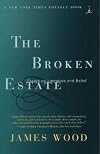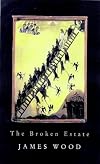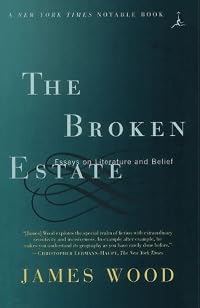
The broken estate: essays on literature and belief
by James Wood
On This Page
Description
This book recalls an era when criticism could change the way we look at the world. In the tradition of Matthew Arnold and Edmund Wilson, James Wood reads literature expansively, always pursuing its role and destiny in our lives. In a series of essays about such figures as Melville, Flaubert, Chekhov, Virginia Woolf, and Don DeLillo, Wood relates their fiction to questions of religious and philosophical belief. He suggests that the steady ebb of the sea of faith has much to do with the revo- show more lutionary power of the novel, as it has developed over the last two centuries. To read James Wood is to be shocked into both thinking and feeling how great our debt to the novel is. In the grand tradition of criticism, Wood's work is both commentary and literature in its own right--fiercely written, polemical, and richly poetic in style. This book marks the debut of a masterly literary voice. show lessTags
Recommendations









Member Reviews
The scholarly rigor of the first essay, "Sir Thomas More: A Man for One Season," surprises. The essay is a review of Peter Ackroyd's biography of Sir Thomas. By way of a heady recapitulation of More's life and times, Wood suggests that Ackroyd's book is little more than hagiography, though he's careful never to use that word. The second essay "Shakespeare in Bloom" is no less kind. (But then kindness is not really what we are looking for here; that can always be got from one of my many books on compassion.) It looks at the Shakespearean criticism of eminence grise Harold Bloom. Calling his approach essentially a recapitulation of the dated "character criticism" of Dr Samuel Johnson, Wm. Hazlitt and A.C. Bradley. (Apparently, Bloom is show more vociferously disliked by the trendier Shakespeare critics of today; something I did not know, not being an academic.) Wood puts Bloom's work in context with a brief discussion of how other schools of criticism, such as New Criticism and New Historicism, view Shakespeare. Very interesting. Will continue my comments here as I sporadically read on. show less
Published when he was thirty-three, The Broken Estate is the first book of essays by the man who would become one of America's most esteemed literary critics. Ranging in subject from Jane Austen to John Updike, this collection introduced American readers to a new kind of humanist criticism. Wood is committed to judging literature through its connection with the soul, its appeal to our appetites and identities, and he examines his subjects rigorously, without ever losing sight of the mysterious human impulse that has made these works valuable to generations of readers.
You can’t accuse James Wood of lacking range. These essays run the gamut from Harold Bloom’s influence on Shakespeare studies to the “theology” of George Steiner to the lasting (though indirect) impact of Ernst Renan. Unfortunately, had I not taken notes as I read these two dozen or so essays, I would have quickly forgotten most of the arguments presented herein. At their worst, they are uncontroversial and too subtle perhaps to make an impression. There are a few, though, that are fascinating and thought-provoking enough to make you reconsider the topic at hand – but they are the exception in an otherwise relatively pedestrian set of essays.
Wood has the odd habit of writing something vaguely resembling a book review which in show more reality is just an opportunity for him to get on a soapbox concerning the subject at hand. This is precisely what he does what the aforementioned essay, titled “Shakespeare in Bloom.” It purports to be a review of Bloom’s “Shakespeare: The Invention of the Human.” In a sixteen-page-long review, he mentions the book perhaps two or three times, choosing to spend most of his time wrapped up in discussion of the place of ontology in artistic creativity: namely, did we invent Shakespeare (that is, his place in the literary canon), or did he invent us? His answers to these questions draw much more from Hazlitt, Coleridge, and other twentieth century critics than they do from the book being considered, and therefore Bloom’s book, no matter your opinion of it, seems to come off as a cipher, an empty vessel upon which Wood can expatiate as he sees fit. His review of Peter Ackroyd’s “The Life of Thomas More” and the Melville essay, “The All and The If: God and Metaphor in Melville” (mostly a review of Hershel Parker’s biography of Melville), are similar in that they are really more polemical in nature, but still operate under the conceit of a book review.
First the lame and the bland. Do we really need another piece on how Jane Austen created successively female characters with more actively interior lives, and therefore was at least in part responsible for bringing the fore the private, internal lives and thoughts of these characters? And what use is it to have Virginia Woolf described for the 72nd time as “mystical”? Or another retelling of how DeLillo’s conspiracy-laden fiction weakens his writing instead of strengthens it? As for the first two observations, they have been fully fleshed out elsewhere and now seem droll and unimaginative. I even happen to agree with the last point, but I certainly don’t want to read another essay about it; it seems to stand on its own merits for anyone who has read almost anything he has written.
There are some pieces of moderate interest, including one on T. S. Eliot’s anti-Semitism (another cipher of a book review, this time of Anthony Julius’ “Anti-Semitism and Literary Form”). I haven’t read Julius’ book, but it sounds like he goes hopping from poem to poem in Eliot’s oeuvre anxious to kind anti-Jewish sentiment wherever he can find it. Wood rightly take the effort to point out that being a bad person (or having prejudices that today seem less-than-fashionable) doesn’t make you a bad poet.
But I wouldn’t want to leave someone with the impression that the whole book is like this; it has its moments. In the essay on George Steiner’s idea of literature and meaning (mostly as presented in Steiner’s “Real Presences”), Wood accuses Steiner of being “theological.” He suggests Steiner says anything can be said about anything and therefore runs the risk – one could liken it to Pascal’s Wager – that meaning even really exists. He also attacks Steiner’s suggestion that American lacks great art because of its liberal, democratic government. I read one of the essays in “Real Presences” for my undergraduate thesis which is why I was particularly interested in Wood’s assessment, but I don’t remember the anti-Americanism in it.
This is my first collection by Wood, supposedly one of the better literary critics writing today, but didn’t really see what much of the ado was about. I would suggest that, instead of sitting down to read these all at once, you read them topically as you make your way through the authors themselves. That might provide you with a reading that’s more lasting and memorable than most of the ones I walked away with. Despite my experience here, I’m sure the soi-disant literary critic in me will have me coming back for more James Wood in the future. show less
Wood has the odd habit of writing something vaguely resembling a book review which in show more reality is just an opportunity for him to get on a soapbox concerning the subject at hand. This is precisely what he does what the aforementioned essay, titled “Shakespeare in Bloom.” It purports to be a review of Bloom’s “Shakespeare: The Invention of the Human.” In a sixteen-page-long review, he mentions the book perhaps two or three times, choosing to spend most of his time wrapped up in discussion of the place of ontology in artistic creativity: namely, did we invent Shakespeare (that is, his place in the literary canon), or did he invent us? His answers to these questions draw much more from Hazlitt, Coleridge, and other twentieth century critics than they do from the book being considered, and therefore Bloom’s book, no matter your opinion of it, seems to come off as a cipher, an empty vessel upon which Wood can expatiate as he sees fit. His review of Peter Ackroyd’s “The Life of Thomas More” and the Melville essay, “The All and The If: God and Metaphor in Melville” (mostly a review of Hershel Parker’s biography of Melville), are similar in that they are really more polemical in nature, but still operate under the conceit of a book review.
First the lame and the bland. Do we really need another piece on how Jane Austen created successively female characters with more actively interior lives, and therefore was at least in part responsible for bringing the fore the private, internal lives and thoughts of these characters? And what use is it to have Virginia Woolf described for the 72nd time as “mystical”? Or another retelling of how DeLillo’s conspiracy-laden fiction weakens his writing instead of strengthens it? As for the first two observations, they have been fully fleshed out elsewhere and now seem droll and unimaginative. I even happen to agree with the last point, but I certainly don’t want to read another essay about it; it seems to stand on its own merits for anyone who has read almost anything he has written.
There are some pieces of moderate interest, including one on T. S. Eliot’s anti-Semitism (another cipher of a book review, this time of Anthony Julius’ “Anti-Semitism and Literary Form”). I haven’t read Julius’ book, but it sounds like he goes hopping from poem to poem in Eliot’s oeuvre anxious to kind anti-Jewish sentiment wherever he can find it. Wood rightly take the effort to point out that being a bad person (or having prejudices that today seem less-than-fashionable) doesn’t make you a bad poet.
But I wouldn’t want to leave someone with the impression that the whole book is like this; it has its moments. In the essay on George Steiner’s idea of literature and meaning (mostly as presented in Steiner’s “Real Presences”), Wood accuses Steiner of being “theological.” He suggests Steiner says anything can be said about anything and therefore runs the risk – one could liken it to Pascal’s Wager – that meaning even really exists. He also attacks Steiner’s suggestion that American lacks great art because of its liberal, democratic government. I read one of the essays in “Real Presences” for my undergraduate thesis which is why I was particularly interested in Wood’s assessment, but I don’t remember the anti-Americanism in it.
This is my first collection by Wood, supposedly one of the better literary critics writing today, but didn’t really see what much of the ado was about. I would suggest that, instead of sitting down to read these all at once, you read them topically as you make your way through the authors themselves. That might provide you with a reading that’s more lasting and memorable than most of the ones I walked away with. Despite my experience here, I’m sure the soi-disant literary critic in me will have me coming back for more James Wood in the future. show less
One of my favorite literary critics has produced yet another collection of outstanding literary essays. The authors of the essays range from W. G. Sebald to Sir Thomas More. Reading this in addition to the numerous books by the writers covered in these excellent essays is highly recommended. It is a great resource.
may wish to read a different edition - will check his publisher in US - esp for How Fiction Works as it resides on my shelves
literature criticism and lack point to Christianity once truth claims are removed (I have no idea what I meant by this comment)
Ratings
Members
- Recently Added By
Author Information

16+ Works 3,420 Members
James Wood is currently a senior editor at The New Republic and a visiting lecturer in English and American literature at Harvard.
Series
Belongs to Publisher Series
Common Knowledge
- Canonical title
- The broken estate: essays on literature and belief
- Original publication date
- 1999
Classifications
- Genres
- Literature Studies and Criticism, Nonfiction, Religion & Spirituality
- DDC/MDS
- 809.93382 — Literature & rhetoric Literature, rhetoric & criticism History, description, critical appraisal of more than two literatures Literature displaying specific features, miscellaneous writings Literature displaying other aspects Literature dealing with specific themes and subjects Philosophic and abstract concepts Religion
- LCC
- PN3351 .W66 — Language and Literature Literature (General) Literature (General) Prose. Prose fiction Philosophy, theory, etc.
- BISAC
Statistics
- Members
- 348
- Popularity
- 90,241
- Reviews
- 6
- Rating
- (4.03)
- Languages
- English, German
- Media
- Paper, Ebook
- ISBNs
- 7
- ASINs
- 6