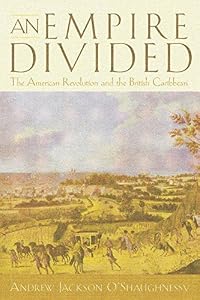
An Empire Divided: The American Revolution and the British Caribbean
by Andrew Jackson O'Shaughnessy
Early American Studies (2000)
On This Page
Description
There were 26-not 13-British colonies in America in 1776. Of these, the six colonies in the Caribbean-Jamaica, Barbados, the Leeward Islands, Grenada and Tobago, St. Vincent; and Dominica-were among the wealthiest. These island colonies were closely related to the mainland by social ties and tightly connected by trade. In a period when most British colonists in North America lived less than 200 miles inland and the major cities were all situated along the coast, the ocean often acted as a show more highway between islands and mainland rather than a barrier.The plantation system of the islands was so similar to that of the southern mainland colonies that these regions had more in common with each other, some historians argue, than either had with New England. Political developments in all the colonies moved along parallel tracks, with elected assemblies in the Caribbean, like their mainland counterparts, seeking to increase their authority at the expense of colonial executives. Yet when revolution came, the majority of the white island colonists did not side with their compatriots on the mainland.A major contribution to the history of the American Revolution, An Empire Divided traces a split in the politics of the mainland and island colonies after the Stamp Act Crisis of 1765-66, when the colonists on the islands chose not to emulate the resistance of the patriots on the mainland. Once war came, it was increasingly unpopular in the British Caribbean; nonetheless, the white colonists cooperated with the British in defense of their islands. O'Shaughnessy decisively refutes the widespread belief that there was broad backing among the Caribbean colonists for the American Revolution and deftly reconstructs the history of how the island colonies followed an increasingly divergent course from the former colonies to the north. show lessTags
Recommendations















Member Reviews
O'Shaughnessy opens a new chapter in American history for me. One of his central themes is: why didn't the British West Indies, the "sugar islands," rebel at the same time as the North American mainland colonies that we know (incompletely) as the 13 original colonies? In fact, why didn't the fabulously wealthy sugar islands rebel, period?
The West Indies—Barbados, Jamaica, and others in the British Caribbean—were part of the English colonial frontier throughout the period that we customarily regard as colonial American history, but we customarily ignore them. That's a mistake. The West Indies were strongly integrated with the mainland colonies by trade, but politically they were a breed apart: much more strongly tied to the mother show more country through their protected status and monopoly exports of sugar products, and therefore much less inclined to rebel and throw away their continuing access to that richly rewarding connection. They needed the English navy to keep predatory French and Spanish forces at bay.
O'Shaughnessy's prose is engaging, if a bit redundant here and there. He makes it plain that King George and his Privy Council and Parliament consistently dealt with the "big picture" of their Atlantic colonies, and he gives new context to the repeated punitive tax and other policies that helped to precipitate the Revolution.
For me, an interesting revelation is that England never committed and never actually had enough military strength on our side of the pond to defeat Gen. Washington's somewhat ragtag army. Apparently the King and his ministers wanted to hang on to the sugar islands more urgently than they wanted to keep the 13 colonies in the family.
You'll learn much by reading An Empire Divided.
Read more on my blog: http://barleyliterate.blogspot.com/ show less
The West Indies—Barbados, Jamaica, and others in the British Caribbean—were part of the English colonial frontier throughout the period that we customarily regard as colonial American history, but we customarily ignore them. That's a mistake. The West Indies were strongly integrated with the mainland colonies by trade, but politically they were a breed apart: much more strongly tied to the mother show more country through their protected status and monopoly exports of sugar products, and therefore much less inclined to rebel and throw away their continuing access to that richly rewarding connection. They needed the English navy to keep predatory French and Spanish forces at bay.
O'Shaughnessy's prose is engaging, if a bit redundant here and there. He makes it plain that King George and his Privy Council and Parliament consistently dealt with the "big picture" of their Atlantic colonies, and he gives new context to the repeated punitive tax and other policies that helped to precipitate the Revolution.
For me, an interesting revelation is that England never committed and never actually had enough military strength on our side of the pond to defeat Gen. Washington's somewhat ragtag army. Apparently the King and his ministers wanted to hang on to the sugar islands more urgently than they wanted to keep the 13 colonies in the family.
You'll learn much by reading An Empire Divided.
Read more on my blog: http://barleyliterate.blogspot.com/ show less
The most interesting and comprehensive account of the British West Indian colonies during the Revolution, focusing mainly on why they didn't join their mainland brethren in rebellion.
Ratings
Members
- Recently Added By
Author Information

3+ Works 537 Members
Andrew Jackson O'Shaughnessy' is Saunders Director of the Robert H. Smith International Center for Jefferson Studies, Monticello, and professor of history, University of Virginia.
Series

Common Knowledge
- Canonical title
- An Empire Divided: The American Revolution and the British Caribbean
- Original publication date
- 2000
- People/Characters
- Governor John Dalling
- Important places
- West Indies; Greater Antilles; Lesser Antilles; Jamaica; Antigua; Dominica (show all 13); Grenada; Montserrat; Nevis; St. Kitts; Saint Vincent and the Grenadines; Tortola; Trinidad and Tobago
Classifications
- Genres
- History, Nonfiction, General Nonfiction
- DDC/MDS
- 972.9 — History & geography History of North America Mexico, Central America, West Indies, Bermuda West Indies (Antilles) and Bermuda; Caribbean
- LCC
- F2131 .O74 — Local History of the United States, Canada and Latin America Latin America. Spanish America Lesser Antilles British West Indies
- BISAC
Statistics
- Members
- 136
- Popularity
- 239,633
- Reviews
- 2
- Rating
- (3.59)
- Languages
- English
- Media
- Paper, Ebook
- ISBNs
- 3
- ASINs
- 1