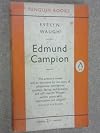
Edmund Campion
by Evelyn Waugh 
On This Page
Description
This volume is part of the Complete Works of Evelyn Waugh critical edition, which brings together all Waugh's published and previously unpublished writings for the first time with comprehensive introductions and annotation, and a full account of each text's manuscript development and textualvariants. The edition's General Editor is Alexander Waugh, Evelyn Waugh's grandson and editor of the twelve-volume Personal Writings sequence.Evelyn Waugh originally wrote his Edmund Campion to thank show more Martin D'Arcy, SJ, and to help with the building of Campion Hall, but his experience of Communist oppression in Mexico and Croatia transformed his understanding of Campion's life, revealing Campion less as an Elizabethan martyr than as partof 'the unending war' between the church and the totalitarian state. Waugh wrote a passionate new 'Preface' for the American edition of 1946 and made important changes to each of the three subsequent editions, culminating in the beautiful third edition of 1961. This new edition provides extensivebiographical and contextual notes to help the reader unfamiliar with early modern history and records the many manuscript revisions and the book's reception both sides of the Atlantic. The introduction explores the personal impact of Waugh's friendship with the Asquith and Herbert families andexamines the cultural context of a brief period of confidence for English Catholicism, energized by the canonization process (in which Waugh's own daughters were involved), which coincided with the publication of the five editions of the book from 1935 to 1961. Waugh received the Hawthornden Prizefor the book just before he took part in the opening of Campion Hall; the book offered him a Jesuit hearth in the 'household of the faith' and gave a new theological direction to his writing, characterized by Brideshead Revisited, Helena, The Sword of Honour trilogy, and Ronald Knox. The bookemerges as one of the best objets d'Arcy, which Waugh continued to give to friends till his death. show lessTags
Recommendations









Member Reviews
I thought this book was great. It's not presented as a scholarly work, but rather a more informal account of the life of Edmund Campion, an English Jesuit priest who was hanged, drawn & quartered under the reign of Queen Elizabeth. The book also gives a little background on the Reformation, especially its effects in England, and events in the wider world. My one word of caution about this book is that it has a marked pro-Catholic bias. Edmund Campion is considered a saint by the Catholic Church, and Waugh wrote the book after he converted to Catholicism, so that's to be expected. But if you won't be offended by that, I definitely think it's worth a read.
3629. Edmund Campion, by Evelyn Waugh (read Sept 16 2002) I read this because it won the Hawthornden Prize (a prize awarded annually to an English writer "for the best work of imaginative literature") in 1936, bringing to 8 the number of Hawthornden winning books I've read, and all 8 have been worthwhile. This book tells in unpretentious but vivid style the life of St. Edmund Campion, killed on Dec 1, 1581, after being sentenced to "be hanged and let down alive, and your privy parts cut off, and your entrails taken out and burnt in your sight then your heade to be cut off and your body divided into four parts." Thank God for the Eighth Amendment, eh? A well worth reading book.
Biography, Tudor, Evelyn Waugh
Ratings
Members
- Recently Added By
Author Information

134+ Works 56,731 Members
Born in Hampstead and educated at Oxford University, Evelyn Waugh came from a literary family. His elder brother, Alec was a novelist, and his father, Arthur Waugh, was the influential head of a large publishing house. Even in his school days, Waugh showed sings of the profound belief in Catholicism and brilliant wit that were to mark his later show more years. Waugh began publishing his novels in the late 1920's. He joined the Royal Marines at the beginning of World War II and was one of the first to volunteer for commando service. In 1944 he survived a plane crash in Yugoslavia and, while hiding in a cave, corrected the proofs of one of his novels. Waugh's early novels, Decline and Fall (1927), Vile Bodies (1930), and A Handful of Dust (1934), established him as one of the funniest and most brilliant satirists the British had seen in years. He was particularly skillful at poking fun at the scramble for prominence among the upper classes and the struggle between the generations. He lived for a while in Hollywood, about which he wrote The Loved One (1948), a scathing attack on the United States's overly sentimental funeral practices. His greatest works, however, are Brideshead Revisited (1945), which has been made into a highly popular television miniseries, and the trilogy Sword of Honor (1965), composed of Men at Arms (1952), Officers and Gentlemen (1955), and The End of the Battle (1961). (Bowker Author Biography) show less
Evelyn Waugh has a Legacy Library. Legacy libraries are the personal libraries of famous readers, entered by LibraryThing members from the Legacy Libraries group.
Awards and Honors
Awards
Series
Belongs to Publisher Series
Image Books (D34)
Work Relationships
Is contained in
Common Knowledge
- Original publication date
- 1935-09
- People/Characters
- Edmund Campion; Elizabeth I, Queen of England; Philip Neri
- Dedication
- To Martin C. D'Arcy, S.J. Sometime Master of Campion Hall, Oxford
- Blurbers
- Nicolson, Harold; Mackenzie, Compton
Classifications
- Genres
- Religion & Spirituality, Nonfiction, Biography & Memoir, History
- DDC/MDS
- 272.7092 — Religion History of Christianity Persecutions in church history Elizabethan (Later 16th century)
- LCC
- BX4705 .C27 .W3 — Philosophy, Psychology and Religion Christian Denominations Christian Denominations Catholic Church Biography and portraits Individual
- BISAC
Statistics
- Members
- 612
- Popularity
- 47,820
- Reviews
- 3
- Rating
- (3.76)
- Languages
- English, French, Slovak
- Media
- Paper, Ebook
- ISBNs
- 15
- ASINs
- 22